Trump family is also eyeing the AI relay station business


- Core Thesis: World Liberty Financial (WLFI) launches AI project WorldClaw. Its essence is to promote its stablecoin USD1 through the AI relay station, rather than competing on low prices or model quantities in the market. The goal is to bind users to the WLFI token ecosystem via the payment layer.
- Key Elements:
- WorldClaw's core function, WorldRouter, packages APIs for over 60 AI models. Its pricing is about 30% cheaper than the official sources, but payments are accepted only in USD1, with no support for KYC or traditional credit cards.
- Purchase packages are divided into 4 tiers. The most expensive Max package costs $9,999 (or locking up 2.5 million WLFI tokens) and includes undisclosed hardware and a lottery for a dinner at Mar-a-Lago, attracting users associated with the Trump family.
- The AI relay station sector is highly competitive. OpenRouter has an annual transaction volume of over $100 million, while domestic sites use reverse engineering to push prices down to 0.3% of the official rate. WorldClaw holds no price advantage.
- WLFI has applied for a national bank trust charter, aiming to make USD1 compliant. WorldClaw uses the AgentPay SDK to enable automated AI payments, driving on-chain transaction volume.
- The WLFI ecosystem is controversial: Justin Sun sued it for alleged extortion, WLFI filed a countersuit, and coupled with governance centralization (the top four wallets control approximately 40% of the voting power), user trust is impacted.
Original Author: Curly, TechFlow of Deep Tide
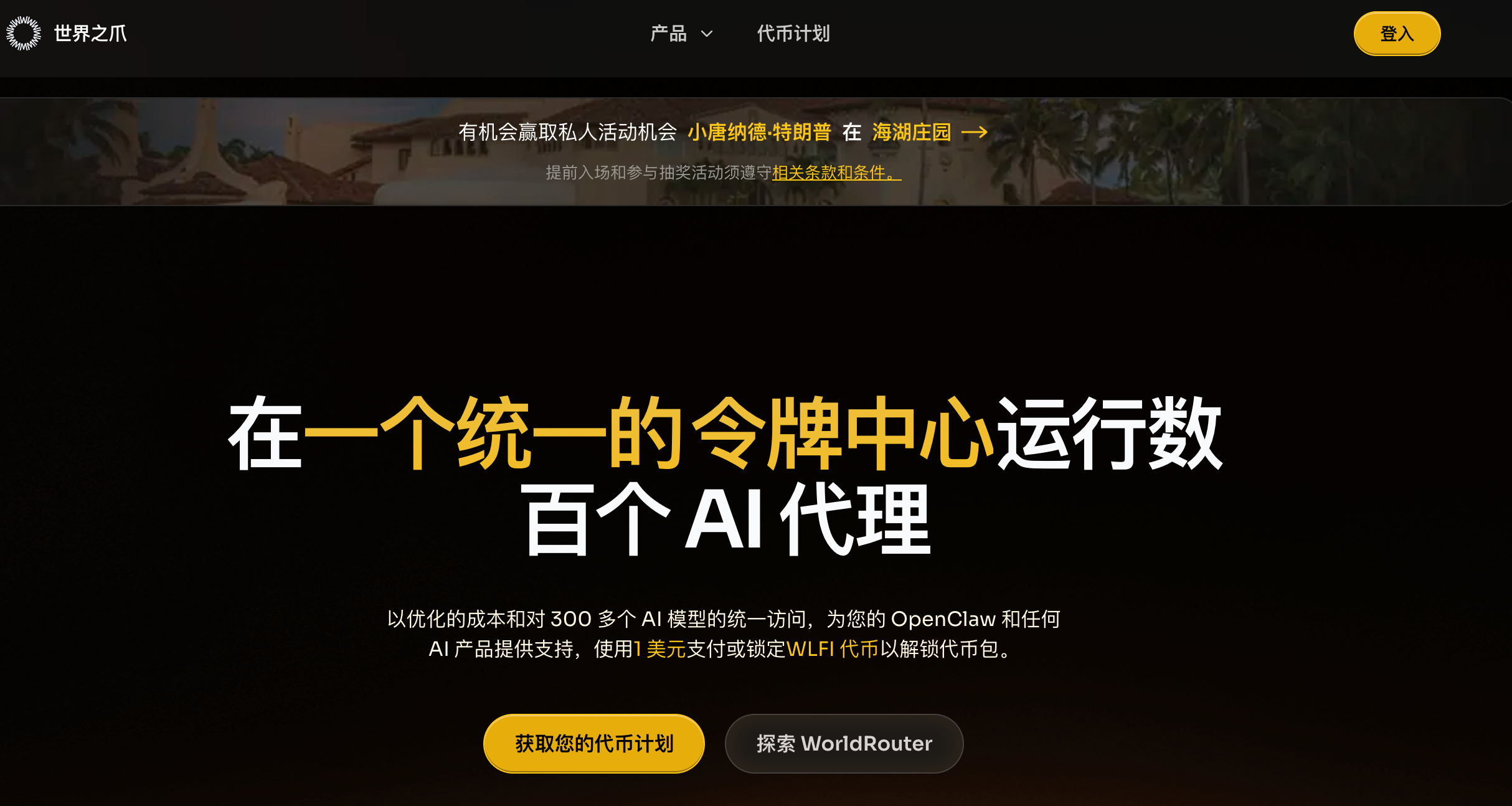
Buy an API Key for $10,000, and get a free entry ticket to a dinner at Mar-a-Lago in Florida, with Donald Trump Jr. as your dining companion.
This is not a joke.
On May 5th, the official account of World Liberty Financial (the crypto project co-founded by the Trump family, hereinafter referred to as WLFI) retweeted a new product called WorldClaw, followed by Donald Trump Jr.'s social media.
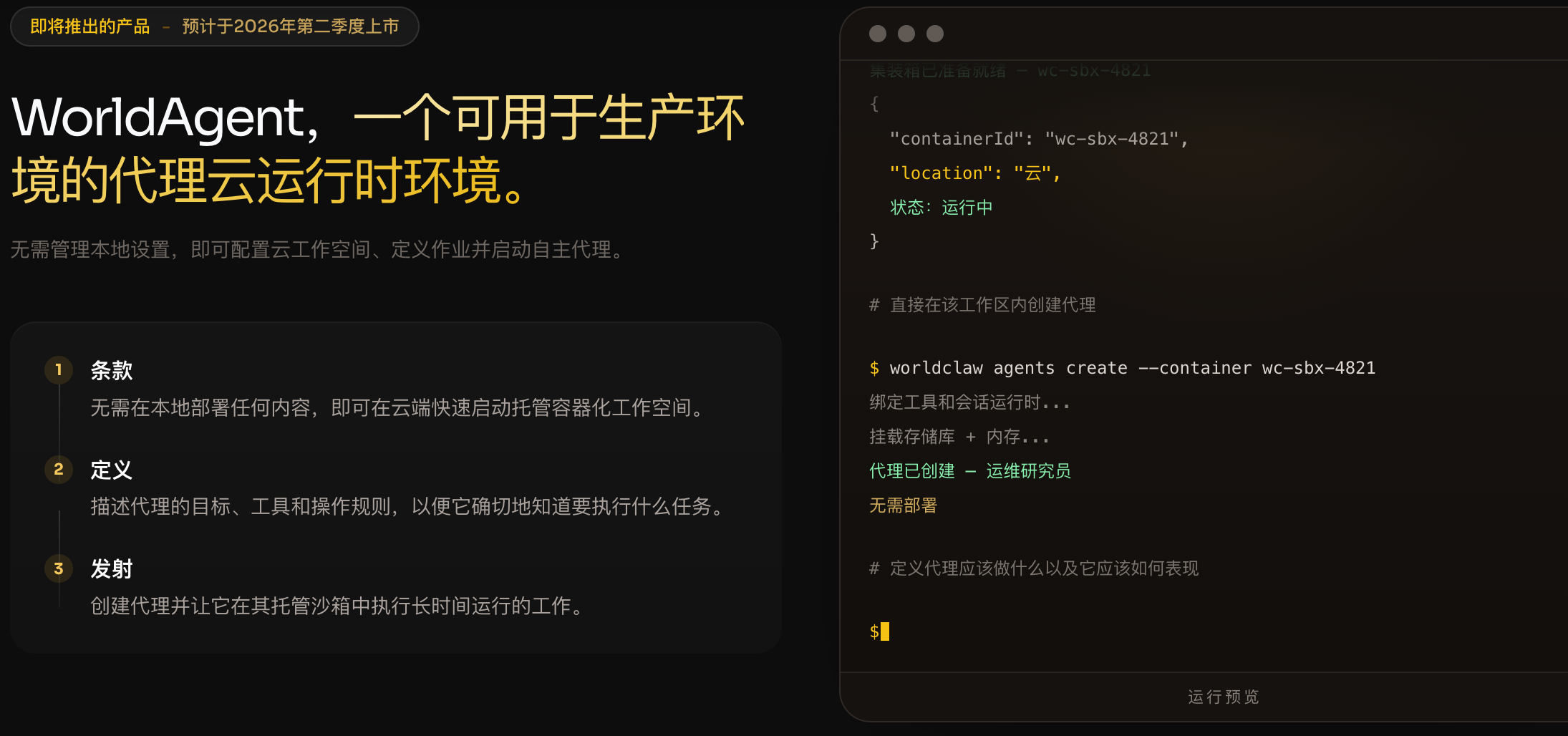
WorldClaw claims to be the first AI project within the WLFI ecosystem, positioning itself as an "AI Agent Operating System."
Experience shows that to gauge whether a business is thriving, you only need to see if the industry's major players are involved; and this project is essentially an AI relay station business.
Currently, the core feature launched by WorldClaw is called WorldRouter. What it does is package the APIs of major AI models like Claude, GPT, Gemini, and Qwen behind a single interface. By registering one account and obtaining one API Key, users can switch between and call all models.
According to the official website, it has already integrated over 60 models, with plans to cover more than 300 in the future.
According to the WorldClaw website, the pricing for WorldRouter is approximately 30% lower than the public prices of the model providers and OpenRouter.
Take Claude Sonnet 4.6, for example. Anthropic's official input price is $3 per million tokens, while WorldRouter charges $2.1. How they achieve this lower price is not explained on the website...
No KYC is required, nor foreign phone numbers or credit cards. To use their relay service, only one payment method is accepted: USD1, the US dollar stablecoin issued by WLFI itself.
Then, the product purchase plans are divided into 4 tiers:
The cheapest plan is $9.9 for 1000 AI Credits, the standard plan is $99 for 10,000 Credits; and the most expensive Max plan is $9,999 (or staking 2.5 million WLFI tokens) for 1 million AI Credits, plus a hardware device of undisclosed brand and specifications. Below the product image on the website, there is a small note: "Image for illustration purposes only. Actual product may differ." Estimated delivery is Q3 2026.
We aren't even entirely sure what this hardware is for.
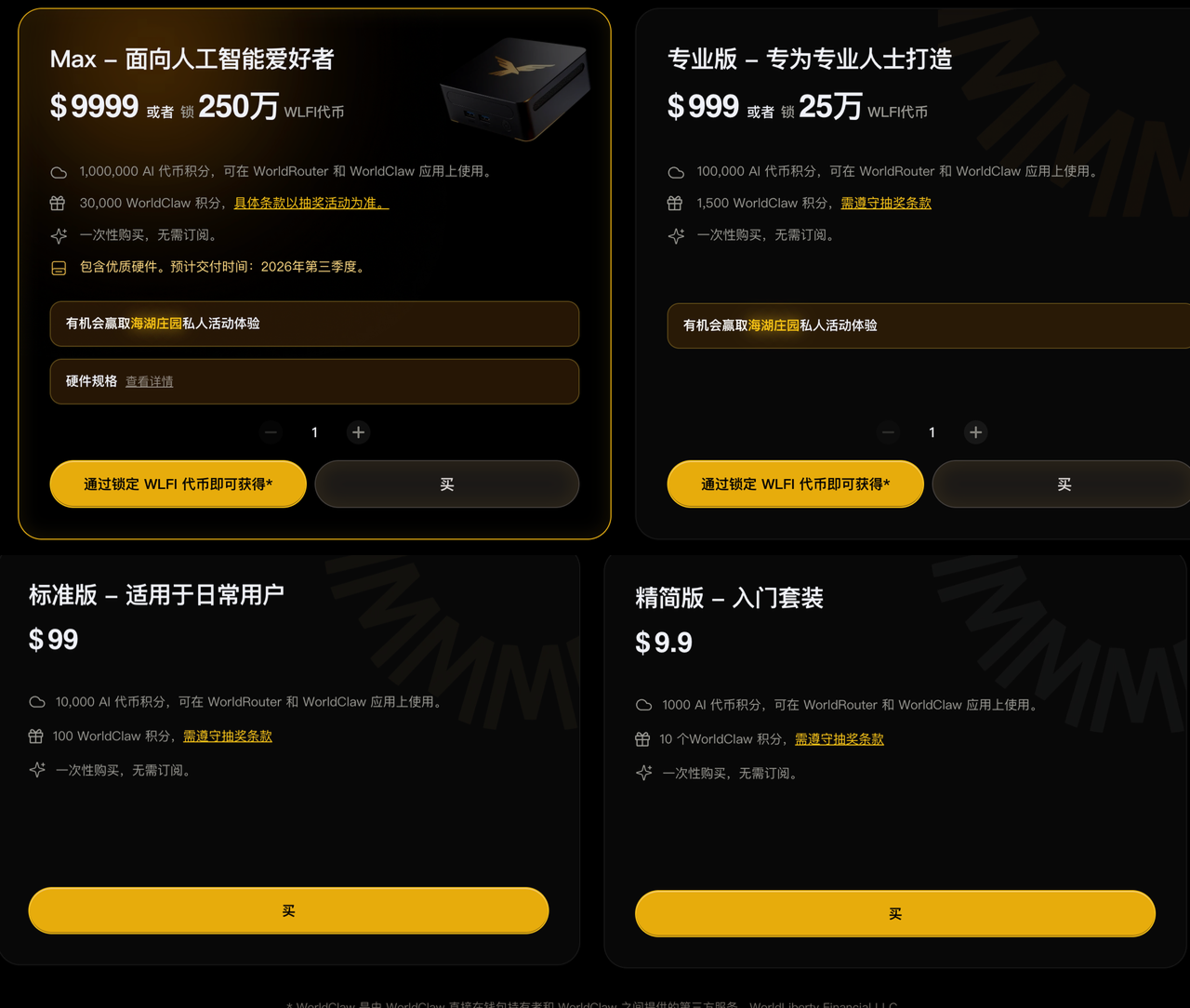
However, the most attractive aspect is that purchasing the Max plan also enters you into a lottery for a private dinner at Mar-a-Lago, potentially offering a chance to dine with the Trump family.
The AI relay station business model is not new. According to the TokenNav navigation site, there are at least 84 domestic and international competitors combined. But WorldClaw is the first to sell AI credits bundled with a dinner invitation with a presidential family.
In such a crowded track, how much moat can a single dinner ticket build?
Insanely Competitive
How much can an AI relay station make?
The current benchmark in this track is OpenRouter, founded by former OpenSea CTO Alex Atallah. According to public reports, a16z led a $40 million investment round last year, valuing it at $500 million. With a team of less than ten people, it generates over $100 million in annual revenue, taking a 5% cut from each API call.
OpenRouter proved this business can scale. But beneath it, the competition is fiercer than most imagine.
In March this year, when TechFlow reported on the token gold rush driven by OpenClaw, it mentioned a relay station owner making monthly profits of over a million. According to a report by Tencent News, relay stations' profit sources come in three forms: charges for access barriers, for quota management, and for information asymmetry.
The tactics of domestic relay stations are much wilder than OpenRouter's.
According to relay station reviews on Zhihu, some sites offer Claude Sonnet 4.6 at 0.3% of the official price, equivalent to approximately RMB 0.45 per million tokens.
How do they do it?
By purchasing subscription accounts in bulk and using browser automation and reverse engineering to package the web chat interface into an API. Users think they are calling the official API, but behind it might be a rotating pool of cookies.
This kind of operation is, of course, problematic from a compliance standpoint. According to public reports, the National Computer Virus Emergency Response Center has repeatedly warned about multiple legal risks associated with AI relay stations. But demand is too strong and prices far too cheap, so users keep flooding in.
Before WorldClaw, there was Justin Sun's B.AI doing relay stations, and now even Fu Sheng has joined the fray. Cheetah Mobile's EasyRouter launched this year, boasting 15% off across the board and up to 75% off for some models...
Now, look back at WorldClaw.
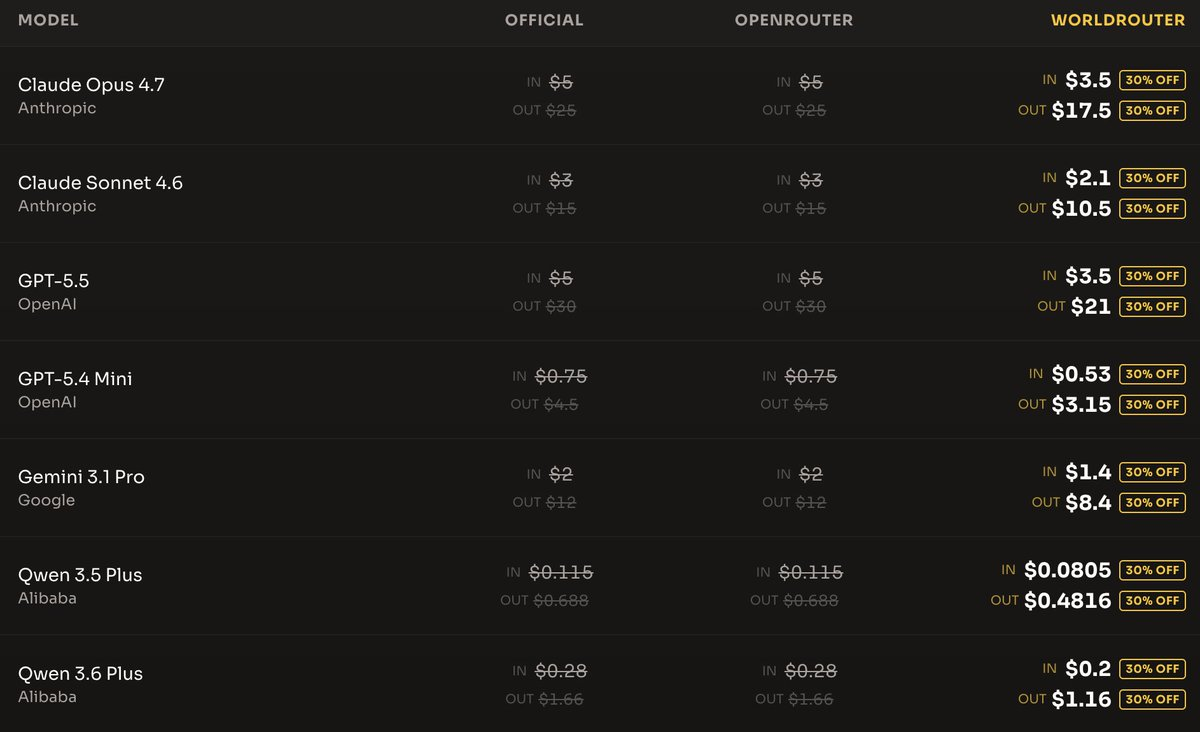
It claims to be 30% cheaper than official prices, which is sincere compared to legitimate channels. But within the entire relay station market, this pricing is not at all competitive. If a domestic user simply wants something cheap and effective, there are dozens of more mature and cheaper options.
WorldClaw is clearly not competing for the same users as those stations. Perhaps its true intention isn't even the relay station itself.
The Real Aim Isn't the Relay Station; It's the Stablecoin
OpenRouter accepts credit cards. Domestic relay stations accept Alipay and WeChat Pay, and some even accept USDT. WorldClaw accepts only one: USD1.
This choice is the answer in itself.
USD1 is a US dollar stablecoin launched by WLFI in March 2025, pegged 1:1 to the US dollar. According to official information, it is custodied by BitGo Trust, with underlying assets being US Treasury bonds, US dollar deposits, and cash equivalents. It currently runs on Ethereum, BNB Chain, and Solana.
In simple terms, WLFI wants to create its own USDT.
WorldClaw's payment design revolves around USD1. Buy AI Credits using USD1. If you don't want to spend money, you can stake WLFI tokens to earn credits. The Pro plan requires staking 250,000 tokens, and the Max plan requires 2.5 million. Both paths lead to the same destination: locking users into the WLFI token ecosystem.
More noteworthy is something called the AgentPay SDK. WorldClaw has integrated it into the product, allowing AI Agents to autonomously make payments using USD1 when performing tasks. If this feature works, it means every automated AI model call or workflow execution will generate an on-chain USD1 transaction.
Machines don't choose payment tools; whoever gets embedded first becomes the default option.
According to public reports, WLFI has already submitted an application to the US Office of the Comptroller of the Currency (OCC) for a national bank trust charter. Once the charter is obtained, WLFI can issue, custody, and redeem USD1 autonomously under a regulated entity, without relying on third parties. This charter aims to transform USD1 from a project token into a compliant financial infrastructure.
Putting these pieces together clarifies WorldClaw's business logic.
Market relay stations are all competing for the same things: who has the most comprehensive models, the lowest prices, and the lowest latency.
WorldClaw doesn't compete on these fronts. It competes on the payment layer. For every user who comes to buy AI Credits, the first step of depositing funds involves holding USD1. The more they use it, the greater the on-chain circulation of USD1.
AI demand is the entry point, but stablecoin adoption rate is WLFI's real target metric.
So, you should look at it this way: WorldClaw is not an AI company adding a crypto payment feature; it is a crypto project finding AI as a distribution channel.
Troubled Times
On April 22nd, Justin Sun formally sued WLFI in the U.S. District Court in San Francisco, accusing it of extortion, claiming WLFI was "on the verge of collapse," and publicly questioning whether USD1 has sufficient reserve backing.
On May 4th, WLFI countersued, accusing Sun of launching a "coordinated smear campaign" by hiring influencers and bots to spread false information intending to depress the token price.
On May 5th, WorldClaw launched.
Beyond the lawsuit, WLFI's own governance structure is also a point of community contention. According to a report by the Taiwanese blockchain media BlockTempo, WLFI's largest single wallet holds nearly 13% of voting power, with the top four wallets collectively controlling about 40%.
Previously, the WLFI Treasury used 5 billion of its own tokens as collateral to borrow $75 million in stablecoins from Dolomite, a lending platform co-founded by its co-founders, which was criticized by the community as an indirect cash-out.
This is the parent ecosystem behind WorldClaw.
The AI relay station operates on a pre-paid model: users deposit money upfront and then consume the service. This means trust is a prerequisite. You need to believe the platform won't run away, the model calls are genuine, and the deposited funds can reliably be exchanged for service.
For a small domestic relay station, this trust relies on the station owner's reputation and community oversight. For WorldClaw, it relies on WLFI's ecosystem credibility. And WLFI's credibility is currently being pulled in two directions simultaneously by the plaintiff and defendant in a federal court in San Francisco and a courtroom in Delaware.
When it comes down to it, the ability to package and resell APIs is not scarce. What's difficult is fostering the trust required for users to hand over their money first.
WorldClaw's answer is the Trump family name and a dinner ticket to Mar-a-Lago. Whether this answer is sufficient is for each person to decide for themselves.