






五大巨头财报周前瞻:市场在看什么?


- 핵심 의견: 이번 주 마이크로소프트, 구글, 아마존, 메타, 애플의 실적은 빅테크 기업들의 대규모 AI 투자가 지속적으로 매출 성장과 수익 효율성으로 이어질 수 있는지 집중 검증하며, 현재 기술 부문의 높은 밸류에이션이 펀더멘털에 기반을 두고 있는지 여부를 결정할 것입니다.
- 핵심 요소:
- AI 투자 지속성: 마이크로소프트, 구글, 아마존, 메타의 2026년 예상 자본 지출 합계는 6000억 달러를 초과합니다. 실적 발표 컨퍼런스 콜에서의 자본 지출에 대한 신중 또는 낙관적 신호는 AI 산업 체인 전반의 밸류에이션을 직접 결정할 것입니다.
- 클라우드 및 광고 사업 탄력성: 마이크로소프트 애저, 구글 클라우드, AWS의 성장률은 기업 IT 및 AI 수요를 측정하는 핵심 지표입니다. 구글과 메타의 광고 수익은 플랫폼 현금 흐름 안정성을 나타내며, 높은 투자를 뒷받침하는 기반입니다.
- AI 상업화 실현도: 마이크로소프트는 기업 고객이 Copilot 등 AI에 비용을 지불할 의사가 있음을 증명해야 합니다. 구글은 Cloud Next 비전을 실적 수치로 전환해야 하는 압력에 직면해 있습니다. 아마존의 경우 높은 투자 속에서 수익성이 유지될 수 있는지 주목해야 합니다.
- 메타의 AI 효율성 논리: 핵심은 AI 추천 최적화가 광고 노출, 가격 및 수익화 효율성을 지속적으로 개선할 수 있는지 여부이며, 단순히 자본 지출 규모를 보는 것이 아닙니다. 애플은 단말기 진입로 가치가 여전히 견고함을 증명해야 합니다.
- 시장 교차 검증: 다섯 개 기업이 공동으로 "AI 투자가 실제로 실현되고 있는가, 아니면 기대감에 의한 것인가"라는 질문에 답합니다. 긍정적이면 밸류에이션을 지지하고, 엇갈리면 시장은 가장 뛰어난 실현 능력을 가진 기업에게만 보상하는 방향으로 전환될 것입니다.
Foreword: This is not an ordinary earnings season, but a centralized verification of the tech main line
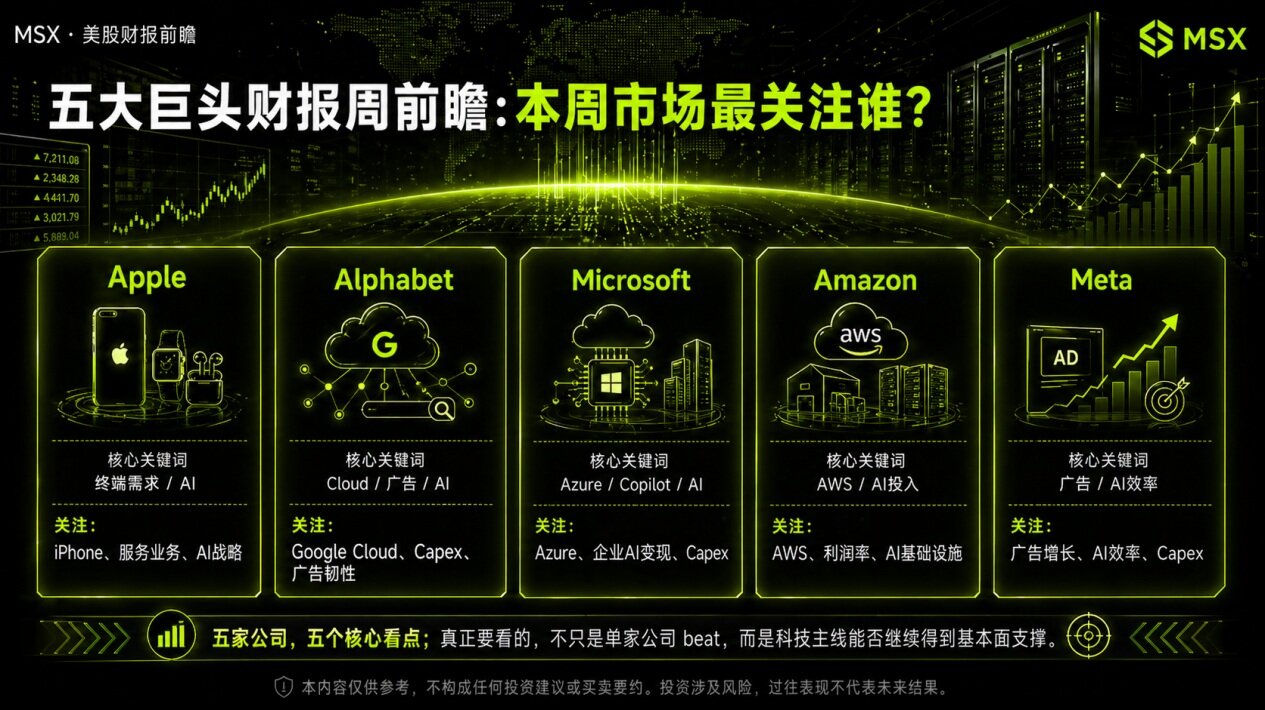
This week, the U.S. stock market will usher in a truly significant "core asset exam week." Microsoft, Google, Amazon, and Meta will all release their earnings reports after the market closes on April 29, while Apple will announce its latest results after the market closes on April 30. Since these five companies cover almost all the most important current tech themes, including cloud computing, advertising, consumer electronics, e-commerce, enterprise software, and AI infrastructure, their earnings reports will affect not just their own stocks, but the entire NASDAQ and the technology sector's direction.
If we condense the market's main theme of the past few months into one sentence, it is: Tech giants continue to increase investment in AI, and the market continues to raise valuations for tech leaders. However, the problem is that after valuations have risen to this level, the market is no longer satisfied with the fact that "companies are investing in AI" itself. Instead, it is starting to ask more practical questions: Have these investments continued to drive cloud business growth? Have they led to improvements in advertising efficiency? Have they supported end-user demand? And most importantly, have they begun to translate more clearly into revenue, profits, and future guidance?
Microsoft's revenue guidance midpoint for the current quarter was approximately $81.2 billion, with Azure growth guidance at 37%-38%. Alphabet has set its 2026 capital expenditure plan at $175 billion to $185 billion. Amazon expects its 2026 capital expenditure to be around $200 billion. Meta has raised its 2026 capital expenditure target to $115 billion to $135 billion. These figures alone indicate that the real theme of this earnings season remains "whether the market will continue to accept high spending."
I. What does the market really want to confirm this earnings season?
1. Are the tech giants still willing to spend on AI?
Because the valuations of many AI infrastructure chains are essentially built on a premise: super buyers like Microsoft, Google, Amazon, and Meta will continue to place orders, expand data centers, and purchase computing power, networking, and power infrastructure. If management signals any caution regarding capital expenditure during the earnings call, it won't just affect them; it will impact the entire AI industry chain.
2. Can the two cash machines – cloud and advertising – remain stable?
Microsoft Azure, Google Cloud, and AWS are the most direct windows into observing corporate IT spending and AI demand. Meanwhile, the advertising businesses of Google and Meta represent the core cash flow resilience of Internet platforms. If the cloud is stable and advertising is stable, the market will continue to believe: Even with high capital expenditure, tech giants still have the capacity to support future investments with their mature businesses.
3. Is AI still just a story, or has it started to become profit?
All five companies are talking about AI, but they verify AI in different ways: Microsoft focuses on enterprise payments, Google on cloud and search, Amazon on AWS and custom chip synergy, Meta on advertising efficiency, and Apple on the terminal entry point and ecosystem position. It is precisely because of these different approaches that this earnings season is particularly interesting.
II. What specific questions must the 'Big Five' answer?
1. Microsoft: The first question to answer isn't growth, but how far along AI commercialization really is
Among the 'Big Five,' Microsoft is most like the "showroom" for this AI cycle. The reason the market has been willing to give Microsoft a premium over the past year isn't just because it's a cloud leader, but because it's seen as the company most likely to turn AI into a real business first. Copilot is embedded into Office, development tools, and enterprise workflows, layered on top of Azure as the underlying cloud platform. Microsoft's advantage is that it can not only provide model capabilities but also directly reach the enterprise customers most willing to pay.
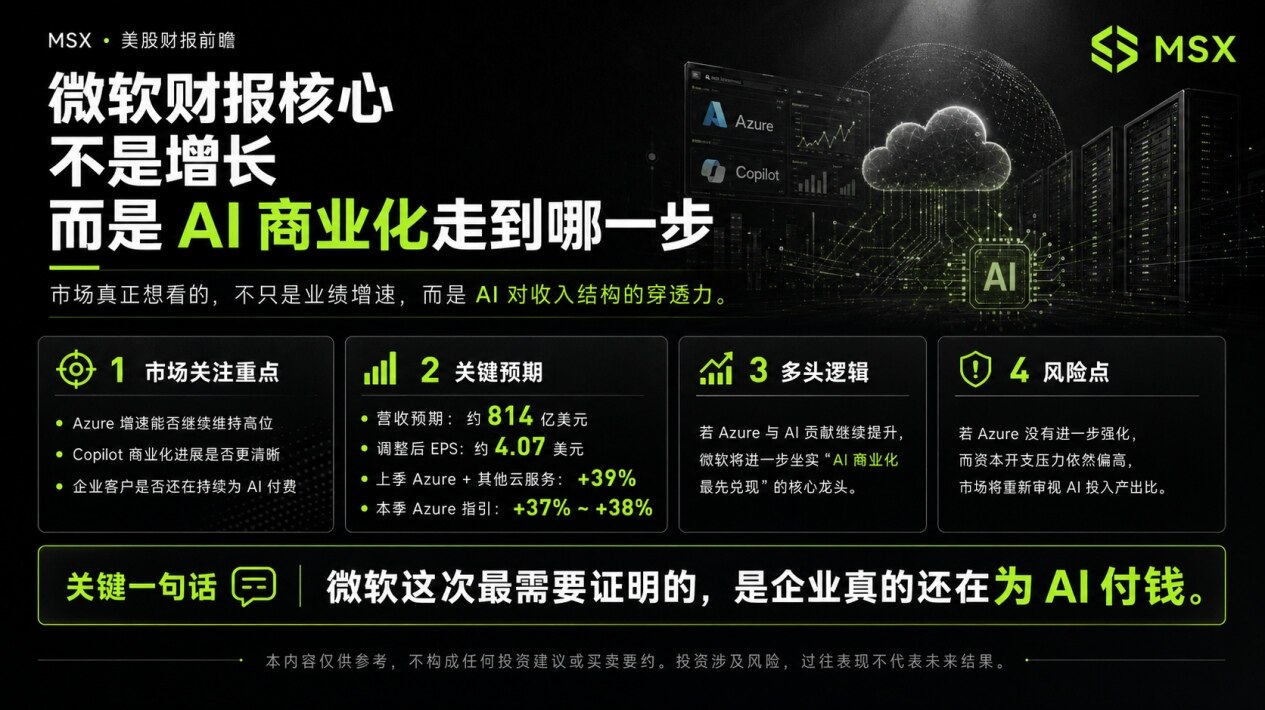
Therefore, the most important thing in this Microsoft earnings report isn't just revenue growth, but whether AI's "penetrative power" on the revenue structure continues to strengthen. The market consensus for FY2026 Q3 is roughly revenue of around $81.4 billion and adjusted EPS of $4.07. Microsoft's own revenue guidance range for the quarter was $80.65 billion to $81.75 billion, closely aligned with market expectations.
What's truly worth watching is whether Azure's growth rate can remain in a high range and whether AI products like Copilot show clearer commercialization progress. Last quarter, Microsoft reported Azure and other cloud services revenue grew 39% and provided guidance for the current quarter of 37%-38% growth. This means the market's core expectation for this report isn't really "whether there is growth," but "whether AI is still driving growth acceleration."
If Microsoft can continue to prove this time that enterprise customer budgets for AI tools haven't shrunk and Azure's AI contribution is still increasing, the market will view it as the core leader in "AI commercialization first to be realized," and related enterprise software, cloud, and data center chains will also continue to benefit. Conversely, if Azure doesn't strengthen further but capital expenditure pressure remains high, the market will refocus on the return on investment.
In other words, the most crucial point of Microsoft's earnings this time is not to prove that AI is important, but to prove that enterprises are genuinely still paying for AI.
2. Google: Cloud Next just told the story; now the earnings report must deliver the results
Compared to Microsoft, Google's situation this time is more like "first having a conference, then taking a quiz." Cloud Next 2026 just ended, and Google released many signals at the conference regarding AI agents, Gemini Enterprise, Vertex AI, TPUs, and infrastructure investment. The market has indeed raised expectations for Google Cloud as a result. However, the conference was about vision, while the earnings report is about execution. The most significant pressure for this Alphabet earnings report comes precisely from the need to quickly turn the "story" into "numbers."
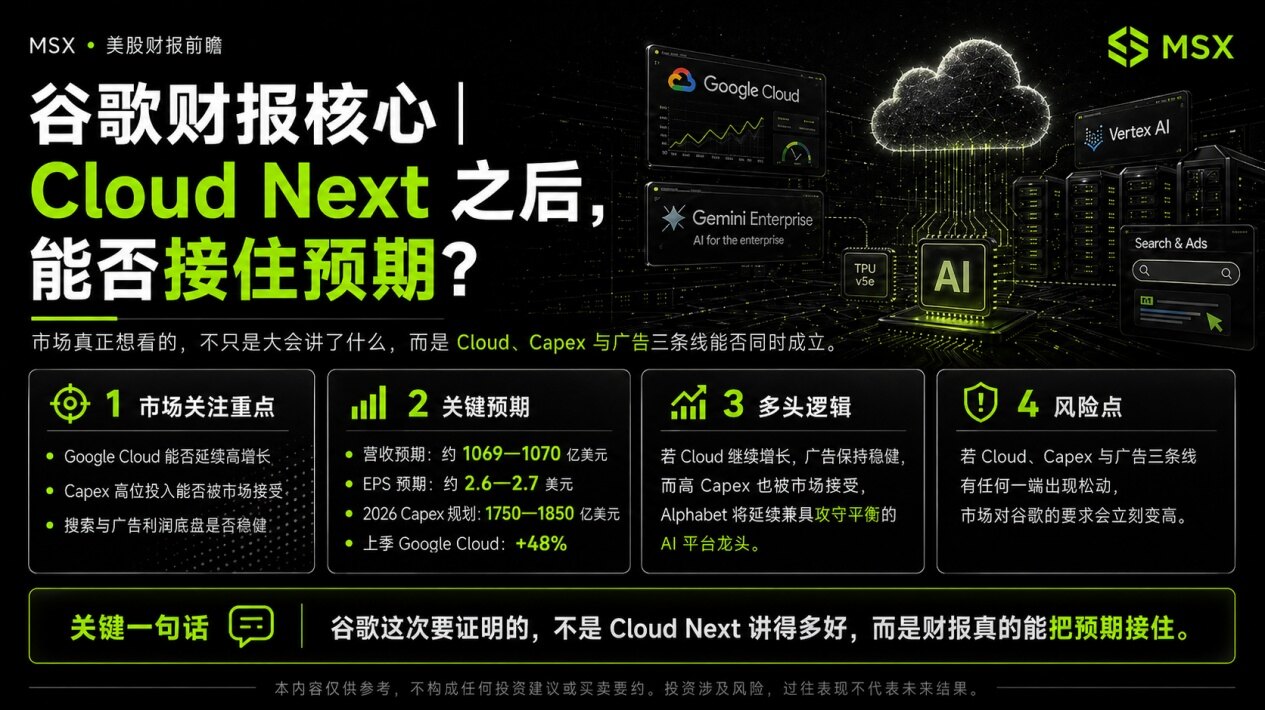
Google's uniqueness lies in the fact that it's neither a pure cloud company nor a pure advertising company. Instead, it operates on two main tracks simultaneously: one is Google Cloud and AI infrastructure, and the other is the mature cash flow machine of search and advertising. The current market consensus is roughly Q1 revenue of $106.9 billion to $107.0 billion and EPS of around $2.73. But compared to just looking at revenue and EPS, what's more critical is whether three things can hold true simultaneously: Google Cloud continues to grow, capital expenditure remains high, and search advertising remains stable. In February, Alphabet clearly outlined a 2026 capital expenditure plan of $175 billion to $185 billion. Last quarter, Google Cloud revenue grew 48% to $17.7 billion, with an annualized run rate exceeding $70 billion, and backlog orders also increased rapidly. This means the market has already partially priced in the narrative of "Cloud is strong, AI investment is aggressive."
So, the real test for Google this time isn't whether Cloud can grow, but whether it can maintain the profit foundation of search and advertising while continuing to invest heavily. If all three lines are stable, Alphabet could be redefined by the market as the current AI platform leader with the best "offense and defense balance." However, if there's any weakness in Cloud, Capex, or advertising, the market's demands will immediately become harsher.
This Google earnings report represents not whether a single business unit beats expectations, but: after Cloud Next, can the earnings report meet the raised expectations?
3. Amazon: The real difficulty isn't AWS, but "investing heavily while still making money"
The challenge of Amazon's earnings this time is different from Microsoft and Google. The market will certainly look at AWS, but looking only at AWS isn't enough because Amazon is not just a single cloud platform company. It simultaneously manages retail, e-commerce, logistics, advertising, and cash flow. In other words, when the market looks at Microsoft and Google, it's more about AI and enterprise demand. When it looks at Amazon, it's about whether a company can continue to bet on the future without sacrificing the quality of its current earnings.
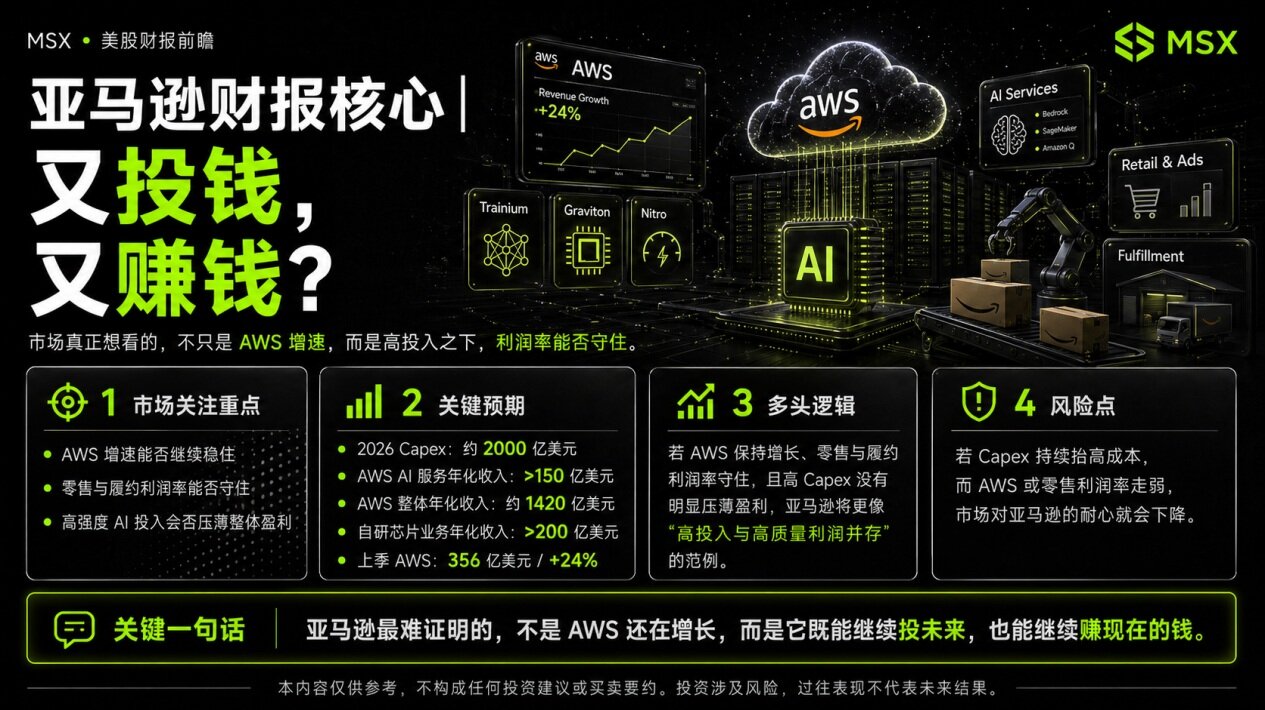
Based on disclosed information, Amazon's investment in AI is very aggressive. In its Q4 earnings in February, the company stated that 2026 capital expenditure is expected to be around $200 billion, primarily directed at AI infrastructure. CEO Andy Jassy later supplemented in a shareholder letter that AWS's AI services annualized revenue run rate has exceeded $15 billion, while AWS's overall annualized revenue run rate is about $142 billion. Simultaneously, the annualized revenue run rate for custom chip-related businesses like Trainium, Graviton, and Nitro has surpassed $20 billion. This shows Amazon is now not just saying "we are also doing AI," but "we expect AI to become the core growth engine for AWS's next phase."
The problem, however, is that Amazon cannot only talk about the future. AWS is its growth and profit engine, but retail and fulfillment systems determine whether overall profit margins can be maintained. Last quarter, AWS revenue grew 24% YoY to $35.6 billion, with full-year AWS revenue reaching $128.7 billion. The company provided Q1 operating income guidance of $16.5 billion to $21.5 billion, with the midpoint not being particularly aggressive. This means the market is looking at Amazon not just for AWS growth itself, but for a more practical question: Will the high-intensity AI investment compress profit margins again? If the answer is no, Amazon will be seen as an example where "high investment and high-quality profits can coexist." If the answer becomes ambiguous, the market's patience will wane.
The real challenge for Amazon is not to prove that AWS is still growing, but to prove that it can continue to invest in the future while continuing to make money in the present.
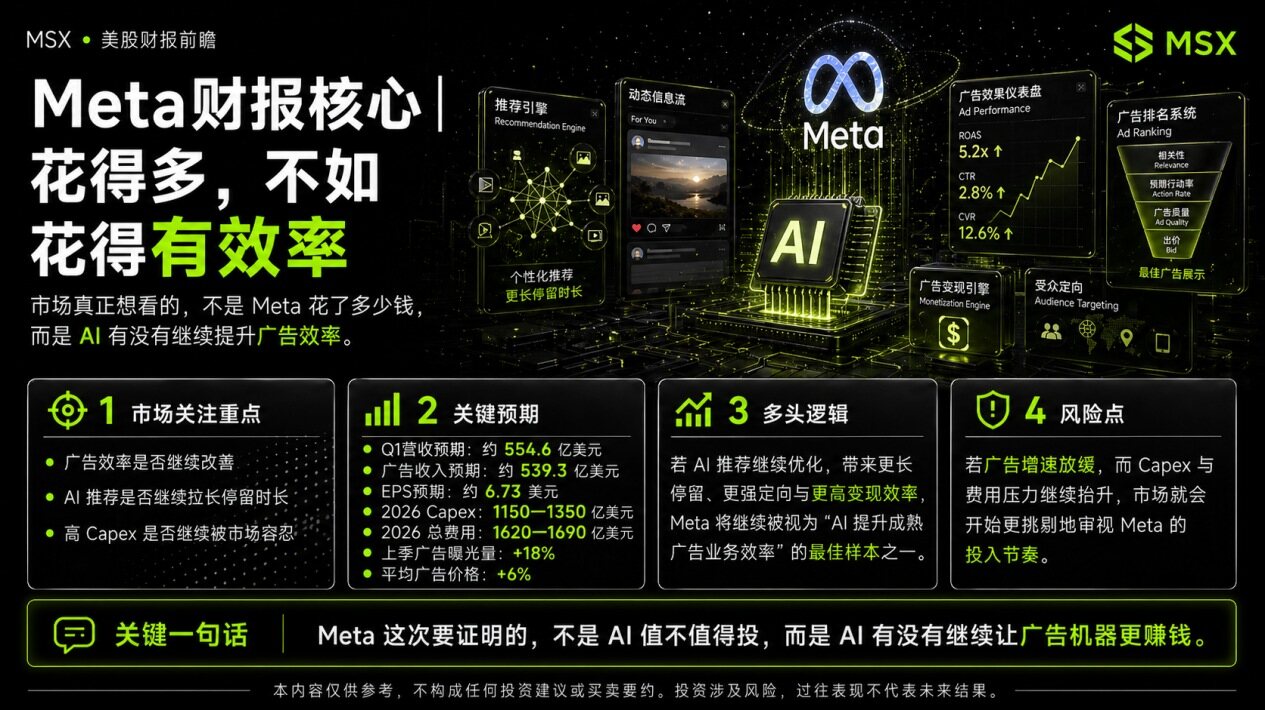
4. Meta: The market continues to buy in, not because it spends a lot, but because it spends efficiently
Among the 'Big Five,' Meta's logic is most easily misinterpreted. On the surface, like the others, Meta is also aggressively increasing capital expenditure. However, the market is still willing to give it a high valuation not because it holds many AI product launches, but because it has repeatedly proven that AI can directly improve its core business – advertising. For Meta, AI is not a new story on the distant horizon but an "efficiency revolution" happening right now.
From last quarter's earnings, Meta's advertising business remains the foundation supporting all its AI investments. In Q4 2025, Meta's ad impressions grew 18% YoY, the average ad price increased 6%, and full-year capital expenditure reached $72.2 billion. At the same time, the company raised its 2026 capital expenditure forecast to $115 billion to $135 billion, with total expense guidance also rising to $162 billion to $169 billion. This means that what investors truly need to observe now is not how much Meta spent, but whether this spending has continued to yield stronger recommendation capabilities, longer user dwell times, better ad targeting, and higher ad monetization efficiency.
Pre-earnings market consensus expects Meta's Q1 revenue to be $55.46 billion, ad revenue at $53.93 billion, and EPS of $6.73. These numbers are important, but what truly determines market sentiment is the underlying logic chain: AI recommendation optimization → increased user dwell time → improved ad efficiency → higher ad revenue → market continues to tolerate high Capex. If this chain holds, Meta will continue to be seen as one of the best examples of "AI improving mature business efficiency." Conversely, if ad revenue growth slows while capital expenditure pressure mounts, the market will start scrutinizing its investment pace more critically.
In other words, Meta's earnings this time isn't about answering "Is AI worth investing in?" It's answering: Has AI continued to make this advertising machine more profitable?
5. Apple: The market doesn't expect it to be the most aggressive; it just wants to confirm it hasn't fallen behind
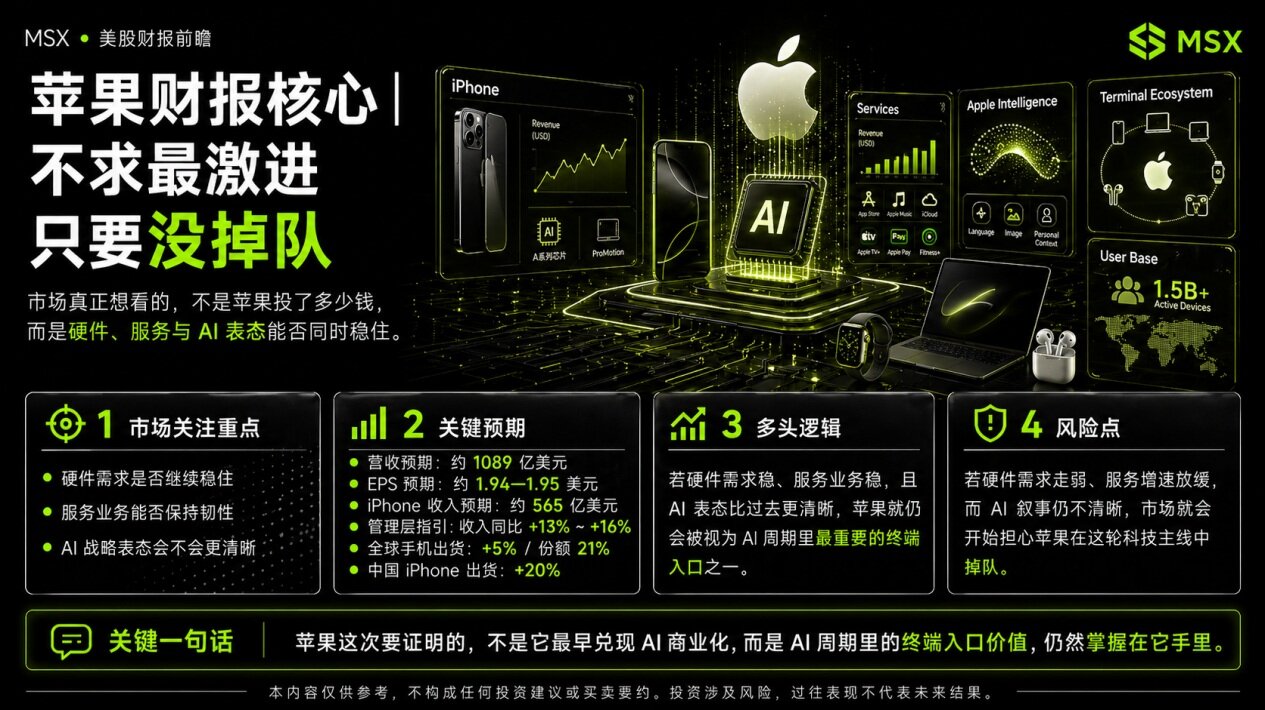
If the first four companies are somewhat centered around "AI investment and commercialization," Apple's logic is entirely different. The market does not expect Apple to tell the most aggressive AI story this earnings season, nor will it measure Apple by "how much capital expenditure you made." Apple's most critical question is simply this: In this AI cycle, does it still firmly hold the most important terminal entry point.
This is also why Apple's focus this time will fall on a more subtle combination: hardware demand, services business, and clarity of AI strategy. In its last quarter earnings report released in January, Apple guided for the current quarter's revenue growth of 13%-16% YoY. Based on this guidance, revenue is roughly estimated to fall within the $107.8 billion to $110.7 billion range. The current mainstream market consensus is approximately revenue of $108.9 billion and EPS of $1.94 to $1.95. S&P Global's preview shows the market expects iPhone revenue for this quarter to be around $56.5 billion. Meanwhile, Apple's global smartphone shipments grew 5% YoY in Q1 2026, capturing a 21% global market share. In the Chinese market, iPhone shipments also grew 20% YoY. This indicates that, at least before the earnings report, the market hasn't seen clear signs of Apple's terminal demand stalling.
Therefore, the real observation point for Apple this time is not whether it will emphasize AI investment as loudly as Microsoft or Google, but whether it can continue to prove that, even if its pace in the AI cycle isn't the most aggressive, it still possesses the most important terminal ecosystem, the strongest user base, and the most stable source of high-quality profits. As long as hardware demand is stable, the services business is stable, and the AI narrative is clearer than before, the market won't easily exclude Apple from this tech theme.
Apple represents not the first to realize AI commercialization, but that the value of the terminal entry point in the AI cycle is still held firmly by it.
III. Looking at the Five Companies Together, the Market is Essentially Conducting a 'Cross-Verification'
If viewed individually, this week is naturally about five separate earnings reports. However, when viewed together, we see that the market is actually conducting a larger cross-verification. Microsoft tests whether AI has formed a closed-loop enterprise payment system; Google tests whether the conference narrative can quickly translate into dual fulfillment from Cloud and Advertising; Amazon tests whether high investment can coexist with high-quality profits; Meta tests whether AI continues to enhance mature business efficiency; Apple tests whether its terminal entry point and ecosystem position remain secure.
These appear to be five different threads, but they all point to the same question: Are the current high valuations of tech leaders built on actual execution, or are they still largely built on expectations? If the answers from the five companies are mostly positive, the market will be more willing to continue pushing up directions related to AI, cloud, advertising platforms, and terminal ecosystems. However, if there is clear divergence, the market will shift from "broadly raising valuations" to "only rewarding the strongest performers."
IV. After the Earnings, What Might the Market Reprice?
After earnings season, the market is most likely to reprice not a single company, but several major themes.
The first is undoubtedly the AI infrastructure chain: If the tech giants' capital expenditure guidance remains high, areas like data centers, networking, optical interconnects, power, and cooling will continue to receive fundamental support.
The second is Cloud and Enterprise AI: As long as Microsoft, Google, and Amazon continue to prove enterprise demand exists, the market will continue to view cloud platforms as the


