Aave는 자신의 어리석음으로 인해 DeFi 대출의 왕좌를 내주고 있다


- 핵심 관점: Aave는 Kelp DAO 해킹 사건 이후 적극적인 위기 대응 부재로 인해 172억 달러 이상의 자금이 유출되었고, 대출 분야에서의 안전성 우위를 경쟁사인 Spark에 넘겨주며 왕좌가 흔들릴 위기에 처했다.
- 핵심 요소:
- Kelp DAO가 2억 9200만 달러 상당의 rsETH를 도난당해 Aave에 1억 2370만 달러에서 2억 3010만 달러 규모의 부실 채권이 발생할 수 있다.
- Aave는 부실 채권을 감당할 능력이 있지만, Kelp DAO, LayerZero와의 책임 공방으로 인해 사용자에게 늑장 대응하여 공포에 의한 뱅크런을 초래했다.
- 지속적인 자금 유출로 Aave의 여러 풀 Utilization(이용률)이 최대치에 도달해 유동성 고갈 현상이 발생, 신뢰 위기를 심화시켰다.
- 경쟁사 Spark(Aave 코드를 포크하여 기반)는 사전에 rsETH 지원을 제거하여 피해가 전혀 없었으며, TVL이 약 200억 달러 증가했고, 저스틴 선은 13억 달러를 예치했다.
- Aave 설립자 Stani는 대규모 자금 유출 이후에야 구제 계획을 발표했지만, Aave는 이미 '가장 안전한 DeFi'라는 사용자 인식과 시장 점유율을 상실했다.
Original: Odaily Planet Daily (@OdailyChina)
Author: Azuma (@azuma_eth)

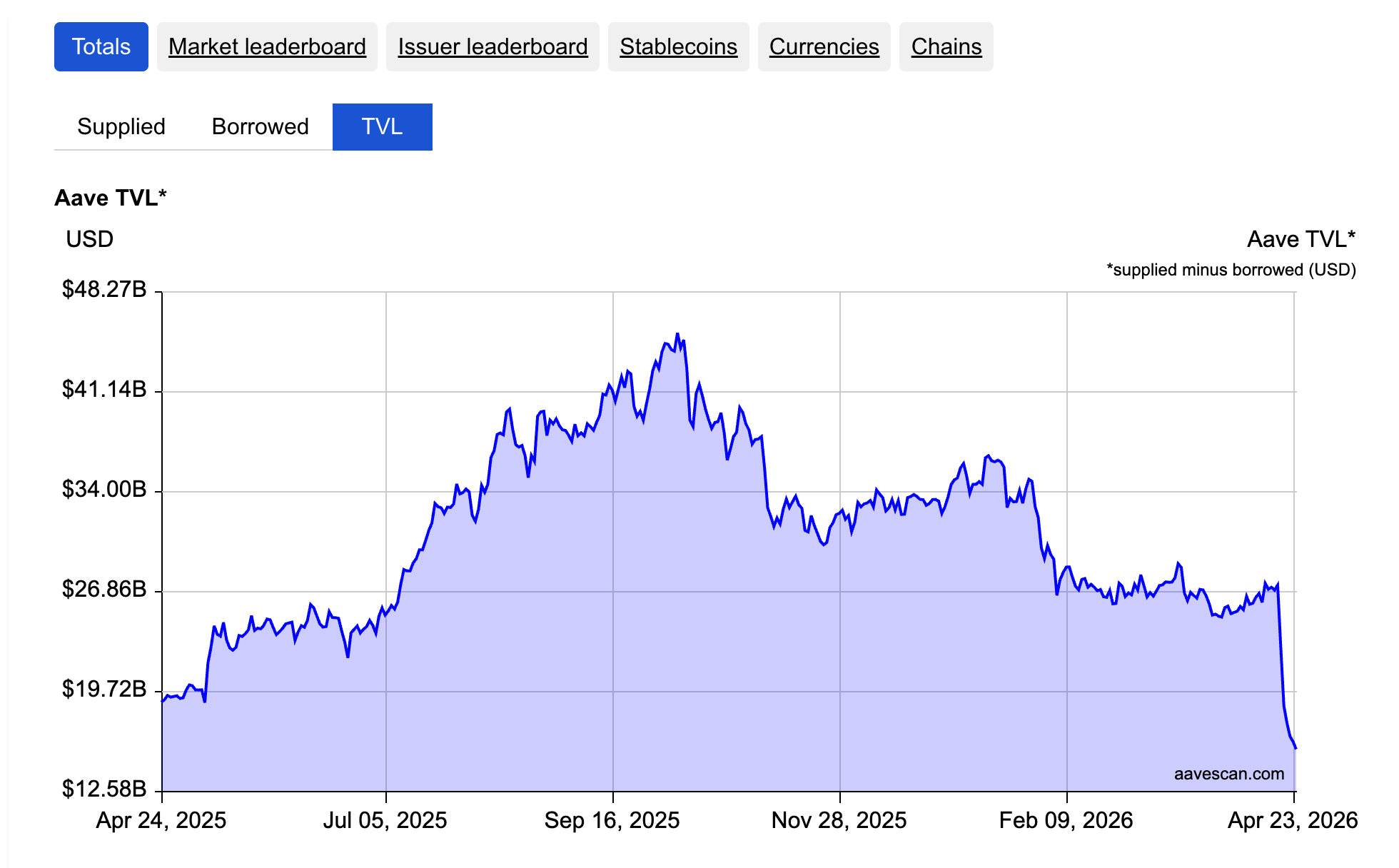
$292 million is the total amount of rsETH stolen from Kelp DAO; $17.2 billion is the scale of funds that have flowed out of Aave since the incident.
Aave is watching its community panic fester for days due to its own incredibly poor crisis management strategy, subsequently losing its greatest advantages in the lending track — hundreds of billions of dollars in locked total value and the user mindshare label of being the "safest DeFi."
- Odaily Note: For context, please refer to "DeFi Hacked Again for $292 Million; Is Even Aave No Longer Safe?"; and "Tripartite Game Under the $290 Million Hole: Who Will Pay – Aave, LayerZero, or Kelp?".
What Did Aave Do Wrong?
The details of the Kelp DAO hack need not be repeated. Criticizing Aave for granting rsETH such a high LTV is pointless now. This is primarily from the perspective of a long-term AAVE user, discussing Aave's response strategy after the incident.
First, regarding the scale of bad debt, Aave itself has done the math. Depending on how rsETH is handled, there are two potential scenarios for bad debt: If the stolen losses are deducted from all circulating rsETH, it is estimated to create $123.7 million in bad debt; if the value of mainnet rsETH is protected, attributing all losses to the mapped rsETH on Layer 2 is estimated to result in $230.1 million in bad debt.
In either case, with its Umbrella, DAO treasury, and team fund reserves, Aave has the capacity to cover this. I understand Aave's reluctance to foot the bill itself and its desire for the primary responsible party, Kelp DAO, and the secondary responsible party, LayerZero, to contribute more. But the problem is they think the same way — "Aave is so wealthy and the situation is so awkward, they should bear more of the burden." So, a consensus among these three parties in the short term is hard to reach, meaning a win-win solution for everyone is temporarily out of reach.
But users cannot wait that long. Aave's yield rates have never been particularly competitive in the industry. Users who choose to deposit with Aave do so for reputation, security, and liquidity. However, during the most tense days following the incident, Aave failed to give users any kind of backstop commitment. Instead, it repeatedly shifted blame by stating "our code is fine" and "Aave cannot control how rsETH is accounted for."
Thus, panic has continued to ferment within the community. Users have scrambled to find ways to exit and hedge. Those who can withdraw do so directly; those who cannot borrow from other pools first, causing a cascading effect. So Aave's current situation is a continuous drain of funds alongside liquidity crises in multiple pools due to maximized utilization rates.
This awkward situation could have been avoided (or at least not been this bad). Since Aave can afford it, why didn't it provide a dose of reassurance to the community at the outset to prevent a bank run? It's just a matter of up to $230 million in bad debt (likely less), and Aave wouldn't have to bear it alone. They could sort out the details with LayerZero and Kelp DAO later.
Now, to avoid committing up to $230 million in relief, Aave has watched $17.2 billion in locked funds drain away (the number might still rise), not to mention the drop in AAVE's token price these days... No matter how you calculate it, this is a losing proposition.
What's worse for Aave is that the more dire its situation becomes, the more comfortable counterparties like LayerZero and Kelp DAO feel. They might perceive Aave as having a greater incentive to resolve the issue quickly, which only weakens Aave's bargaining position.
At this point, Aave has only itself to blame.
Behind Aave, Spark is Watching Eagerly
While Aave grapples with its headache, competitor Spark is celebrating a booming success. What's even more ironic is that Spark is a competitor "hatched" by Aave itself.
Spark was a lending protocol forked from Aave V3's open-source code by Sky (formerly MakerDAO), essentially sharing the same underlying code logic. In return, there was a profit-sharing agreement between Spark and Aave, but later Aave accused Spark of breaching the contract. Coupled with diverging paths, the two are now purely competitive.
Three months before the Kelp DAO hack, Spark had just removed support for rsETH (details in "Same Week, Different Fates: Aave Embraces rsETH, Loses Nearly $200 Million; Spark Exits Unscathed"). Call it strategic conservatism, rigorous risk control, or even just luck, the result is that Spark was completely unaffected this time. On this sole point, Spark can relentlessly attack Aave's former label of "safest DeFi."
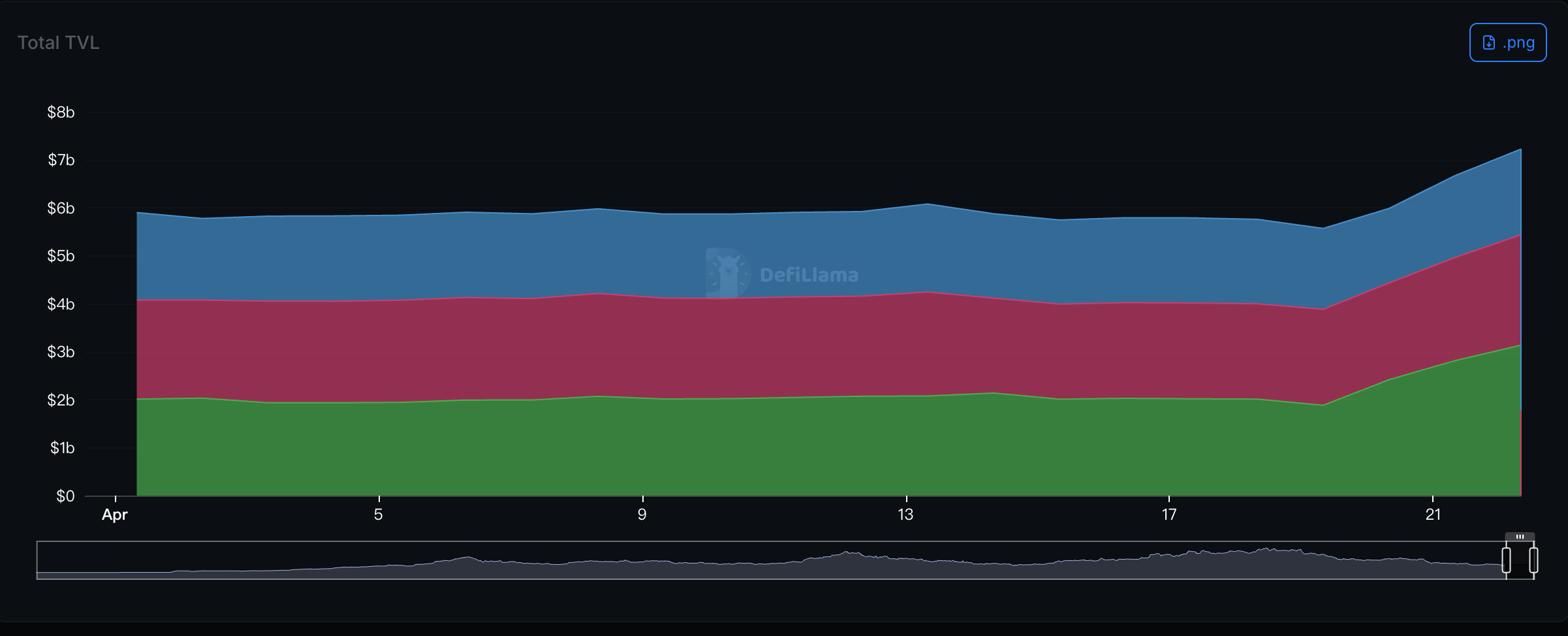
Consequently, Spark became one of the safe havens for funds fleeing Aave. Since the incident, Spark's TVL has grown by nearly $2 billion (green section in the chart below). Justin Sun withdrew 53,665 ETH ($124 million) from Aave on the day of the incident, subsequently depositing it into Spark, and has continued adding, bringing his total deposit to $1.3 billion. In the DeFi world, you really need to learn from Sun Ge's moves.
On April 23rd, Upbit officially listed Spark (SPK) on its Korean Won trading market. Stimulated by this news, SPK surged over 80% in a single day, significantly narrowing the market capitalization gap between it and AAVE.
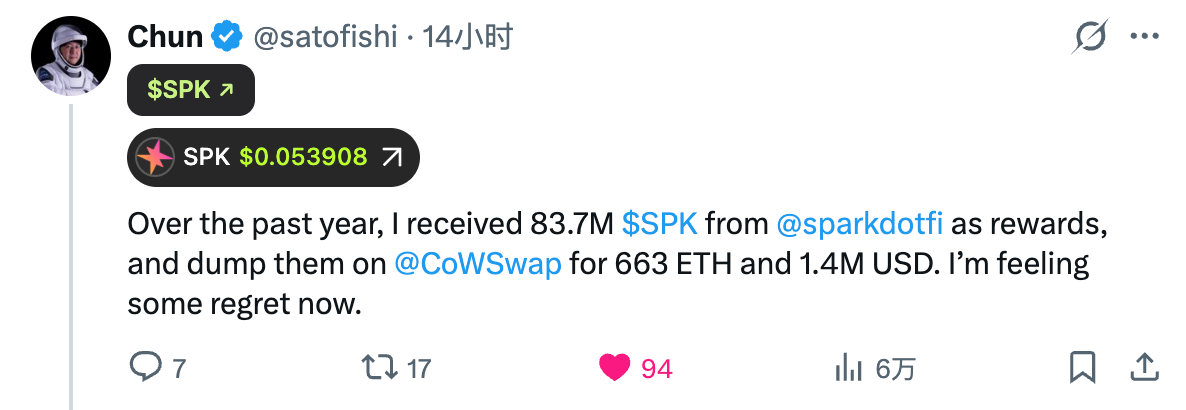
Even fish pond founder Wang Chun lamented on X: "In the past year, I received 83.7 million SPK rewards from Spark and sold them on CoWSwap for 663 ETH and $1.4 million. Now I kind of regret it."
Spark clearly recognizes this as a golden opportunity to grab market share from Aave. Since the incident, Spark's Strategy Lead, MonetSupply, has arguably become the most vocal KOL on the matter, posting dozens of times a day. While his statements help the public understand what happened, they have objectively fueled the panic surrounding Aave.
But this is pure business competition. MonetSupply simply made the most correct choice.
Aave is Losing Its DeFi Lending Throne
In the early hours of April 24th, perhaps realizing the severity of the situation, Aave founder Stani announced on X a plan to launch a relief initiative called DeFi United, with participants including LayerZero, Ethena, ether.fi, Ink Foundation, Golem Foundation, Trydo, etc. Stani will personally donate 5000 ETH to address the current issue.
But the funds have already drained away, and user trust has been severely damaged. With just this belated statement, it will be difficult for Aave to quickly recover its locked value and user confidence in the short term.
The DeFi lending track has long had a "one superpower, multiple strong contenders" structure, with Aave seemingly holding a very stable leading edge. However, Aave has now surrendered its throne. Behind it, challengers are rushing in. Besides the surging Spark, other competitors like Morpho and Jupiter Lend also hope to take a bite out of Aave's market share.
Last year, Stani purchased a five-story mansion in London for approximately $30 million, one of the most expensive deals in the UK's sluggish luxury real estate market last year. I don't know if there's something like a "backfire" at play, but with examples like Su Zhu et al., it seems that high-profile spenders in this circle often run into trouble.
I can only guess what Stani is thinking right now in his five-story mansion.