






从Coinbase到Upbit:あるトークンが28日間の「お荷物引き受け」の道を辿る方法


- 核心观点:2026年の弱気相場において、CEXへの上場はトラフィック主導から検証主導へと移行し、Coinbase/ByBit(発見)→ Binance Perps(検証)→ Binance Spot(確認)→ 韓国取引所(お荷物引き受け)という構造化された経路が形成されている。上場イベントは増加の触媒というよりも、既存資金の再配分であり、投資家はこれによりアルファの機会を特定できる。
- 关键要素:
- Coinbase、ByBit、Binance Perpsは初回上場の第一層であり、それぞれ67%、39%、48%のトークンが初回上場となり、価格発見を担っている。一方、Binance Spotは19のトークンのみを上場し、初回上場率は28%で、安全性の検証に重点を置いている。
- 韓国取引所(Bithumb、Upbit)は体系的に上場経路の末端に位置しており、初回上場からの平均遅延は約28日で、追随率は85%と高く、上位の順位である。ユーザーは高値でお荷物を引き受けることが多く(Upbitの参入プレミアムは最大27.4%に達する)。
- Binance Perps上場の中核となる先行シグナルは、CoinbaseとByBitの上場動向(変換率75%と70%)であり、その反応は極めて速い(平均4.9日)。また、価格パフォーマンスが安定している人気プロジェクトを優先的に選別し、継続的な下落や過度な投機のトークンを回避する。
- 上場後の価格パフォーマンスは全体的に弱含み:全ての取引所で30日平均リターンはマイナスであり、下落幅は徐々に拡大している。これは成長ではなく流動性放出の特性を反映している。初回上場所(例:ByBit)のピーク平均は+86%に達するが、後発の取引所(例:OKX)では+25%に過ぎない。
- 取引所の選択はリスク・リターン構造に顕著な影響を与える:初回上場所(Coinbase/ByBit)のユーザーは最も低い参入価格と最も高いピーク値の余地を持つ一方、韓国取引所のユーザーは高値掴みと大幅な下落(30日リターン-25.7%)に直面し、損益の差は4.5ポイントにも及ぶ可能性がある。
Original Author: Xinyang & Ethan @ IOSG
Every bear market quietly reshapes the listing logic of CEXs. When liquidity tightens and retail enthusiasm wanes, exchanges become more prudent in their listing decisions, making each one more valuable as a signal. We systematically tracked new listings on the spot markets of six major exchanges – Coinbase, Binance Spot, ByBit, OKX, Bithumb, and Upbit – as well as Binance Perpetual, from the beginning of 2026 to mid-May. This data comprises a total of 207 listing records covering 92 independent tokens. The data clearly reveals a core fact: listing is a highly structured path of validation and liquidity transfer.
Who identifies and prices a project first? Who absorbs and amplifies liquidity in the middle? Who completes market coverage at the end? Different exchanges play distinctly different roles along this chain. By the time a token is finally listed on Binance Spot, it has often undergone multiple rounds of validation by various exchanges. This report will dissect this listing path from three core dimensions:
- Landscape & Path: The differentiation of listing roles among exchanges and the flow pattern of tokens between them.
- Binance Perps Selection Logic: What kind of tokens are more likely to be listed on Binance Perp?
- Price Impact: How does listing timing determine investor entry points, and what are the actual return differences across exchanges post-listing?
For projects, understanding this path means a more precise and efficient listing strategy. For investors, recognizing the positional differences within the path might just be one of the most important Alpha sources of 2026.
2026 CEX Listing Landscape & Path
Overview of Exchange Listings
▲ Total Listings by Exchange
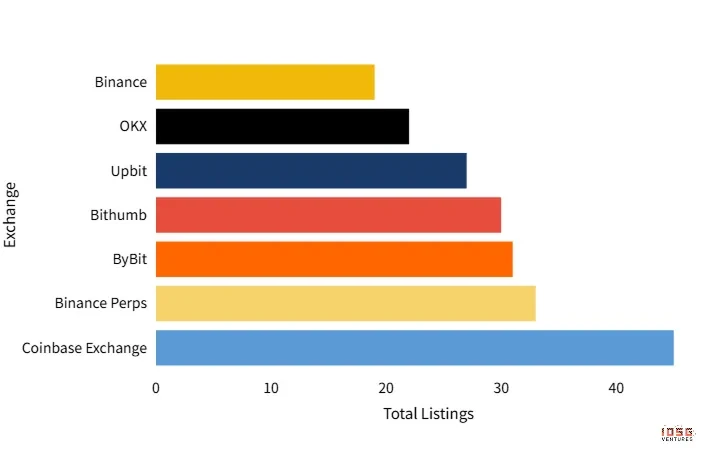
From the start of 2026 to date, we have tracked new listings on the spot markets of six major exchanges – Coinbase, Binance Spot, ByBit, OKX, Bithumb, and Upbit – as well as Binance Perp, totaling 207 listing records covering 92 independent tokens.
The number of listings shows a clear stratification. Coinbase leads with 45 new listings, closely followed by Binance Perps (33) and ByBit (31). Bithumb (30) and Upbit (27) form the second tier, with OKX listing 22 and Binance Spot listing only 19, the fewest among the observed exchanges.
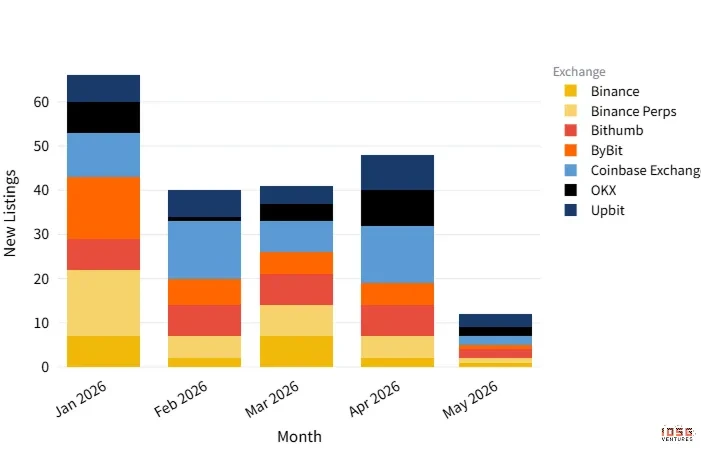
Looking at the monthly rhythm, January was the peak listing period for the year. Binance Perps listed 15 tokens in a single month, and ByBit listed 14. From February onwards, the overall pace slowed significantly, with average monthly listings falling to 5-8, entering a more cautious and stable selection phase. Coinbase, however, showed a listing rhythm offset from other exchanges, with two concentrated listing peaks in February and April (13 in a single month), demonstrating its independent and rapid listing decision-making characteristics.
▲ Monthly Listings by Exchange
Simple differences in quantity only reflect surface-level activity. More important is the profound differentiation in listing timing and roles among different exchanges, which will be further dissected in the following sections.
Differentiation of Listing Roles: Discoverers, Screeners, and Confirmers
Among tokens listed on multiple exchanges, there is a significant sequential order. We define the exchange that lists first within our tracking scope as the "Pioneer" and the rest as "Followers".
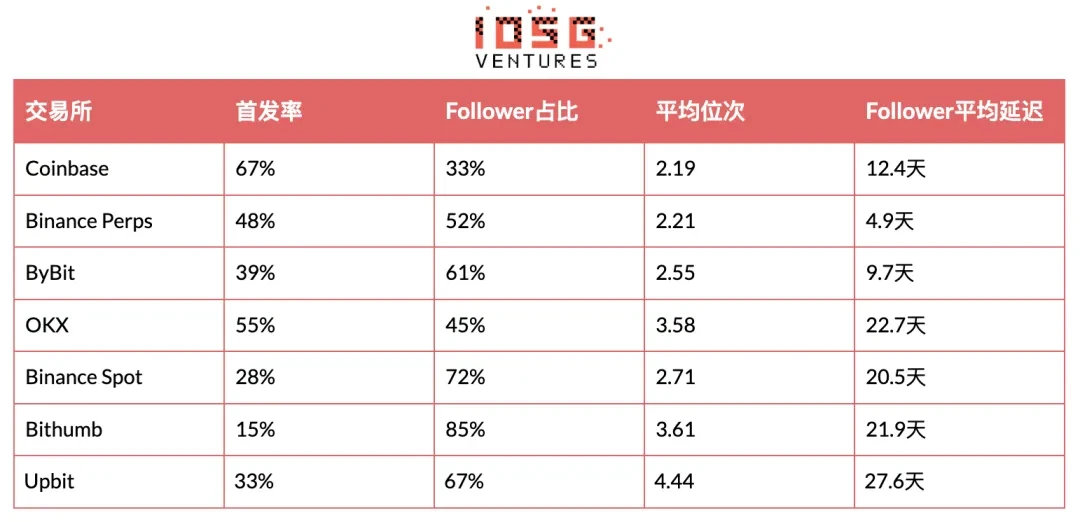
Coinbase was the most prominent pioneer listing venue in 2026. 67% of its tokens were the first to be listed among the tracked exchanges, undertaking the market's initial price discovery function. ByBit (39% pioneer rate) and Binance Perps (48% pioneer rate) also maintain high activity levels. These three often list the same token densely within the same week, collectively forming the first tier for new project listings.
Korean exchanges (Bithumb and Upbit) are systematically at the end of the listing path. Bithumb has a Follower rate as high as 85%, and Upbit has an average rank of 4.44, with a high probability of being the last to list among all exchanges, lagging the pioneer exchange by an average of about 28 days. This is closely related to the lengthy regulatory review process in Korea and the preference of local exchanges to introduce projects only after they have gained widespread consensus.
Binance internally forms a clear funnel-like division of labor: Binance Perps pioneers about half the time and follows up extremely quickly (average of only 4.9 days) after Binance Spot listings the other half, making it the most responsive among all exchanges. Its main role is to quickly test liquidity and market demand through the derivatives market. In contrast, Binance Spot has the fewest listings (only 19) with a pioneer rate of only 28%, clearly preferring to wait for sufficient market validation before choosing its listing moment.
OKX demonstrates a relatively strong ability to select coins independently, with a pioneer rate of 55%. However, its overall number of listings is relatively restrained (22), with an average rank of 3.58, indicating a higher screening threshold and a more prudent strategy.
Listing Path Paradigm
Based on the sample of tokens listed on 3 or more exchanges, the listing order shows a highly stable tier characteristic: early discoverers represented by Coinbase and ByBit pioneer first. Binance Perps follows up quickly within days for validation. Binance Spot then selectively lists for confirmation. OKX, Bithumb, and Upbit mainly provide supplementary coverage in the later part of the path.
Typical Case: ROBO (Fabric Protocol)
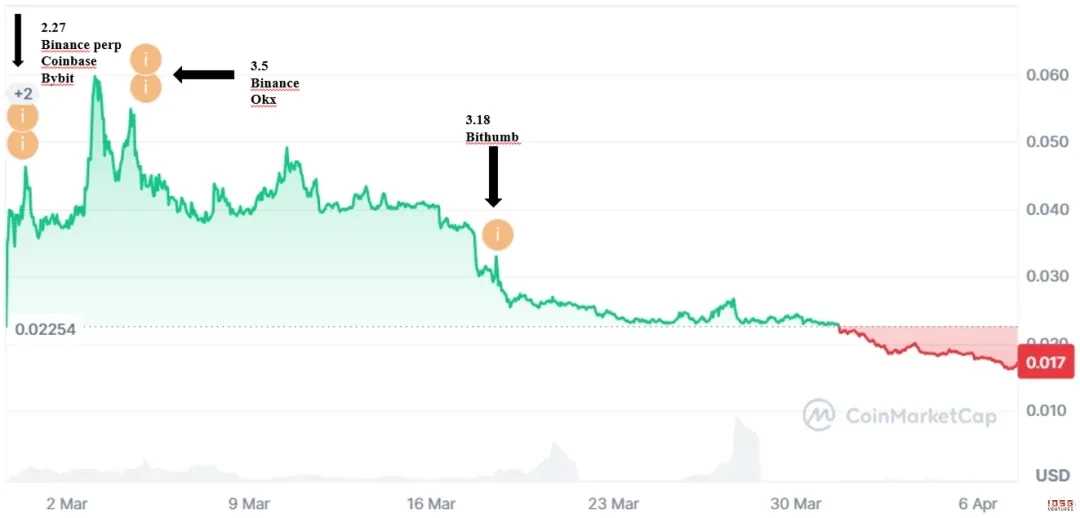
On February 27th, the DePIN project Fabric Protocol (ROBO) premiered on Binance Perp. Coinbase and ByBit followed up on the same day. The opening price was $0.022, with an increase of over 80% on the first day of listing. The opening price the next day had already risen to $0.0405, nearly doubling from the listing price. The project, which raised $20 million led by Pantera Capital, focuses on the intersection of blockchain and the robotics economy. It quickly gained market attention, amplified by the enthusiasm from Kaito's public sale and the "AI + Robot" narrative.
On March 5th, Binance Spot officially listed ROBO at a price of $0.0493. This also became the highest price point for ROBO throughout the entire cycle. When OKX subsequently entered, its opening price was already lower than the Binance Spot price. Bithumb listed on March 18th at a price of $0.0303. Although it briefly sparked a rally, the token price has since fallen back and is now below the initial listing price.
From its pioneer listing to the Bithumb listing, ROBO completed its journey along a typical 2026 listing path in just about 20 days:
Binance Perps, Coinbase & ByBit Pioner → OKX & Binance Spot Confirm at Peak → Korean Exchanges Catch at the End.
ROBO is not an isolated case. In the sample from the first five months of 2026, 28 tokens were listed on 3 or more exchanges. The rank distribution of these cross-exchange cases consistently shows a tier pattern highly similar to ROBO. Although the specific order may vary slightly depending on the project's nature, the overall path structure is stable and predictable.
This path clearly reflects the differences in risk appetite among exchanges: Coinbase, ByBit, and Binance Perps tend to proactively seize the early window; Binance Spot focuses on safety post-validation; while Korean exchanges and OKX prefer to enter only after sufficient market consensus has formed.
Binance Perps Listing Conditions
As a crucial entry point for the derivatives market, Binance Perps' listing decisions directly influence the inflow direction of a large amount of leveraged capital. Through an analysis of 33 Perps listing cases, we can clearly extract the core logic behind Binance's token selection in a bear market environment.
Leading Indicators: Coinbase and ByBit Listings
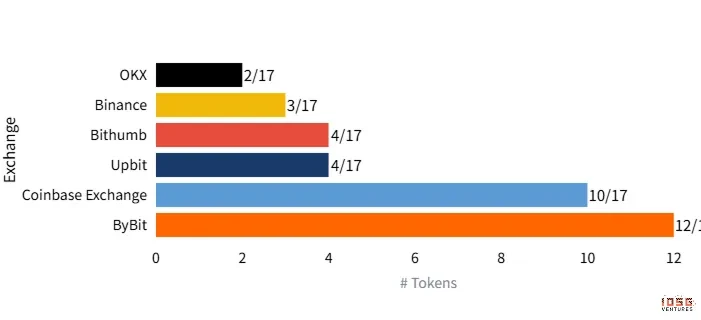
▲ Exchanges Listed Before Perps
Among the 33 tokens that entered Binance Perps, 17 were first listed on other spot exchanges before being included in Perps. Tracking this subset reveals that Coinbase and ByBit are the most important leading indicators for Perps.
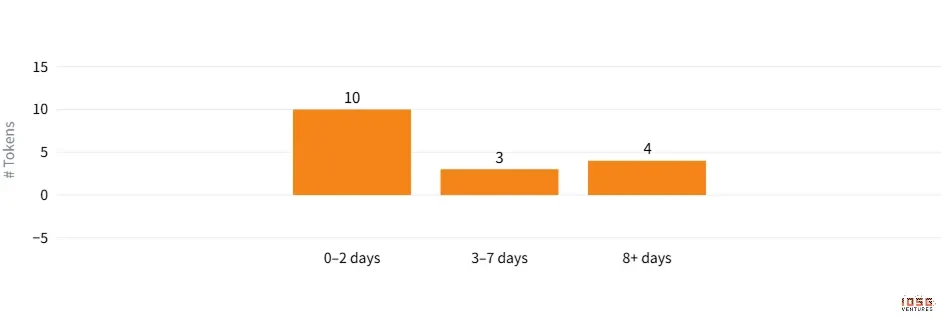
▲ Days from First Spot to Perps
Specifically, ByBit listed before Perps in 71% of these cases, and Coinbase in 59%. More importantly, regarding response speed: among the 17 follower listing cases, 10 were listed on Perps within 0-2 days of their spot listing, with an average delay of only 4.9 days. This extremely fast follow-up speed indicates that Binance Perps pays close attention to the listing activities of Coinbase and ByBit and uses them as important decision-making references.
Looking at the broader sample, 75% of tokens listed on Coinbase eventually entered Binance Perps, while the figure for ByBit is 70%. When a token is supported by both Coinbase and ByBit and shows relatively stable price performance, it is highly likely to land on Binance Perps within a week. This is one of the strongest, directly observable leading indicators currently available in the market.
Price Performance is the Most Critical Screening Standard
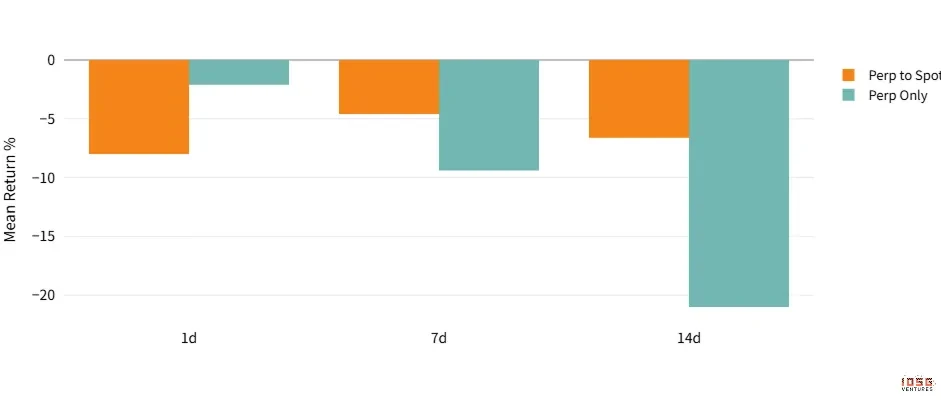
▲ Post-Listing Mean Return (Converted vs Perp Only)
Projects listed on Coinbase and ByBit generally have an opening FDV of over $100M. FDV itself is not a differentiating factor. What truly determines entry into Perps is the price performance after listing.
Looking at tokens listed on Coinbase and ByBit but not entering Perps, three main characteristics emerge:
- Projects whose price continues to weaken post-listing, lacking market heat.
- Meme coins with excessive speculative nature (e.g., WHITEWHALE, ELON). Binance's screening for such tokens is noticeably stricter than ByBit's.
- Tokens that have not passed through Binance Alpha. Alpha, serving as a pre-screening channel within the Binance ecosystem, is an important prerequisite step for entering Perps.
The impact of price performance extends beyond "whether it gets listed on Perps" to the subsequent "Perps to Spot" transition. Data shows that tokens which eventually successfully transitioned to Binance Spot (Converted group) had a 7-day return of -4.6% and a 14-day return of -6.6% post-Perps listing. In contrast, tokens that did not transition to Spot (Perp Only group) had a 7-day return of -9.4% and a much steeper 14-day return of -21.0%. Although both groups show negative returns under the bear market influence, the Converted group's price maintenance ability is significantly stronger, indicating that Binance considers "sustainability" as an important factor during the Perps stage.
Price Impact of Listings
The actual impact of a listing event on a token's price is the issue most concerning for projects, institutions, and traders. We analyze it from two core dimensions: Price Position (relative price position at listing) and Post-Listing Return (7-day, 14-day, and 30-day returns after listing).
Price Discovery Concentrated in the Pioneer Window, but Entry Prices Vary Significantly Across Exchanges
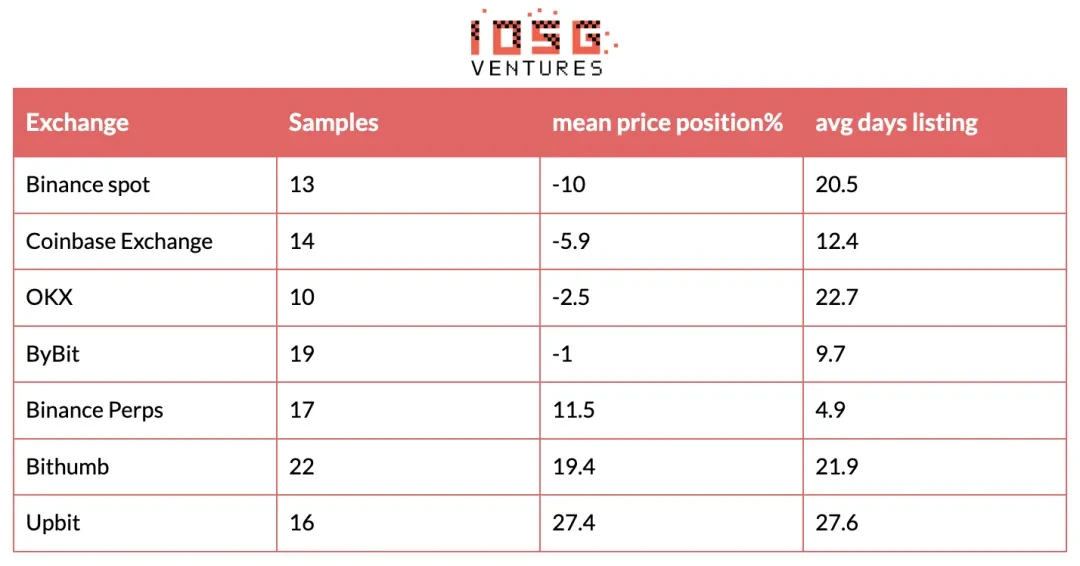
▲ Price Position at Listing
Price discovery mainly occurs during the pioneer window. When acting as followers, the entry prices for ByBit and Coinbase are essentially flat or slightly lower than the pioneer price, indicating a rapid price convergence among first-tier exchanges.
Binance Perps, as a follower, has an average price that is 11.5% higher than the pioneer. However, thanks to its very fast follow-up speed (only 4.9 days), it is still in a relatively early position. Binance Spot's Price Position is -10%, suggesting it tends to list only after a price correction, allowing its users to potentially get a relatively better entry price.
Korean exchanges face the most disadvantageous entry positions: Bithumb's average is 19.4% higher, and Upbit's is a staggering 27.4% higher. With an average delay of over three weeks, users often end up buying near the peak.
2026 Listings Under Overall Pressure: Liquidity Unlocking Rather Than Growth Catalyst
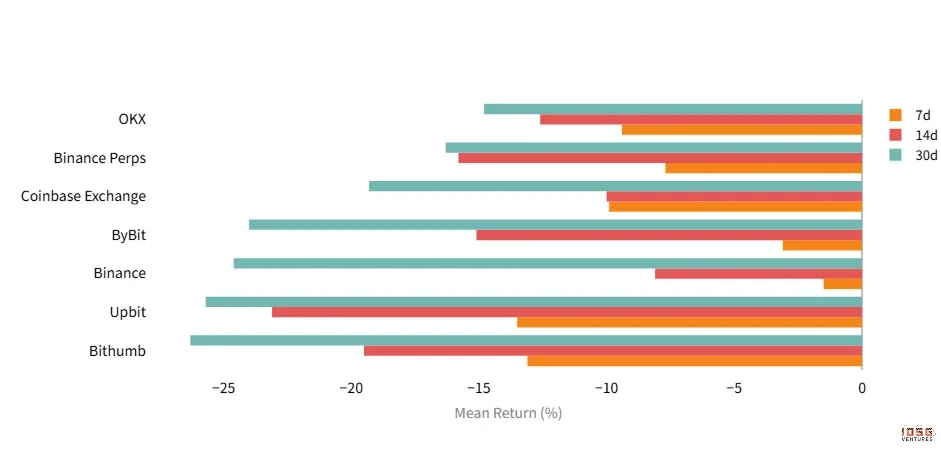
▲ Mean Return by Exchange 7d/14d/30d
In the bear market environment of 2026, the price performance of newly listed tokens is generally weak. No exchange shows a positive 30-day average return.
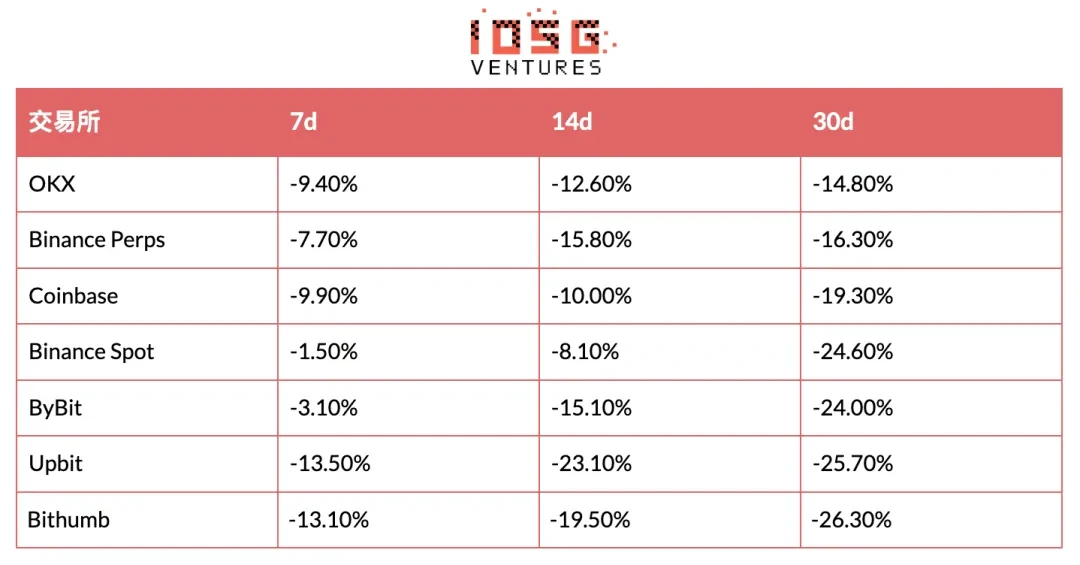
From the 7d to 30d period, the decline deepens progressively, indicating that the post-listing price drop is not a short-term fluctuation but a sustained downward trend. In the current market environment, new listings act more as liquidity unlocking events – providing an exit window for early holders (including projects, investment institutions, and early traders) rather than attracting continuous inflow of new capital.
The performance of the two Korean exchanges is particularly noteworthy: Upbit's 7d return is already -13.5%, reaching -25.7% at 30d. Combined with its Price Position of +27.4%, this means Upbit users not only entered at the highest price but also suffered the deepest decline.
Peak Price Performance Along the Listing Path
Although the final returns after 30 days are generally negative, the short-term rebound highs (Peak Return) after listing show a completely different distribution structure. Dissecting the price performance data of tokens reveals that the listing sequence directly determines the upper limit of short-term speculative space.
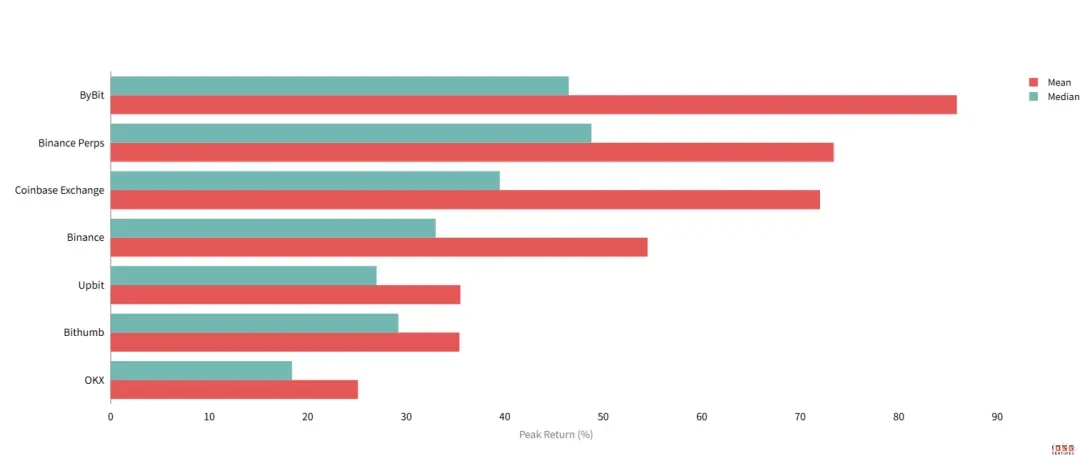
▲ Peak Return by Exchange (14d High)
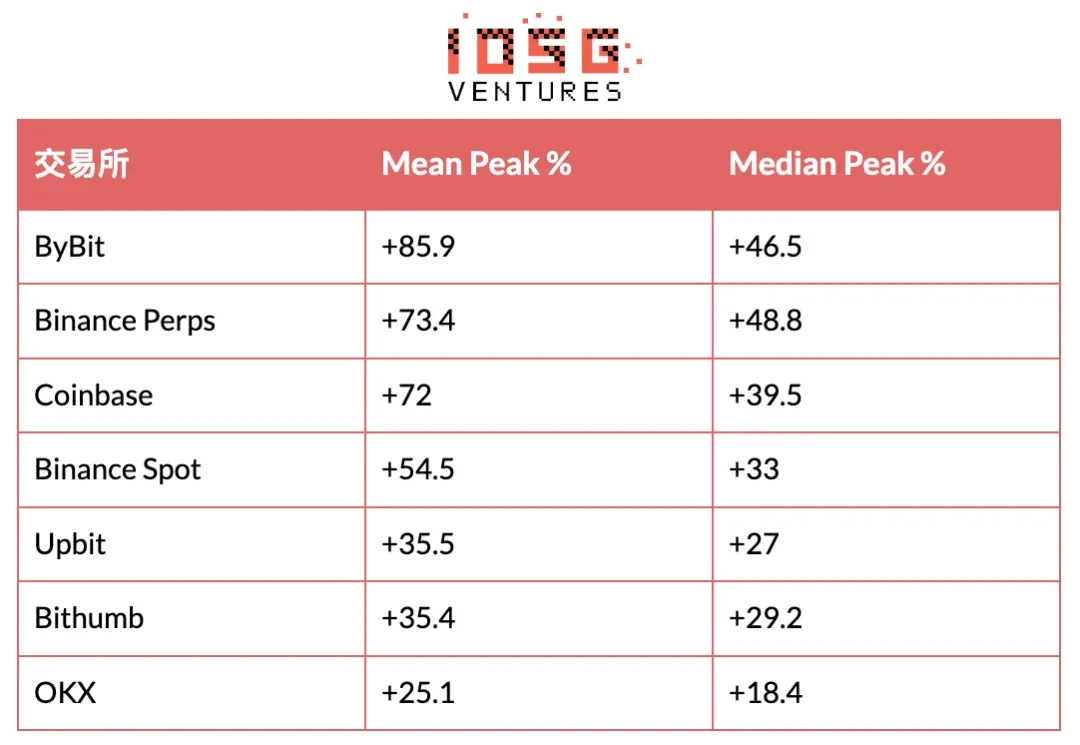
The pioneer exchanges hold an absolute advantage: ByBit's average peak return is as high as +86%, and Binance Perps' median is the highest at +49%. The first tier of listings (ByBit, Coinbase, Binance Perps) captures the highest price elasticity, providing significant liquidity premiums for early chips. Even if the price subsequently plummets, there is ample time to exit at the peak.
Late followers have limited space: Bithumb and Upbit's peak returns are capped around +35%, while OKX's is only +25%. Due to their delayed entry timing, the buy orders on these platforms are more about absorbing profit-taking from earlier participants rather than initiating upward trends.
This difference confirms the transmission path of liquidity: Pioneer exchanges undertake the primary price discovery function, offering the best exit liquidity for early holders. Over time, the buy orders on subsequent exchanges are more about absorbing already realized gains, leading to diminishing marginal utility. For traders, this means the later in the listing cycle one enters, the lower the probability of capturing excess returns.
Exchange Choice Determines the Risk-Reward Structure
Combining the three indicators – Price Position (entry point), Peak Return (upside potential), and Mean Return (final outcome) – the users of different exchanges face entirely different risk-reward structures.
Users of pioneer exchanges (Coinbase/ByBit), while still facing negative returns, have the best risk buffer. With the lowest entry prices (-10% to -5.9%) and the highest market-wide peak potential (average >+70%), even if they fail to perfectly time the exit, the absolute loss relative to the listing price is relatively controllable. They even have a decent chance to take profits


