




CertiK Completes Independent Verification of GL1 Self-Assessment Statements, Providing Technical Reference for Financial Institutions Evaluating Underlying Networks


- Core Viewpoint: CertiK has completed an independent technical verification of the self-assessment statements made by the XRP Ledger Foundation and Partior under the "Architecture" and "Resilience" principles of the GL1 Market Infrastructure Toolkit, providing financial institutions with a verifiable source of technical evidence for evaluating underlying networks.
- Key Elements:
- The GL1 Toolkit is guided by international standards and industry best practices, providing a common control framework for assessing the suitability of digital financial infrastructure.
- GL1 is a multilateral initiative jointly participated in by global financial institutions and policymakers; the next phase will be advanced by GL1 Org, established in Singapore by HSBC, JPMorgan Kinexys, MUFG, Societe Generale-FORGE, and Standard Chartered.
- CertiK reviewed all 112 control measures in the Toolkit and selected those suitable for independent technical verification.
- The verification combines evidence such as code, system configurations, logs, and test results to check actual implementation against operators' self-assessment statements.
- This work enhances the transparency of self-assessment statements and provides more concrete technical basis for financial institutions' infrastructure assessments.
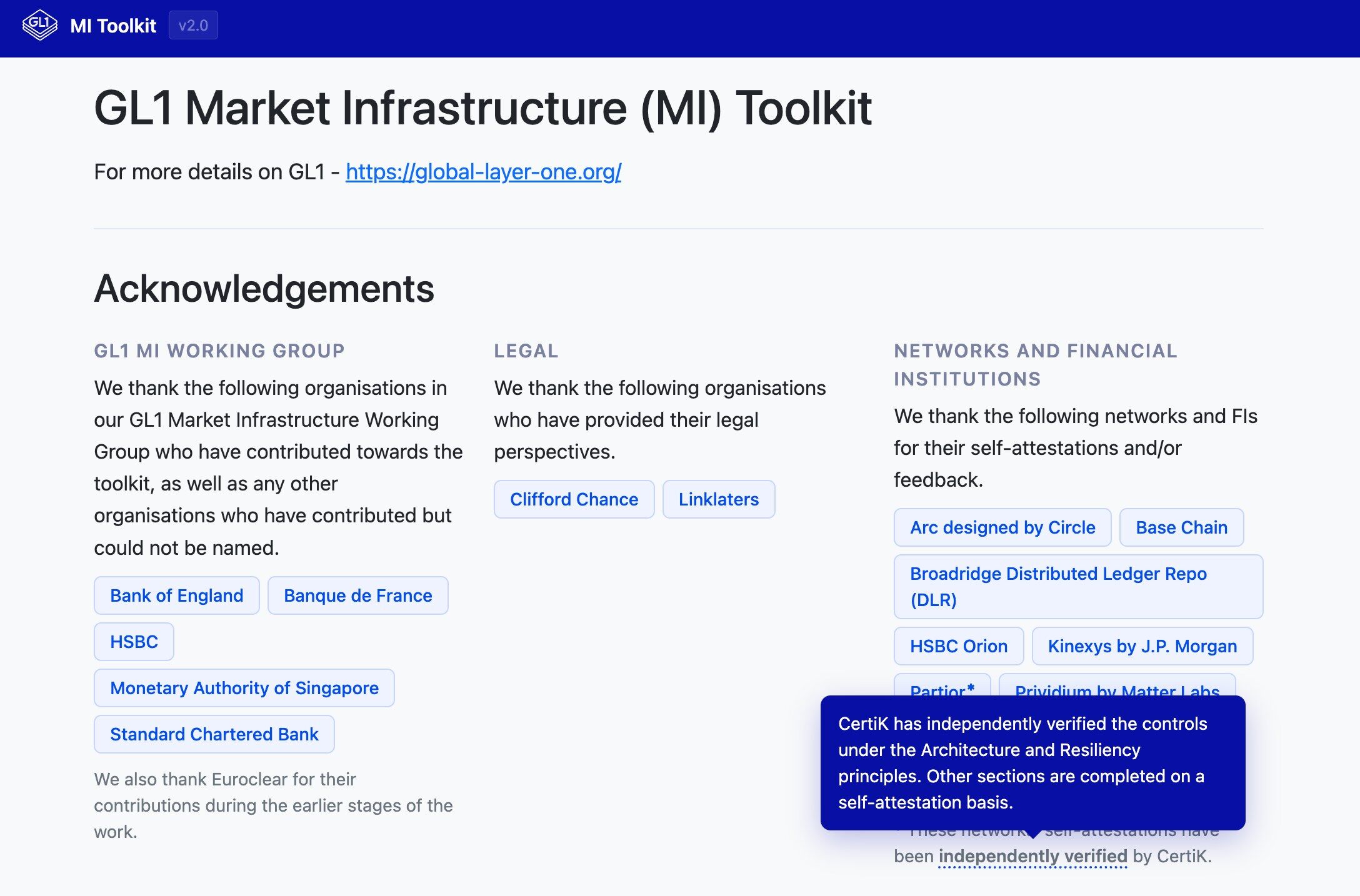
Recently, CertiK completed an independent technical verification of the self-assessment statements made by the XRP Ledger Foundation and Partior under the "Architecture" and "Resilience" principles of the Global Layer One (GL1) Market Infrastructure Toolkit (MI Toolkit), providing financial institutions with an additional technical reference for evaluating the underlying networks involved.
The GL1 Market Infrastructure Toolkit is guided by international standards and industry best practices, providing a common control framework to help market participants assess the suitability of digital financial infrastructure. The toolkit was developed under the GL1 framework, a multilateral initiative involving global financial institutions and policymakers.
On this basis, the next phase of related work is being advanced by the Global Layer One Organisation (GL1 Org). The organization was jointly established in Singapore by HSBC, JPMorgan's Kinexys, MUFG Bank, Societe Generale-FORGE, and Standard Chartered Bank, and is an industry-led non-profit organization.
Network operators use self-assessment statements to describe the implementation of the toolkit's related controls. The focus of CertiK's verification this time was to assess, in conjunction with technical evidence, whether the relevant controls have been implemented in the manner stated.
To develop the verification methodology, CertiK first reviewed all 112 controls in the toolkit and screened out those suitable for independent technical verification. The team then combined supporting evidence such as code, system configurations, logs, and test results to verify the actual implementation of the relevant controls against the self-assessment statements made by the network operators under the "Architecture" and "Resilience" principles.
For financial institutions considering adopting the relevant networks, this work adds a source of evidence for evaluation, helping them gain a more concrete understanding of how the underlying infrastructure operates and determine whether the relevant controls meet their own requirements. For network operators, independent technical verification also helps improve the transparency of self-assessment statements, allowing the relevant claims to be supported by technical evidence.
"Institutions developing and expanding tokenized asset businesses need to understand how the controls supporting their infrastructure are implemented," said Esme Pau, Head of Capital Markets and Policy at CertiK. "Independent technical verification can help operators support their self-assessment statements with evidence, and also give financial institutions more concrete technical grounds for reference when conducting their own infrastructure assessments."