


Alphabet (GOOGL) Q3 2026 Earnings: Google Cloud Revenue Doubles, Free Cash Flow Turns Negative


Alphabet released its Q3 2026 earnings report on October 28, with revenue reaching $127.58 billion, up 25% year-over-year, including Google Cloud revenue more than doubling to $30.71 billion.
Diluted earnings per share (EPS) fell from $2.87 in the same period last year to $2.12. As capital expenditures more than doubled to $51.36 billion, free cash flow turned negative, recording -$9.07 billion.
According to Reuters, Alphabet shares fell about 10% in after-hours trading. Investors are weighing slower search business growth and the high costs required for AI infrastructure buildout.
On MEXC, the GOOGLUSDT perpetual contract fell 8.7% in the first hour after the earnings release, and by 9:00 PM ET, the decline reached 9.1%.
Key Takeaways
- Revenue: $127.58 billion, up 25% year-over-year, slightly below LSEG's estimate of $128.2 billion.
- Google Cloud: Revenue grew 103% to $30.71 billion; operating margin rose from 23.7% to 36.2%; remaining performance obligations reached $561 billion.
- Search and Advertising: Google Search & other revenue grew 12% to $63.35 billion; total advertising revenue was $82.01 billion, below market expectations of $83.4 billion.
- Cash Flow: Q3 capital expenditures reached $51.36 billion, free cash flow was -$9.07 billion; Alphabet did not repurchase any shares this quarter.
- Outlook: Full-year 2026 capital expenditure guidance maintained at $195 billion to $205 billion, and the company stated that 2027 capital expenditures will increase significantly.
- MEXC Market: GOOGLUSDT fell from 326.03 USDT to 297.81 USDT in the first hour after the earnings release, with trading volume 84 times that of the same period the previous day.
Alphabet Q3 2026 Earnings Key Data
The following company financial data all come from Alphabet's Q3 2026 earnings announcement.
- Revenue: $127.58 billion, up 25% year-over-year; also up 25% at constant currency, marking the 13th consecutive quarter of double-digit growth.
- Operating income: $40.58 billion, up 30% year-over-year, with an operating margin of 31.8%.
- Net income: $26.17 billion, down 25% year-over-year.
- Diluted EPS: $2.12, compared with $2.87 in the same period last year.
- Capital expenditures: $51.36 billion, compared with $23.95 billion in the same period last year.
- Dividend: $0.22 per share, payable on December 14, with a record date of December 7.
Why Did Alphabet's Revenue Grow 25% but EPS Decline?
Alphabet's EPS decline was mainly due to $8.66 billion in losses on equity securities investments, rather than weakness in core operating businesses.
This loss turned other income into an $8.22 billion expense, compared with $12.76 billion in gains recorded in the same period last year.
Alphabet said the loss reduced net income by $6.7 billion and lowered diluted EPS by $0.55.
Adding back this impact, adjusted EPS was $2.67, still below analysts' estimate of $3.02. This means that even excluding investment losses, Alphabet's earnings still fell short of market expectations.
Operating costs also rose rapidly. Losses in Alphabet's group-level businesses widened from $4.47 billion to $7.66 billion, while Other Bets lost $2.05 billion.
Google Cloud Revenue Doubles, Search Business Growth Slows
Google Cloud was the most prominent growth driver this quarter. Revenue grew 103% year-over-year to $30.71 billion, further accelerating from 82% growth in the second quarter, while operating income tripled to $11.12 billion.
According to Reuters, Google Cloud head Thomas Kurian said on the earnings call that sales of Google's self-developed TPU chips have become an important revenue source. Alphabet also disclosed that Google Cloud's remaining performance obligations reached $561 billion, of which more than 55% is expected to be recognized as revenue within the next 24 months.
This growth rate also exceeded the roughly 92% market expectation threshold we previously outlined in our Alphabet Q3 2026 earnings preview.
By comparison, the advertising business grew more slowly.
- Google Search & other: $63.35 billion, up 12% year-over-year.
- YouTube ads: $11.21 billion, up 9% year-over-year.
- Google Network: $7.46 billion, up 1% year-over-year.
- Subscriptions, platforms, and devices: $14.29 billion, up 11% year-over-year.
Total advertising revenue was $82.01 billion, below analysts' expectations of $83.4 billion.
This gap matters because the search business still contributes most of Alphabet's profit. Google Services operating income this quarter was $39.16 billion, while Google Cloud was $11.12 billion.
AI usage continued to grow. CEO Sundar Pichai said the Gemini app has reached 1 billion users, up from 950 million monthly active users in the second quarter. In addition, Google's self-developed models currently process nearly 32 billion tokens per minute through APIs.
AI Spending Continues to Rise, Free Cash Flow Turns Negative
Alphabet's Q3 capital expenditures rose 14% from $44.92 billion in the second quarter and more than doubled year-over-year.
Cash flow from operating activities fell to $42.29 billion, turning free cash flow to -$9.07 billion, a larger shortfall than the -$5.86 billion in the second quarter.
According to Reuters, analysts had originally expected free cash flow to be close to break-even.
Alphabet did not repurchase any shares this quarter, compared with $11.5 billion in buybacks in the same period last year.
The company also raised funds through capital markets: it sold $4.3 billion of Class A shares and $8.1 billion of Class C shares through an at-the-market (ATM) offering, and obtained $28.7 billion in net financing through senior note issuance.
Despite massive capital expenditures, Alphabet still held $265.1 billion in cash and marketable securities at the end of September.
How Does Alphabet View 2026 and 2027 Capital Expenditures?
CFO Anat Ashkenazi maintained 2026 capital expenditure guidance at $195 billion to $205 billion, consistent with the range provided in the second quarter.
She said 2027 capital expenditures will increase significantly but did not provide a specific figure, while warning that building TPU chip inventory will further pressure free cash flow.
For investors, the core issue now is the timing gap: $561 billion in remaining performance obligations indicates strong demand, but the related cash outlays will occur before revenue recognition.
How Did GOOGL Contracts on MEXC React After the Earnings Release?
After Alphabet's earnings release, MEXC's GOOGLUSDT perpetual contract fell in tandem with the underlying stock and continued trading after the U.S. market close.
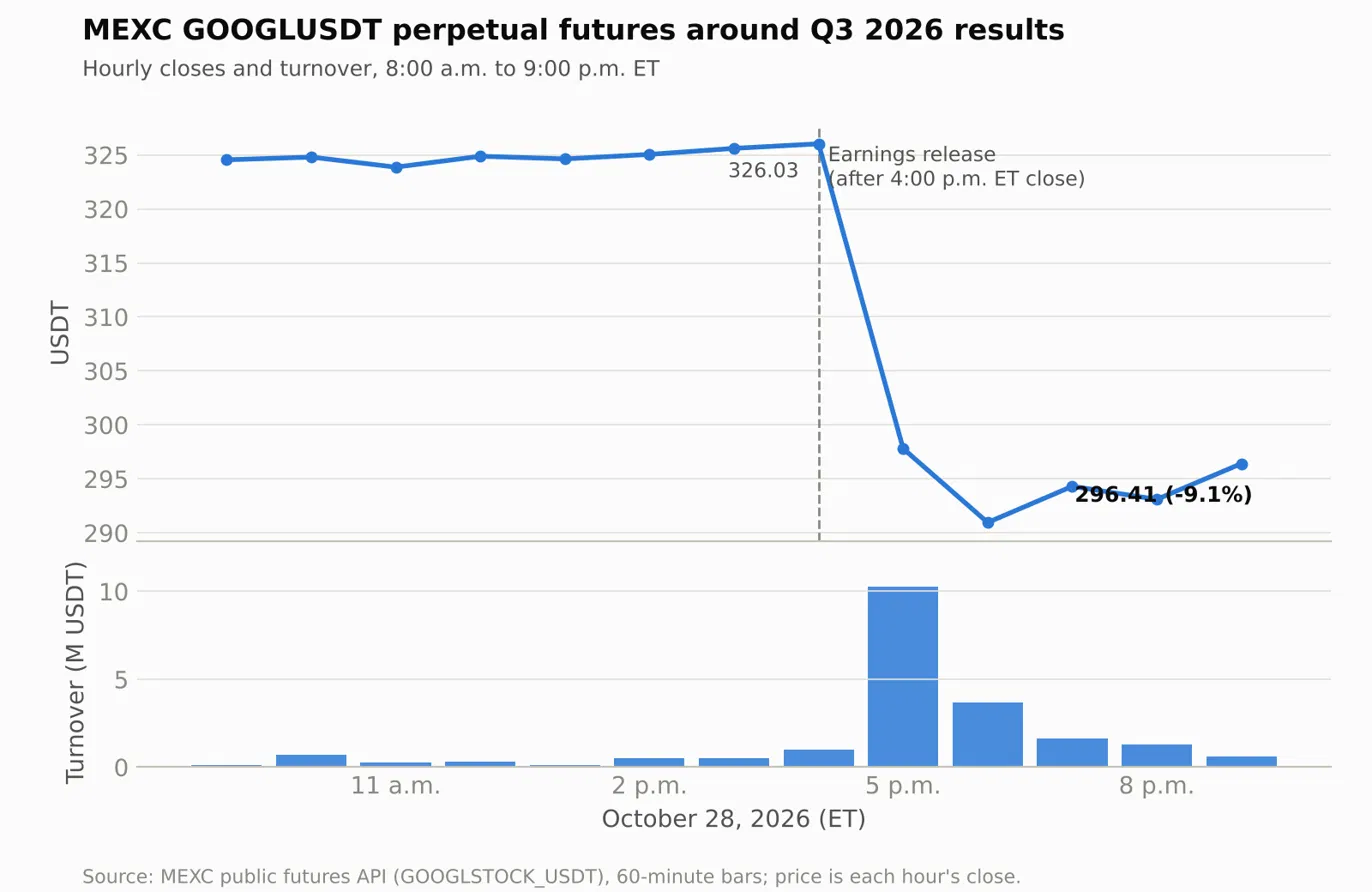
Hourly closing prices and trading volume of MEXC GOOGLUSDT from 8:00 AM to 9:00 PM ET on October 28, 2026. Source: MEXC.
Price: GOOGLUSDT's hourly candle from 3:00 PM to 4:00 PM ET closed at 326.03 USDT, then fell to 297.81 USDT by 5:00 PM, a decline of 8.66%. During the 5:00 PM to 6:00 PM period, the price briefly touched 288.24 USDT, with a maximum decline of 11.6%. By 9:00 PM, the contract price was 296.41 USDT, down 9.09%.
Trading activity: Trading volume in the first hour after the earnings release was approximately 10.26 million USDT, 84 times that of the same period the previous day and 47.5 times the average hourly volume over the prior 24 hours. Trading volume in the five hours after the U.S. market close was approximately 17.41 million USDT, about five times the 3.38 million USDT traded between 9:00 AM and 4:00 PM ET.
Premium to index price: The gap between hourly closing prices and the index price remained within about 10 basis points, indicating that the contract decline mainly followed changes in the underlying stock price rather than additional pressure unique to the contract market.
Funding rate: GOOGLUSDT settles funding every eight hours. The first settlement after the earnings release occurred at 00:00 UTC on October 29, with a funding rate of 0.0666%, higher than 0.0143% before the earnings release and the highest among the past eight settlements. A positive funding rate means long position holders need to pay funding costs; it does not represent the number of bullish traders.
Frequently Asked Questions (FAQ)
Did Alphabet's Q3 2026 earnings beat expectations?
No. Revenue was $127.58 billion, slightly below LSEG's estimate of $128.2 billion; adjusted EPS was $2.67, below the expected $3.02. However, Google Cloud outperformed expectations, with revenue growing 103%.
Why did Alphabet's stock fall after its Q3 2026 earnings release?
Alphabet shares fell about 10% in after-hours trading, mainly because search business growth slowed to 12%, advertising revenue fell short of expectations, free cash flow turned negative at -$9.07 billion, and the company signaled that 2027 capital expenditures will increase significantly.
How much did Google Cloud grow in Q3 2026?
Google Cloud revenue grew 103% to $30.71 billion, operating income rose to $11.12 billion, and operating margin was 36.2%. Remaining performance obligations reached $561 billion.
What is Alphabet's capital expenditure guidance?
Alphabet expects 2026 capital expenditures of $195 billion to $205 billion and said 2027 capital expenditures will increase significantly, but did not provide a specific amount.
Why was Alphabet's EPS lower than the same period last year?
$8.66 billion in losses on equity securities investments reduced diluted EPS by $0.55. Reported EPS this quarter was $2.12, down from $2.87 in Q3 2025.





