


An In-Depth Analysis of Meta's $95 Billion Financing Plan: The Shareholder Interest Game Behind Capital Operations


Overview
Meta's financing plan, priced on October 26, 2026, consists of three parts with a total size of up to approximately $95 billion, but the cash arrival times for these three parts differ by more than a year, and the largest portion has not even had an agreement signed yet.
The two priced components total approximately $37.5 billion. One is $12.5 billion of 6.50% Series A mandatory convertible preferred stock, issued as 250 million depositary shares at $50 per share, with funds arriving upon settlement on October 29. The other is $25 billion of Class A common stock, issued at $625 per share for a total of 40 million shares, but structured as a forward sale agreement, meaning Meta receives no funds at the initial sale and will only receive approximately $24.9 billion on a settlement date of its own choosing, no later than November 19, 2027.
The third part is an at-the-market offering program of up to $60 billion of Class C shares, expected to launch no earlier than Q1 2027 and only after Class C shares begin trading. No agreements have been entered into for this program; the timing, size, and terms are all undetermined, and it was not mentioned at all in the pricing announcement.
Therefore, within the headline figure of $95 billion, only approximately $12.5 billion actually arrived in October 2026, representing about 13%. Meanwhile, Meta's capital expenditures alone in Q3 2026 reached $34.91 billion, exceeding its operating cash flow of $32.786 billion for the same period for the first time. This article breaks down the terms of the three instruments, the cash arrival cadence, and each dilution path based on the original documents.

Key Points
The cash arrival times for the three parts are completely different. The approximately $12.5 billion of preferred stock settles and arrives on October 29; the approximately $24.9 billion from the forward sale arrives no later than November 19, 2027; the $60 billion ATM has no agreement yet.
The mandatory convertible preferred stock carries a dividend rate of 6.50%. Based on a liquidation preference of $1,000 per share, dividends are payable quarterly from February 15, 2027 through August 15, 2029, in cash, Class A common stock, or a combination of both.
The conversion number is a range rather than a fixed figure. Each share of preferred stock converts into 1.3620 to 1.6000 shares of Class A common stock, depending on the volume-weighted average price over the twenty trading days preceding conversion in 2029.
The degree of dilution is inversely correlated with the stock price. Based on the contract terms, when the stock price is below $625, the highest conversion rate applies and the most shares are issued; when above approximately $734.21, the lowest conversion rate applies and the fewest shares are issued.
Dilution from the priced portion is approximately 2.2% to 2.7%. Calculated on the base of 2.556 billion shares as of September 30, including the scenario where the over-allotment options are exercised in full.
Q3 capital expenditures exceeded operating cash flow for the first time. $34.91 billion versus $32.786 billion, with free cash flow at negative $2.12 billion, compared to positive approximately $10.6 billion in the same period last year.
The subscription intentions of Nvidia, AMD, and Broadcom are non-binding. The three companies collectively indicated interest in subscribing to up to $5 billion of Class A shares on the same terms as other investors, but they may buy more, less, or not at all.
What Are the Three Financing Instruments
The three instruments differ in legal nature, cash arrival timing, and dilution mechanism; viewing them together will lead to erroneous conclusions.

Mandatory Convertible Preferred Stock
This component involves the issuance of 250 million depositary shares, each priced at $50, with each depositary share representing a 1/20th interest in one share of 6.50% Series A mandatory convertible preferred stock, which carries a liquidation preference of $1,000 per share. The underwriters have a thirty-day over-allotment option to purchase up to an additional 37.5 million depositary shares. Net proceeds are expected to be approximately $12.5 billion, or approximately $14.3 billion if the option is exercised in full.
The dividend rate is 6.50% per annum, calculated on the $1,000 per share liquidation preference, payable from February 15, 2027 on February 15, May 15, August 15, and November 15 of each year through August 15, 2029, when and as declared by the board of directors. Dividends may be paid in cash, Class A common stock, or a combination of both, subject to certain limitations.
The mandatory conversion date is expected to be on or around August 15, 2029. Each share of preferred stock converts into 1.3620 to 1.6000 shares of Class A common stock, corresponding to 0.0681 to 0.0800 shares per depositary share. The specific conversion rate depends on the volume-weighted average price of Class A shares over the twenty trading days beginning on the twenty-first scheduled trading day prior to August 15, 2029. The preferred stock has applied to list on the Nasdaq Global Select Market under the symbol METAM; there is currently no public trading market.
The documents also state that following the issuance of Class C common stock and satisfaction of other conditions, the conversion may be changed to Class C shares, subject to the same minimum and maximum conversion rate range.
Class A Common Stock Under Forward Sale Agreements
This component was upsized from $22.5 billion to $25 billion at pricing, at $625 per share, corresponding to 40 million shares of Class A common stock; or 46 million shares if the underwriters' thirty-day option is exercised in full and additional forward agreements are entered into. The over-allotment option is capped at an additional $3.75 billion of Class A shares.
The key lies in the structure. The forward purchasers are Morgan Stanley Capital Services LLC and Goldman Sachs & Co. LLC, with an initial forward price of approximately $622.92 per share. Meta does not expect to receive proceeds from the initial sale of shares by the forward purchasers; instead, it will receive funds on one or more settlement dates of its own choosing, no later than November 19, 2027, at which point it expects to receive approximately $24.9 billion (before fees), or approximately $28.7 billion if the option is exercised in full.
The implication of this structure is that the economic effect of the shares is established through the market on the pricing date, but the company's cash inflow and the formal issuance of shares are both deferred to a future point in time chosen by the company. The documents also state that following the issuance of Class C common stock and satisfaction of other conditions, these agreements will involve both classes of stock, and under certain circumstances Meta may settle entirely in Class C shares.
Class C Shares At-the-Market Offering Program
This is the largest and most uncertain of the three, with a cap of $60 billion, targeting non-voting Class C shares.
The program is expected to launch no earlier than Q1 2027 and must occur after Class C shares begin trading. As of the date of verification for this article, no agreements have been entered into; the timing, size, and terms are all undetermined. It should be specifically noted that the October 26 pricing announcement did not mention this program at all; it comes from the financing framework disclosed at the same time rather than from priced documents.
There is also a dependency chain for this program. According to a previously compiled explanation of Meta's Class C shares and voting rights, January 19, 2027 is the expected effective date of the charter amendment in Delaware, not the date of completion of the stock split or the commencement of trading of Class C shares; the record date and distribution date for the stock dividend have not yet been announced, nor have the ticker symbol and listing date for Class C shares. The launch timing of the ATM program depends on Class C shares beginning trading, and the latter itself has no confirmed date.
It is also worth noting that the article was published on October 22, when the CFO stated that there was no specific financing plan to announce. The framework announced five days later provided an intended size, but the three questions of "whether, when, and how many Class C shares to issue for financing" remain unanswered until agreements are signed.
When the Money Arrives
By arranging the arrival times of the three components on a timeline, the gap between the headline figure and actual funds becomes apparent.

Under this cadence, the $95 billion figure corresponds to actual cash of approximately $12.5 billion in October 2026, or about 13%. Even if the full $37.5 billion of the priced portion arrives, it will not be until some point before November 2027.
Both offerings are expected to settle on October 29 and are not conditioned on each other's completion. The underwriting syndicate is led by Morgan Stanley and Goldman Sachs as joint book-running managers, with Allen & Company, BDT & MSD, Centerview Partners, Jefferies, Lazard, and The Raine Group as co-managers. The proceeds are for general corporate purposes, and the future settlement proceeds from the forward sale agreements will also be used for general corporate purposes.
Nvidia, AMD, and Broadcom have indicated interest in subscribing to up to a total of $5 billion of Class A shares on the same terms as other investors, but this intention is non-binding, and the three companies may subscribe for more, less, or none at all. This arrangement is worth noting separately because these three companies are simultaneously major suppliers of Meta's artificial intelligence infrastructure.
How Much Dilution Will There Be
According to the S-1 supplement, as of September 30, 2026, Meta had 2.214 billion shares of Class A common stock and 342 million shares of Class B common stock outstanding, totaling 2.556 billion shares. Not included are 154 million Class A shares subject to restricted stock units or options, and 445 million shares reserved under equity incentive plans.
Based on 2.556 billion shares, the calculations for each dilution path are as follows. The percentages below are calculations made in this article based on public terms, not figures provided in the documents.
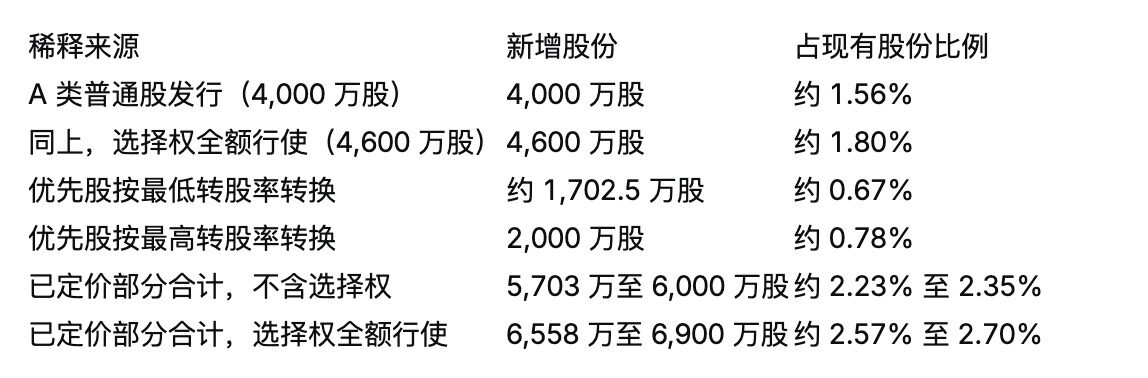
The $60 billion ATM program cannot be precisely calculated because the issuance price and timing are undetermined. As an order-of-magnitude illustration only, if calculated at this offering's price of $625, $60 billion would correspond to approximately 96 million shares, or about 3.76% of existing shares, meaning that a program not yet under contract has a potential dilution exceeding the combined total of all instruments in the priced $37.5 billion portion. If all three are realized, the total would be approximately 6.0% to 6.5%, but this figure depends on multiple undetermined conditions and should not be treated as a forecast.
An Easily Overlooked Mechanism: Dilution Is Inversely Correlated with Stock Price
The conversion rate of the mandatory convertible preferred stock is a range rather than a fixed value, which means the final number of shares issued depends on the stock price in 2029, and in a direction contrary to intuition.
Two key prices can be derived from the liquidation preference and the conversion rate range. The price corresponding to the maximum conversion rate of 1.6000 is $1,000 divided by 1.6000, or $625.00, which is exactly equal to this offering's Class A common stock issue price. The price corresponding to the minimum conversion rate of 1.3620 is $1,000 divided by 1.3620, or approximately $734.21, which is about 17.5% higher than $625. These two figures are derived from the terms; the pricing announcement did not list them directly.
Three scenarios emerge. If the stock price at conversion in 2029 is below $625.00, the maximum conversion rate of 1.6000 applies, the most shares are issued, and holders bear the full decline in stock price. If the stock price is between $625.00 and approximately $734.21, the conversion rate floats, and the conversion value received by holders is relatively fixed. If the stock price is above approximately $734.21, the minimum conversion rate of 1.3620 applies, the fewest shares are issued, and holders participate only in the appreciation above that threshold.
For existing shareholders, the implication of this structure is that the most severe dilution scenario occurs precisely when the stock price performs worst. This is fundamentally different from a common stock offering, where the number of shares is fixed at issuance.
There is also a secondary source of dilution. Preferred stock dividends may be paid in Class A common stock; if the company chooses to pay in shares, the 6.50% annual dividend would add additional shares each year. Based on a $12.5 billion size, 6.50% corresponds to approximately $810 million per year, from February 2027 through August 2029, a total of eleven quarters. Whether and how much is actually paid in shares depends on the board's decision at the time.
Why Raise Now: Capital Expenditures and Cash Flow
The scale of financing only becomes meaningful when placed alongside the scale of spending.
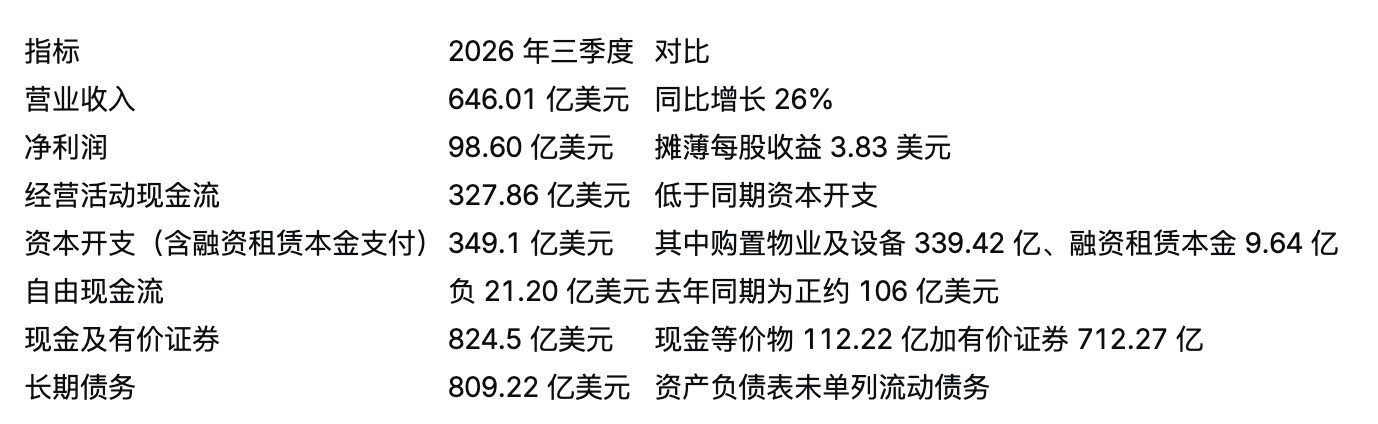
Q3 was the first time capital expenditures exceeded operating cash flow for the same period, with a gap of $2.124 billion, corresponding to negative free cash flow of $2.120 billion. Capital expenditures in the same period last year were approximately $19.4 billion, a year-over-year increase of approximately 80%; cumulative capital expenditures for the first three quarters were $85.8 billion, compared to $50.1 billion in the same period last year, an increase of approximately 71%.
The full-year 2026 capital expenditure guidance is $135 billion to $145 billion, including finance lease principal payments, a range narrowed from the previous $130 billion to $145 billion. Based on this, Q4 standalone capital expenditures are estimated at approximately $49.2 billion to $59.2 billion.
This estimate provides a scale for measuring the size of this financing. At the implied Q4 standalone spending level, the total financing of up to $95 billion roughly equates to one and a half to two quarters of capital expenditures, while the approximately $12.5 billion actually received in October 2026 is less than forty percent of Q3 standalone spending.
It should be noted that the company has not yet provided a 2027 capital expenditure figure, stating only that it will continue to invest aggressively in 2027, and provided an estimated loss of approximately $15 billion for Reality Labs in 2027. Q4 revenue guidance is $73 billion to $76 billion.
The capital expenditure methodology is important here. Meta's guidance and disclosures both use the "including finance lease principal payments" methodology, and its free cash flow calculation deducts both purchases of property and equipment and finance lease principal. Compared to the methodology that only counts purchases of property and equipment, the former was $964 million higher in Q3. If methodologies are inconsistent when comparing across companies or periods, conclusions will be skewed.
Regarding the broader pattern of financing AI infrastructure with equity and structured instruments, a previous analysis of CoreWeave's financing structure can serve as a comparison for similar structures.
Terms to Track Going Forward
The following matters were undetermined as of the verification date of this article, October 27, 2026, and are key variables for judging the final dilution.
The exercise of the two over-allotment options, both with thirty-day terms. The cap for the preferred stock portion is 37.5 million depositary shares, and the cap for the common stock portion is $3.75 billion; whether they are exercised would push dilution from the priced portion from approximately 2.23% to approximately 2.70%.
The actual settlement timing and price adjustments of the forward sale agreements. The settlement date is designated by Meta at its discretion, no later than November 19, 2027, and the forward price is subject to adjustment provisions in the agreements, so the final amount received may differ from the estimated approximately $24.9 billion.
The commencement date of trading for Class C shares, and the record date and distribution date for the stock dividend. None of these three have been announced, and the launch timing of the ATM program depends on the trading date among them.
The signing of agreements, final size, and pricing mechanism for the ATM program. The program currently has only an intended size of up to $60 billion, no agreements, and did not appear in the pricing announcement.
The actual subscription amounts from Nvidia, AMD, and Broadcom





