


No token selling allowed, recovery takes 526 days, no one is playing PaperTrade anymore


- Core Viewpoint: Synthetic perpetual contract platform PaperTrade announced that its platform token PAPER will be non-transferable indefinitely, causing open interest to plunge and airdrop farming users to exit, exposing the token economic model's heavy reliance on speculative incentives and the challenges of PMF validation.
- Key Elements:
- PAPER remains non-transferable to prevent attackers from shorting and manipulating the price; Paragon and Aster suspended pre-market contracts, and Hyperliquid open positions were settled at $0.026296.
- After the announcement, BTC open interest fell 41% to $230 million, ETH dropped 55% to $66.3 million, the platform saw capital outflows of approximately 7%, and TVL remained at $58.3 million.
- Of 23,675 total accounts, only about 3,500 were profitable, accounting for 14%; among the top 25 on the loss leaderboard, 21 remained at a loss even after factoring in staking rewards.
- For every $1 lost, users receive only 10 PAPER; based on an average daily staking reward of $0.00019, the recovery period is extended to approximately 526 days.
- Officials adjusted the issuance curve so that for every $1 million in future losses, 0.1% of total supply in PAPER will be minted, gradually diluting the advantage of early whales.
- PAPER has no hard supply cap and continues to inflate, and once transfers open, accumulated selling pressure may trigger a chain reaction, weakening protocol revenue and staking yields.
Original | Odaily(@OdailyChina)
Author | Golem(@web 3_golem)
PAPER may have already become nothing more than an in-game currency within PaperTrade's single-player game.
This morning, PaperTrade, a synthetic perpetual contract platform featuring 1000x leverage and liquidation mining, dropped a bombshell on the market: its platform token PAPER will remain non-transferable, and the specific timetable for enabling transfers or secondary market trading has been indefinitely postponed. The reason given is to prevent attackers from shorting PAPER in conjunction with price manipulation to drain PaperTrade's fund pools.
Following the announcement, both Paragon and Aster immediately suspended PAPER pre-market perpetual contract trading, and all open positions on Hyperliquid were settled at $0.026296.
PaperTrade founder Jez subsequently posted on X responding to the controversy over PAPER's non-transferability, stating: "The PAPER malicious attack is currently an unresolved issue, and the team no longer has 6 months (the original schedule for the PAPER contract launch) to find an effective solution, so we were forced to make this decision."
At the same time, Jez confidently added: "Whether the token is transferable or not won't change whether a degen chooses to trade on PaperTrade long-term. Execution, website quality, mechanics, and trading economics are what determine that."
But Jez is clearly still too optimistic. According to official PaperTrade data, since PaperTrade published its announcement at 6:20 AM today, the platform's contract open interest has declined significantly. As of press time, BTC open interest has dropped from $390 million to $230 million, a decrease of 41%; ETH open interest has fallen from $150 million to $66.3 million, a decrease of 55%.
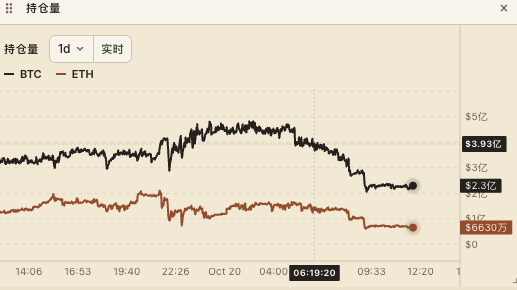
PaperTrade's platform funds have also seen a modest outflow. As of press time, approximately 7% of platform funds have flowed out, with TVL remaining at $58.3 million, down from an all-time peak of approximately $100 million.
Such data changes are sufficient to show that a large proportion of PaperTrade's users are not genuine traders, but airdrop farmers who trade in pairs to obtain PAPER tokens. These farmers are after PAPER staking yields and PAPER's future realizable value. When the official announcement declared that PAPER would not be open for transfer, it meant PAPER had no realizable value — essentially equivalent to PAPER going to zero.
PAPER Staking Yields Alone Are Insufficient to Cover Trading Losses
Why does PAPER's realizable value matter? The reason is that at the current stage, PAPER's staking rewards are not enough to cover trading losses.
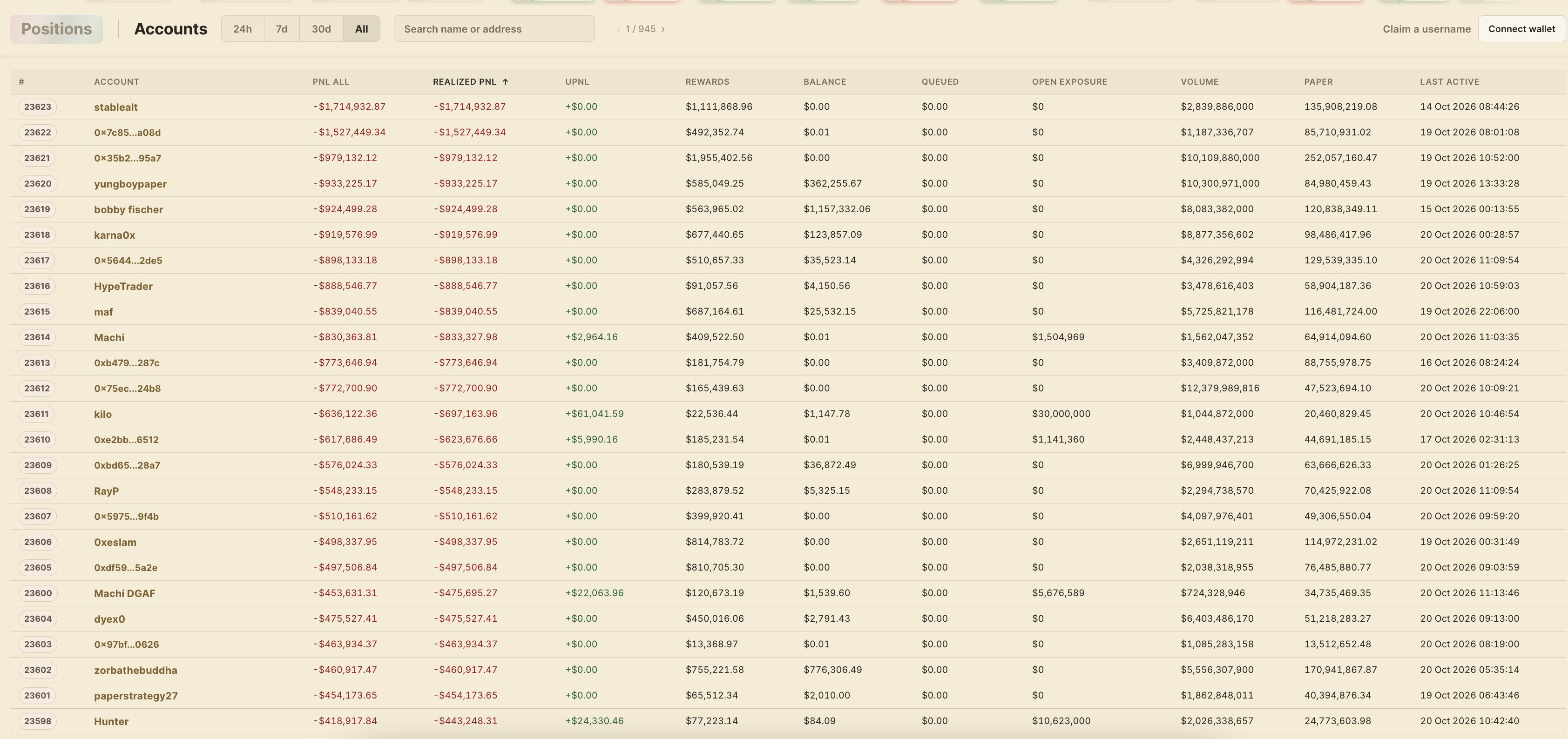
According to PaperTrade platform data, out of 23,675 total accounts, only about 3,500 are in profit — a mere 14%. The vast majority of traders are in the red.
Financial trading inherently follows the "80/20 rule" — traders who can profit in the market are always a minority. Some whales are still willing to lose hundreds of thousands to millions of dollars on PaperTrade because they want to obtain PAPER. They are not solely pursuing profits from contract trading itself, but rather PAPER's staking yields and future realizable value.
However, according to Lookonchain statistics, among the top 25 traders with the highest losses on PaperTrade, 21 remain in loss even after accounting for staking rewards, with only 4 being profitable overall. These traders have accumulated a total trading volume of $111.5 billion, received 2.06 billion PAPER tokens (23.4% of total supply), and claimed $11.61 million in USDC rewards (20.6% of total rewards).
Among them, "Maji Ge" (Brother Maji), ranked 10th on the loss leaderboard, has total losses of $833,000. He has cumulatively received 64.9 million PAPER airdrops, with PAPER staking rewards of approximately $410,000 — still leaving a net loss of $420,000 after offsetting.
Currently, the PAPER earned per $1 of loss has been reduced to 10 tokens. At the current daily staking reward rate ($0.00019 per token), the break-even period has been extended to approximately 526 days (if PAPER rewards were not reduced, the break-even period would be approximately 50 days).
Before PaperTrade announced that PAPER would not be open for transfer, these users still had incentive to participate. Even assuming Hyperliquid's final PAPER settlement price ($0.026296) represents PAPER's final spot price, Maji Ge's 64.9 million PAPER airdrop would be worth approximately $1.68 million, instantly turning his loss into a profit of over $1.2 million.
However, loss-making airdrop farmers who had hoped to slowly recover their losses through staking rewards now have no hope under the current PAPER distribution rules. (Odaily note: Because PaperTrade uses an asymmetric profit-and-loss mechanism, lossless volume farming is not possible. Related reading: Why Did You Get Farmed by PaperTrade?)
Ask yourself: if the token you hold has no market, no price, and no exit, and you can only rely on staking to earn yield (USDC dividends), would you still have the confidence to keep losing money?
One Piece of Good News: The Early Whale First-Mover Advantage Problem Is Being Addressed
Besides "PAPER not being open for transfer," today's PaperTrade announcement contains another piece of good news: PaperTrade is adjusting PAPER's issuance curve to address the problem of early whales having an excessive first-mover advantage.
According to the official explanation, in the future, for every $1 million in trader losses generated, PAPER equivalent to 0.1% of the total supply at that time will be minted (the exact ratio depends on the issuance rate at the time of the contract upgrade); when the protocol fund pool is below $2 million, PAPER will no longer be issued at a fixed 1:100 loss ratio, but instead will use a weighted multiplier that grows over time.
PaperTrade also stated that while these changes will have minimal impact on PAPER's issuance volume in the short term, in the long run they will gradually dilute the rights of older holders and give new users an advantage. Ultimately, the ideal state of the PAPER system is to be closer to an exchange rebate mechanism.
Previously, PaperTrade's mechanism of "token issuance efficiency continuously declining as protocol LP grows" was criticized by the market for creating a very obvious first-mover advantage. When bearing the same losses, early users received more PAPER than later participants, which in turn meant early users' PAPER staking rewards were always higher than those of later participants.
While such an issuance decay mechanism can effectively incentivize users to participate early, the excessive issuance disparity also has a clearly negative effect on the enthusiasm of later participants. Therefore, this adjustment to PAPER's issuance curve gives later-joining whales on PaperTrade the conditions to catch up with the first-mover advantage of early whales.
PMF Still Needs Validation
However, the problems facing PaperTrade go far beyond the two mentioned above (price manipulation attacks, PAPER issuance curve). There are also issues such as PAPER's token supply having no hard cap and PAPER's potential accumulated sell pressure.
PAPER's initial supply is 0, and the total token supply has no hard cap — meaning PAPER will continuously inflate and remain inflationary forever. The problem this creates is that even if the official team changes PAPER's issuance curve to alleviate the early whale first-mover advantage, as PAPER continues to inflate and staking volume continues to rise, the share of existing PAPER holders in total staked amount will inevitably be continuously diluted, reducing staking yields — and protocol revenue growth may not be able to keep up with this dilution rate.
Second, the longer PaperTrade delays opening PAPER token transfers and trading, the more "repressed" holders' desire to break even becomes — like a continuously compressed spring. When PAPER officially opens for transfer and trading, these holders will be more likely to sell their tokens directly to recover their costs, creating enormous sell pressure. This accumulating potential sell pressure will be a Sword of Damocles permanently hanging over PaperTrade's head.
This sell pressure will also trigger a chain reaction. Galaxy Research has previously pointed out that PAPER's market price will affect the scale of user mining activity, which in turn determines the protocol's long-term revenue. A decline in token price will lead to reduced user mining activity, potentially further weakening protocol revenue and staking yields.
PaperTrade founder Jez says PaperTrade's success depends on whether it ultimately achieves PMF. He believes PaperTrade is the fastest way to convert users' money into leveraged speculative exposure on any chain.
In short, PaperTrade is the ultimate on-chain playground designed for "degen gamblers," but its most attractive feature for users right now is staking yields and volume-farming mining. What users seem to care about more is "stable returns." If a casino tries to retain users by designing stable returns, will real gamblers show up? This is a question PaperTrade must reckon with.





