Global Payments Weekly 2026W38


- Key Takeaways: After the US CLARITY Act vote failed, regulatory certainty shifted to administrative paths including SEC exemptions, CFTC rule packages, and OCC trust charters; the stablecoin yield controversy and the shift toward fee-based real-time payments have become core industry tensions.
- Key Elements:
- Within two days of the CLARITY vote failure, the SEC, CFTC, and OCC each introduced alternative regulatory paths, with compliance certainty now derived from administrative documents rather than a single piece of legislation, raising the risk of reversibility.
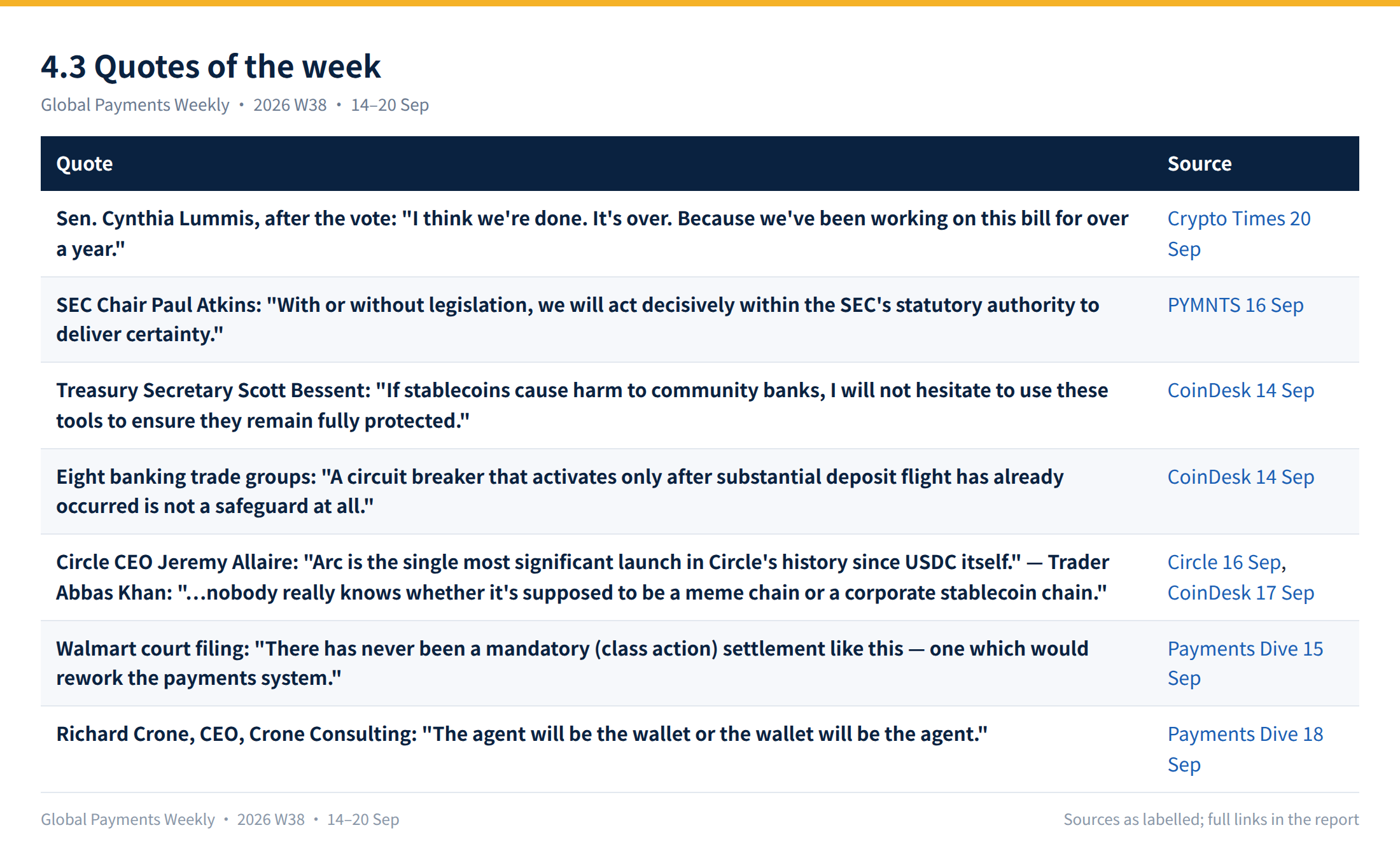
- Eight major bank trade groups warned that the stablecoin yield "circuit breaker" mechanism is ineffective; Treasury Secretary Bessent publicly stated he would use the tool, and rising interest rates are intensifying spread pressure between zero-yield stablecoins and money market funds.
- UPI ended the zero-MDR era with a 0.4% fee rate; 19 UK institutions jointly funded a domestic retail payment utility; BNP Paribas is advancing Wero merchant acceptance in five markets.
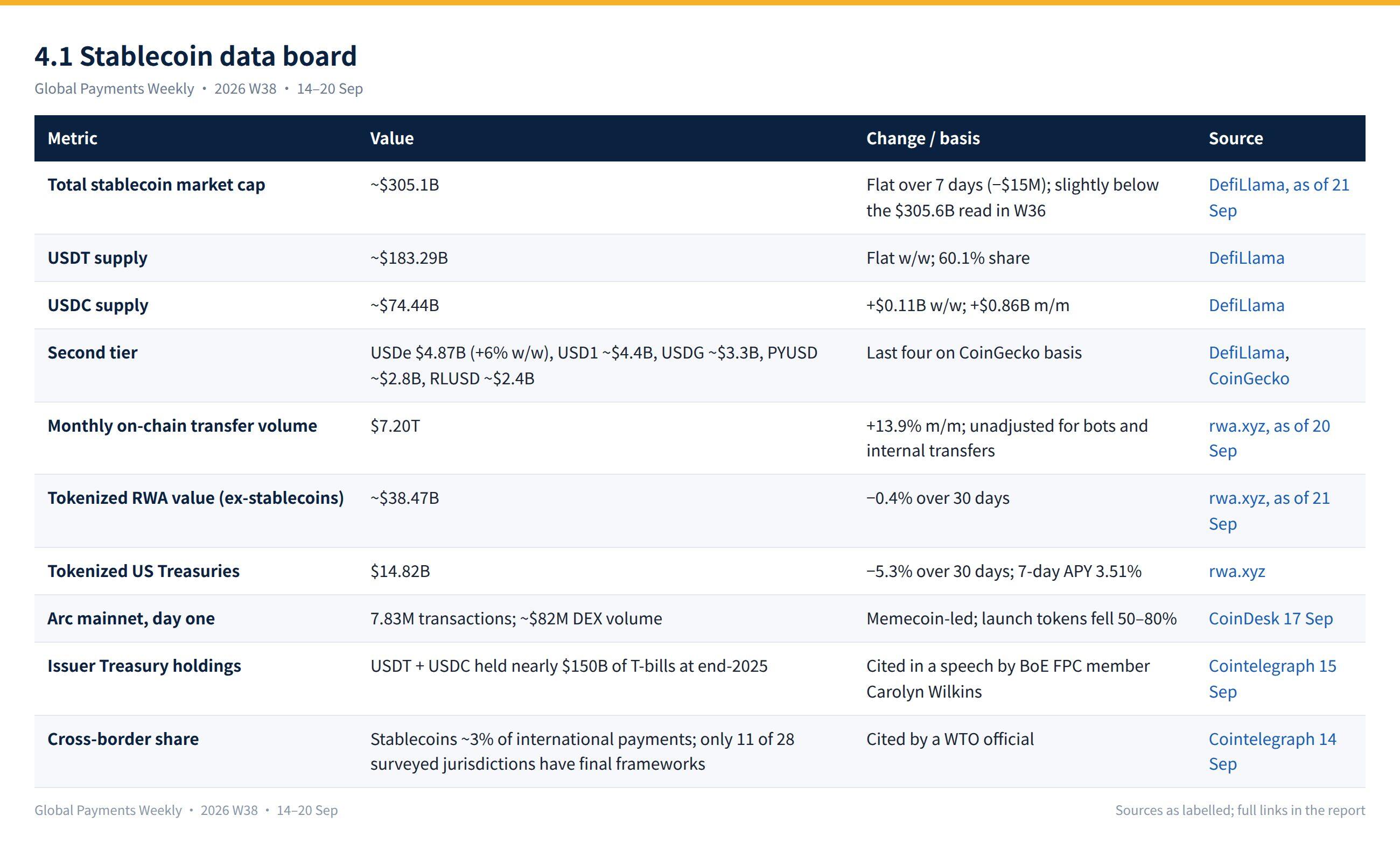
- Arc's mainnet launched with 7.83M transactions on day one, but lifetime USDC transfers totaled only about 624,000, with DEX trading volume at roughly $82 million and dominated by meme coins — real payment adoption remains to be seen.
- Non-USD stablecoins are accelerating onto cards: Rain integrated Korean won stablecoin KRW1 with Visa, HKDAP launched on HashKey, and Ripio issued six Latin American local currency stablecoins on Arc, with distribution outpacing home-country legislation.
- Regulatory developments: Hong Kong's policy statement proposes allowing licensed stablecoins to trade on licensed VASPs and settle tokenized money market funds; South Korea's Digital Asset Basic Act remains stuck on the "50%+1" bank shareholding rule; the FCA's crypto regime authorization gateway opens on September 30.
- User research: Only 7% of US and UK consumers are willing to let AI agents complete purchases without approval, while 77% are willing to open a crypto or stablecoin wallet within their existing bank/fintech app.
Coverage period: 14–20 September 2026 (Week 38) · For traditional-payments and crypto-payments practitioners · ~4-minute read
1. This Week at a Glance
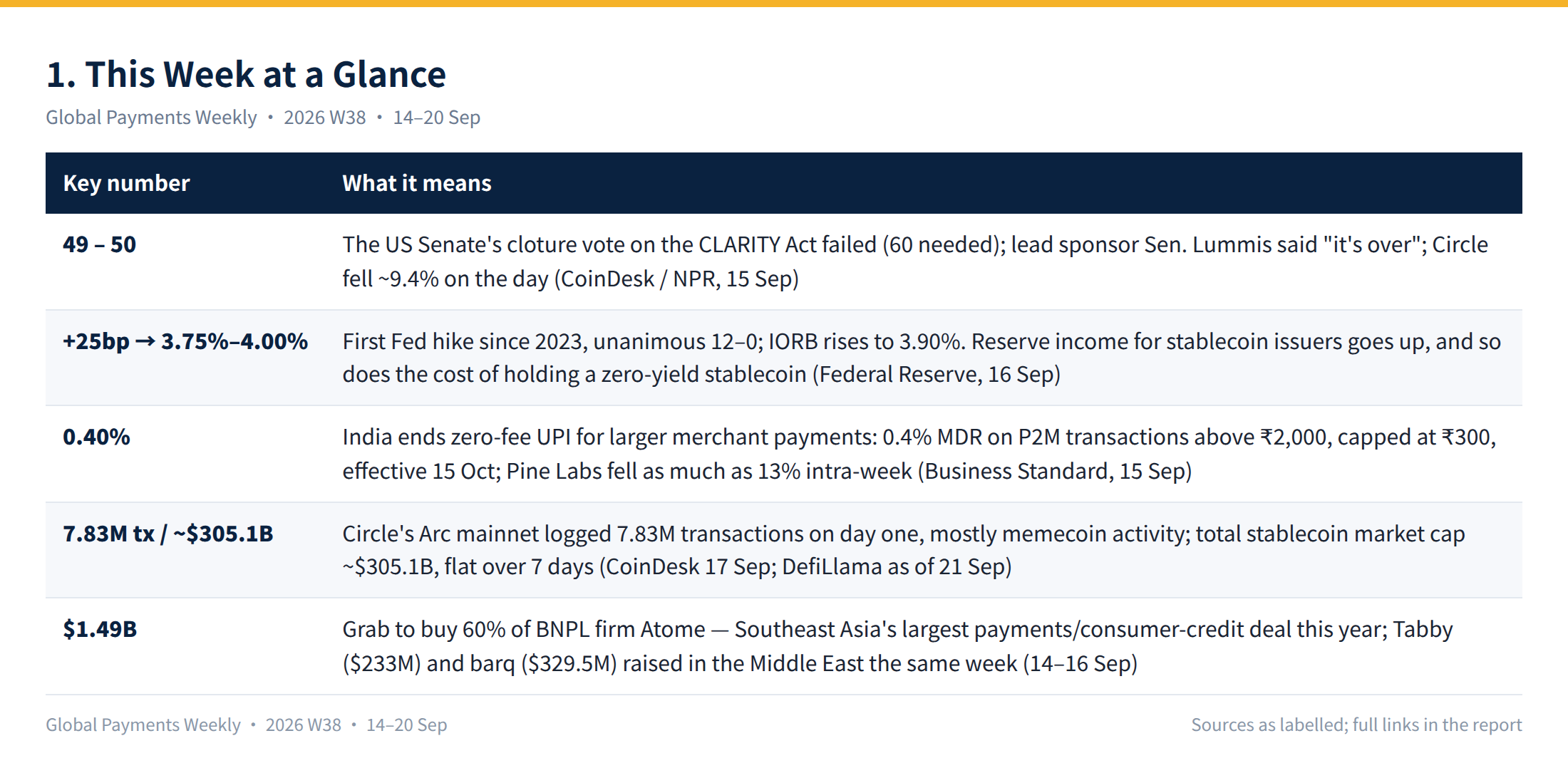
Last issue's watchlist, resolved: CLARITY vote → failed; Money20/20 Middle East → Saudi–Qatar card-scheme cross-acceptance, Alipay+ on mada; Arc mainnet → launched on 16 Sep as expected.
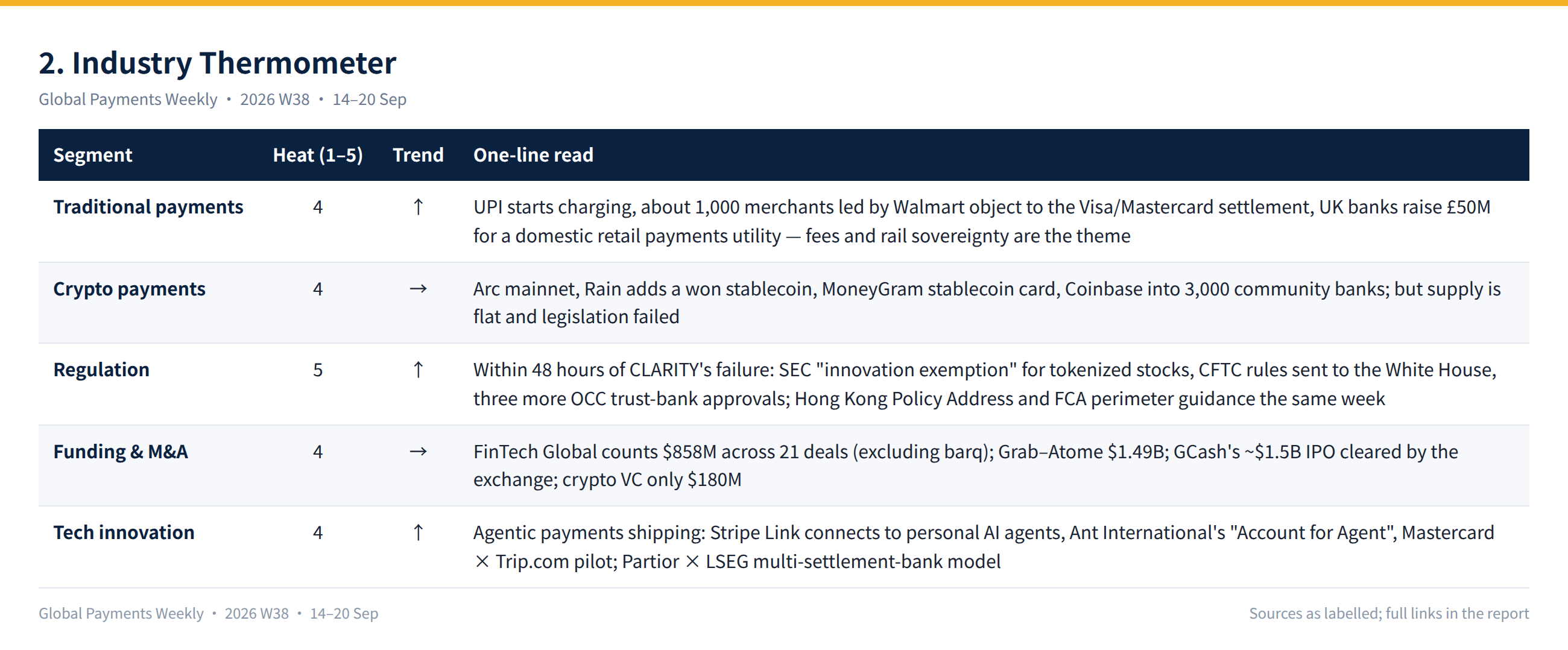
2. Industry Thermometer
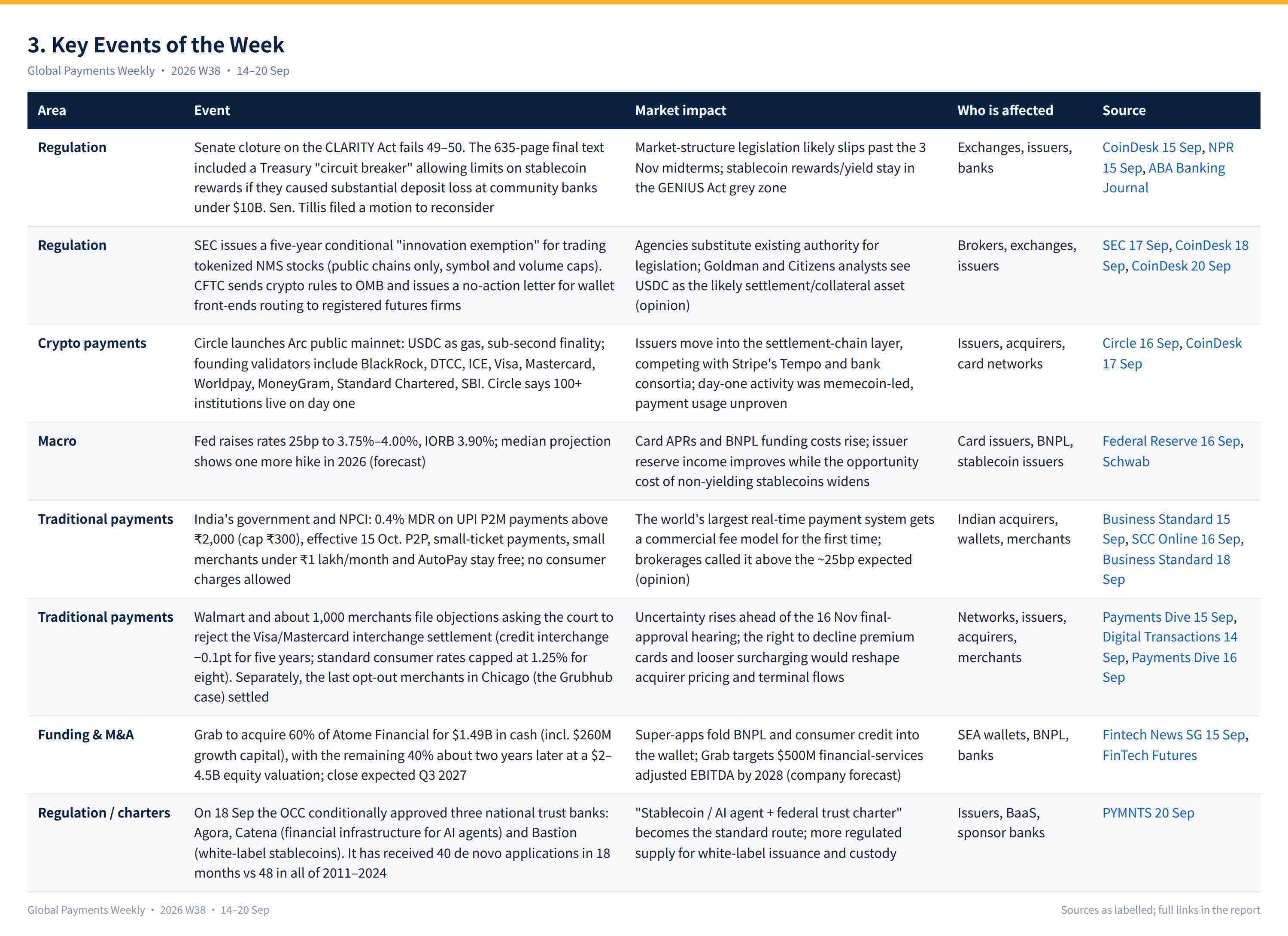
3. Key Events of the Week
Why it matters (editorial analysis)
- Legislation stalled; rule-making did not. Within two days of the vote, the SEC, CFTC and OCC each offered a substitute path — an exemptive order, a rule package under review, and charters. Certainty now comes from a stack of administrative documents rather than one statute: workable but reversible, so compliance designs need room to adjust.
- Yield is the real sticking point. Eight banking trade groups wrote the day before the vote that "a circuit breaker that activates only after substantial deposit flight has already occurred is not a safeguard at all"; Treasury Secretary Bessent replied publicly that he would use the tool. With rates up, the spread between zero-yield stablecoins and money funds widens, and commercial pressure for rewards only grows.
- Real-time payments enter the fee era. UPI answered the "zero MDR is unsustainable" question at 0.4%. The same week, 19 UK institutions began funding a domestic retail payments utility and BNP Paribas pushed Wero merchant acceptance across five markets. Governments are backing domestic rails and giving them business models.
- Read Arc's day-one numbers separately. The 7.83M transactions sit beside roughly 624k lifetime USDC transfers and ~$82M of memecoin-dominated DEX volume (CoinDesk). The validator list shows institutional intent; real payment usage will take weeks to judge.
- Non-USD stablecoins are getting onto cards. Rain added the won stablecoin KRW1 to Visa card programs while Korea's stablecoin bill still has not reached the National Assembly; HKDAP went live on HashKey and Ripio launched six LatAm local-currency stablecoins on Arc. Distribution of local-currency stablecoins is running ahead of their home legislation.
4. Crypto / Web3 Deep Dive
4.1 Stablecoin data board
4.2 Main theme: three substitute paths after the bill failed
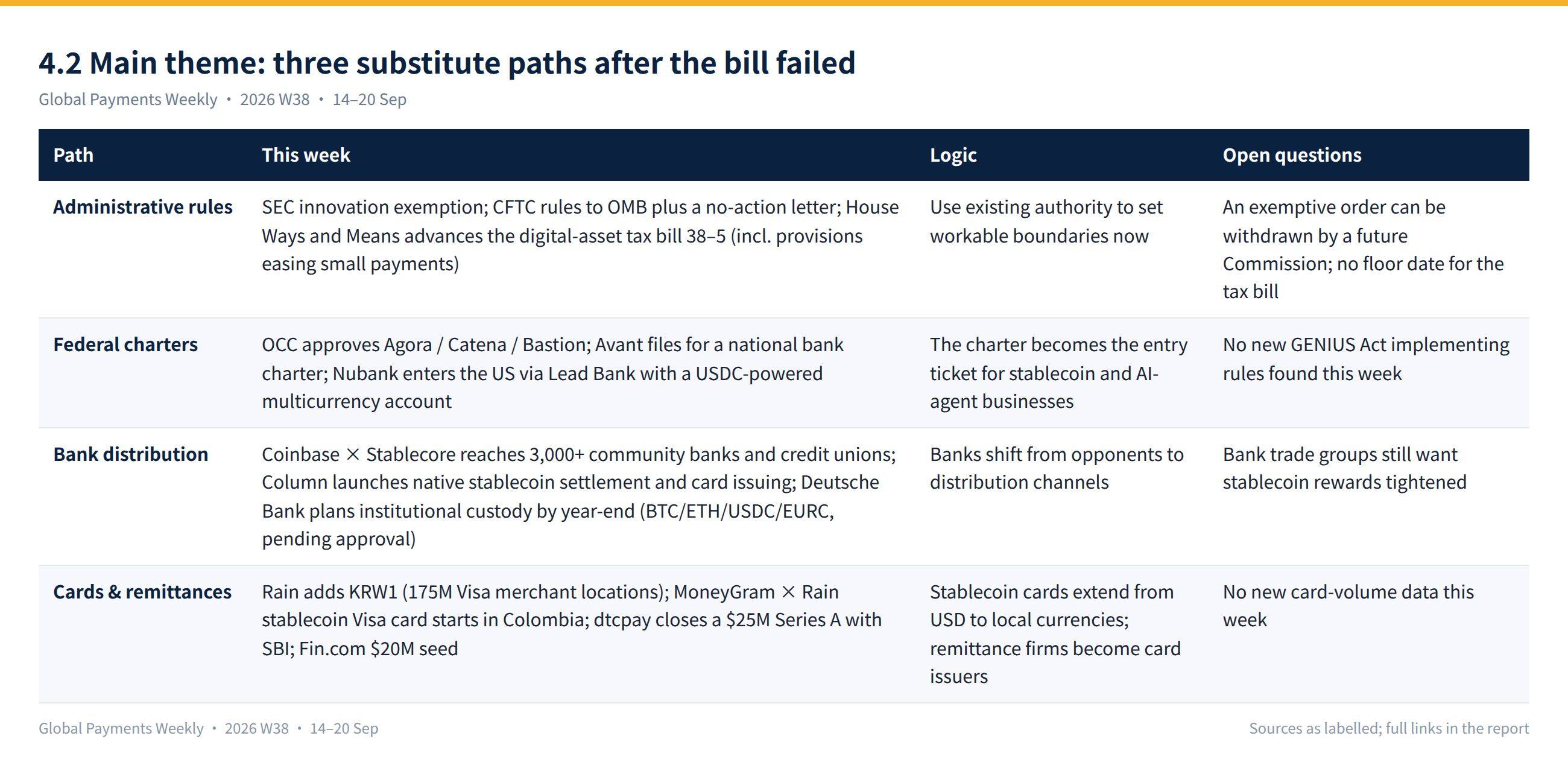
Editorial view: the week's mix was "no law, but charters and products arrived anyway." Near term, licensed entities — trust banks, community-bank channels, card program managers — gain bargaining power. Medium term, the unresolved yield/rewards question is where banks and issuers fight next. With total supply flat for a second straight week, growth is still coming from rails and use cases rather than issuance.
4.3 Quotes of the week
4.4 Regulatory notes
United States: after the CLARITY failure, seven Senate Democrats called it "a setback, but not the end" (The Block 16 Sep); the SEC's innovation exemption and its 24-hour trading roundtable landed the same day; House Ways and Means advanced the digital-asset tax bill (CoinDesk 16 Sep); the Fed's 120-day deadline under the payment-system-access executive order passed with no public findings seen (PYMNTS 17 Sep); Visa is closing the loophole that let memecoin purchases earn card rewards under a "digital media" merchant code (The Block 19 Sep). No credible public progress on GENIUS Act implementing rules this week.
EU / UK: the ECB opened a call for online and mobile merchants to join the digital euro pilot (12 months from H2 2027; 2029 issuance is a target) (ECB 15 Sep); the WSJ reported that ECB President Lagarde intervened to delay Binance's MiCA licence in Greece, while the ECB says it "has no institutional role" (a report, not officially confirmed) (CoinDesk 18 Sep); the FCA published perimeter guidance for its crypto regime — the authorisation gateway opens 30 Sep and the regime starts 25 Oct 2027 (FCA 16 Sep).
Asia: Hong Kong's Policy Address proposes letting licensed stablecoins trade on licensed virtual-asset platforms and settle tokenized money-market funds, with 24/7 settlement on EnsembleTX and a tokenization test of Exchange Fund Bills around year-end (all policy targets) (Ledger Insights 17 Sep); Korea's Digital Asset Basic Act is still not before the National Assembly, stuck on the "50% + 1" bank-ownership rule (Korea JoongAng Daily); the Philippine central bank closed 8,000+ merchant accounts tied to online casinos and drafted new rules for payment intermediaries (Fintech News PH 18 Sep). No major new payments policy from mainland China this week.
5. Traditional Payments vs. Crypto Payments
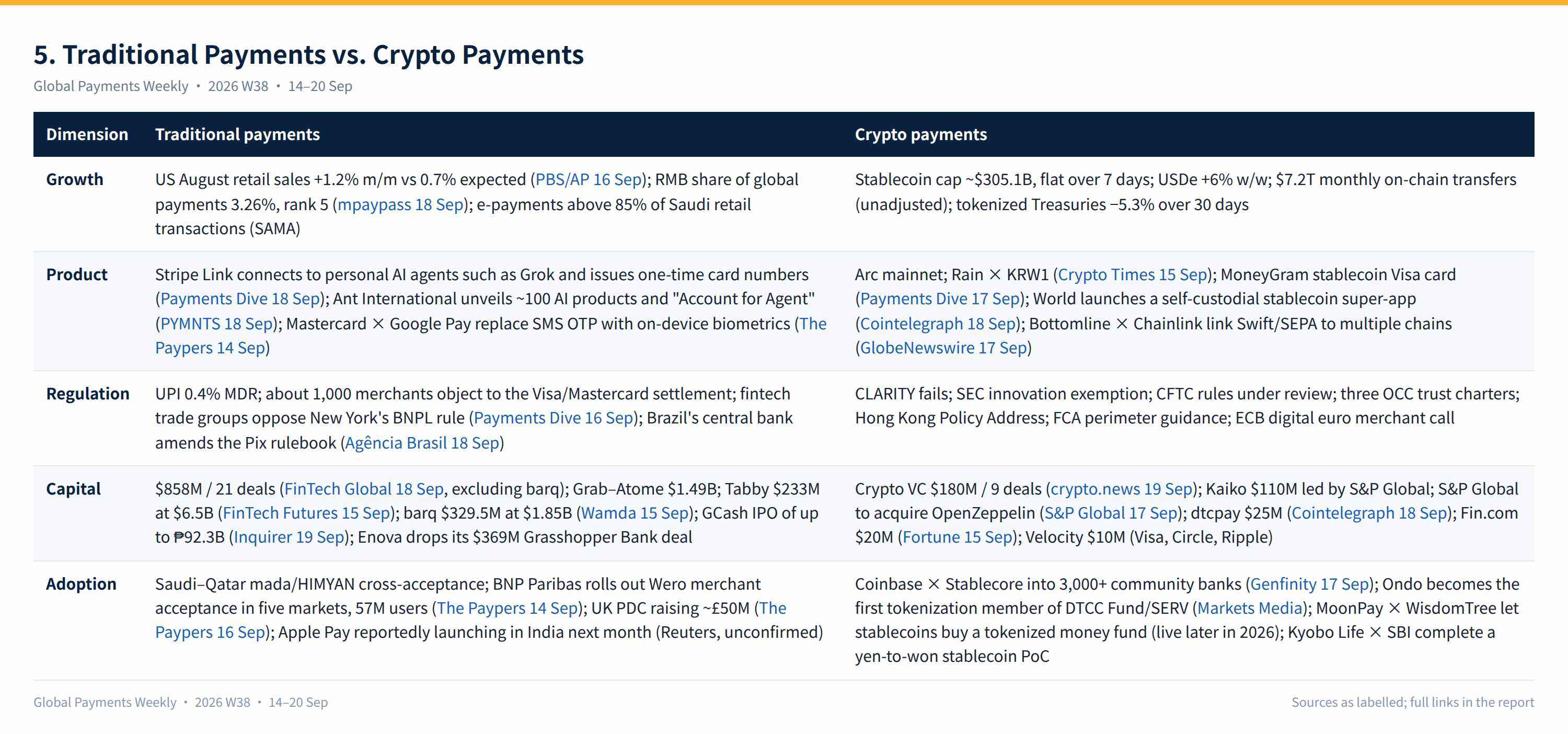
User-attitude data (surveys): ACI/YouGov polled 3,300 US and UK shoppers — only 7% would let an AI agent buy without approval, 53% are uncomfortable (Digital Transactions 16 Sep); PYMNTS found 77% would open a crypto or stablecoin wallet inside their existing bank/fintech app (PYMNTS 14 Sep).
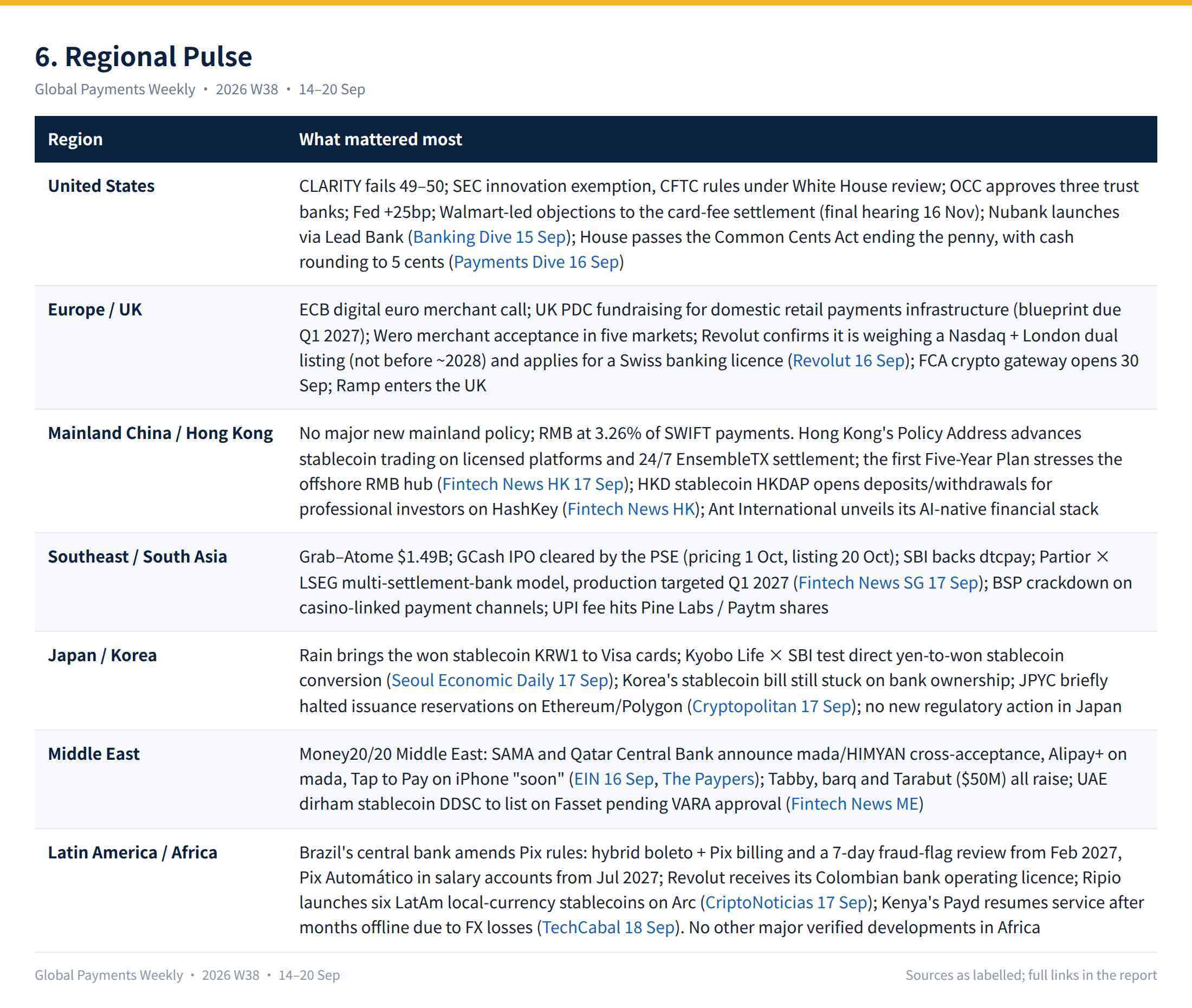
6. Regional Pulse
7. Action Items for Practitioners
Traditional payments
- Finish UPI fee readiness before 15 Oct. Acquirers and merchants with India exposure should reprice and re-reconcile on "0.4% above ₹2,000, cap ₹300, flat ₹5 for utilities." An industry newsletter reports the fee will be split among acquirer, issuer, PSP and app — confirm your share.
- Prepare two scenarios for the 16 Nov card-fee hearing. If approved, US merchants could decline premium and commercial cards and surcharge more freely; acquirers and ISVs should cost out terminal prompts, routing and pricing changes now. If rejected, litigation uncertainty returns.
- Ship agentic payments with a human-approval step first. Only 7% of consumers would fully delegate; Stripe Link's one-time card numbers, which keep real credentials away from the agent, are a useful pattern. Reprice BNPL and instalments for post-hike funding costs.
Crypto payments
- Re-plan compliance around administrative documents. Map products to the SEC exemption, the CFTC no-action letter and the OCC trust charter; keep rewards/yield features easy to switch off — bank lobbying and Treasury's stance will not soften soon.
- Secure bank and card distribution. Coinbase × Stablecore, Column and Rain show channels filling fast; smaller issuers and payment firms should lock in chartered banks, card program managers and local-currency stablecoin partners (KRW1, HKDAP, DDSC).
- Watch three filing windows. The FCA crypto authorisation gateway opens 30 Sep; MAS's stablecoin legislation consultation closes 16 Oct; the SEC exemption is open for comment — issuers aiming to be the cash leg for tokenized securities should file.
8. Next Week's Watchlist
- CLARITY reconsideration and the administrative relay: whether Tillis's motion moves before the Senate adjourns in early October; when the CFTC package clears OMB; the first "Tokenized Securities Venue" filers under the SEC exemption (the market names Coinbase, Robinhood and Securitize).
- Sibos 2026 (28 Sep–1 Oct, Miami) and the FCA gateway on 30 Sep: look for announcements on Swift's shared ledger, tokenized deposits, the 21-bank stablecoin consortium and Bottomline × Chainlink.
- October effective dates: 1 Oct — GCash IPO pricing, Australia's card-surcharge ban takes effect (RBA), and Brazil bars stablecoin settlement in regulated cross-border eFX payments (rule published in April; The Paypers); 15 Oct — UPI MDR takes effect. Keep tracking real USDC payment volume on Arc and whether total stablecoin supply returns to growth.
All data and events come from public reporting; links go to the original sources. Forecasts, opinions and unconfirmed reports are labelled as such. Editorial analysis reflects judgement based on public information and is not investment advice.