ZEC Surges 21x in a Year — Which US Stocks Stand to Benefit?


- Core Viewpoint: The privacy coin ZEC has surged 21x over the past year, and compliant channels are opening up (listed on Robinhood, ZCSH ETF launched), bringing it into mainstream brokerage accounts; however, the five US-listed related tickers have different connection pipelines, and "correlation does not equal benefit."
- Key Elements:
- ZEC has risen 21x over the past year, crossing $1,000 in September 2026 with a market cap of approximately $17.95 billion. ZCSH is the first privacy coin spot ETF, with assets surpassing $500 million.
- CYPH transitioned from a pharmaceutical company to a ZEC treasury company, holding 326,418 coins, representing 1.9% of circulating supply, with a target of 5% of total network supply. Coin price fluctuations are directly recorded on the income statement.
- ZCSH charges a management fee of 2.50%/year (Bitcoin ETFs charge approximately 0.25%). Its holdings are placed in transparent addresses rather than shielded addresses — what you're buying is price exposure, not privacy functionality.
- COIN covers two pipelines (listing + custody of ZCSH). GEMI's connection comes from platform listing and founder narrative (Winklevoss Capital invested in CYPH, not GEMI). HOOD has only one pipeline.
- Connection pipelines fall into five categories: direct holding, product tracking, platform listing, custody provision, and founder narrative; transmission strength follows the order of direct holding > product tracking > platform business.
- Excluded tickers: No US-listed miner derives ZEC as its primary revenue; Reliance Global Group has insufficient disclosure and executed a 1-for-40 reverse split, so it is excluded from the main text.
Privacy coin Zcash (ZEC) has surged 21x over the past year, crossing $1,000 in September 2026 with a market cap of approximately $17.95 billion. As interest heated up, "Which US stocks benefit from ZEC?" became one of the most frequently asked questions among cross-market investors. Let's get one thing straight upfront: correlation does not equal benefit. This article individually verifies five US stock related targets: Cypherpunk Technologies (CYPH), The Zcash ETF (ZCSH), Coinbase Global (COIN), Gemini Space Station (GEMI), and Robinhood Markets (HOOD), and breaks down their connections into five verifiable pipelines—direct holdings, product tracking, platform listing, custody provision, and founder or shareholder narrative. Upon verification, none of the five targets simultaneously occupies three pipelines; the sources of their connections are all different, and the paths from coin price transmission to company financials are completely different matters. All data in this article is based on public disclosures as of September 18, 2026, with all times in UTC+8; this article does not cite individual stock prices or price changes, and only reviews company businesses and publicly disclosed operating figures.
1. First, Let's Clarify This ZEC Cycle: It's Not Just the Coin Price Rising—It's "Legally Buyable"
ZEC is a privacy coin launched in 2016 that uses zero-knowledge proofs to allow transaction amounts and addresses to be hidden, while retaining a transparent address layer—it is "optional privacy," not "mandatory privacy," a point that will be referenced repeatedly later.
This cycle has a structural difference from previous privacy coin rallies: the channels have opened up.
① On April 24, 2026, Robinhood listed ZEC spot across the US. This was the platform's first major new crypto listing in over two years, with withdrawals restricted to transparent t-addresses only, not shielded z-addresses, opening trading while meeting anti-money laundering requirements.
② On August 25, 2026, The Zcash ETF (ZCSH) listed on NYSE Arca, the first privacy coin spot ETF in the US. On September 8, 2026, the issuer announced assets exceeded $500 million, with cumulative net inflows exceeding $70 million in the first two weeks of listing, plus $100 million from a seed investor.
⚠️ Together, these two events mean: In the past, getting ZEC exposure required opening a crypto account yourself; now an ordinary brokerage account can access it. This is a channel change, not a judgment on ZEC's price direction, and this article makes no such judgment.
2. How the Five Targets Are Divided: There Are Five Correlation Pipelines, and the Most Connected Only Has Two
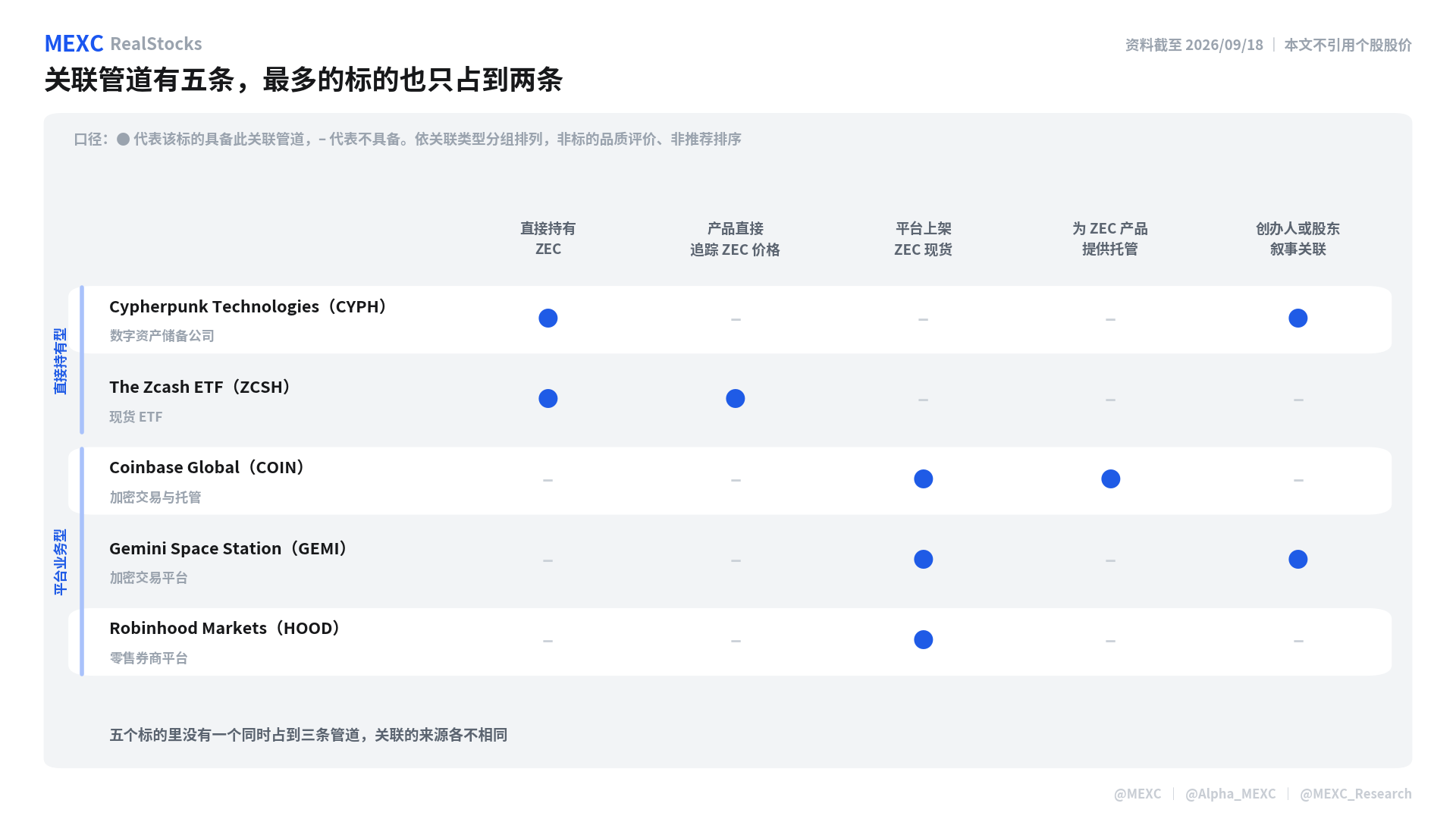
Breaking down the phrase "related to ZEC," there are actually five completely different pipelines:
- Directly holding ZEC — ZEC appears on the balance sheet or in fund holdings
- Product directly tracks ZEC price — Issuing a product with ZEC as the underlying
- Platform lists ZEC spot — Users can buy and sell ZEC here
- Providing custody for ZEC products — Safekeeping ZEC for others
- Founder or shareholder narrative connection — Key figures publicly endorsing ZEC
Verification results:
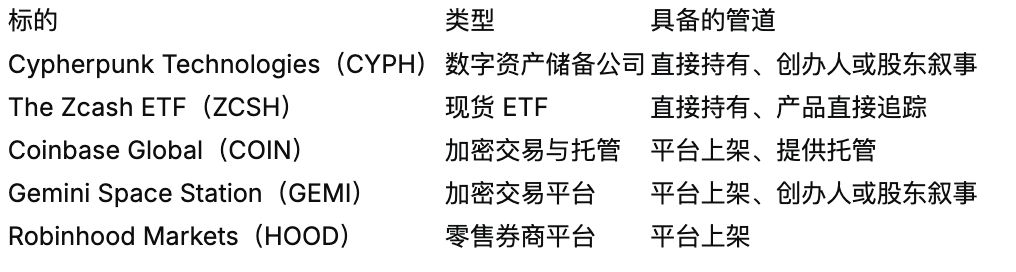
⚠️ This table is grouped by correlation type, not a quality assessment, nor a recommendation ranking. More pipelines does not mean a better target—it only indicates that the connections come from different places.
3. Direct Holdings Type ①: Cypherpunk Technologies (CYPH)
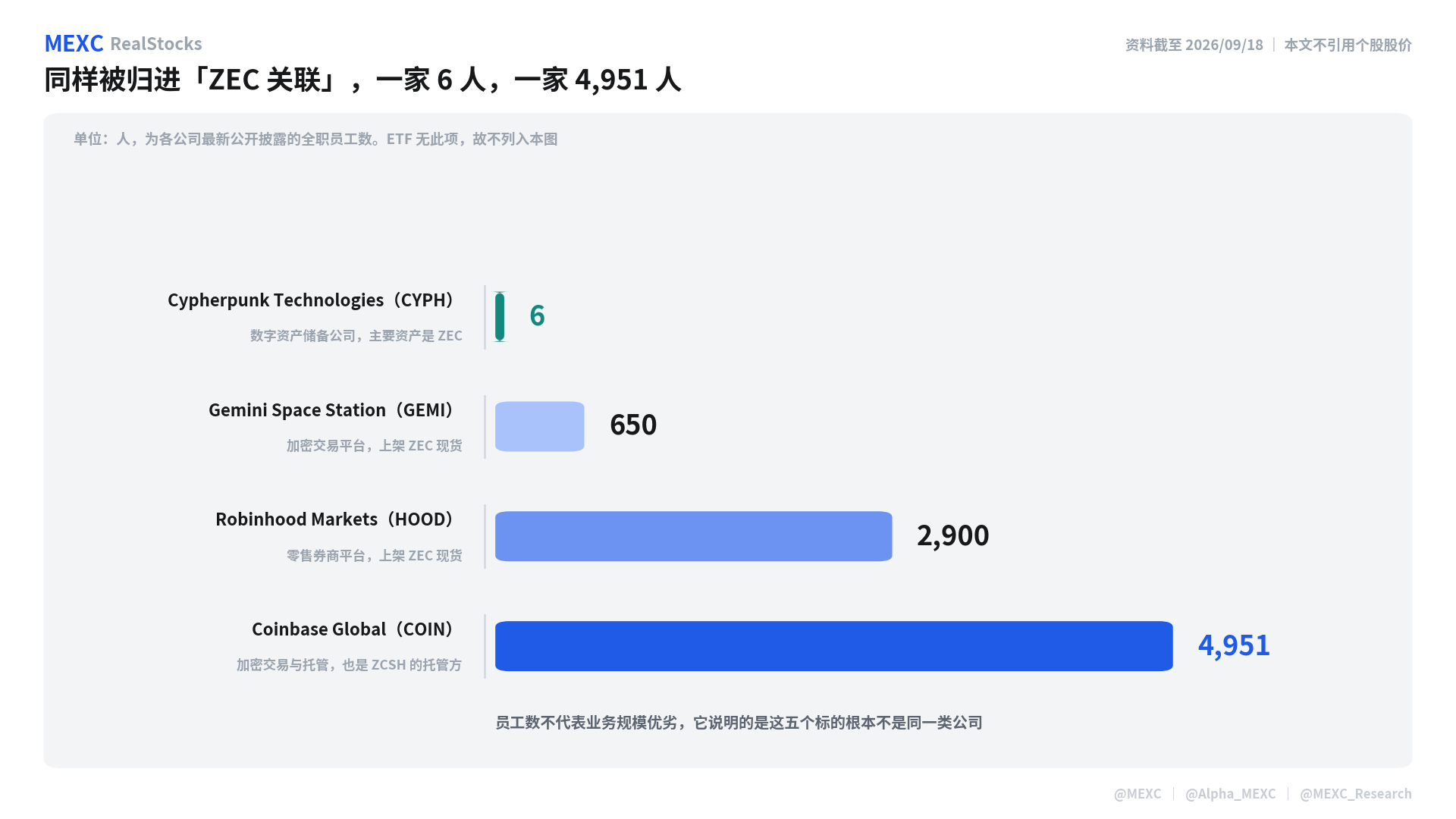
What this company does. CYPH was formerly Leap Therapeutics, a cancer drug company. In November 2025, the company renamed itself Cypherpunk Technologies and pivoted, treating Zcash as its core asset with a positioning of "privacy technology company + ZEC digital asset treasury." The original cancer drug pipeline remains in a subsidiary for continued development. Full-time employees: 6—this number will appear again later.
Where the connection comes from. On November 12, 2025, Winklevoss Capital (the family fund of Gemini co-founder Tyler Winklevoss) invested $58.9 million, and the company made its first purchase of 203,775 ZEC at an average price of approximately $245, setting a clear goal: to acquire 5% of Zcash's total network supply of 21 million, or 1,050,000 ZEC.
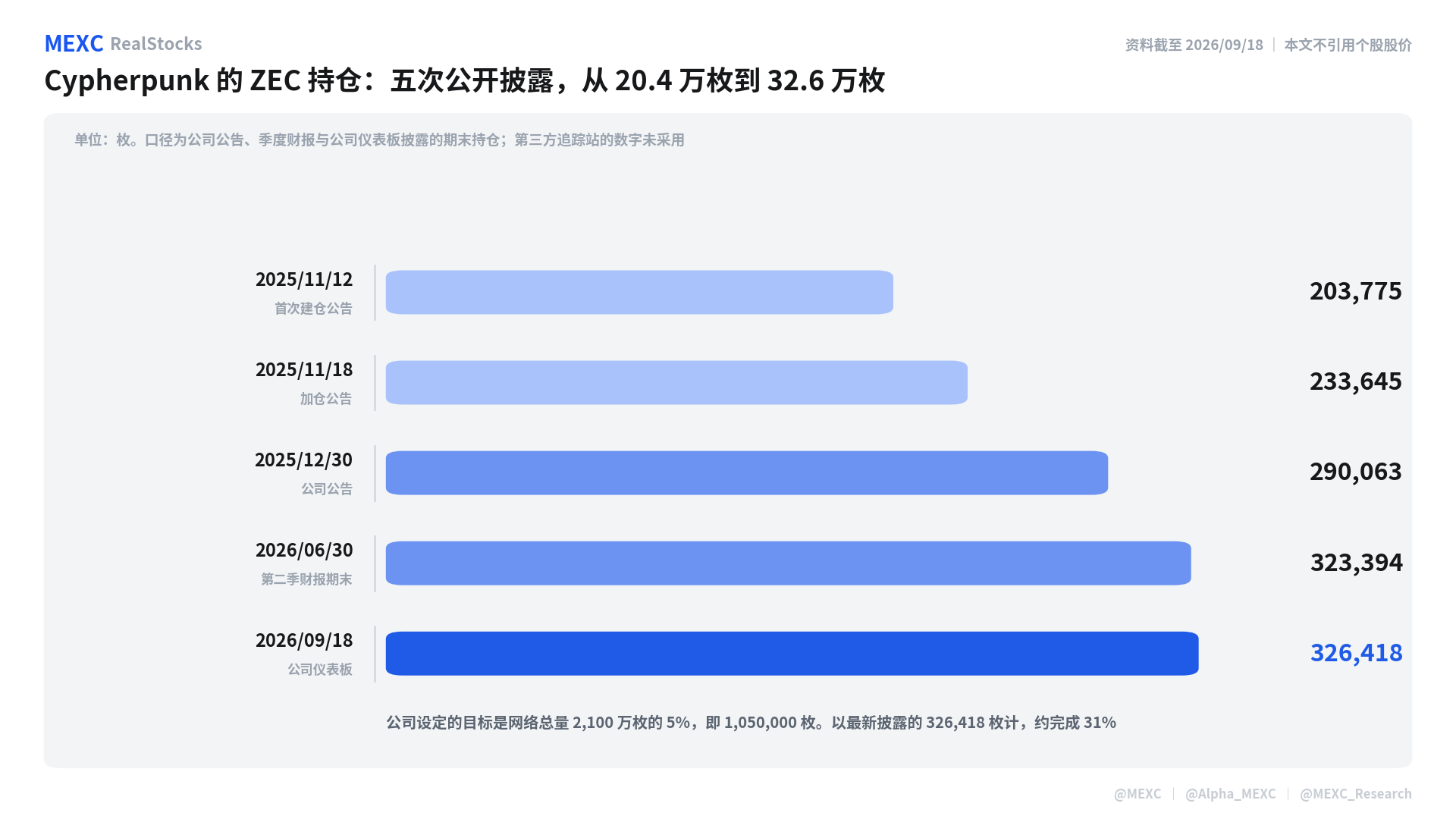
Where holdings stand. Based on company announcements, quarterly reports, and the company dashboard, the period-end holdings trajectory is:
- 2025/11/12 203,775 ZEC (initial position announcement)
- 2025/11/18 233,645 ZEC (additional purchase announcement)
- 2025/12/30 290,063 ZEC (company announcement)
- 2026/06/30 323,394 ZEC (end of Q2 fiscal period)
- 2026/09/18 326,418 ZEC (company dashboard)
Based on the latest disclosed 326,418 ZEC, this represents approximately 1.9% of ZEC's circulating supply (approximately 16.86 million). Against the company's own target of 1,050,000 ZEC, it has completed approximately 31%.
⚠️ Don't confuse the two bases: the 1.9% figure uses circulating supply as the denominator, while the 5% target uses the total network supply of 21 million as the denominator—different denominators.
⚠️ Third-party tracker figures not adopted. The public tracker page shows holdings stuck at 294,743 as of March 2026, more than 30,000 less than the company's own disclosure. This article uniformly uses company disclosures as the standard.
What it looks like financially. Because ZEC is recorded on the balance sheet, price movements directly become profit and loss: Q1 2026 net loss of $77.2 million (ZEC pullback), Q2 net income of $39.4 million, diluted EPS of $0.18 (ZEC moving from $243.35 to $400.09 generated approximately $46 million in unrealized gains), period-end cash of $7.6 million.
→ Same company, two directions within half a year. This is not abnormal—it is the inevitable result of "putting coins on the balance sheet."
→ R&D expenses dropped from $10.5 million in the year-ago period to $200,000, while G&A expenses rose from $1.8 million to $4.5 million—the expense structure has shifted from pharmaceutical to asset management.
⚠️ Risks must be discussed as well: On June 5, 2026, a vulnerability allowing counterfeit ZEC was discovered in Zcash's Orchard shielded pool. The network was urgently upgraded to patch it, with no evidence of exploitation, but the company's stock price fell sharply that day. The company's CIO subsequently reaffirmed the 5% accumulation target unchanged. Protocol-layer technical risks transmit directly to such targets—this is what makes it most different from ordinary public companies.
4. Direct Holdings Type ②: The Zcash ETF (ZCSH)
What this is. ZCSH was converted from Grayscale Zcash Trust and listed on NYSE Arca on August 25, 2026. It is the first and currently only privacy coin spot ETF in the US. It is not a stock; it is an exchange-traded fund.
Where the connection comes from. The fund holds ZEC by shares, and NAV directly follows ZEC price—among the five targets, this is the most directly connected one.
Several parameters you must know:
- Management fee 2.50%/year, paid in ZEC. For comparison, Bitcoin spot ETF fees are approximately 0.25%—ten times. The fee is accrued daily; assuming the coin price stays flat, over ten years fees alone would erode approximately 22% of share value.
- Custodian: Coinbase Custody Trust Company; Prime Broker: Coinbase Inc.; Administration & Transfer Agent: Bank of New York Mellon; Authorized Participants: Jane Street, Virtu.
- Scale: Officially announced exceeding $500 million on September 8, 2026.
🔴 The most important point to clarify: ZCSH holds its ZEC in transparent addresses, not shielded addresses. This is a design trade-off made to satisfy auditing and creation/redemption verification. The result is—when you buy this ETF, you get ZEC price exposure, not Zcash's privacy features. To use shielded transactions, you still need to hold the coins yourself.
⚠️ A common factual error: The ticker GRAY does not currently belong to Grayscale. The issuer's parent company Grayscale Investments has filed an S-1 and plans to list on the New York Stock Exchange under GRAY, but has not yet completed its listing; at this stage, the GRAY ticker belongs to Graybug Vision (biotech, trading halted). To access Grayscale's Zcash product line, currently only ZCSH is available.
5. Platform Business Type: Robinhood (HOOD), Coinbase (COIN), Gemini (GEMI)
What these three have in common is: ZEC is one of the tradable assets on their platforms, not their asset.
Robinhood Markets (HOOD) | Retail Brokerage Platform | Full-time employees: 2,900
It serves as a US retail investment gateway, with stocks, ETFs, options, gold, and crypto all in one account. On April 24, 2026, it listed ZEC spot across the US, adopting a compliance design of "withdrawals limited to transparent t-addresses," viewed as a model for US fintech platforms handling privacy coins. It occupies only one pipeline among the five targets—the most straightforward connection, and also the thinnest.
Coinbase Global (COIN) | Crypto Trading and Custody | Full-time employees: 4,951
The largest regulated crypto exchange in the US, serving both retail and institutional clients, and providing custody and developer infrastructure. It occupies two pipelines: platform listing of ZEC spot, and serving as custodian for ZCSH (Coinbase Custody Trust safekeeps the ZEC held by the fund, Coinbase Inc. serves as prime broker). In ZEC's institutionalization, it is present at two points in the chain.
Gemini Space Station (GEMI) | Crypto Trading Platform | Full-time employees: 650
Founded by the Winklevoss brothers, listed on September 12, 2025, with Tyler Winklevoss as current CEO, covering spot, perpetual contracts, custody, prediction markets, and crypto credit cards. The platform lists ZEC, and it is also the source of the strongest bullish narrative for ZEC—Tyler Winklevoss publicly defines ZEC as "Bitcoin for crypto," where Bitcoin is digital gold and ZEC is digital cash.
⚠️ There is a very easy mistake to make here that must be clarified: The investor in Cypherpunk is Winklevoss Capital (family fund), not the public company Gemini Space Station. GEMI's connection to ZEC comes from platform listing and founder narrative, not the company balance sheet. Writing that "Gemini invested in a ZEC treasury company" is incorrect.
A side comparison. Also categorized under "ZEC-related," CYPH is a company with 6 people, while COIN is a company with 4,951 people. Employee count does not indicate business scale superiority—it shows that these five targets are fundamentally not the same type of company and should not be measured with the same yardstick.
6. One-Minute Concept: Correlation Does Not Equal Benefit—Three Types of Correlation Have Different Transmission Strengths
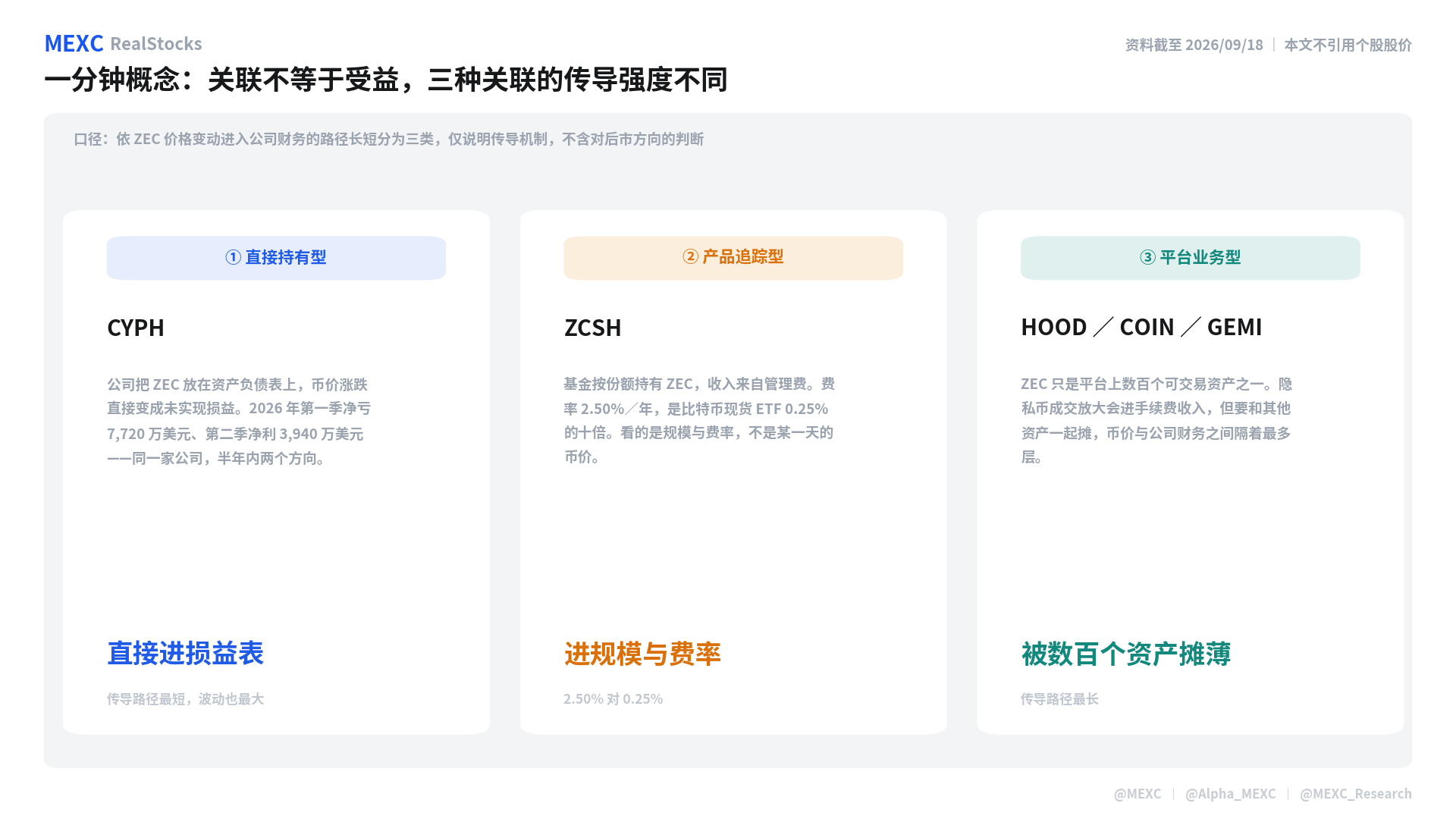
When you see the words "related target," the first question to ask is: When the coin price moves, how many layers does it pass through before reaching this company's financial statements?
① Direct Holdings Type (CYPH)—Goes directly to the income statement.
The company puts ZEC on its balance sheet, and price movements directly become unrealized gains/losses. Q1 net loss of $77.2 million, Q2 net income of $39.4 million—same company, two directions within half a year. Shortest transmission path, largest volatility.
② Product Tracking Type (ZCSH)—Goes to scale and fee rate.
The fund holds ZEC by shares, with revenue coming from management fees. Fee rate of 2.50%/year, versus 0.25% for Bitcoin spot ETFs. What determines it is scale and fee rate, not the coin price on any given day.
③ Platform Business Type (HOOD/COIN/GEMI)—Diluted by hundreds of assets.
ZEC is just one of hundreds of tradable assets on the platform. Increased privacy coin trading volume does contribute to fee revenue, but it must be spread across all other assets. The most layers between coin price and company financials, the longest transmission path.
A transferable criterion: Next time you see any "concept stock," first answer three questions—Does this company hold it? Does this company's product track it? Or is it just one of the things this company sells? Once you answer these three, the correlation strength ranks itself—no one needs to give you a ranking.
7. What's Not on This List Is Equally Worth Discussing
The parts that were excluded during verification actually illustrate the boundaries of this theme better than what remained:
① No US-listed miner with ZEC as primary revenue. ZEC uses the Equihash algorithm and is mined with specialized ASICs, with hash power concentrated among non-listed miners. After tier-by-tier verification, no US-listed miner could be identified with ZEC as a primary revenue source, so this article does not include any. This is "if it doesn't pass verification, don't write it," not an omission.
② Reliance Global Group (EZRA, formerly RELI) has a connection, but disclosure is insufficient. This is an insurance brokerage and insurtech company that announced in November 2025 it would convert all existing digital assets to ZEC, and added more on December 8. ⚠️ However, the company did not disclose the holding quantity—this is "the company didn't publish it," not "we couldn't find it"; the two must not be conflated. Additionally, the company executed a 1-for-40 reverse stock split on May 14, 2026 to comply with Nasdaq's minimum bid price requirement, with the ticker simultaneously changed from RELI to EZRA. Insufficient disclosure plus reverse split—this article places it outside the main text.
③ Grayscale Investments itself is not yet listed, for reasons stated in Section 4.
Frequently Asked Questions
Q: Does buying the ZCSH ETF mean I'm using Zcash's privacy features?
A: No. ZCSH holds its ZEC in transparent addresses