TRX ETF Lands on Cboe Exchange, TRON Accelerates Integration into Global Mainstream Capital Markets


- Core Insight: The Canary Staked TRX ETF from the TRON ecosystem will be listed on the U.S. Cboe BZX exchange on September 9, 2026, marking TRX's entry into mainstream securities markets through a staking-based ETF. Combined with TRON Inc.'s public listing, this creates a dual-engine model of "public company + ETF," driving the ecosystem toward institutionalization and globalization.
- Key Elements:
- The Canary Staked TRX ETF (ticker: TRXS) has been approved for listing, with plans to stake all eligible TRX. Approximately 80% of staking rewards will accrue to the fund and be reflected in daily net asset value, providing price exposure plus additional yield.
- TRON Inc. is already trading on Nasdaq and, as of early September 2026, holds over 712.8 million TRX tokens. The company continues to expand its reserves, working alongside TRXS to broaden access channels for traditional investors.
- Total on-chain accounts surpassed 400 million on August 23, 2026, with cumulative transactions exceeding 15.4 billion and transfer volume nearing $30 trillion, placing the network's scale at a new level.
- TRON's USDT issuance has reached $94.2 billion, making it the world's largest issuance network. In Q2 2026, it processed approximately $2.1 trillion in USDT transfers, with average daily transfer volume of around $25 billion, reflecting high-frequency stablecoin flows.
- AI platform B.AI has surpassed 2.4 million users, with daily token throughput peaking above 1 trillion. Cumulative throughput has exceeded 10.9 trillion tokens, with over 89.56 million API calls, demonstrating rapid business scaling.
- The potential synergy between B.AI and stablecoin payments is emerging, providing a 7×24 settlement foundation for AI Agent commercialization and strengthening the ecosystem's diversified layout.
On September 8, Justin Sun, founder of TRON, announced on the X platform that the Canary Staked TRX ETF will be listed on the Cboe BZX Exchange in the United States on September 9, 2026, under the ticker TRXS. Following the Nasdaq listing of TRON Inc., a company related to the TRON ecosystem, TRX will also enter the U.S. mainstream securities market through an ETF. Sun stated that the TRON ecosystem is forming a dual-wheel drive pattern of "listed company + ETF."
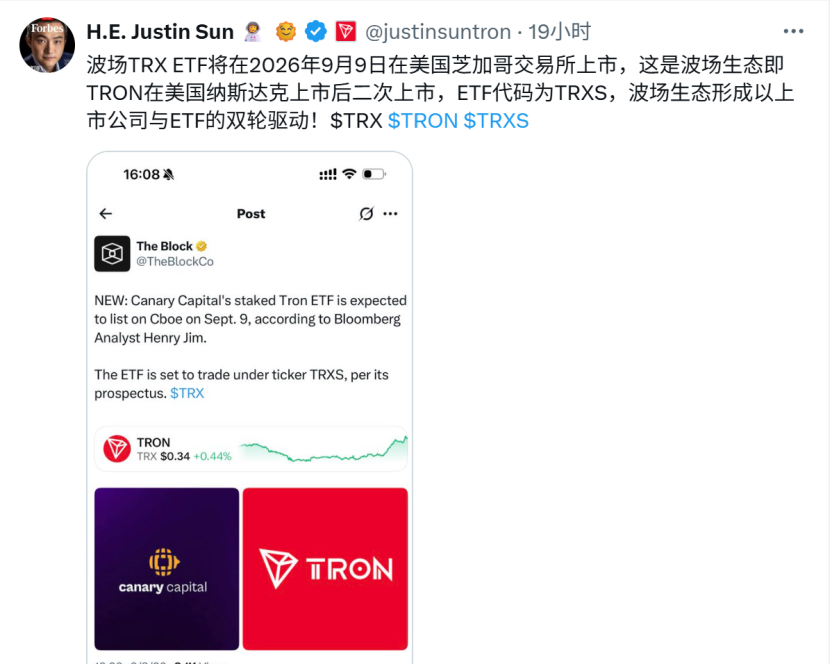
For TRON, the significance of this ETF listing goes beyond merely adding an investment channel. Over the past few months, TRON's on-chain accounts, stablecoin scale, U.S. capital market presence, and AI business have all set new periodic records, with multiple business lines achieving breakthroughs simultaneously. This also signals that TRON is transitioning from on-chain scale expansion to a broader phase of institutionalization and globalization.
TRXS Is Not Just Tracking TRX Price—It Will Also Participate in On-Chain Staking
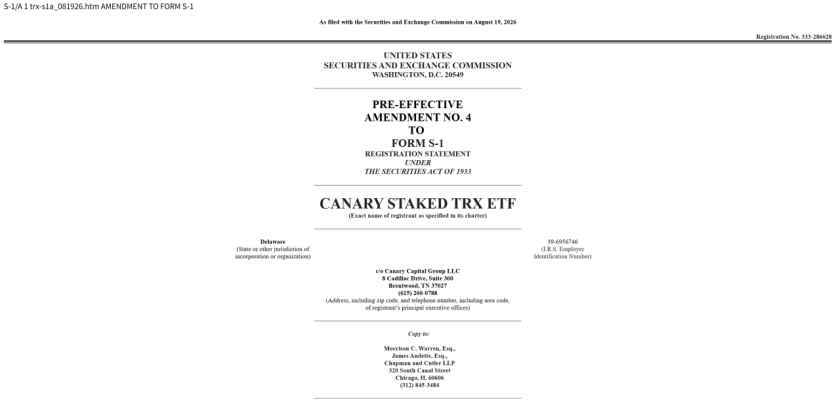
According to the S-1/A filing submitted to the U.S. Securities and Exchange Commission (SEC) by Canary Capital on August 19, the primary objective of the Canary Staked TRX ETF is to provide investors with exposure to TRX price while generating additional TRX through participation in TRON network staking.
From a product design perspective, TRXS differs from spot ETFs that simply hold crypto assets. The filing shows that the fund plans to stake substantially all eligible TRX, with staking rewards—after deducting related fees—credited to the fund's assets. Staking service fees are expected to account for approximately 20% of staking rewards, with the remaining roughly 80% retained by the fund. Accrued rewards will also be reflected in the daily net asset value (NAV).
In other words, traditional securities accounts will not only gain exposure to TRX price going forward—the staking yield generated by the TRON network itself will also be incorporated into the ETF's product structure.
For TRX, this also marks the first time its on-chain staking mechanism enters the broader traditional financial market through an ETF product.
Prior to TRXS, the TRON ecosystem had already established a connection with U.S. public markets through TRON Inc., a Nasdaq-listed company.
TRON Inc. is traded on Nasdaq and holds TRX as its core digital asset reserve. The company has since continued to increase its TRX holdings and plans to further participate in TRON network infrastructure development. As of early September 2026, TRON Inc. held over 712.8 million TRX and continues to expand its TRX digital asset reserve.
Following the listing of TRXS, the investor demand addressed by these two products is not entirely identical. TRON Inc. is closer to a listed company built around TRX reserves and ecosystem operations, while TRXS directly provides exposure to the TRX asset and staking yields.
Therefore, rather than calling this a "secondary listing" for TRON, a more accurate description would be: TRX has gained another important entry point into the U.S. capital market. Both stocks and ETFs as public market instruments are diversifying the ways traditional investors can access the TRON ecosystem.
400 Million Accounts, $94.2 Billion USDT—On-Chain Scale Hits Consecutive Records
Beyond the capital markets, TRON's recent on-chain metrics are also at a new scale.
On August 23, 2026, the total number of TRON on-chain accounts officially surpassed 400 million. The network has processed over 15.4 billion cumulative transactions, with cumulative transfer volume approaching $30 trillion.
Stablecoins remain TRON's most core business foundation.
Currently, the USDT issuance on the TRON network has reached $94.2 billion, surpassing other blockchain networks such as Ethereum and establishing TRON as the world's largest USDT issuance network.
This metric explains TRON's current usage structure better than account numbers alone. A significant portion of on-chain activity on TRON revolves around USDT—from exchange deposits and withdrawals and peer-to-peer transfers to cross-border payments, fund settlement, and DeFi. Stablecoins have become the network's primary vehicle for asset movement.
This year, this advantage has continued to widen. In Q2 2026, the value of USDT transfers processed on the TRON network was approximately $2.1 trillion. Previously disclosed data also shows that TRON's daily average USDT transfer volume has reached approximately $25 billion.
From a $94.2 billion stock to hundreds of billions of dollars in daily on-chain flow, TRON's competitive focus in the stablecoin market is no longer just about "how much USDT has been issued," but whether these stablecoins are truly circulating at high frequency. For payment and settlement networks, the latter is closer to real-world usage.
B.AI Daily Token Throughput Surpasses 1 Trillion—AI Business Scaling Rapidly
Beyond its stablecoin business, B.AI, the AI platform supported by TRON, has also shown notable growth recently.
As of early September, B.AI's user base has surpassed 2.4 million, with peak daily token throughput exceeding 1 trillion. Since the launch of the free campaign on August 17, more than 220,000 new API users have joined, cumulative throughput has exceeded 10.9 trillion tokens, and the platform has supported over 89.56 million API calls.
This growth rate has clearly surpassed B.AI's early-stage scale after its launch. Introduced in April this year, B.AI initially focused on large model aggregation and API services, then gradually expanded its product capabilities to include model integrations, AI Agents, and AI coding. Its target users have also evolved from general AI consumers to developers and Agent scenarios.
B.AI and TRON currently operate under different business frameworks, but there is a notable intersection worth watching: payments.
For AI Agents to truly engage in commercial activities, they ultimately need to complete actions such as payments, settlement, and cross-border transfers. Traditional payment systems require accounts, banks, and manual authorization, whereas stablecoins natively support 7×24 operation and are more easily embedded into programmatic workflows. TRON already carries over $94.2 billion in USDT, while B.AI is rapidly accumulating AI users, developers, and model call volumes—providing a practical foundation for the future convergence of AI Agents and stablecoin payments.
Over the past period, TRON has consistently made progress across multiple fronts: on-chain scale, stablecoins, capital markets, and AI. The TRXS listing further broadens the channels connecting TRX with traditional financial markets, advancing the TRON ecosystem's globalization and institutionalization process.
With its core business foundation continuously expanding and new businesses gradually reaching scale, the boundaries of the TRON ecosystem continue to extend. From public chain infrastructure and stablecoin networks to capital markets and AI scenarios, TRON is entering a more diversified stage of development.