The Real Gold Mine Beneath the Meme Coin Craze: The "Rent-Collecting" Era for LPs


- Core Thesis: The article points out that speculators generate massive trading fees on Meme coins, but liquidity providers remain scarce. This creates an opportunity for retail investors with DeFi skills to generate high yields through arbitrage and fee collection—especially in arbitrage pools between Meme coins and tokenized stocks on Robinhood Chain.
- Key Elements:
- Robinhood Chain has posted impressive metrics since launch: TVL reached $757 million, DEX trading volume hit $1.66 billion, 24-hour application fees totaled $16.98 million, with a daily fee rate of 2.24% (implying extremely high theoretical annualized APY).
- Meme coin traders are mostly high-risk speculators unwilling to provide liquidity, while institutions cannot enter due to the small size of liquidity pools (e.g., the RBLX/USDG pool has a TVL of just $168,000), leaving room for retail participants to capture yields.
- Tokenized stock trading is highly active: 13 million trades occur in a single day, with 203,000 holding wallets. This has spawned 27 Meme coin-stock trading pairs (such as AI/NVDA, BONER/HIMS), and arbitrage activity continues to contribute fees.
- Certain liquidity pools generate significant fee income: the AI/NVDA pool generated $447,000 in 24-hour fees, and AI/WETH reached $340,000, with fee-only annualized returns as high as 1,329%.
- Strategy suggestion: There is no need to hold Meme coins. By becoming an LP in stock/USDG pools, one can continuously earn fees as arbitrage bots correct price discrepancies. Preferred pools include HOOD/USDG, NVDA/USDG, and others.
Original author: Ignas | DeFi Research
Original translation: Saoirse, Foresight News
It feels like DeFi Summer is back. But most high-risk speculators are busy losing money on meme coins, rather than us profiting from their losses.
Speculators, driven by FOMO, hype meme coins and generate millions of dollars in daily trading fees. But they don't become liquidity providers—they only engage in high-risk trading. If you completely abstain from this kind of speculation, it's actually a great opportunity.
Furthermore, the Pons launchpad has popularized meme coins that directly mirror tokenized stock issuance (AI/NVDA, BONER/HIMS, MOO/MU). Significant arbitrage activity occurs between these trading pair pools and standard stock/USDG pools, with arbitrage generating a continuous stream of fees—this is exactly the opportunity I'm bullish on.
You don't need to hold meme coins to profit from mining these speculators' losses. I find this play fascinating. Here's what you need to know to get started.
Impressive Numbers
Robinhood Chain launched in July. Despite its short time online, the data is impressive:
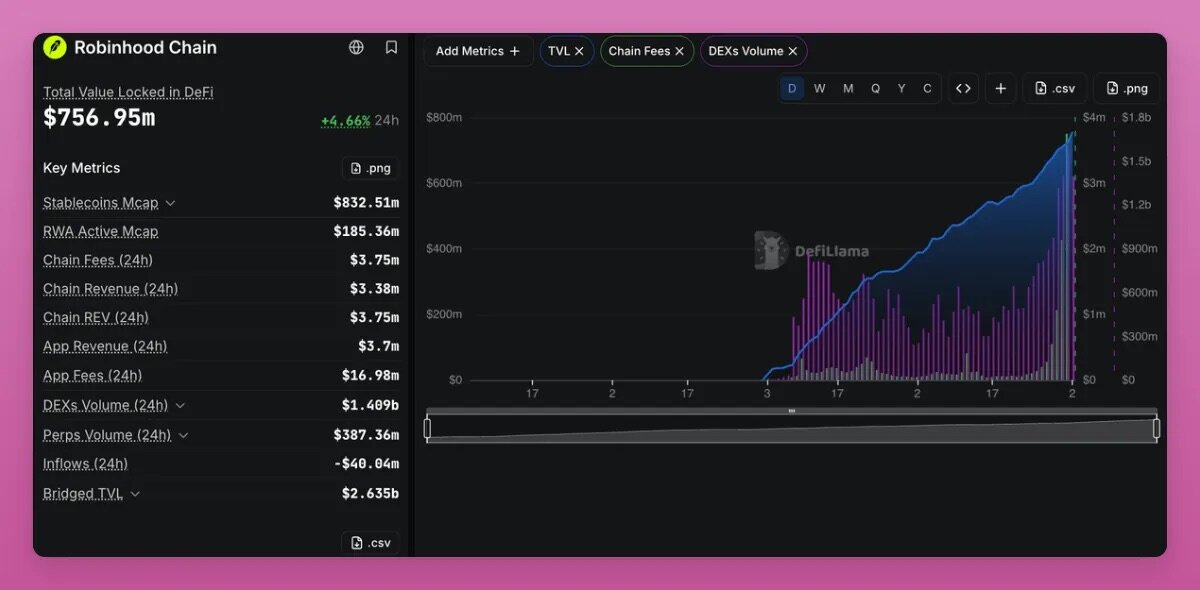
- Total Value Locked (TVL): $757 million
- DEX trading volume: $1.66 billion (second only to Solana's $2.1 billion, higher than Ethereum's $1.37 billion)
- 24-hour application fees: $16.98 million
- Stablecoin market cap: $833 million; cross-chain locked value: $2.6 billion
- Perpetual futures trading volume: $387 million
With a TVL of $757 million, it generates $17 million in daily application fees.
This translates to a corresponding annualized APR of 819%, or approximately 2.243% daily. If compounding is considered, the nominal APY reaches as high as 328,000%.
(Note: The 328,000% APY is a theoretical compounding calculation derived from a single day's extreme fee ratio in one small pool. This yield represents transient historical data and is not sustainable.)
Crypto player @0xSammy shared some data: tokenized stocks generate 13 million trades daily, with 203,000 wallet addresses holding tokenized stocks—a 46% increase in just 3 days.
Why the Annualized Yields Here Are So Attractive
There are two main reasons.
Nobody wants to provide liquidity. Fomo integrated with Robinhood Chain in July. It's a meme coin trading application that doesn't inherently feature liquidity pool functionality.
Robinhood Wallet and Fomo also support direct credit card purchases of meme coins. The Block reported that JPMorgan has already requested Visa investigate this matter. This trading volume all comes from users who will never become liquidity providers.
If you experienced the last DeFi Summer, you already possess all the skills needed for yield farming. These newly arrived crypto speculators become our source of yield.
Pool sizes are too small for institutional capital to enter. When I entered, the RBLX/USDG pool had a TVL of only $168,000, yet trading volume reached $6.2 million. Daily fees accounted for as much as 11% of total locked value!
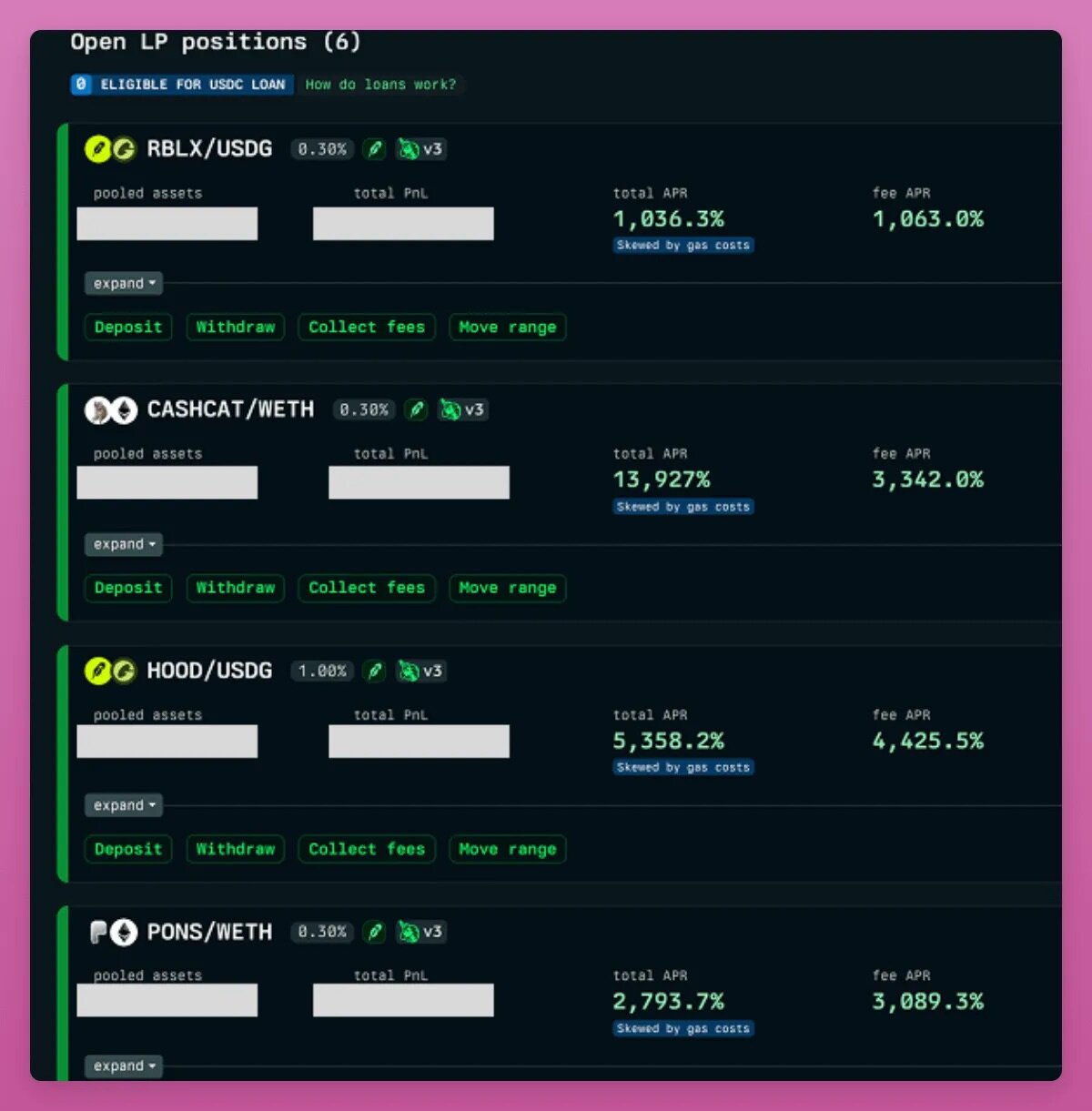
Institutions cannot deploy $5 million into a pool with only $168,000 locked. This is a perfect arena for retail speculators like you and me.
MemeFi Is the Best Liquidity Provision Business on This Chain
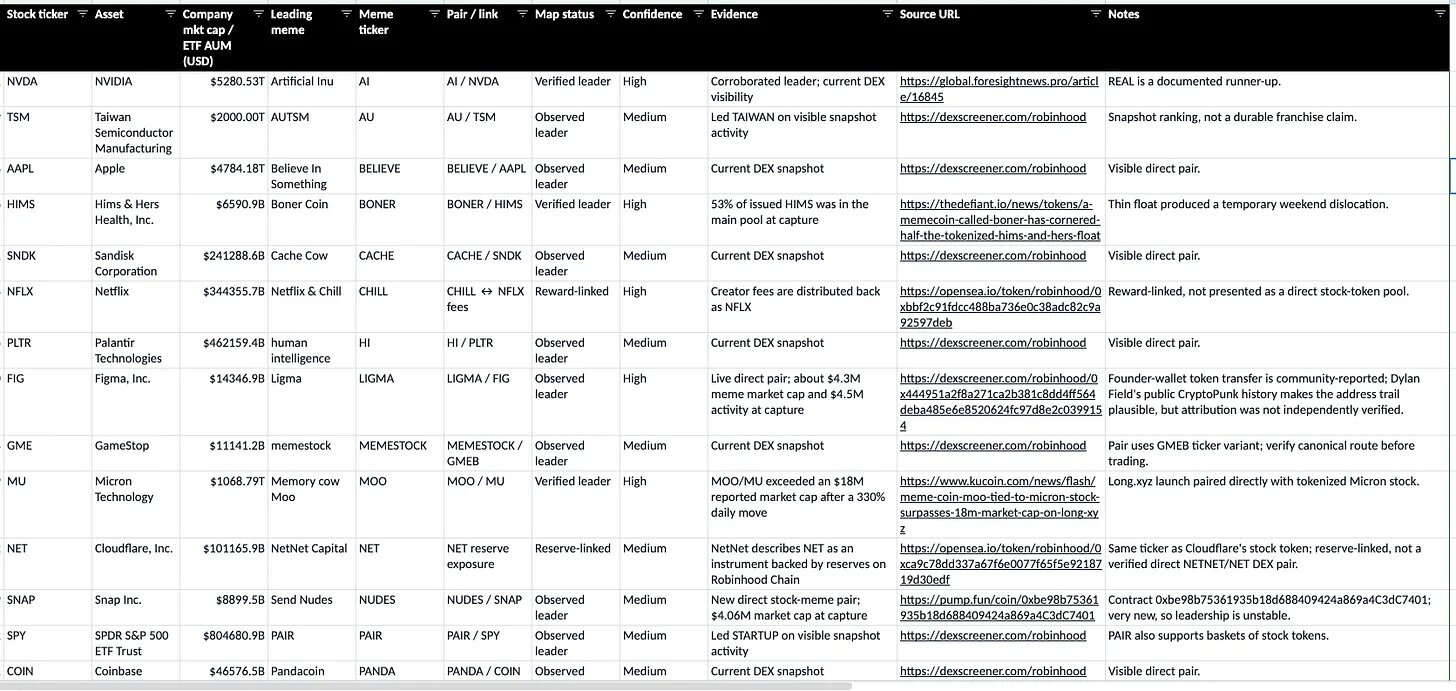
According to @0xSammy's statistics, there are currently 22 underlying assets, giving rise to 27 meme coin-tokenized stock trading pairs. Examples include AI/NVDA, MOO/MU, BONER/HIMS, NUDES/SNAP, LIGMA/FIG.
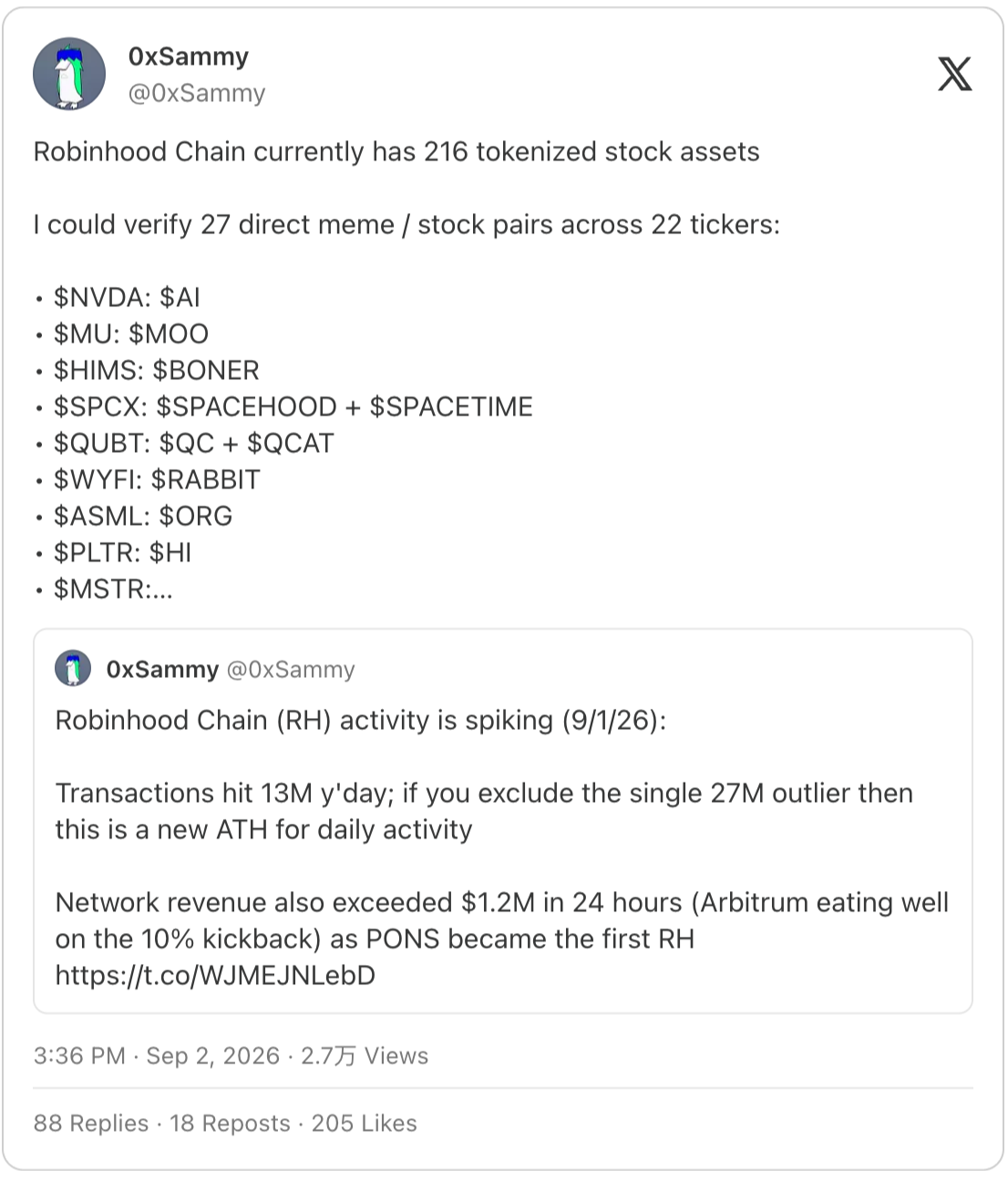
BONER alone accounts for 81% of the HIMS supply on-chain. Players attempt short squeezes, but it's essentially just circulating supply compression.
Data from scopl.live shows that some meme-stock pools are among the highest 24-hour fee generators on-chain:
- AI/NVDA: $447,000
- AI/WETH: $340,000
- UBIK/GLD: $321,000
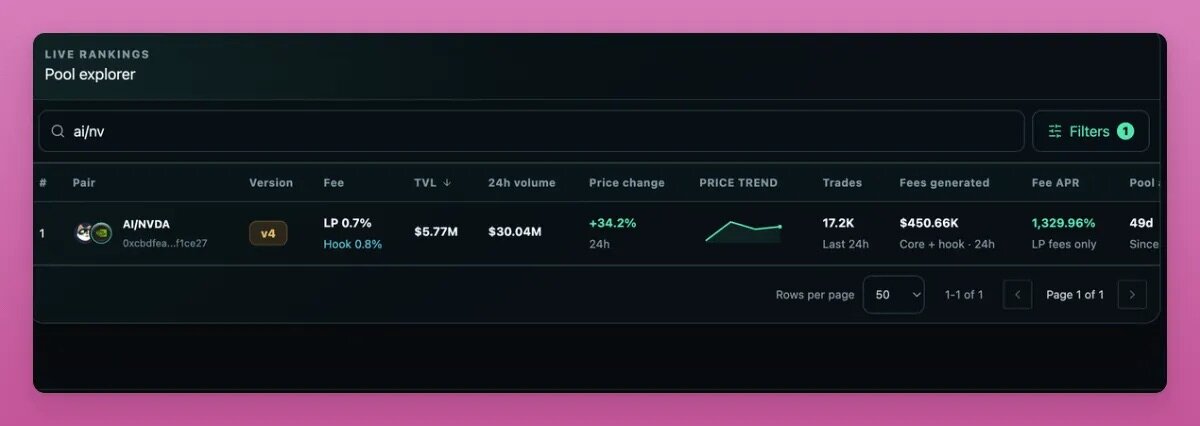
Fee-only annualized returns can reach 1,329%.
You don't need to hold meme coins at all, avoiding impermanent loss or catastrophic asset depreciation from KOL dumps. Every AI purchase executed through NVDA, every HIMS repricing triggered by BONER—arbitrage bots will continuously correct prices through stock/USDG pools, generating fees relentlessly.
My currently preferred pools: HOOD/USDG, NVDA/USDG, RBLX/USDG, DJT/USDG.
The complete list of meme coin trading pairs can be found in the spreadsheet link in this article.
Indeed, the experience accumulated during the 2020 DeFi Summer is your greatest advantage. But instead of mining valueless cat and dog meme coins, we're leveraging the growth of the tokenized stock sector to make meme coin speculators generate yields for us.
I love these high-risk meme coin traders.
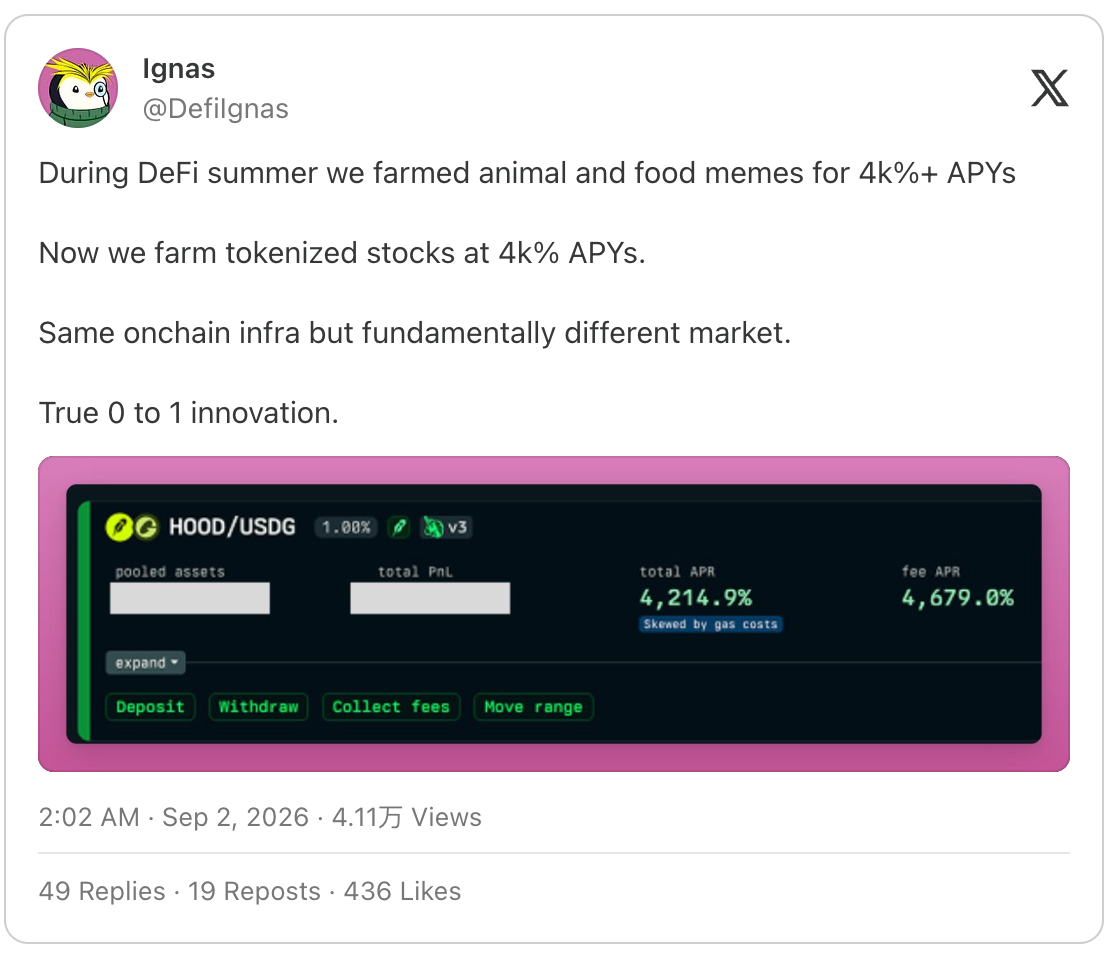
Mining Tool Checklist
Revert: My go-to LP tool. Instead of copy-trading meme coin speculators, you can directly copy-trade top-performing liquidity providers. You can filter LPs by APR, profit/loss, creation time, and more. You'll need to establish your own screening criteria and test extensively.
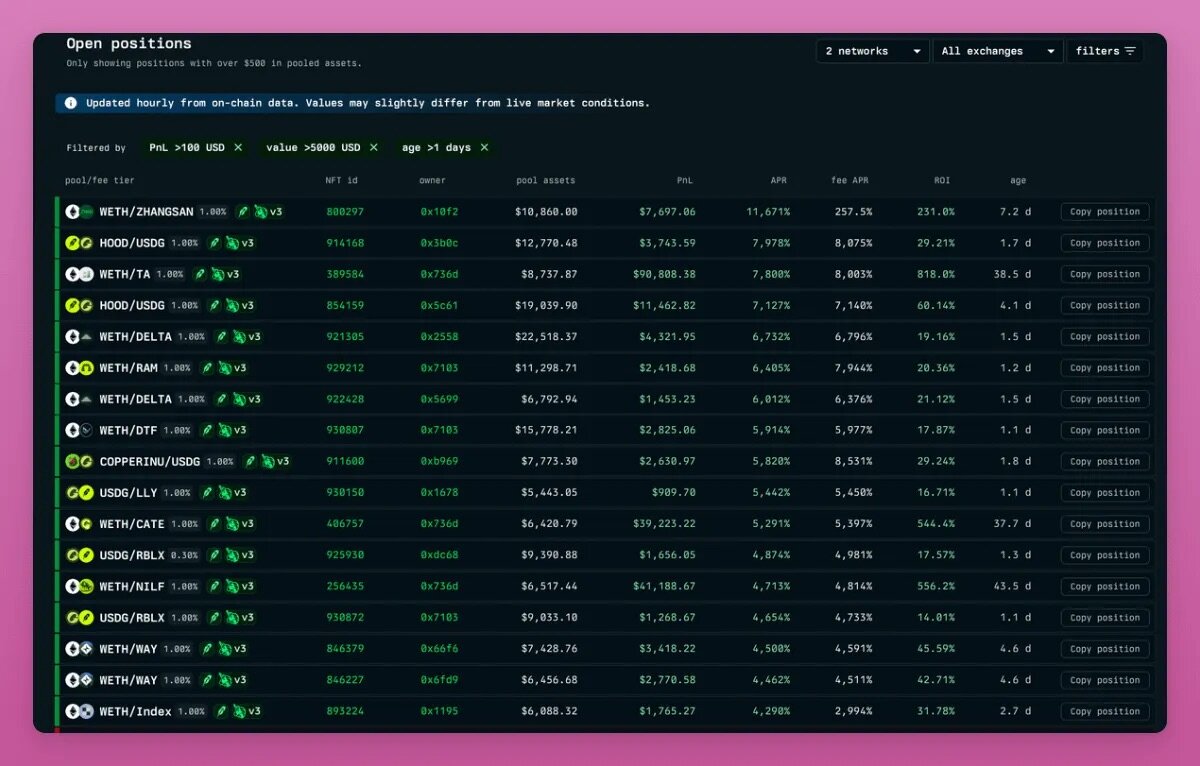
I particularly appreciate its support for single-sided liquidity provision and auto-rebalancing (though the platform seems to add a small fee for this feature).
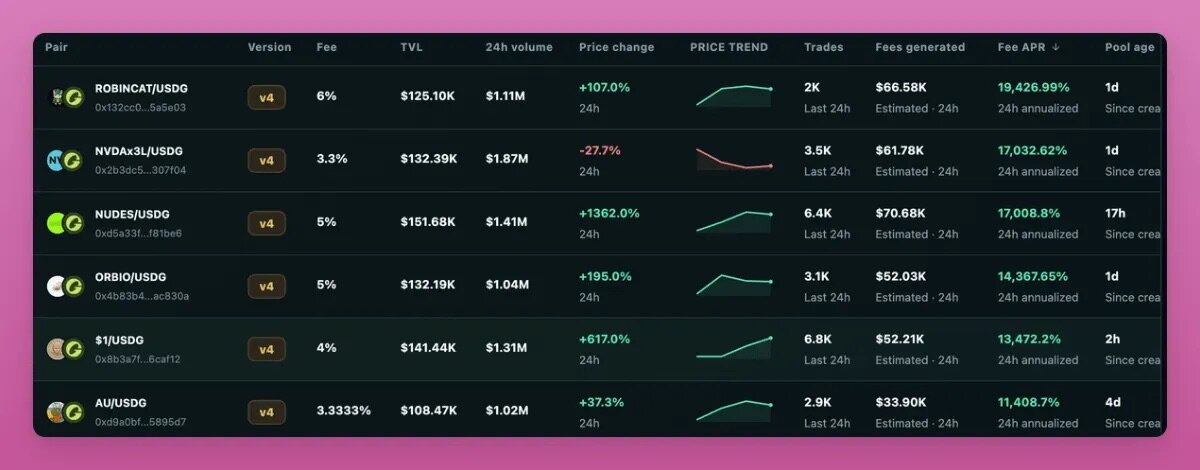
scopl.live: A pool discovery tool for viewing real-time fee APRs. The project's development quality is uncertain, but it's highly practical for discovering new pools—a solid alternative to Revert.
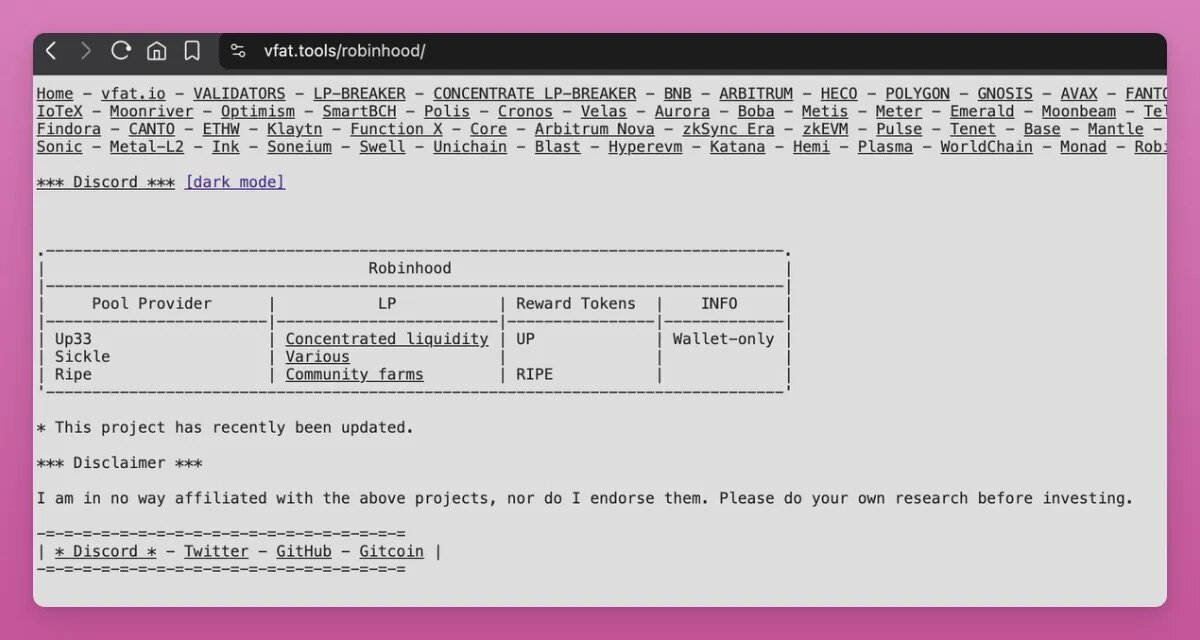
vfat.tools: A veteran reward farming tool, well-suited for token reward mining. Its utility is limited if you're doing Uniswap-style LP farming.
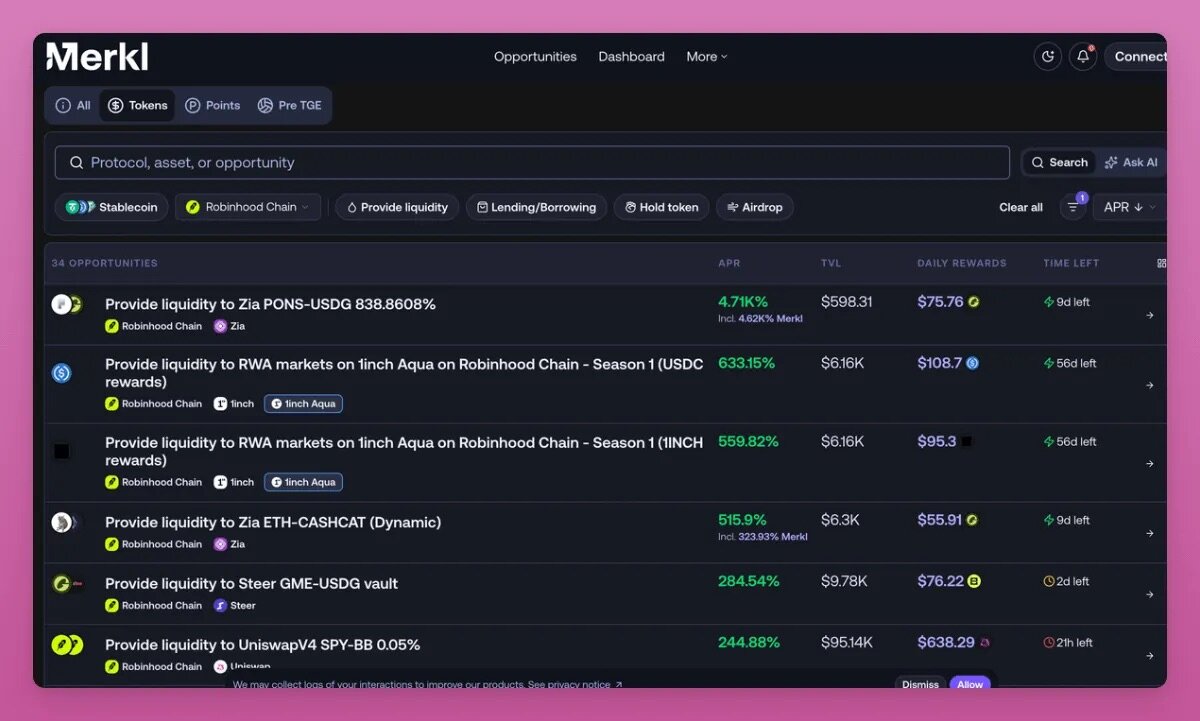
Merkl: The 2026 version of vfat, specifically designed for incentivized Uniswap positions. Filter by chain and select Robinhood. Currently, for the stock-token Uniswap v4 order books, Merkl offers over 100% additional annualized rewards on top of trading fees.
Leveraging AI for Yield Farming
AI has dramatically lowered the barrier to entry. Use Claude, Grok, ChatGPT, or whichever large language model you prefer to become a better farming participant.
AI can help you track and calculate total ROI, discover new pools, and build a unified position dashboard across multiple platforms. In the age of AI, there's no excuse not to master yield farming.
At the time of publishing, HOOD is only 1.5% above my cost basis—not bad at all.