AI Agent's "Coming of Age": From Simulated Training to Real Trading, What's Still Missing?


- Core Thesis: AI Agents are evolving from "learning to use tools" to "learning how to work." The current key bottleneck lies in the lack of trial-and-error mechanisms in continuous decision-making environments and the absence of secure, controllable execution permissions. The development of simulated training grounds and smart wallet infrastructure will determine whether financial Agents can move from testing to real fund management.
- Key Elements:
- In mid-August, SKALE launched AgentPit, a simulated trading sandbox for prediction market AI Agents. It syncs real Polymarket market data, employs a CLOB order book, replaces real funds with simulated USDC, and provides a dynamic feedback loop to iterate strategies.
- Traditional static benchmark tests cannot assess an Agent's capability in real-world complex decision-making. Financial markets require Agents to continuously adjust positions based on real-time news, odds, and order books, forming a "observe-judge-execute-feedback-adjust" loop.
- On August 18, Amazon Bedrock AgentCore Payments officially reached General Availability (GA), integrating Coinbase and Stripe/Privy wallets with support for stablecoins and the x402 machine payment protocol, enabling Agents to autonomously pay for and call third-party APIs without human intervention.
- On August 20, Binance launched Agent OS, integrating the Binance API, Wallet Agentic Hub, x402, Skills Hub, and MCP. This allows Agents to access market data and execute trades, while also supporting sub-account fund isolation and revocable permissions.
- imToken's Agent Wallet design employs account isolation, session keys generated within a TEE, and hard constraints via policy rules (such as protocol whitelists, per-transaction limits, and daily quotas). Users retain ultimate control and can pause or revoke permissions at any time.
- Simulated training is responsible for raising the ceiling of an Agent's decision-making capability, while smart wallets fortify the bottom line of operational security. The combination of both is a necessary precondition for Agents to enter real financial markets.
If you're a heavy Token consumer, over the past year, you've likely felt the most core evolution of AI Agents firsthand:
Beyond the intellectual leap of the underlying large language models themselves, they are increasingly beginning to resemble true "workers."
From the earliest chatbots to the gradual maturation of infrastructure like MCP, Skills, and Harness, Agents are gaining more and more "hands and feet"—they can open web pages, read real-time data, operate software, and even connect to wallets and trading accounts.
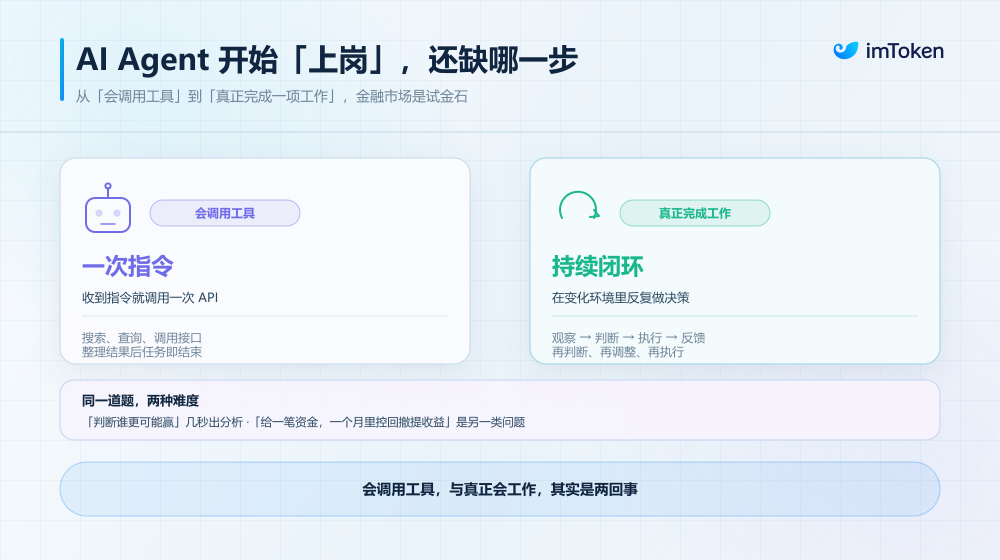
But at this stage, a new practical problem emerges: being able to use tools and actually completing a work task are two different things.
An Agent truly capable of undertaking tasks shouldn't just call an API once after receiving an instruction; it needs to continuously adjust its next actions based on results in a constantly changing environment.
Financial markets illustrate this difference particularly clearly.
You can tell an Agent, "Help me determine which team is more likely to win a certain match," and it can provide a decent-looking analysis within seconds. But if the requirement changes to, "Here's a sum of capital—participate in prediction markets continuously over the next month, increasing returns while controlling maximum drawdown," it becomes an entirely different category of problem.
It must continuously read real-time news, odds, and order books, assess whether the market has already priced in information, decide when to enter, add to, or exit positions, and adjust its strategy promptly when its own judgment proves wrong.
A series of infrastructure innovations that have emerged intensively in recent times seem to be filling in this previously missing piece of the puzzle, one by one.
1. Does an AI Agent Need a "Simulation Training Ground"?
In mid-August, SKALE launched a rather interesting new product called AgentPit.
Simply put, it's a "simulated trading sandbox" built specifically for prediction market AI Agents. It synchronizes real Polymarket market information and is compatible with its API, while adopting a production-grade CLOB order book, CTF Token, and settlement mechanisms—only replacing real funds with simulated USDC.
Developers can let Agents read order books in real-time, place orders, match trades, and manage positions within it, testing strategies with zero risk of capital loss. At the same time, they can observe the emergent group behavior that arises when multiple Agents compete within the same order book.
This seems somewhat similar to backtesting and paper trading in traditional quantitative finance, but for AI Agents, its significance runs far deeper.
That's because one long-standing problem Agents face is: how do you actually know whether an Agent "can really trade"?
As everyone knows, in the past, evaluating large model capabilities relied heavily on static benchmarks—solving a few math problems, fixing a piece of code, or summarizing a long text.
But complex decision-making in the real world has no predefined standard answers, especially in financial markets. Suppose an Agent determines that the fair value of "YES" for a prediction event should be $0.70, while the current market price is $0.55. After it buys, the price could continue dropping to $0.45, or it could spike rapidly due to breaking news. Additionally, the instantaneous liquidity of the order book will directly affect the actual average execution price.
This means an Agent cannot simply make one prediction and be done with the task—it must continuously face the real consequences of its previous decisions. This is precisely the core value of AgentPit. It provides intelligent agents with a dynamic feedback loop that approximates a real production environment:
Observe → Decide → Execute → Receive Feedback → Adjust → Re-execute.
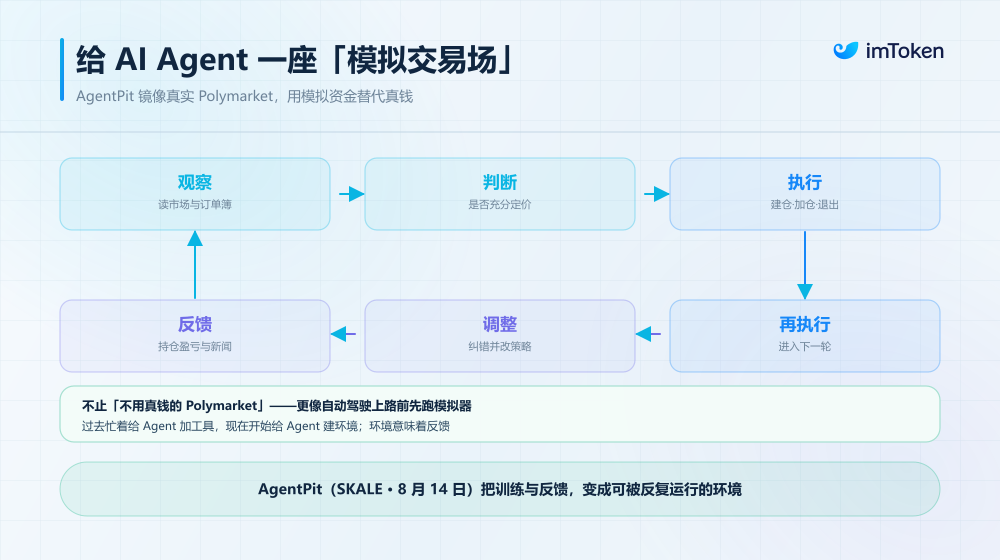
Of course, "training" here doesn't necessarily mean the Agent automatically modifies its underlying model parameters after every trade. What it provides is an environment where strategies can be repeatedly run, results evaluated, and workflows iterated upon.
Just as autonomous driving systems need to experience numerous extreme scenarios in simulators before hitting real roads, a financial Agent that may one day manage real funds can hardly be granted asset control rights based on just a few prompt tests. It needs to first prove how well it performs in a continuous decision-making environment.
But with this, problems also arise.
Performing well in a simulated environment doesn't mean real money can be handed over to AI immediately. There's still a more critical layer in between.
2. Infrastructure Convergence: When Payments and Trading Become Native Components of Agents
If you observe the moves of mainstream cloud giants and leading trading platforms over the past few months, it's not hard to see that the operating rails for Agents are being standardized and connected at astonishing speed.
First is the landing of machine-native payment protocols.
On August 18, Amazon Bedrock AgentCore Payments officially became generally available. This service allows agents running on AgentCore to autonomously discover and pay for third-party APIs, MCP services, or specialized data sources. It integrates wallet infrastructure from Coinbase and Stripe/Privy, with native support for stablecoins and machine payment protocols like x402.
This solves an extremely pain-point-heavy bottleneck—if an Agent discovers during market analysis that a high-quality real-time data feed requires payment, previously the workflow would have to be interrupted, waiting for a human to manually swipe a card and configure an API key before continuing.
Under the AgentCore Payments framework, payment is directly encapsulated as an automated node within the workflow. Users only need to pre-set budgets and policies, and the Agent can autonomously initiate micropayments to complete calls when hitting paywalls. The entire process requires no human intervention, and wallet private keys and credentials remain isolated from the model itself.
Then, two days later on August 20, Binance launched Agent OS, opening up Agent-native interfaces.
Unlike merely providing a single AI feature, Agent OS functions more like a layer of financial infrastructure interfaces purpose-built for Agents, integrating components such as the Binance API, Wallet Agentic Hub, x402, Skills Hub, and MCP.
It allows compatible AI applications to fetch market data and view account information via MCP, and execute supported trading operations after user authorization. More critically, it emphasizes permission boundaries and isolation at the mechanism level:
Users can assign dedicated sub-accounts to Agents, isolating funds and trading activities from the main account, and configure specific permissions for Agents; these access permissions can also be revoked at any time.
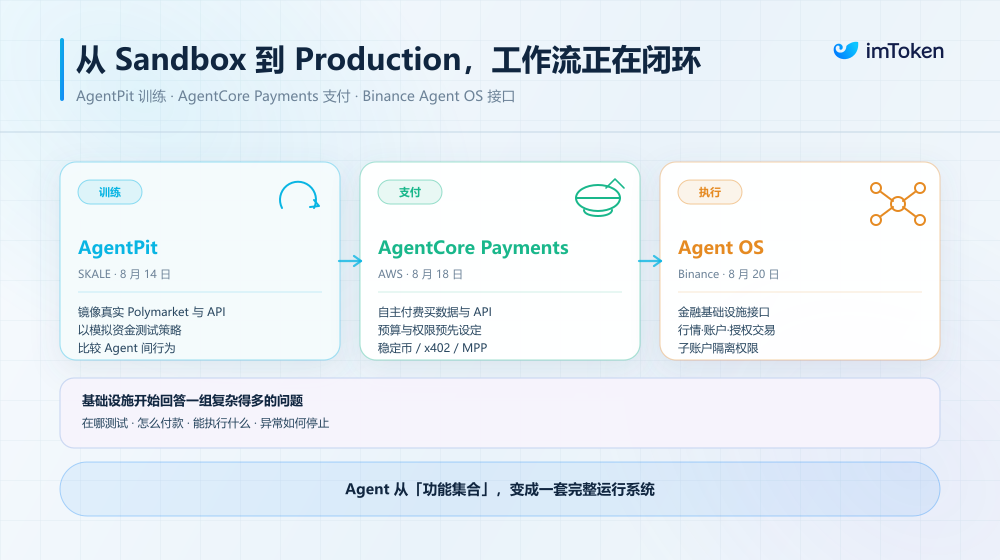
If you put AgentPit, AWS AgentCore Payments, and Binance Agent OS together, an increasingly clear shift emerges:
AgentPit provides an environment for strategy testing and continuous feedback, x402 and AWS AgentCore Payments begin to enable machine-native payments, and Binance Agent OS further opens up market data, accounts, trading, and on-chain capabilities to Agents. The previously fragmented capabilities are being gradually strung together into a complete workflow.
However, one particularly special aspect of financial scenarios is that if code is written incorrectly, you can just rerun it—but once an Agent executes a wrong trade, assets may have already truly left the wallet.
This means that when transitioning from a simulated environment to the real world, there's one role that cannot be bypassed.
That role is the wallet.
3. What Is the Real Value of Agent Wallets?
If you sketch out the complete workflow of a future AI Agent, it presents a clear chain:
- First, train and test strategies in a simulation environment like AgentPit;
- Then, obtain information and tools through MCP, Skills, and various APIs;
- Purchase data and compute resources via protocols like x402 (further reading: "When AI Agents Start Owning 'Wallets': After Economic Autonomy, Who Holds the Control?");
- Then enter real markets to execute trades;
- And finally, continue optimizing strategies based on actual results;
By the time we reach the execution step, the role wallets play will be completely different from today.
After all, the interaction logic of traditional Web3 wallets is designed for human-computer interaction—every signature relies on a human visually verifying details on screen and manually clicking to confirm. But if a high-frequency Agent needs to read multiple sets of order book data every second and continuously fine-tune positions, requiring human signature for each transaction would render automation meaningless.
On the other hand, directly handing private keys to AI would mean abandoning all security bottom lines.
Therefore, what Agent Wallets truly need to solve is never "how to let AI obtain private keys," but rather "how to provide Agents with safe, controllable execution authority without ceding ultimate control over assets."
This is also the core solution offered by imToken in its Agent Wallet design framework:
- Account Isolation and Session Keys: In imToken's Agent Wallet design concept, each Agent granted execution authority corresponds to an independent Agent Account. Its Session Key is generated and isolated within a Trusted Execution Environment (TEE) and never leaves that secure environment.
- Hard Constraints via Policy Rules: Each Agent Account must be bound to a clear Policy, including restrictions such as whitelists of protocols allowed for interaction, per-transaction limits, daily quotas, operation frequency, and authorization validity periods. In other words, what an Agent receives is not an unconstrained wallet, but an execution account surrounded by rules.
- Users Retain Ultimate Control: Agents can only execute autonomously within the Policy boundaries pre-authorized by users. Operations beyond those boundaries must be re-submitted for user confirmation. Users can always adjust Policies, pause or resume Agents, revoke permissions, and withdraw funds. For transactions identified as abnormal or exceeding preset policies, automated execution is also paused, and user identity authentication is required again.
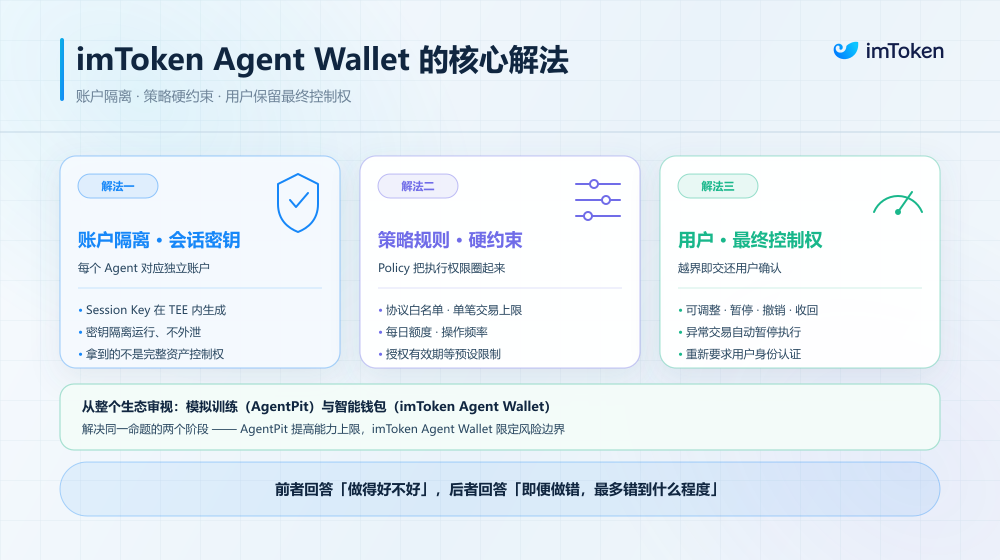
Viewed from this dimension across the entire ecosystem, it becomes clear that simulation training (like AgentPit) and smart wallets (like imToken's Agent Wallet) are actually solving two stages of the same proposition.
The former is responsible for raising the ceiling of an Agent's decision-making capability; the latter is responsible for fortifying the safety floor of an Agent's actions.
Neither can be omitted.
This may be the most significant change Agent Wallets bring compared to traditional wallets.
Final Thoughts
In this sense, with the arrival of AgentPit, a noteworthy new phase is emerging.
AI Agents are transitioning from "learning to use tools" to "learning how to work."
And when they finally step out of the simulation training ground and into the turbulent world of real trading, what determines whether that step is steady and far-reaching often depends not only on how smart the underlying large models are, but also on how robust the account and authorization boundaries we build for them are.
After all, in a real, complex economic system, what we truly need is never an Agent that never makes mistakes, but an Agent whose risks remain within controllable boundaries—even when it does err.