13F New Signal: AI Isn't Fading—Wall Street Is Just Getting More "Selective"


- Core Takeaway: The Q2 2026 13F filings show that Wall Street hasn't systematically retreated from AI, but consensus is beginning to diverge internally—shifting from chasing hot sectors to calculating individual stocks' "odds" and expectation gaps. The phase of blindly buying chip stocks is over.
- Key Elements:
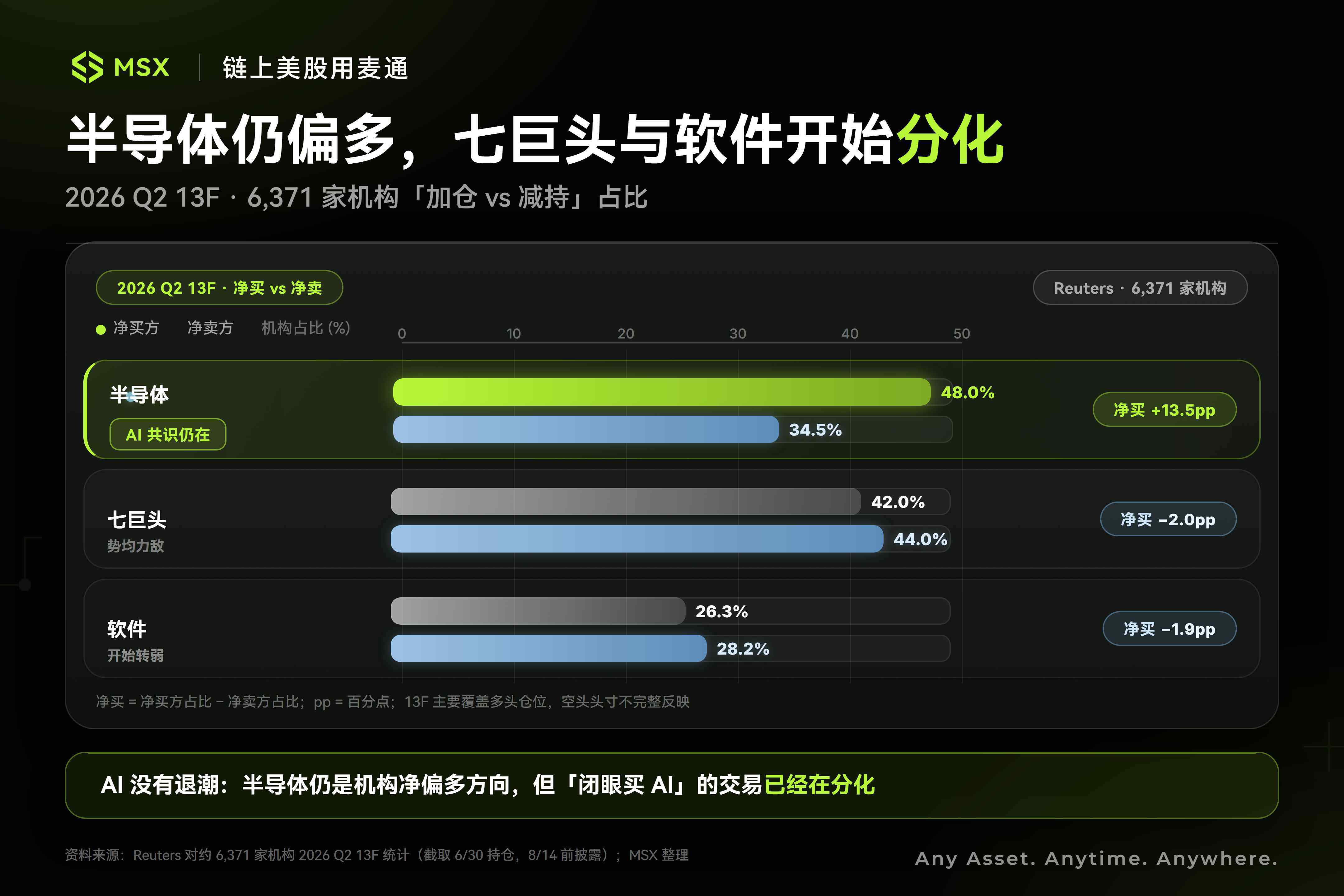
- Across 6,371 institutions surveyed, 44% trimmed positions in the "Magnificent Seven" while 42% added—a near dead heat. Semiconductors remain favored (48% net buyers), while software shows divergence, indicating the AI consensus is loosening rather than reversing.
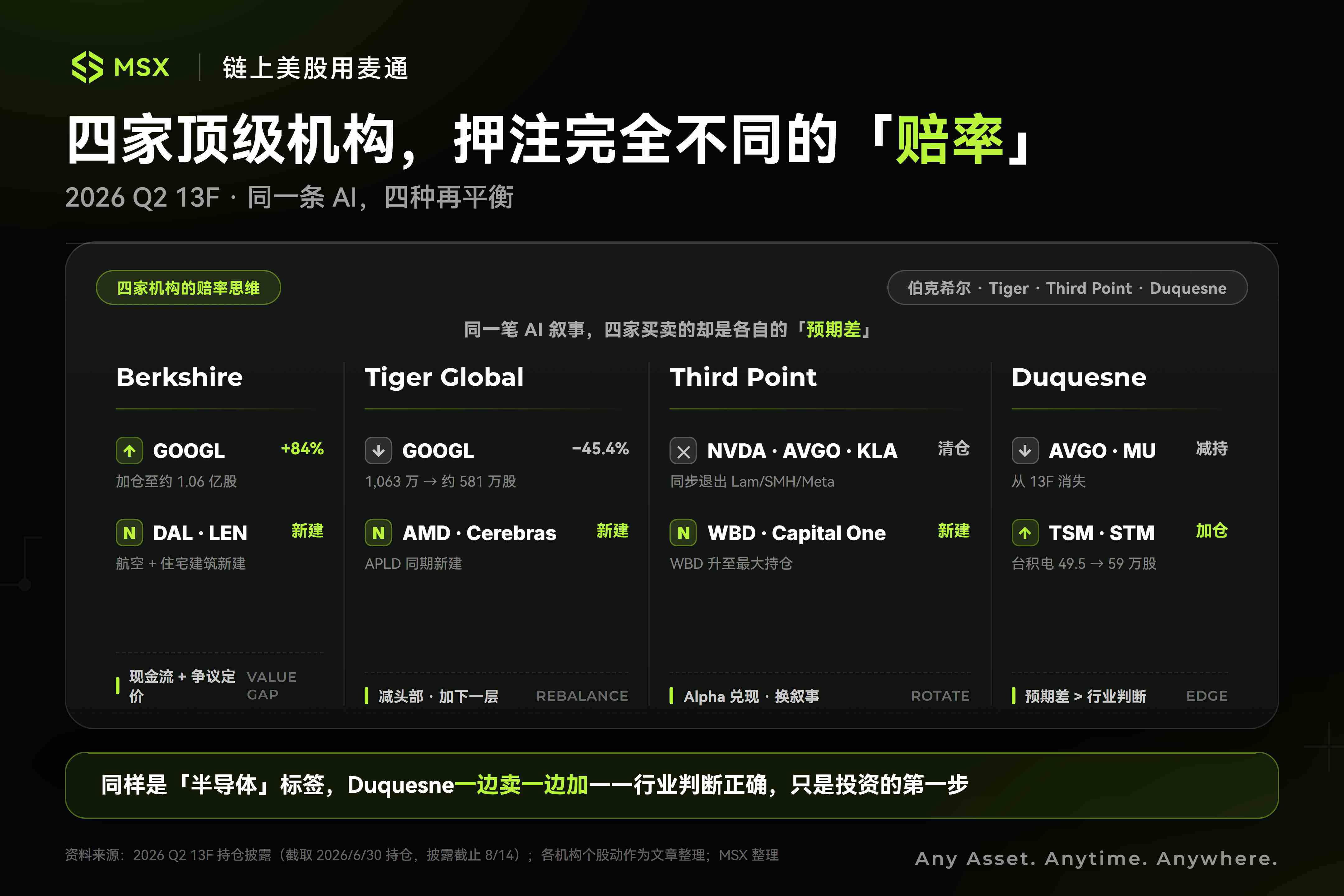
- Berkshire Hathaway significantly boosted its Alphabet stake by over 80% to 106 million shares in Q2, viewing it as a repricing opportunity where cash flow is strengthening but the stock is suppressed by AI controversy. It also increased exposure to airlines and residential construction.
- Tiger Global cut top holdings like Alphabet and Broadcom while establishing new positions in AMD and AI computing companies—reflecting an internal rebalancing from crowded leaders toward the next tier of opportunities.
- Third Point liquidated direct beneficiaries like Nvidia and Broadcom, instead adding to Alphabet and TSMC, while taking heavy positions in non-AI assets such as media and financials—aiming to lock in first-phase gains and search for new opportunities.
- Druckenmiller's Duquesne sold Broadcom and Micron but bought AMD the same quarter. The core logic is adjusting positions based on market expectation gaps—rebalancing between assets that have risen too fast and those not yet priced in.
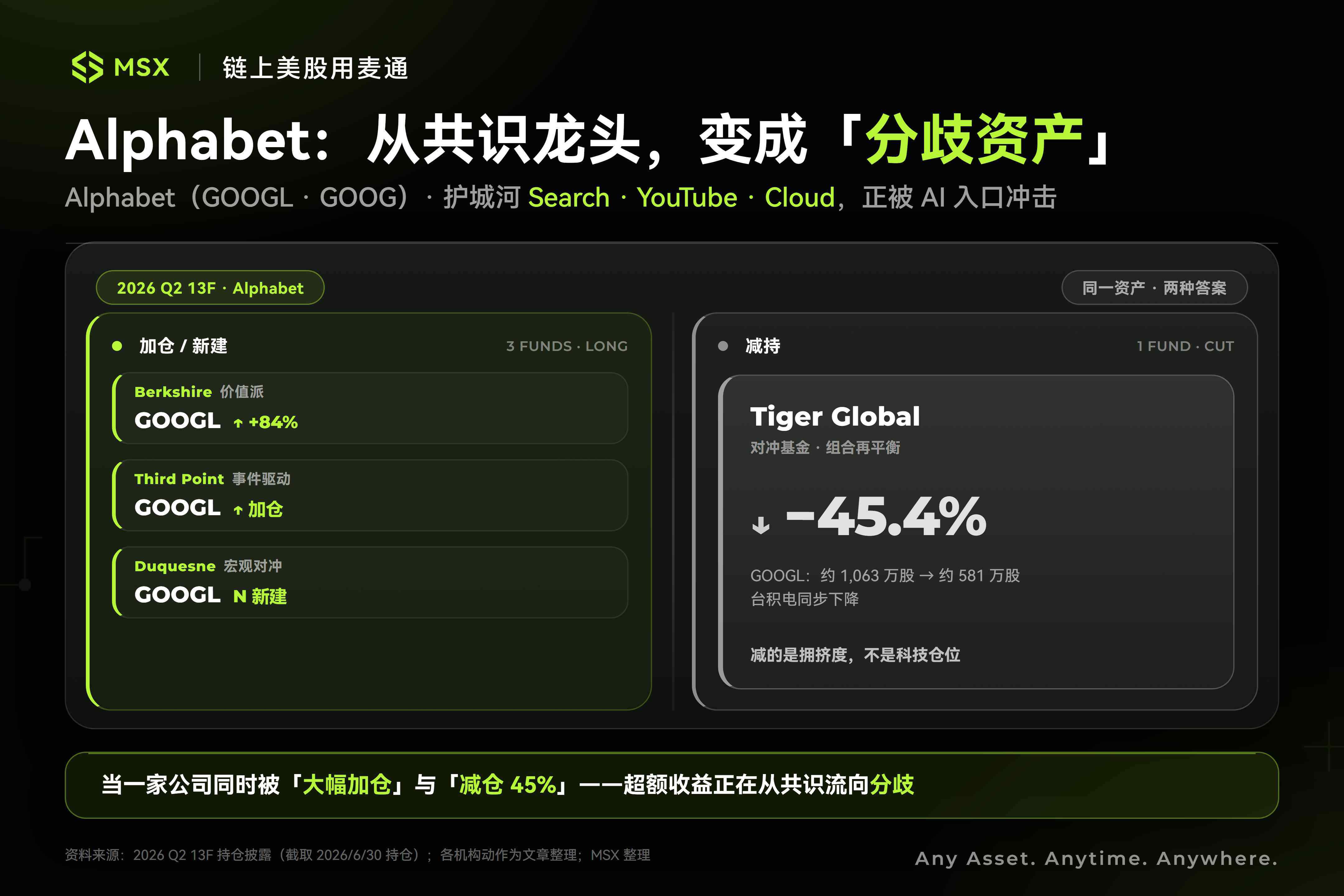
- The conclusion is that Alphabet has become the "divergence asset" among top institutions. Non-AI assets are being used to reduce portfolio correlation, and investment focus is shifting from judging the macro direction toward refined portfolio management.
In each quarter's 13F filings, perhaps the least valuable observation is:
"Which stocks did the big investors buy?"
Because 13F filings are, by nature, a lagging snapshot of holdings.
Under SEC rules, institutions have up to 45 days after the end of a quarter to disclose their holdings. The latest round of Q2 2026 13F filings reflects positions as of June 30, with the centralized disclosure deadline falling on August 14. More importantly, 13F filings primarily cover long positions in eligible US-listed securities, while short positions and other holdings are not fully reflected.
So, they're not really suitable for real-time "copy trading."
But from another angle, the value of 13F filings is actually quite high—over the past three months, what have the truly big money players actually been buying and selling?
After sorting through them, we've spotted a critical signal: AI hasn't receded, but Wall Street is starting to get "picky" about it.
1. The AI Consensus Remains, But the "Herd Consensus" Is Beginning to Loosen
If you only look at a few star funds, it's easy to be misled by individual trades.
What's truly worth paying attention to is the shift across the entire institutional landscape. Reuters analyzed Q2 13F filings from 6,371 pension funds, hedge funds, wealth management firms, and others, and found:
- Nearly 44% of institutions trimmed their positions in the "Magnificent Seven," while about 42% chose to build new or add to positions—almost evenly split;
- But for semiconductors, the direction remains clearly bullish: about 48% of institutions were net buyers, while only 34.5% were net sellers;
- Software tells the opposite story: among a group of major software companies, net sellers accounted for 28.2%, slightly higher than net buyers at 26.3%.
This shows that the AI consensus still exists, but it's rapidly fragmenting from within.
After all, if Wall Street were truly beginning a systematic rejection of AI, the first sign would be a coordinated retreat from semiconductors, computing power, and the data center supply chain.
That's not what's happening.
Chips remain a clearly favored sector among institutions, and there's been no systematic sell-off of AI infrastructure. Big money is simply starting to ask questions that didn't matter as much over the past two years:
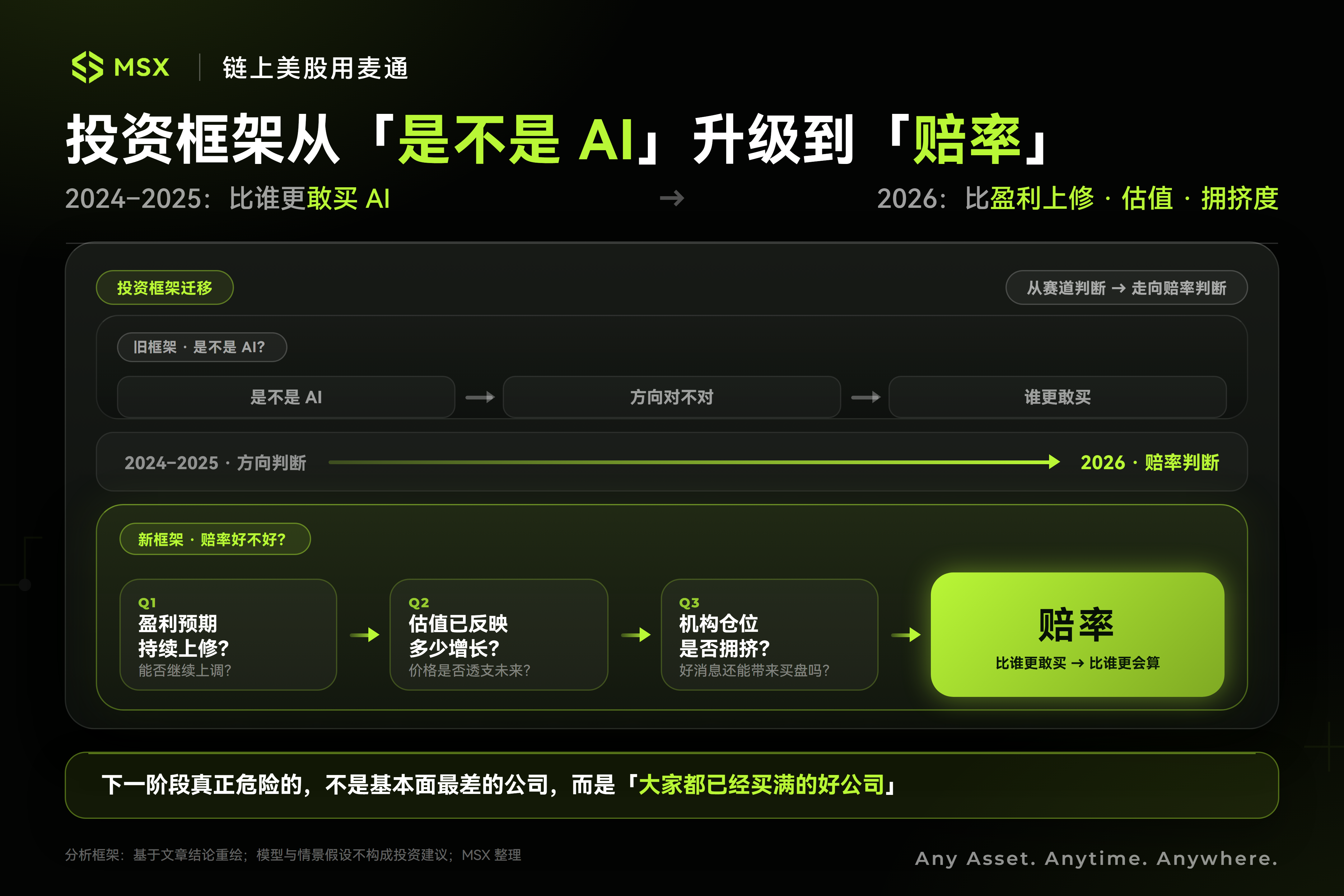
Has the stock price already priced in this company's growth over the next two to three years? With AI CapEx continuing to grow, who can actually convert capital expenditures into profits? If the market faces a correction, which asset class has the most crowded institutional positioning and would be the first to be liquidated?
This is the most important shift in Q2 13F filings—Wall Street is now visibly debating "who offers better odds within AI."
And Berkshire Hathaway, Tiger Global, Third Point, and Druckenmiller's Duquesne have each provided four completely different answers.
2. Four Institutions, Four "Odds-Based" Approaches
1. Berkshire Hathaway: Starting to Put Cash to Work, Betting Big on Google
In this round of 13F filings, Berkshire's moves on Alphabet deserve special attention.
At the end of Q1, Berkshire disclosed approximately 57.84 million shares across Alphabet's Class A and C stock. By the end of Q2, that number had risen to roughly 106 million shares—an increase of over 80%.
Based on quarter-end market value alone, Alphabet has become one of Berkshire's most important public US equity holdings. At the same time, Berkshire also increased its exposure to Delta Air Lines, Lennar, and other aviation and residential construction-related positions.
Keep in mind that Alphabet is arguably one of the Magnificent Seven least resembling a "pure AI trade."
Over the past few years, one of the market's biggest concerns has been whether generative AI will change the search entry point, potentially eroding the core commercial moat that Google Search has maintained for so long.
But on the other hand, Alphabet still owns Search, YouTube, Google Cloud, its advertising business, and a massive cash flow base.
So Berkshire's heavy bet is essentially asking: Is there room for repricing in a company that still generates strong cash flow, whose core business hasn't been proven wrong, yet has long been weighed down by AI-related controversy?
This is a completely different trade from chasing the hottest AI winners.
2. Tiger Global: Trimming Big Tech, But Still Focused on Tech Positions
Tiger Global's portfolio offers another highly representative example.
In Q2, it cut Alphabet from approximately 10.63 million shares to about 5.81 million—a 45.4% reduction. Its Broadcom position was nearly halved, TSMC was also reduced, and Microsoft, Meta, and NVIDIA all saw varying degrees of trimming.
If you stopped there, you might easily conclude that "Tiger is retreating from AI."
But look at what it bought, and the answer is almost the complete opposite.
Tiger established new positions in AMD, Applied Digital, and Cerebras in Q2, while its portfolio also added AI computing and data center-related assets like Cipher Digital and Core Scientific. Its Intel stake also grew from roughly 1.64 million shares to about 4.25 million.
So this looks more like a rebalancing within AI positions—reducing exposure to already extremely crowded headliners while shifting some chips toward the next tier of opportunities where market expectations aren't yet so uniform.
NVIDIA is the most typical example. A fund being bullish on AI computing power long-term doesn't mean it must keep increasing its NVIDIA position forever.
As long as the position weight is already high enough, or the stock price is rising faster than earnings estimate revisions at any given stage, trimming can simply be portfolio management—not a reversal of the thesis.
This is also becoming increasingly important for US equities: continued earnings growth doesn't necessarily mean the stock will keep rising the way it has over the past two years.
Because what determines a stock price isn't just "whether results are good," but also how much of that the market has already believed in advance.
3. Third Point: Banking Profits and Hunting for AI's Next Wave
Daniel Loeb's Third Point made even bolder moves.
In Q2, it completely exited NVIDIA, Broadcom, KLA, Lam Research, and the VanEck Semiconductor ETF (SMH)—a cluster of core beneficiaries of the AI capex cycle—while also stepping away from Meta.
If you only looked at this batch of trades, you could almost interpret it as a large-scale "AI reduction."
But Third Point hasn't left tech.
Instead, it significantly increased its positions in Alphabet and TSMC, and built new positions in Keysight and Flex. Meanwhile, capital flowed into media, financial, and industrial names like Warner Bros. Discovery, Capital One, and Norfolk Southern. Warner Bros. Discovery even became its largest public US equity holding at the end of Q2.
So Third Point is essentially cashing out of the easiest-to-understand winners of the first phase, while searching for opportunities that haven't yet been fully priced in by the market.
Why were NVIDIA, Broadcom, KLA, and Lam Research the winners of the first phase? Because their logic was too straightforward:
Model scale expands, requiring GPUs; advanced chip capacity expands, requiring semiconductor equipment; AI clusters expand, requiring networking, ASICs, and increasingly complex infrastructure.
There's nothing wrong with this logic.
The problem is, once all investors already know this logic, what determines returns in the next phase is whether actual growth can continue to exceed already-elevated market expectations.
This also means that top investment institutions are beginning to believe that the most obvious Alpha from AI's first phase is getting increasingly expensive.
4. Druckenmiller: Trading Only on Expectation Gaps
If you're looking for the fund that best explains this round of institutional thinking, Stanley Druckenmiller's Duquesne might be the most representative example.
At the end of Q1, it still held Broadcom and Micron. By Q2, both had disappeared from the 13F.
But at the same time, Duquesne built new tech positions in Alphabet, AMD, and Palo Alto Networks, while continuing to increase its TSMC and STMicroelectronics stakes: TSMC grew from about 495,000 shares to roughly 590,000, while STMicroelectronics rose from about 2.61 million shares to approximately 3.1 million.
At first glance, this even seems contradictory—both are semiconductor names, so why selling one while buying another?
The answer may be the most important keyword of this 13F round: the expectation gap.
If a company's stock has risen too fast and the market has already priced in two to three years of future growth, it's entirely reasonable to take profits first—even if the long-term thesis remains intact.
Conversely, if another company's earnings cycle is improving while the market hasn't yet formed a consensus, then even if it isn't the hottest AI leader, it may offer a better risk-reward profile.
Getting the industry thesis right is just the first step of investing. Where you buy—at what valuation, at what point, and how much the market has already priced in—is what truly determines your final returns.
3. From "Buying AI" to "Calculating Odds": What Is Wall Street Trading?
Put the four institutions together, and the truly valuable signals begin to emerge.
First, Alphabet is shifting from a consensus leader to a "divergent asset."
Alphabet is arguably the most interesting large-cap tech stock this cycle. Berkshire heavily increased its stake, Third Point and Duquesne also chose to add or re-establish positions, while Tiger Global slashed its stake by nearly half.
For the same company, top-tier capital has reached completely different conclusions.
The market is uncertain whether AI will ultimately weaken Google Search's moat, or whether it will further unlock the value of Alphabet's massive traffic, data, cloud computing, and computing power base.
From this perspective, buyers see cash flow, valuation, and potential AI-driven upside; sellers see changing search entry points, expanding capex, and the long-term structural challenges that legacy business models may face.
Assets like this are often more worthy of research than companies "everyone knows are great," because true excess returns inherently come from places where the market disagrees.
Second, the semiconductor consensus still holds, but the "blindly buy chips" phase is over.
Across the overall 13F data, chips remain a clearly favored sector among institutions, with net buyers significantly outnumbering net sellers.
But looking at individual star funds, you see massive internal divergence. Broadcom—some are selling. TSMC—some are adding, some are reducing. AMD—some institutions are rebuilding positions. NVIDIA, meanwhile, has gone from a virtually uncontested core AI asset to one where position costs and crowding now require recalculation.
This shows that semiconductors can no longer be traded as a single, monolithic Beta.
GPUs, ASICs, wafer foundry, memory, semiconductor equipment, networking, and data center infrastructure—these all look like AI hardware, but they occupy completely different earnings cycles, supply-demand dynamics, and valuation states.
In other words, AI hardware is moving from "buying the industry Beta" to a stage where "individual stock Alpha" truly matters.
Another easily overlooked shift: non-AI assets are re-entering portfolios.
This isn't a rejection of AI—it looks more like a hedge to reduce correlation. Residential construction, aviation, financials, healthcare, media, railroads, and industrial assets are reappearing in significant moves by some top institutions:
Berkshire added aviation and residential construction exposure; Third Point directed substantial capital toward media, financials, and railroads; Duquesne's portfolio itself is far from being purely AI-focused.
In a sense, precisely because AI has become the most conspicuous and easily understood theme across the market, big money increasingly needs to find return sources with lower correlation to AI.
Over the past two years, simply getting the direction of AI right was enough to generate substantial returns. Going forward, portfolio management will matter far more.
This may be the most important takeaway for ordinary investors from the latest 13F round: it shows us what questions the smartest, best-resourced capital is beginning to disagree on, even as they face the same industrial theme.
Final Thoughts
Over the past two years, the easiest trade in US equities was to find AI—and buy it.
NVIDIA, Broadcom, Meta, Microsoft, TSMC, and the entire semiconductor supply chain all simultaneously enjoyed the tailwinds of industry growth, earnings upgrades, and valuation expansion.
But the latest round of 13F filings is sending an increasingly clear signal—AI isn't over, but the phase where "as long as you're in the right direction, everything rises together" is coming to an end.
That's the most important change in the Q2 2026 13F filings:
AI hasn't receded, but the herd is starting to break apart.
In the next phase, the game isn't about who's bolder in chasing—it's about who's better at calculating the odds.