






Li Lin Returns to Entrepreneurship: UMX Aims to Build a "Unified Market" for Crypto and US Stock Trading


- Core Insight: UMX, a trading platform incubated by Li Lin's Avenir Group, has launched public beta testing. It aims to create a unified trading market for crypto assets and US equities, addressing the pain point of low cross-market capital efficiency for professional investors through cross-market fund transfers in both directions and collateralized lending mechanisms.
- Key Elements:
- UMX allows users to trade crypto assets, US equities, and ETFs within a single account system. Funds can be instantly transferred between crypto and securities accounts, with stablecoins automatically converted to US dollars.
- The platform offers a "Lending Transfer" feature, enabling users to collateralize crypto assets such as BTC and ETH to borrow stablecoins for US stock trading without selling their holdings. Conversely, users can convert US stock positions into tokens through the "Equity-to-Token" function to use as margin for crypto trading.
- Business operations encompass cryptocurrency trading, securities trading, and wealth management. Among these, the "Fixed-Term Wealth Management" and "Cash Management" products allow deposited funds to continue serving as trading margin, enhancing the utilization of idle capital.
- In terms of fees, crypto spot trading charges a 0.1% fee, with futures maker fees at 0.02% and taker fees at 0.05%. Stock trading carries a commission of $0.0099 per share, and options are priced at $0.95 per contract, comparable to traditional brokerages.
- UMX primarily targets high-net-worth and professional investors. Distinct from existing crypto CEXs and traditional brokerages, it is positioned as a cross-market trading gateway with unified capital management and margin systems.
Original | Odaily (@OdailyChina)
Author | Golem (@web3_golem)
On August 10, UMX, a trading platform incubated by Avenir Group under Li Lin, launched invite-only public beta testing, allowing users to apply for early access.
According to official publicity, UMX, short for The Unified Market Exchange, is a crypto-friendly securities platform built for professional investors worldwide. It offers unified market trading services, enabling users to trade both crypto assets and real stocks on a single platform, with seamless cross-market capital allocation.
Thirteen years ago, Li Lin founded Huobi. In that "Wild West" era of crypto, Li Lin built the gateway to the crypto world, solving the problem of where users could trade Bitcoin. Thirteen years later, Bitcoin has become deeply integrated into the global financial system, and the boundaries between crypto finance and traditional finance are gradually blurring. Now, with UMX, Li Lin is attempting to build a unified trading gateway for crypto and traditional finance, solving the cross-market and cross-asset capital efficiency problem for users.
UMX: Building a Truly Unified Crypto & Stock Market
Today, trading global stocks on crypto CEXs or on-chain is no longer a novelty. Coverage includes US stocks, Korean stocks, and even individual stock perps that only offer price exposure. In some cases, the price discovery capability of on-chain pre-IPO markets has even begun to surpass traditional financial markets. However, this still hasn't changed the fragmented landscape between crypto assets and traditional stocks. The market still lacks a unified trading platform where professional investors can trade both crypto assets and real stocks simultaneously.
Creating such a truly unified market framework for crypto assets and stock trading is precisely what sets UMX apart from both crypto CEXs and traditional stock brokers. On the UMX platform, users can trade crypto assets and US stocks within the same account system, with funds flowing seamlessly between the crypto and stock markets.
Two-Way Transfers Between Crypto and Securities Funds
On typical crypto CEXs, the "transfer" function in a user's asset page usually only moves funds between "crypto spot accounts" and "crypto derivatives accounts." On UMX, however, users can transfer funds between their "crypto trading account" and "securities account." Stablecoins in the crypto account can be transferred to the securities account and instantly converted to US dollars, and vice versa.
Once funds are transferred to the securities account, users can directly trade US stocks, ETFs, and US stock options. The UMX platform provides users with actual US stock holdings, not just price exposure. Stocks purchased on UMX come with full shareholder rights.
This two-way transfer capability means that for professional traders active in both the crypto and stock markets, it effectively adds a lossless, instant fiat on-ramp. Without the frequent friction and costs of moving funds in and out of crypto, capital can flow freely between the crypto and stock markets on a single UMX platform. This greatly helps professional traders improve capital efficiency and seize cross-market trading opportunities.
Enhancing Cross-Market Capital Efficiency
On UMX, beyond the flexible cross-market allocation of user funds, what's more important is the ability to enhance capital efficiency in both directions. Crypto collateralized lending is a familiar feature for traders – on CEXs, users can collateralize BTC, ETH, and other assets to borrow stablecoins for crypto trading. On UMX, users can do this and more.
Building on the two-way transfer mechanism between UMX's "crypto trading account" and "securities account," users can further utilize the "loan transfer" feature. This allows them to collateralize their BTC, ETH, and other crypto assets to borrow stablecoins, which are then transferred to the securities account and converted to US dollars for trading US stocks or options. Users can gain purchasing power for stock trading without selling their crypto assets, thereby increasing the capital efficiency of their crypto holdings.
Conversely, users can also deploy securities assets to participate in crypto trading. With traditional brokers, stock holdings cannot be used as margin for crypto trading unless the stocks are sold. On UMX, however, users can "collateralize" their stocks to obtain capital for crypto trading.
This is achieved through UMX's "Stock-to-Token" feature. Users can convert their US stock holdings into stock tokens (backed by real US stock assets). After conversion, the platform grants users margin for crypto trading based on a predetermined discount rate. Similar to two-way fund transfers, users can convert these stock tokens back into the underlying US stocks at any time.
Under this mechanism, users can maintain their long-term US stock exposure while unlocking capital for crypto derivatives and leveraged trading, significantly boosting cross-market capital efficiency.
It's worth noting that UMX's business actually consists of three parts. Besides cryptocurrency trading and securities trading, the third pillar is wealth management and capital management. Unlike other platforms, its "Term Wealth Management" and "Cash Management" products allow users to still use the deposited funds as trading margin, improving the efficiency of idle capital.
Platform Fees
According to UMX's official website, for regular users (VIP0), the taker and maker fees for crypto spot trading are both 0.1%. Fees gradually decrease with higher asset balances held on the platform and increased 30-day trading volume.
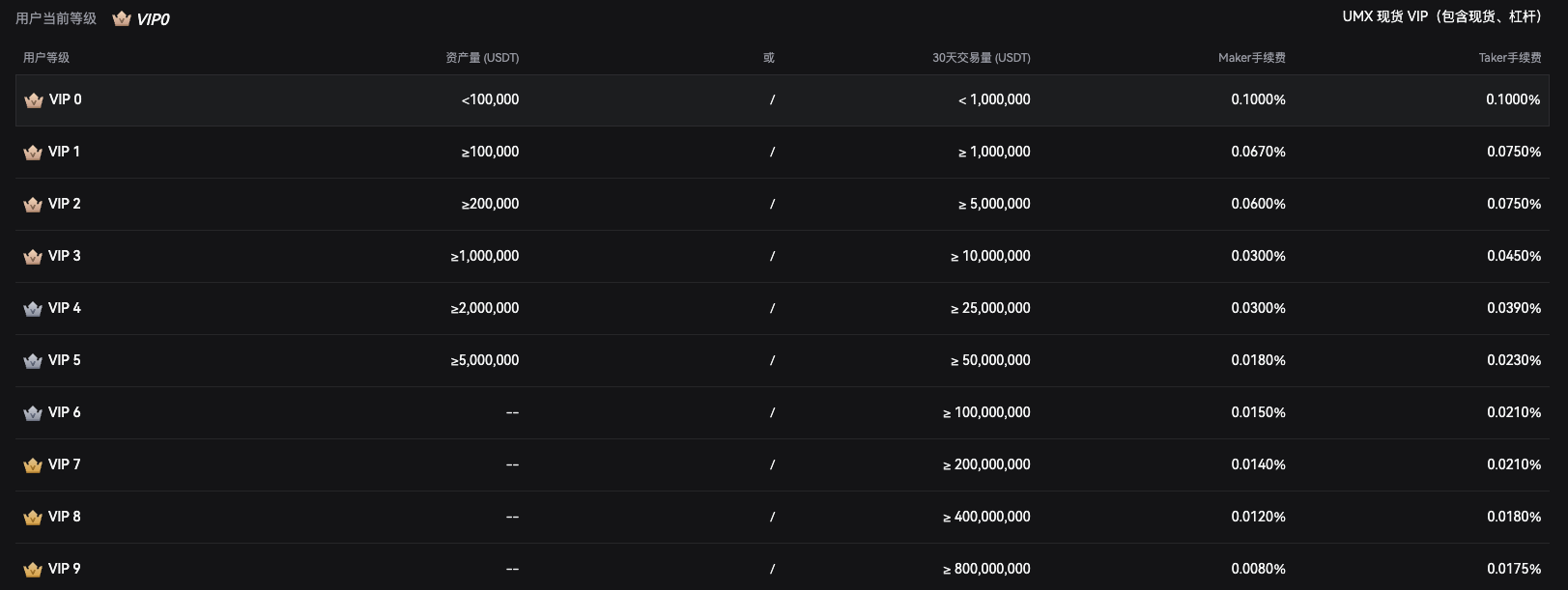
Crypto spot trading fees
Crypto derivatives trading fees are relatively lower. For regular users (VIP0), the maker fee is 0.02% and the taker fee is 0.05%. To encourage liquidity provision, the maker fee is 0.03% lower than the taker fee.
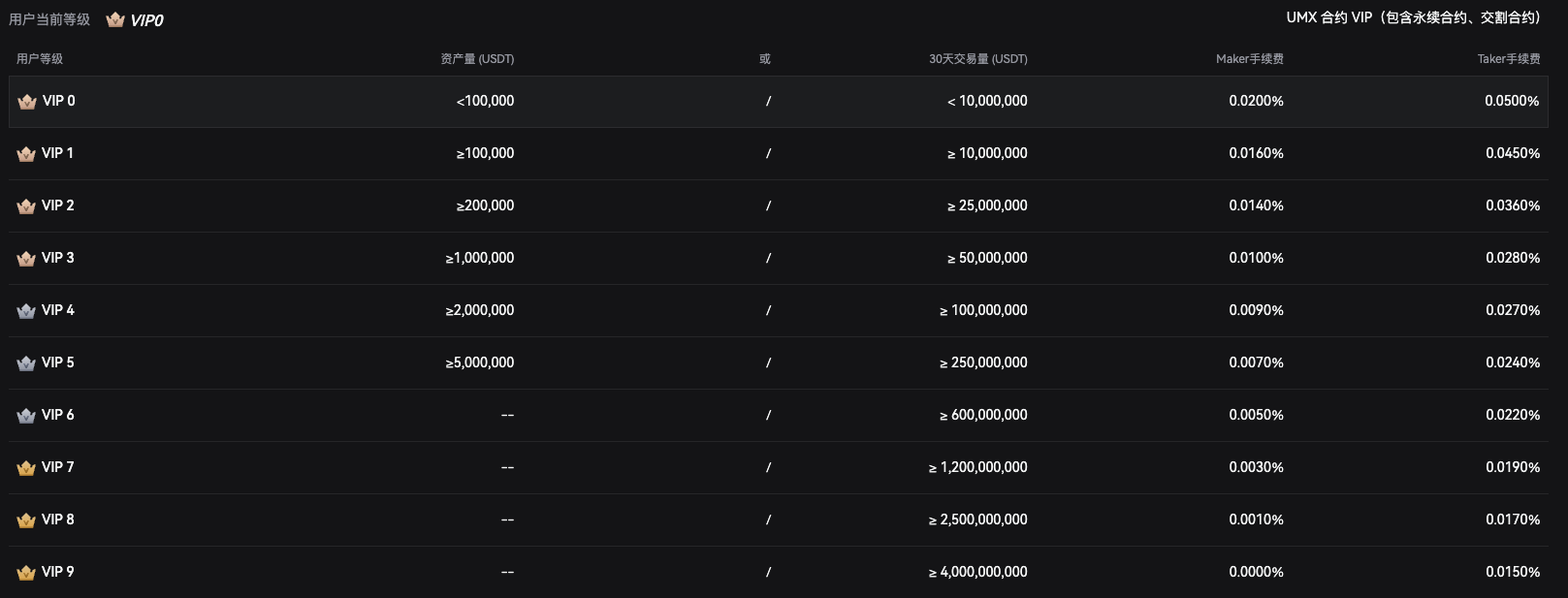
Crypto derivatives trading fees
Stock trading fees are calculated differently from crypto trading fees. For regular users (VIP0), UMX charges a commission of $0.0099 per share, with a minimum fee of $0.99 per order (Odaily Note: equivalent to the fee for trading 100 shares, but the platform discloses that some US stocks and ETFs support fractional share trading with a minimum of $1). Similarly, as the VIP level increases, the commission per share decreases, but the minimum fee per order remains unchanged.
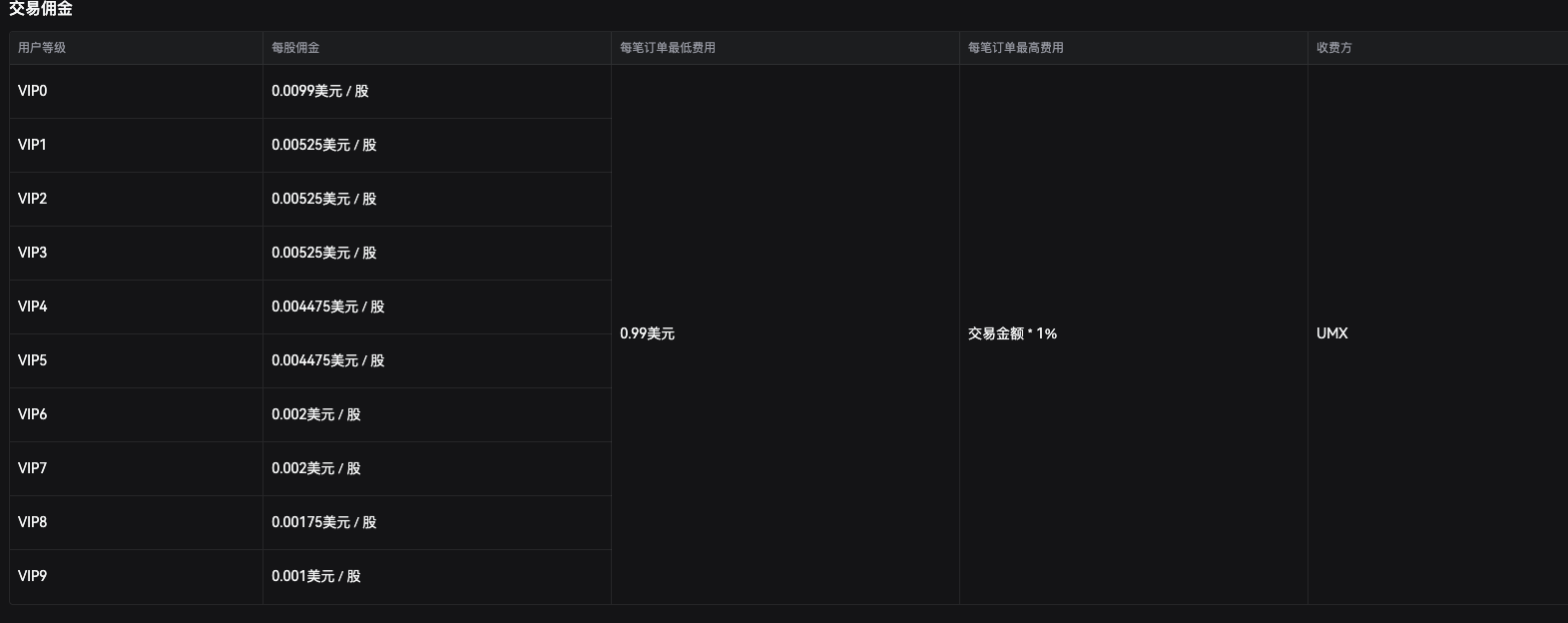
Per-share and ETF trading commissions
For options trading, UMX charges regular users a commission of $0.95 per contract, with a minimum fee of $1.99 per order and no maximum fee cap. This is generally in line with traditional broker fee levels.
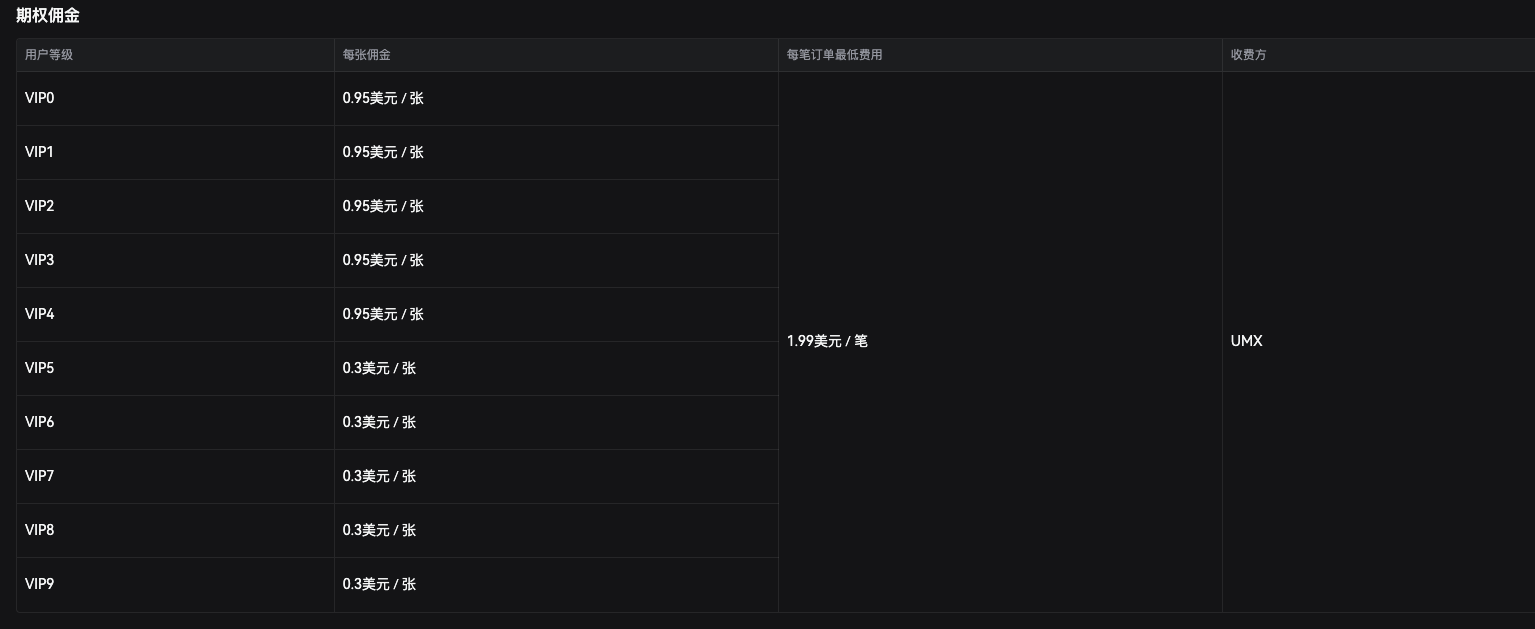
US stock options commissions
Serving Professional Investors
Today, a growing number of professional investors hold a diverse mix of assets including BTC, stablecoins, US stocks, and options. Yet, for most, the common practice remains trading crypto assets like BTC and ETH on crypto platforms such as Binance or OKX, while allocating to US stocks, ETFs, and options through traditional broker apps like Futu or Interactive Brokers.
While assets may have entered the same portfolio, the accounts, capital, and margin systems remain isolated, creating significant friction in cross-market allocation. This is the biggest pain point for professional investors, and Li Lin has clearly recognized it.
Therefore, rather than competing with CEXs by lowering the barrier to entry for US stock trading or touting a "let everyone participate in the AI stock bull market" narrative, he has positioned UMX from the outset to cater primarily to high-net-worth and professional investors. For these investors, opening an account and trading US stocks isn't the challenge. What they truly need is a platform that can simultaneously support multiple asset classes like crypto and stocks, allowing these assets to enter a unified capital and margin system, enabling centralized capital management, and significantly enhancing capital efficiency.
Undoubtedly, the current cycle's competition surrounding RWA, stock tokenization, and crypto-stock trading platforms has entered its second half. Leading players in the space, such as Hyperliquid, Binance, and Ondo, have largely solidified their market positions. The market no longer lacks general-purpose stock trading gateways; what's missing are platforms that concretely solve user pain points.
Li Lin's decision to launch UMX at this juncture represents a re-evaluation of the current market infrastructure gaps from the perspective of a seasoned asset allocator. Whether UMX can ultimately become the foundational infrastructure unifying crypto and traditional finance trading remains to be seen and validated by the market.


