






Outcast by SK Hynix! "Korea Chip Bear" Morgan Stanley Struggling to Survive in South Korea


- Core Thesis: Morgan Stanley, dubbed the "Grim Reaper of South Korean Semiconductors" due to its long history of issuing bearish reports on the Korean chip industry, has recently triggered stock market volatility with its research. However, this has also backfired on its own business operations in Korea, most notably being excluded from SK Hynix's massive ADR listing. This highlights the structural conflict between a bank's research independence and its business interests.
- Key Elements:
- On July 21, Morgan Stanley analyst Shawn Kim published a report warning that the AI-driven memory industry boom is nearing an inflection point, predicting memory contract prices will peak in Q4, which triggered a sharp decline in South Korean semiconductor stocks.
- In SK Hynix's approximately $26.5 billion ADR listing, Morgan Stanley was the only major investment bank left out as a lead underwriter, missing out on roughly $130 million in commissions. Internally, this is attributed to the negative impact of its research reports.
- Shawn Kim has accurately forecast semiconductor cycle turning points multiple times over the past decade, such as his bearish call on NAND in 2017 and his 2021 "Winter is Coming for Memory" warning. His current report bases its Q4 peak judgment on signals from inventory, profitability, and other factors.
- Morgan Stanley has lost several other deals in South Korea recently, including controversies over the SpaceX IPO subscription and the IGIS sale scandal, further damaging its reputation and business prospects in the country.
- Internally, Morgan Stanley's Seoul office has reportedly seen a sentiment of reflection about "losing business due to negative reports," reflecting the inherent tension between investment banking and research divisions.
Original Author: Zhang Yaqi
Original Source: Wall Street CN
Today, the South Korean stock market has fallen back into the "ICU."
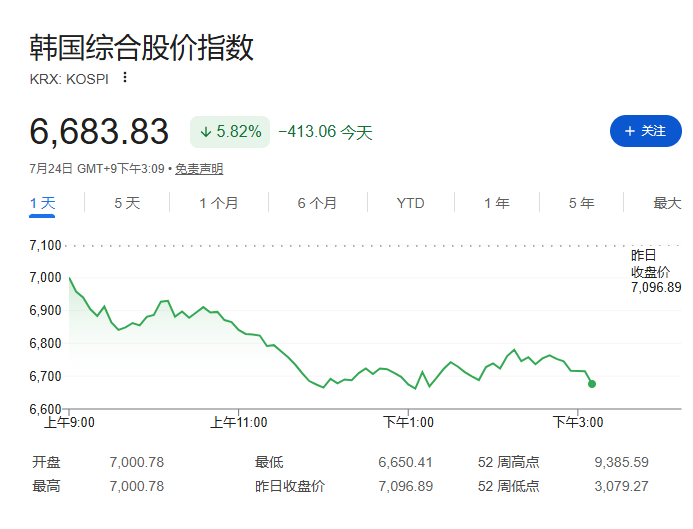
SK Hynix and Samsung Electronics both fell over 7% in intraday trading, and the KOSPI index once dropped more than 6%, triggering a circuit breaker. According to media reports, the trigger for the sharp decline is linked to the "Grim Reaper of South Korean Semiconductors" — Morgan Stanley's Head of Asia-Pacific Technology Research, Shawn Kim.
In a report released on July 21, he warned that the AI-driven semiconductor memory industry boom is approaching an inflection point. Memory contract prices are expected to peak in the fourth quarter, and the ratio of net profit upgrades has fallen to 77% from a peak of 92%. While some analysts suggest that Shawn Kim's report was used to create panic and may not be the sole cause of the crash,
This time, however, Shawn Kim's report has not only roiled the market but also placed Morgan Stanley itself in a more awkward position.
This top Wall Street investment bank, having long issued bearish reports on South Korean semiconductors, is now facing a series of setbacks in the Korean market — from being excluded from the list of lead underwriters for SK Hynix's US listing to multiple major deals falling through. Its business in South Korea is facing increasing reputational and commercial pressure.
The most symbolic event this time is SK Hynix's approximately $26.5 billion American Depositary Receipt (ADR) listing project. Bank of America, Citigroup, Goldman Sachs, and JPMorgan Chase were selected as joint lead underwriters, making Morgan Stanley the only top-tier investment bank to be excluded. Based on an underwriting fee rate of 0.5%, the total commission for this listing is around $1.3 billion. For an institution that prides itself on super IPOs like SpaceX and Anthropic and is seen as a leading candidate for OpenAI's IPO underwriting, this exclusion is not just a loss of cold, hard cash but a direct blow.

Repeatedly Bearish, Nicknamed the "Grim Reaper of South Korean Semiconductors"
In South Korean investment circles, mentioning Morgan Stanley's research department inevitably brings up the name Shawn Kim. This Korean-American Managing Director joined Morgan Stanley in 2002 and currently oversees technology research in Europe and Asia. He was previously based in Seoul and Hong Kong and is now in London. In the Korean market, he has built up significant influence with a series of stark semiconductor reports,and has earned the nickname the "Grim Reaper of South Korean Semiconductors."
Over the past decade, he has frequently issued warnings near the peak of South Korea's semiconductor cycle: In 2017, he released a report bearish on NAND prices and memory oversupply. In August 2021, he published "Memory, Winter is Coming," which accurately foreshadowed the subsequent two-year semiconductor downturn. In September 2024, his report on the potential oversupply of HBM was seen as one of the triggers for the sharp decline in Samsung Electronics and SK Hynix stocks that year — Morgan Stanley later admitted to errors in its short-term earnings forecasts for SK Hynix.
On July 6, Morgan Stanley's equity strategy team, led by Chief Investment Officer Michael Wilson, once again stepped in, recommending underweight positions on memory semiconductor stocks like Samsung Electronics, SK Hynix, and Micron. With the market already under downward adjustment pressure, this move was described by South Korean industry insiders as "rubbing salt in the wound."
Shawn Kim's latest report is even more systematic: NAND module manufacturer inventories have risen to about 13 weeks, approaching the peak level of around 15 weeks seen during the pandemic era; spot prices are weakening; some cloud service providers have indicated ample inventories, including Tencent, which has already stocked up about 90% of its required amount (this data source and metric have yet to be officially confirmed). He also proposed a trading logic of "sell DRAM when NAND turns down," bringing the two sub-markets into the same cyclical narrative.
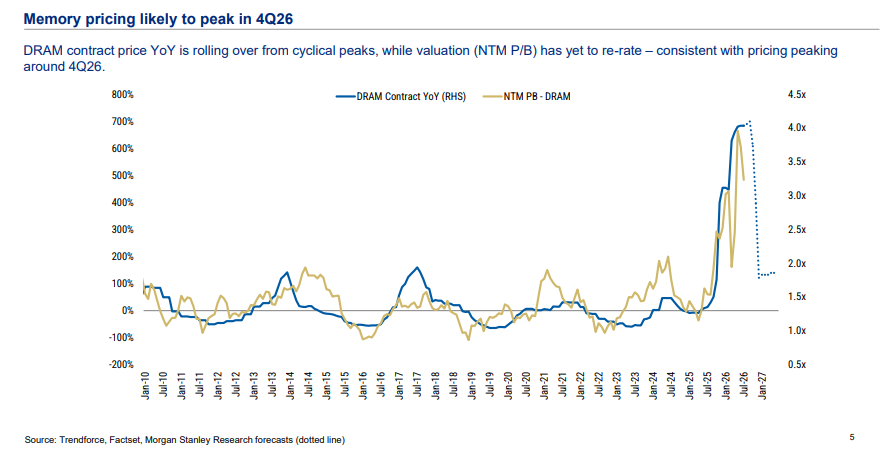
Despite this, Joseph Moore, Morgan Stanley's US-based semiconductor analyst, holds a more optimistic view — he believes AI data center investments will make memory a core bottleneck, with supply shortages potentially extending to 2028. The root of their disagreement lies in their different perspectives: Joseph Moore focuses on the capital expenditures of major US cloud providers, while Shawn Kim pays more attention to early warning signals emerging from Asian distribution channels.
After Being Excluded by SK Hynix, Morgan Stanley Begins to Reflect: South Korean Semiconductors Are Not to Be Trifled With
The SK Hynix ADR listing is the largest IPO by a foreign company in US history. Morgan Stanley's absence has triggered a direct chain reaction internally.
According to several investment bankers (including former Morgan Stanley executives), a sentiment has been spreading within the Seoul office:
"Is it because of bearish reports from Shawn Kim and others that we lost the SK Hynix business? We need to be more cautious in the future."
This sentiment has also spread to Morgan Stanley's business lines responsible for raising funds from institutional clients in South Korea. According to Korean media reports, relevant departments have voiced complaints:
"How can we do business like this?"
This rift reflects a structural dilemma commonly faced by international investment banks: the tension between the independence of the research department and the commercial interests of the investment banking business. If research reports are perceived by the market as being manipulated for business purposes, it damages credibility. However, if self-censorship is applied to appease client relationships, the research loses its value.
A head of a major domestic investment institution stated, "Morgan Stanley's transactions in South Korea have been repeatedly thwarted. Recently, they seem to have entered a mode of self-reflection. Being the only one excluded from the SK Hynix listing project has been quite a shock for them."
More Troubles: Multiple Large Deals Fall Through
The SK Hynix project is not an isolated case. Several transactions Morgan Stanley recently participated in or led in South Korea have not ended well.
The most notable among these is the controversy related to the SpaceX IPO. According to Mirae Asset Securities, a prominent South Korean brokerage, they applied for $1.14 billion in shares through the underwriting system led by Morgan Stanley between June 5 and 10 and received a "confirmation" receipt, but ultimately received zero allocation. Mirae Asset internally suspects that Morgan Stanley omitted their application when transferring the work to joint lead underwriter Goldman Sachs. Since IPO allocation rights are entirely at the discretion of the underwriters, Mirae Asset cannot formally hold them accountable. A Bloomberg report on June 30 attributed the failed allocation to an operational error on Mirae Asset's part. On July 14, Mirae Asset filed a civil lawsuit against Bloomberg over this matter, escalating the issue into a legal confrontation between a major domestic securities firm and an international media outlet. The South Korean Financial Supervisory Service has completed an on-site inspection, with results expected to be announced in a few months.
Another equally awkward case involved Morgan Stanley and Goldman Sachs jointly leading the sale of IGIS Asset Management. IGIS is South Korea's largest real estate asset management company, managing 73 trillion Korean won, including 2 trillion won in entrusted funds from the national pension. Last December, the two investment banks designated Singapore-based Hillhouse Capital as the preferred acquirer, but Hillhouse ultimately withdrew due to financing issues. A competing bidder subsequently reported to the police that price information had been unilaterally leaked to Hillhouse during the negotiations, involving five individuals from IGIS's controlling party and Morgan Stanley. Concurrently, reports emerged that details of the national pension's entrusted investments were leaked during the due diligence process, drawing regulatory attention.
An earlier example dates back to 2017-2018, when Morgan Stanley released a report predicting that the stock price of biopharmaceutical company Celltrion would halve, causing a major market stir. Celltrion questioned the report's credibility, and there were market speculations linking the report to short-selling activities.
A Deeper Predicament: Research Independence vs. Business Interests
Behind this turmoil lies a structural dilemma faced by international investment banks universally:
There is an inherent tension between the independence of the research department and the commercial interests of the investment banking business.
If research reports are perceived by the market as being manipulated for business purposes, it damages credibility. However, if self-censorship is applied to appease client relationships, the research loses its value.
For Morgan Stanley, the controversy surrounding Shawn Kim's reports is not simply about "bearish calls leading to retaliation." Looking back, his bearish calls in 2017 and 2021 proved to have some foresight, while his 2024 prediction on HBM missed the mark. The root of his influence lies in the fact that semiconductors are a typical cyclical industry. When optimism builds to a peak, contrarian warnings can often trigger portfolio adjustments by foreign institutions first, subsequently having a tangible impact on the South Korean stock market.
From a valuation perspective, the price-to-book ratios of Samsung and SK Hynix have fallen to about 1.7x and 2.5x, respectively, both significantly lower than their recent highs but still above their long-term historical averages. This valuation range aptly reflects the market's neutral pricing logic, caught between the memory industry being "not purely a cyclical stock" and the "AI narrative not yet fully materialized."
This latest July 21 report is methodologically more refined than previous ones: it constructs a framework for predicting a Q4 price peak by cross-validating multidimensional signals such as NAND module inventory weeks, earnings upgrade ratios, and contract price growth rates. Morgan Stanley estimates HBM's supply growth ceiling at around 40%. The report also incorporates a long-term addressable market of approximately $25 billion into the memory innovation track, covering multiple technological pathways including capacity, bandwidth, and power consumption.
One investment banker summed it up bluntly: "For an investment bank, successful transaction records are key performance indicators. The accumulation of failed cases inevitably brings burdens."
Morgan Stanley's current predicament in South Korea may be the most realistic footnote to this logic.





