Citigroup: Upgrades China to Overweight, Tactically Downgrades Korea


- Key thesis: Citi Research notes that the 2025 EM rally is highly concentrated in Korea and Taiwan, hitting a 25-year high for concentration. The core question for the second half is whether the rally will broaden. Based on this, Citi upgrades China to Overweight and tactically downgrades Korea to Neutral.
- Key factors:
- The MSCI EM Index rally is extremely concentrated, with Korea and Taiwan contributing nearly all gains. The cross-sectional dispersion of returns has hit its highest level in 25 years.
- A "broadening rally" requires two conditions to be met simultaneously: improved macroeconomic data and broadening earnings upgrades; a pause in the Tech/AI rally.
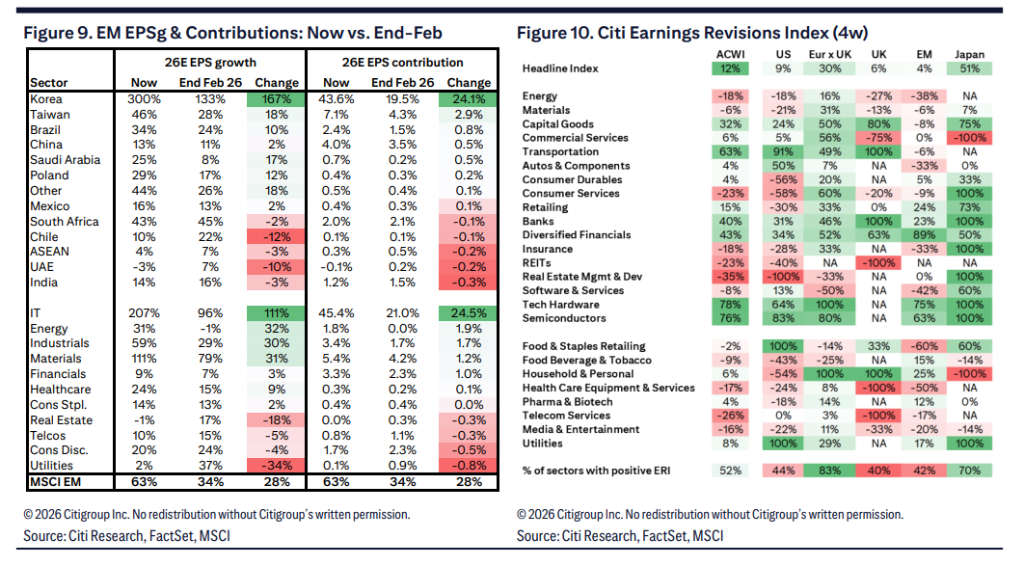
- Approximately 85% of the upward revision to MSCI EM's 2026E EPS growth comes from the IT sector, with earnings upgrades not broadly spreading.
- Citi downgrades Korea from Overweight to Neutral due to three pressures: doubts over AI capex, volatility amplified by retail leverage, among others.
- Citi upgrades China from Neutral to Overweight, citing light positioning, improving macro environment, and attractive valuations. It sets a 2026 year-end target of 29,600 for the Hang Seng Index.
- Citi maintains its MSCI EM Index year-end target of 1,870 (approx. 12% upside) and keeps an overall Neutral allocation to EM.
Original Author: Long Yue
Original Source: Wall Street CN
The emerging market rally this year has been a feast for the few—and Citi believes the core question for the second half is whether this feast can broaden out.
The MSCI Emerging Markets Index has risen approximately 20% year-to-date, marking one of its best opening performances ever. However, according to the Chase Trading Desk, Citi Research stated directly in its "Emerging Market Equity Strategy 2026 H2 Outlook" released on July 19 that this rally is "extremely concentrated," with South Korea and Taiwan contributing almost all of the index-level gains. This level of concentration is historically rare. The bank's data shows that the cross-sectional dispersion of returns among major emerging market (EM) countries has risen to its highest level in the past 25 years.
Citi believes that the rise in AI volatility has exposed concentration risks. Meanwhile, China's light positioning and improving macro environment create conditions for a "rally broadening." Their targets for the Hang Seng Index at the end of 2026 are 29,600 points, and for the CSI 300, 5,600 points.
Rally Concentration Hits 25-Year High; "Broadening" Becomes Core H2 Theme
The bank's analysts point out that a genuine "broadening rally" requires two conditions to be met simultaneously:
First, evidence of a cyclical recovery—improving macroeconomic data and earnings estimate upgrades spreading to a wider range of sectors and regions.
Second, a temporary pause in the Tech/AI leadership—allowing room for relative performance catch-up in other sectors.
Currently, both conditions are "partially met."
On the macro front, the bank's economic data change index has been trending upwards since May, and its Economic Surprise Index (CESI) remains positive. However, the magnitude of improvement is notably weaker than in developed markets. The Iran conflict previously caused a stagflationary shock, lowering growth expectations and pushing up inflation expectations, particularly impacting energy-importing countries like ASEAN. The bank's commodity strategists maintain their base forecast for Brent crude at an average of $75/barrel in Q3, falling to $65/barrel early next year. If oil prices decline as expected, it would benefit the stock markets of South Korea, Taiwan, and India.
On the earnings front, problems are more pronounced. MSCI Emerging Markets' expected EPS growth for 2026 has been revised up by 28 percentage points since late February, but approximately 85% of this comes from the IT sector. The overall EM EPS growth expectation currently stands at +63%, with the IT sector contributing about two-thirds. Within Citi's tracked EM Earnings Revision Index (ERI), only 42% of sectors show net upward revisions, and only Technology and Financials show clear positive directionality. In contrast, earnings upgrades in Japan and Europe have already exhibited a much broader diffusion pattern.
Tactical Downgrade of South Korea; Upgrade China to Overweight
Based on the above assessment, Citi has made three key changes to its EM country allocation:
South Korea: Overweight → Neutral (Tactical)
The bank has been overweight South Korea since July 2025. However, recent market volatility in South Korea has been intense, with KOSPI implied volatility far exceeding comparable global markets.
Analysts point to three pressures behind the volatility: uncertainty over the sustainability of AI capital expenditure, local resistance to data center construction, and the rising threat of open-source models to frontier AI labs. Additionally, a surge in retail investor participation and the use of leveraged products have further amplified volatility.
The bank's quantitative data shows that KOSPI long positioning has reverted from extreme overweight to neutral but has not yet turned net short. The analysts stated, "Although South Korea still performs excellently in our fundamental models, we are tactically downgrading it to Neutral given the volatility in current trading conditions."
Citi's local strategists for South Korea maintain their year-end target for the KOSPI at 10,000 points (approximately 47% upside from current levels) and expect memory shortages to intensify further in 2027. They anticipate the memory upcycle will continue, forecasting operating profits for memory makers at 58.53 trillion KRW and 76.36 trillion KRW for 2026 and 2027, respectively, accounting for 65% of total KOSPI 200 operating profit.
China: Neutral → Overweight
Citi has been cautious on Chinese equities this year, primarily due to weak relative EPS momentum. However, the logic for this upgrade is that China is a strong candidate for a "broadening rally"—light positioning, favorable macro conditions from falling oil prices and improving global growth, and attractive valuations.
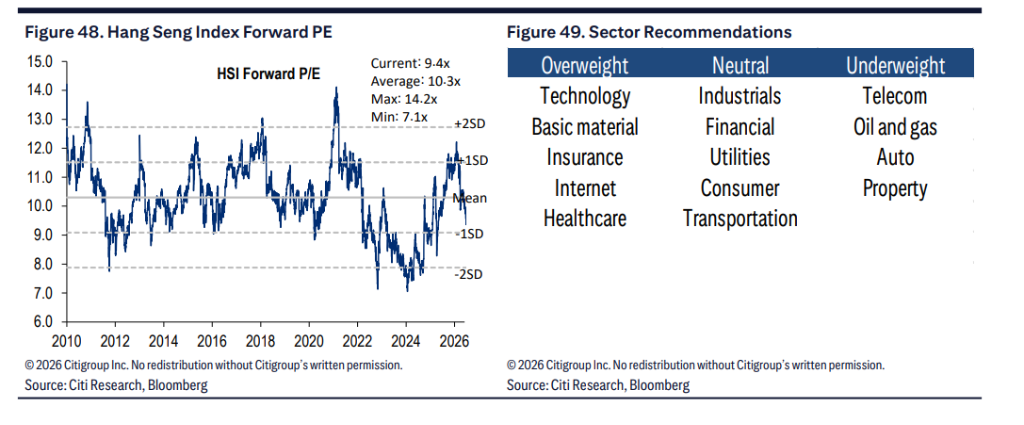
Citi's China strategist, Pierre Lau, notes that the Hang Seng Index currently trades at 9.4x forward P/E and 1.1x P/B for 2026, both below historical averages (10.3x P/E, 1.2x P/B). The bank's China economists expect potential rate cuts by the PBoC and accelerated fiscal policy deployment, marginal positives that could support the market.
Analysts set the year-end 2026 target for the Hang Seng Index at 29,600 points and a mid-2027 target of 30,500 points; CSI 300 targets are 5,600 points and 5,700 points, respectively; and for MSCI China, targets are $92 (end-2026) and $97 (mid-2027), implying approximately 31% upside from current levels.
Mexico: Underweight → Neutral
Mexico has continued to underperform this year, weighed down by uncertainty surrounding the USMCA renegotiation and expectations of tighter policy. However, similar to China, Mexico scores well in Citi's "broadening candidate" framework and has the lightest positioning among EMs. The bank sets its target for the Mexico IPC Index at 70,000 points for end-2026 and 73,000 points for mid-2027.
AI Theme: Structurally Bullish, But Short-Term Volatility Inevitable
Citi explicitly states that it will not make a wholesale retreat from Tech/AI exposure due to short-term volatility.
Three reasons are cited:
First, free cash flow for Asian memory manufacturers is projected to rise sharply in 2026-27, contrasting sharply with near-zero FCF for US hyperscalers, indicating the global tech profit pool is still expanding.
Second, Citi's local strategist in South Korea believes memory shortage signals will strengthen further in 2027, with trends in memory customization and AI token growth driving an extended upcycle.
Third, fundamentals in the EM Tech sector remain solid: EPS growth in the IT sector far outpaces global peers, earnings upgrades are sustained, and valuations are attractive relative to peers.
The bank also notes that for investors looking to hedge AI exposure, Saudi Arabia, India, and Mexico have low correlations with the Bloomberg AI Index and could serve as effective hedging tools.
Target Prices and Overall Allocation Framework
Citi maintains its year-end target for the MSCI Emerging Markets Index at 1,870 points, implying approximately 12% upside from current levels, and introduces its first mid-2027 target of 2,050 points (around 20% upside). The targets are based on conservative EPS growth assumptions (about 40-45%, below consensus expectations) and modest valuation multiple contraction.
Among the bank's local strategists, the most optimistic are for South Korea and China, with both targets implying approximately 40% upside.
At the global allocation level, Citi currently maintains a Neutral stance on EM (relative to global markets), citing that EM still faces AI volatility risks and macro complexities (geopolitics, Fed, El Niño). A return to Overweight would require seeing a genuine inflection point in EPS across the broader market.
The bank's global Bear Market Checklist (BMC) is currently at its highest level since the financial crisis but has not yet triggered an "excessive euphoria" signal. Historical patterns suggest that near the end of bull markets, market-cap-weighted indices tend to persistently outperform equal-weight indices—suggesting the tech-led rally pattern may continue until market euphoria ends.
Quantitative Perspective: EM Valuations Cheapest, Fund Flows Slow
Citi's quantitative strategists note that within their global "World Radar" model, EM's relative valuation is the cheapest among all global regions and scores the highest overall.
However, fund flows are less encouraging: inflows into global and US funds continue to outpace EM funds, and inflows into EM funds (excluding China) are nearly stagnant. Chinese funds have experienced net redemptions year-to-date but have seen a small amount of returning flows in recent weeks.
South Korea experienced sustained foreign net outflows in Q2, with cumulative net outflows reaching approximately $97 billion. Crowding in the Tech sector has increased further, making it the most crowded sector in Asia, with an Information Technology sector crowding score of 60%.