Musk "copied" Zhipu


- Core View: xAI releases Grok 4.5, claiming comparable intelligence to Anthropic's Opus 4.7 at an output price roughly 80% lower, adopting a high cost-performance strategy similar to Chinese open-source AI vendors, placing pressure on the high-end closed-source model market.
- Key Elements:
- xAI Pricing Strategy: Grok 4.5's output token pricing is set at $6 per million, less than a quarter of Anthropic Opus 4.7 ($25), while claiming similar capabilities.
- Token Efficiency Advantage: xAI claims Grok 4.5 is twice as token-efficient as other leading models, which can significantly reduce enterprise inference costs, forming its core selling point.
- Intensified Industry Competition: Closed-source models like Anthropic that rely on high pricing face pressure on both capability and cost fronts, while OpenAI is also set to release GPT-5.6 this week.
- Echoing Chinese Strategy: Analysts comment that this move mirrors Chinese AI vendors using price competition to capture market share, following Zhipu GLM-5.2 which previously approached Anthropic's flagship product at an 82% lower price.
- Coding Agent Layout: The strategic value of xAI's acquisition of Cursor lies in gaining access to large-scale, real-world coding data, enabling it to challenge Claude Code's leading position in the agent market.
Original Author: Bao Yilong
Original Source: Wall Street CN
xAI releases Grok 4.5, challenging Anthropic with "Opus-level" capabilities, its cost-performance strategy directly mirrors the Chinese open-source model approach.
On Wednesday, Elon Musk's xAI released its latest model, Grok 4.5, claiming to achieve intelligence on par with Anthropic's flagship model, but at an output token price less than one-fifth of it.
This pricing strategy closely aligns with the recent approach of Zhipu AI's GLM-5.2, which matched closed-source frontier models by pricing 82% lower, leading market observers to remark that Silicon Valley's top labs are beginning to converge towards the cost-performance tactics of Chinese open-source vendors. Musk himself characterized it in a post on X:
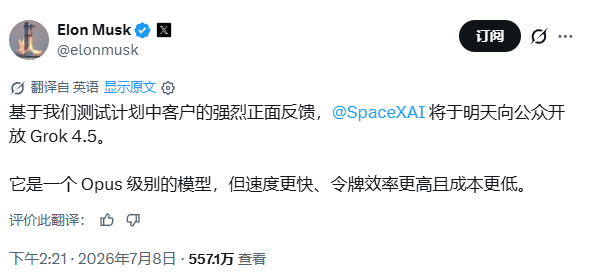
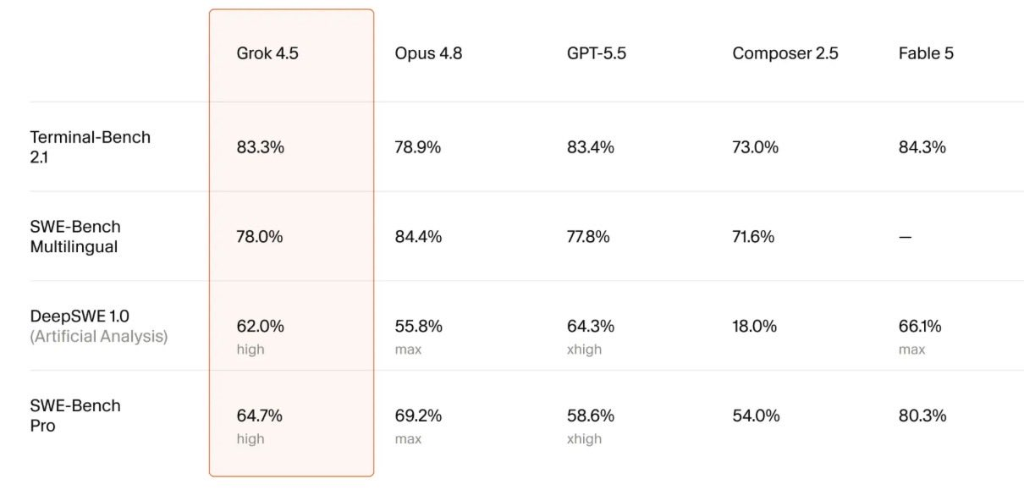
Grok 4.5 is an Opus-level model, but faster, more token-efficient, and lower cost.
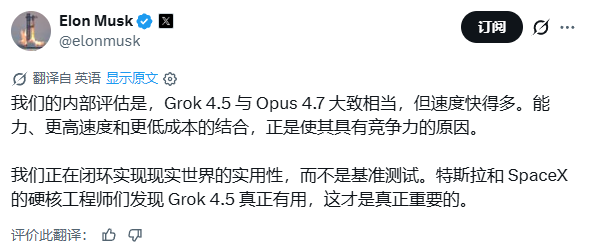
He further stated that internal evaluations show Grok 4.5's overall capabilities are roughly on par with Opus 4.7, but significantly faster. The combination of capability, speed, and low cost forms the core competitive logic of this model.
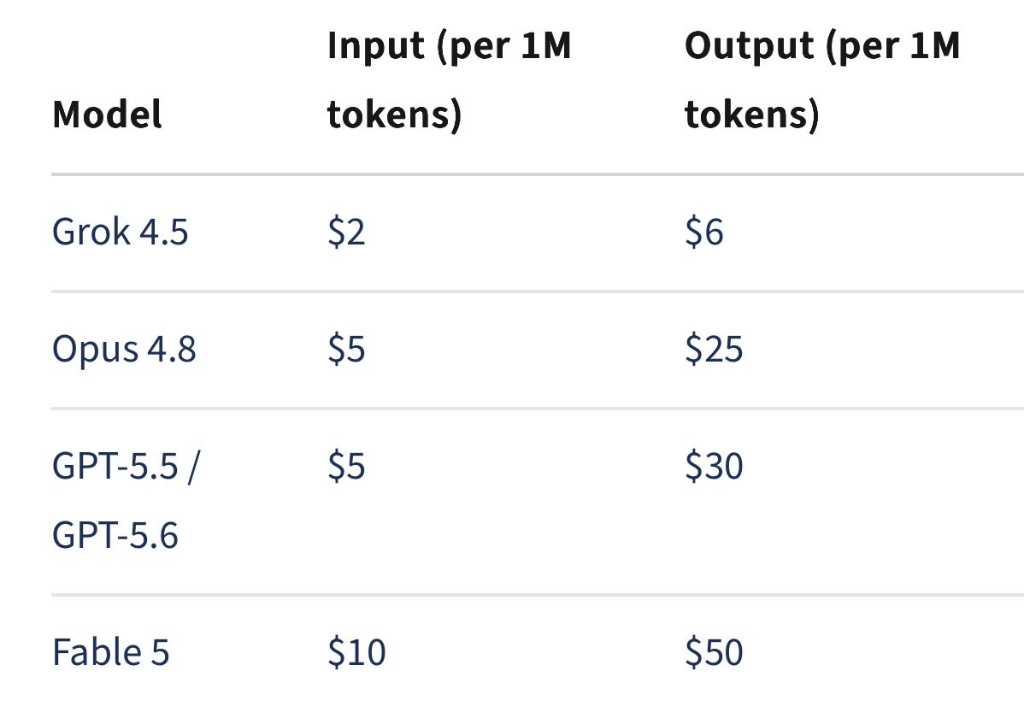
According to xAI's published pricing, Grok 4.5 is priced at $2 per million input tokens and $6 per million output tokens. In comparison, Anthropic Opus 4.7 is priced at $5 and $25 per million tokens for input and output respectively, a significant price difference.
If this pricing strategy delivers on its claimed capabilities, it will directly impact the procurement decisions of AI enterprise customers. Meanwhile, OpenAI plans to release its latest flagship model, GPT 5.6, on Thursday, making this week a dense window for AI model releases.
Cost-Effectiveness Strategy, Token Efficiency as Core Selling Point
xAI disclosed in a blog post that Grok 4.5 achieves token efficiency twice that of other leading models.
If this metric is realized in practical applications, it will directly reduce inference costs for enterprises, a direct appeal to corporate users for whom token expenditure is becoming a primary concern in AI procurement.
In a horizontal comparison, OpenAI's tiered pricing system charges $5 and $30 per million input/output tokens for its highest-tier Sol version, and $1 and $6 for its lowest-tier Luna version.
Grok 4.5's pricing is significantly lower than key competitors, and in Musk's narrative, it corresponds to near-flagship model capabilities comparable to Anthropic's.
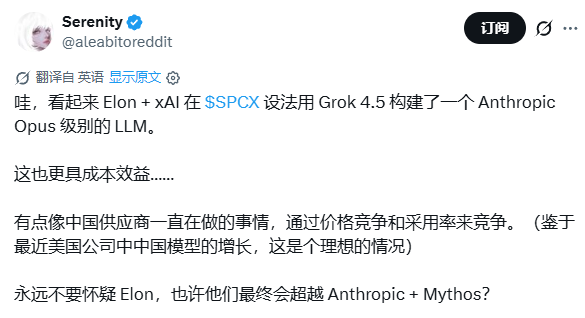
"White-haired Stock God" Serenity commented on X, noting that xAI's move somewhat resembles what Chinese AI vendors have been doing, competing through price and adoption rates.
Just weeks ago, Zhipu AI's open-source model GLM-5.2 scored 74.4 on the advanced coding benchmark FrontierSWE at a price 72% to 82% lower, trailing Anthropic Opus 4.8's 75.1 by less than one percentage point, while surpassing GPT-5.5's 72.6.
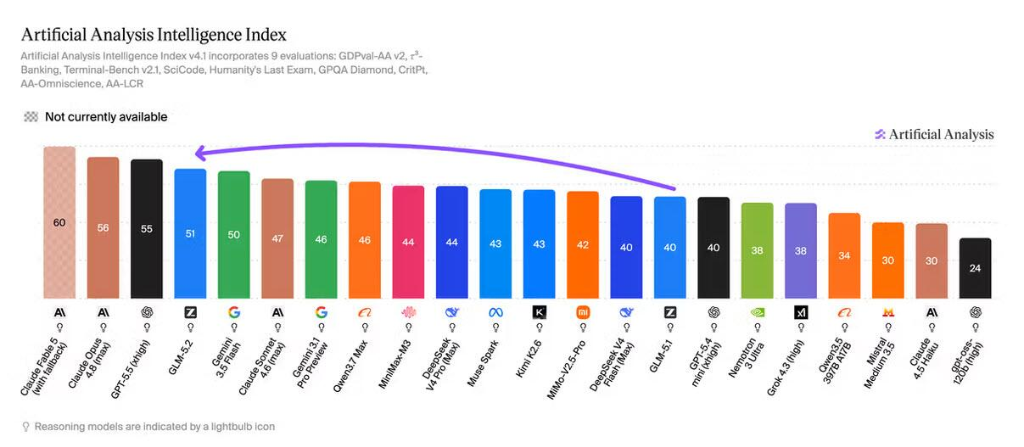
J.P. Morgan subsequently summarized this phenomenon in a report: mature intelligence continues to compress pricing, but frontier capability upgrades can still support premiums, indicating a structural divergence emerging in the monetization logic of the AI model layer.
The arrival of Grok 4.5 further complicates this competitive landscape: as leading US labs begin entering the market with pricing strategies close to open-source models, institutions like Anthropic that rely on high-priced closed-source models will face pressure from both capability and cost dimensions.
Programming Agent Market, The Cursor Acquisition Logic Surfaces
In terms of product positioning, xAI describes Grok 4.5 as a "workhorse model" for daily knowledge work, covering scenarios like programming and application development, office documentation, research, and content writing. This echoes the strategic logic behind its previous acquisition of the code editing tool Cursor.
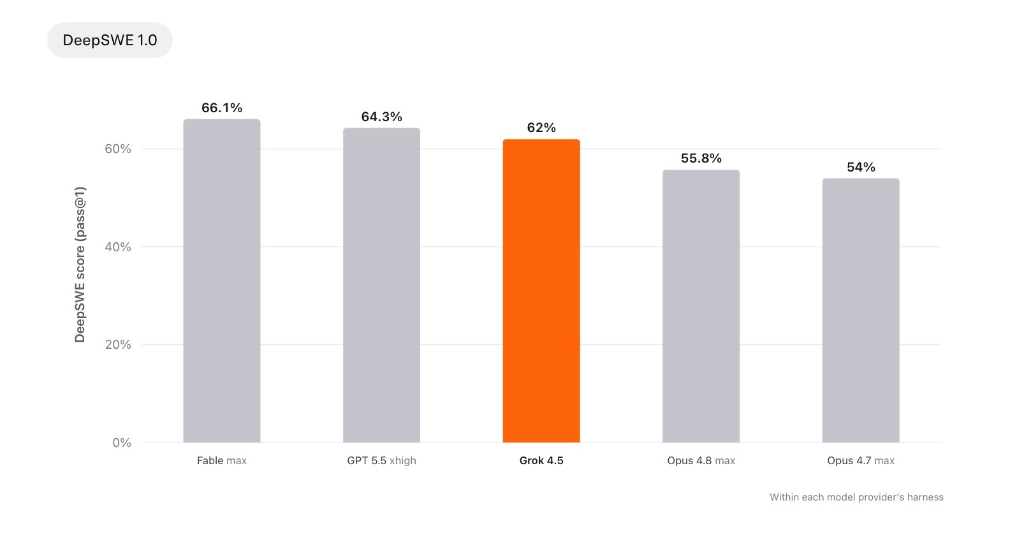
Jukan, an analyst at investment research firm Citrini Research, noted in a commentary that at the recently held ICML conference, he heard a noteworthy bullish logic for Grok: Claude Code currently leads the programming agent market, relying not solely on superior model quality, but on a first-mover advantage in accumulating a large user base. More users bring more real-world programming data, which in turn feeds back to improve model quality, creating a flywheel effect.
Jukan believes the core value of xAI's acquisition of Cursor lies precisely here:
Cursor likely has a larger real user base and code dataset than OpenAI Codex. If xAI can effectively train and leverage this data, surpassing Codex might just be a matter of time.