






ADI's Quiet Victory: From World Cup Onboarding to Traditional Finance Integration


- Core Thesis: By becoming FIFA's official prediction market partner, ADI PredictStreet captured the World Cup traffic gateway. The underlying ADI Chain follows a differentiated "institutions-first, retail-later" approach, prioritizing real-world financial activities in the Middle East—such as stablecoin settlement, institutional asset custody, and tokenization—to build ecosystem value and support its token, $ADI.
- Key Elements:
- ADI PredictStreet secured the role of FIFA's official prediction market partner for the 2026 World Cup cycle, ahead of Polymarket. Through a co-branded partnership, it generated $20 million in revenue from Kalshi, highlighting its platform's gateway value.
- Instead of relying on on-chain asset speculation, ADI Chain targets governments, banks, and institutions, focusing on enterprise-grade applications such as stablecoin settlement (e.g., $DDSC), real-world asset (RWA) tokenization, and payment networks.
- The UAE Dirham-pegged stablecoin $DDSC, authorized by the central bank, recently processed an institutional transaction worth approximately $30 million on ADI Chain, validating its regional financial settlement capability.
- Through partnerships, ADI Chain covers institutional asset custody (BNY Mellon), digital security issuance (SettleMint), and asset management (BlackRock, Franklin Templeton), establishing a complete RWA infrastructure from compliant custody to asset transfer.
The Unseen Winner of the World Cup
As one of the most-watched sporting events in human history, the World Cup has never been just a game.
It is more like an attention machine that starts on schedule. Matches, broadcasts, advertisements, social media discussions, pre-match predictions, and post-match controversies are all swept into the same narrative within a short period. The LED boards on the sidelines might seem like mere background, but with every attack, replay, and slow-motion shot, they are repeatedly brought before a global audience.
This year, a name not commonly mentioned by ordinary users appeared on those advertising boards: ADI PredictStreet.
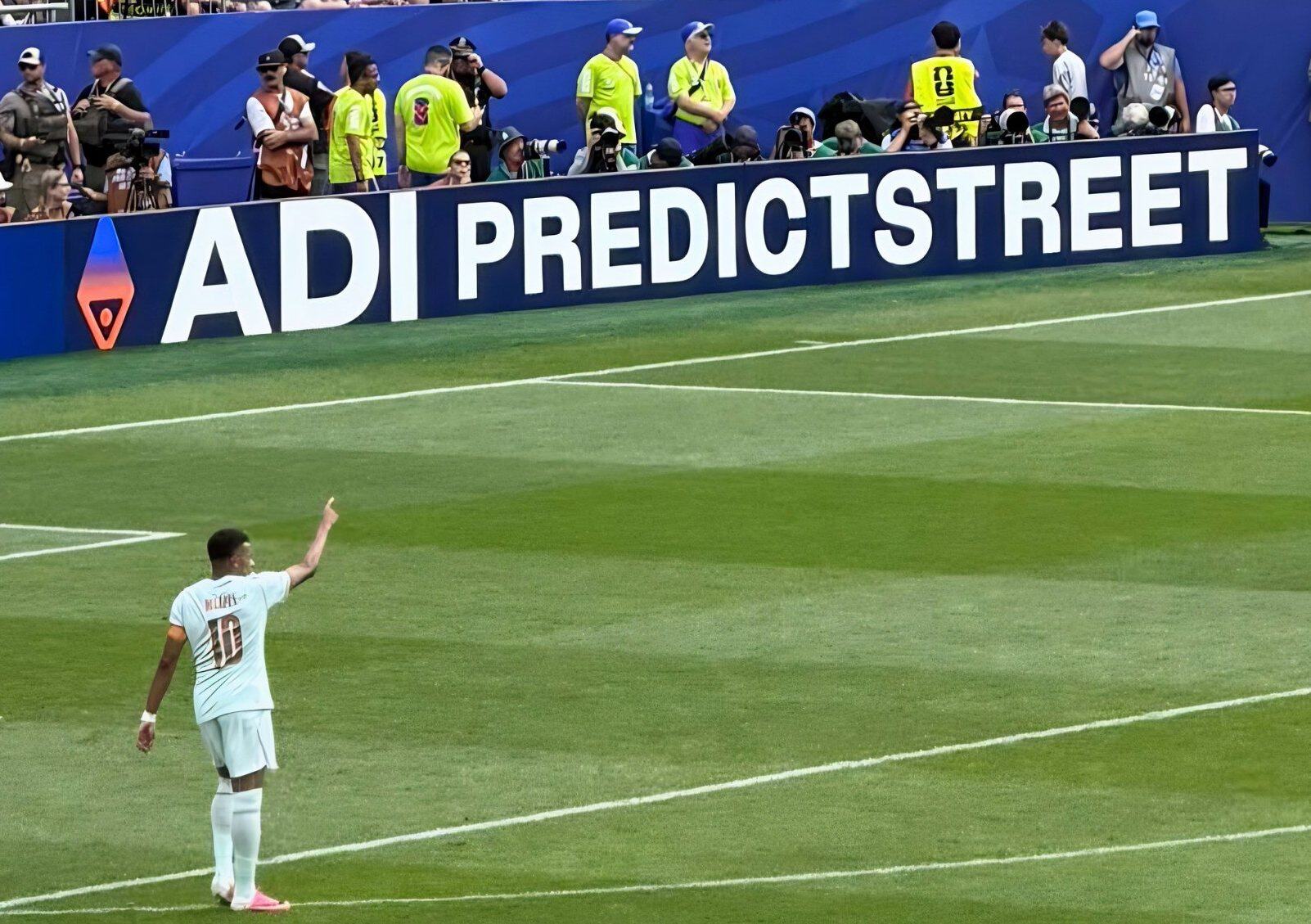
Image source: ADI PredictStreet's World Cup pitch-side advertisement
This is a very intriguing clue.
Because the entity appearing here is not Polymarket, which has already captured the mindshare of the prediction market. As early as April this year, ADI PredictStreet signed a multi-year agreement with FIFA, becoming an official prediction market partner for the FIFA World Cup 2026 as a top-tier commercial affiliate.
Another prominent prediction market project, Kalshi, later engaged in a co-branded advertising campaign with ADI PredictStreet, but this was not an official FIFA partnership obtained directly by Kalshi. According to a Bloomberg report, Kalshi paid ADI $20 million just for this co-branded deal.
This means ADI is the more discreet winner in this World Cup prediction market narrative.
Simply because it secured the entry point into the prediction market for the world's largest sporting event.
And behind this entry point lies ADI Chain.
A Chain Starting from the Backend
Unlike the blockchains familiar to the public, ADI Chain has a different positioning.
It is not a chain built around a single application, nor is it a trading venue exclusively for crypto users. From the outset, it has been designed for governments, banks, financial institutions, and enterprise-level applications, aiming to facilitate stablecoin settlement, real-world asset tokenization, payment networks, and institutional asset infrastructure.
In recent years, the common path for new public chains often began from within the crypto ecosystem: first building the developer ecosystem, then attracting DeFi, NFTs, memes, airdrops, and points, proving market viability through TVL, trading volume, and daily active users, and only then approaching the institutional world.
This path is now facing increasing pressure.
The activity level of a public chain largely depends on asset activity, but a chain's ability to continuously generate new assets, narratives, and transaction incentives is limited. After the meme craze fades, trading volume declines; after airdrop expectations conclude, users leave; even foundational networks like Ethereum grapple with the constant tension between application growth and asset activity.
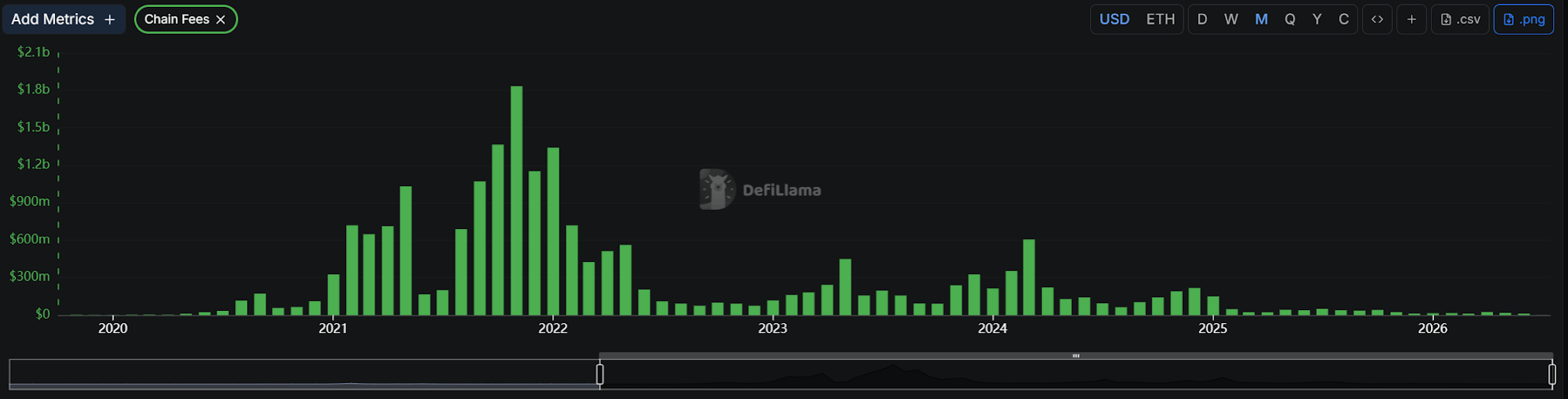
ETH network fees fluctuate significantly with on-chain asset cycles. Data source: DeFiLlama
ADI Chain's path seems to be the reverse.
Instead of first generating asset hype on-chain and then waiting for capital and institutions to enter, it attempts to bring pre-existing financial activities onto the chain: the issuance and settlement of stablecoins, tokenization of real-world assets, custody and circulation of institutional assets, and capital movement within payment networks.
This path is most clearly visible with stablecoins.
The best representation of ADI Chain's approach is not the globally liquid $USDT or $USDC aimed at crypto users, but the regionally and institutionally focused $DDSC.
$DDSC is a stablecoin pegged to the Dirham, backed by FAB, IHC, ADQ, and the Central Bank of the UAE's regulatory framework. It doesn't serve general trading scenarios but rather payment, settlement, and institutional capital flows within the UAE's local financial system.
A recent significant public transaction occurred in May.
IHC disclosed in a filing with the Abu Dhabi Securities Exchange that it completed a transaction of 110 million Dirhams, approximately $30 million, using $DDSC on the ADI Chain. The filing stated:
- This is one of the largest single stablecoin transactions in the region.
The same rationale applies to $PUSD.
Issued by Palm Azgar Finance, this stablecoin emphasizes Sharia compliance over trading liquidity. According to reports, $PUSD targets corporate treasuries, exchanges, and payment processors, with a circulating supply of approximately $2.3 billion, aiming for the Islamic finance market, which is valued at over $3 trillion.
By this point, ADI Chain's first layer is clear: first integrate the settlement needs of regional financial systems.
$DDSC corresponds to institutional capital movement within the UAE, while $PUSD targets the larger Islamic financial market. They don't solve the question of "whether there are stablecoins on-chain" but rather whether funds in regional finance can enter the chain in a way acceptable to institutions.
This is also the prerequisite for the viability of subsequent payment networks. Whether it's the Mastercard partnership targeting cross-border payments in the Middle East or M-Pesa, which covers 8 African markets with over 60 million monthly active users, what is truly needed is not another on-chain asset but a foundational network capable of handling settlement and capital flows.
Once money flows in and can circulate, the next step is assets.
From Regional Settlement to Institutional Assets
However, ADI Chain's布局 is certainly not limited to the Middle East.
If $DDSC and $PUSD prove its penetration into regional financial systems, then international institutions and infrastructure providers like BlackRock, Franklin Templeton, BNY, and SettleMint represent another line: how global assets enter this on-chain financial network.
This inevitably starts with custody.
In May, BNY partnered with Finstreet and the ADI Foundation to announce plans to provide institutional-grade digital asset custody within the ADGM, extending to the ADI Chain. For institutional assets, custody is not an ancillary service; it is the entry point itself. Without compliant safekeeping of assets, subsequent issuance, trading, and settlement cannot occur.
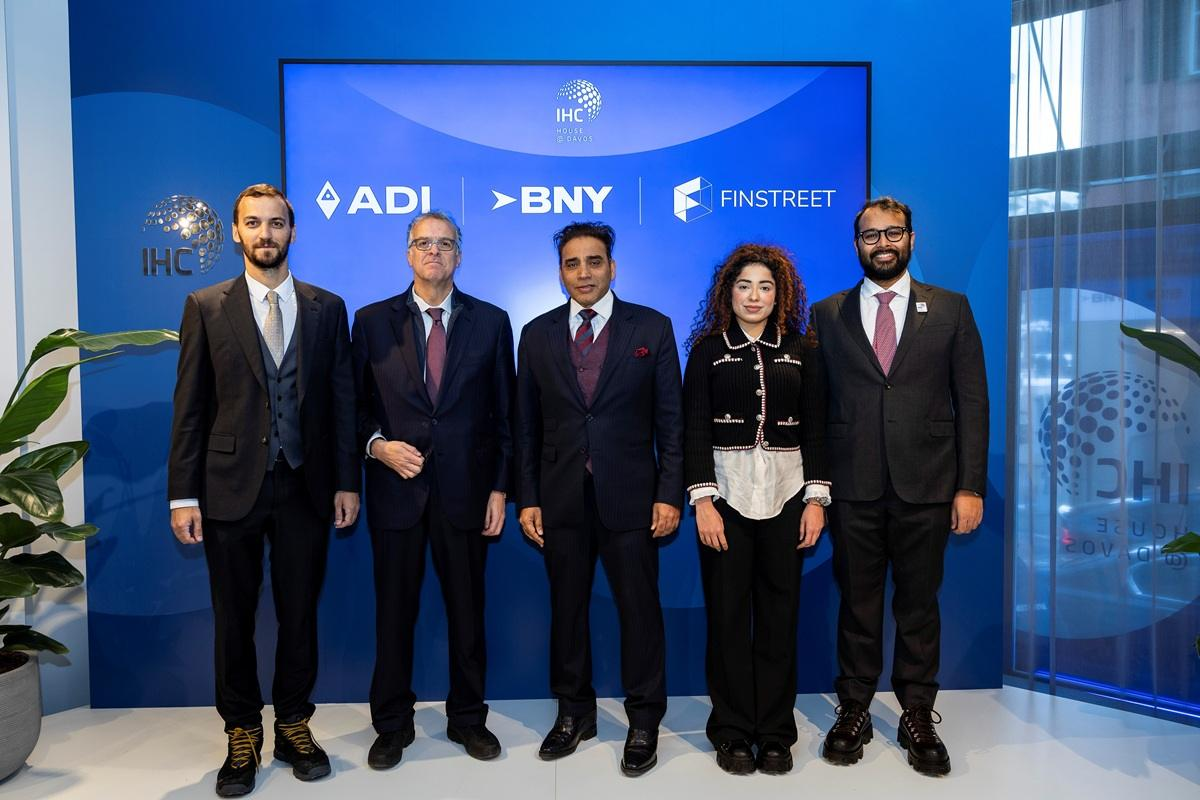
Source: Official Press Release
Only after custody comes issuance.
The collaboration between the ADI Foundation and SettleMint focuses on the digital securities side. SettleMint is an institutional-grade tokenization infrastructure provider, operating within the ADGM framework. In other words, ADI is not seeking to package a curated RWA product but to integrate the regulated digital securities process.
Moving outward, we find asset management institutions.
The presence of BlackRock and Franklin Templeton is not just about adding two familiar big names. If RWA relies solely on on-chain protocols packaging assets themselves, it will quickly hit a dead end. Ultimately, the real drivers for bringing assets on-chain are traditional asset managers, custodians, issuance tools, and settlement networks.
Seeing these lines together makes ADI Chain's asset narrative coherent.
It doesn't start by slapping on an "RWA" label and then stuffing in partners. It begins with the most cumbersome part of integrating assets into the financial system: where the assets are stored, who issues them, who manages them, and on which network they ultimately circulate.
When Real-World Finance Becomes On-Chain Costs
By now, ADI's resource puzzle is largely laid out.
The World Cup entry point, regional stablecoins, institutional custody, digital securities infrastructure, and asset management institutions – they appear to be distinct business lines, but they all point to the same question: can they be continuously integrated into the ADI Chain network?
This is where $ADI fits in.
It is not a token serving a single application, nor is it an accessory to a specific asset class. The value of $ADI depends on whether ADI Chain can organize these entry points, capital, and assets into a continuously operating ecosystem.
If these collaborations remain isolated developments, $ADI merely benefits from associated narratives. If they actually facilitate transactions, settlements, and asset flows on the same chain, $ADI then serves as the fundamental fuel repeatedly consumed during the operation of the ADI ecosystem.
This is also where ADI Chain's path diverges from many other public chains.
It doesn't first generate asset hype on-chain and wait for external capital; it tries to bring existing real-world funds, assets, and transaction processes onto the chain first, allowing these flows to, in turn, support the use cases for $ADI.
The World Cup merely brought ADI into the spotlight.
What truly determines the value of $ADI is whether these visible entry points can continue to funnel capital, assets, and transactions back onto the ADI Chain.


