Metrics Ventures Market Observation: The Fragility of the World is Rapidly Accumulating


- Core Viewpoint: The report warns that risks in the global capital markets are accumulating. Economies such as Japan, South Korea, and Europe, facing supply chain disruptions and a loss of monetary and fiscal policy autonomy, are concentratedly doubling down on trades, which could trigger systemic liquidity shocks, placing the crypto market (especially BTC) under severe adjustment pressure.
- Key Elements:
- The risk originates from persistent global supply chain disruptions since 2022, which have eroded the fiscal and monetary policy autonomy of economies like Japan, South Korea, and Europe, accumulating momentum for market turmoil.
- Outside of AI and certain non-ferrous metal sectors, market liquidity is already showing signs of exhaustion. Vulnerable nations are betting everything on concentrated trading, which could precipitate a systemic crisis.
- Technically, stock markets in Japan and South Korea have hit long-term resistance levels, the US Dollar Index has broken through key positions, and the 2-year Treasury yield is forming an upward trend, all exacerbating market fragility.
- Leveraged funds (e.g., SK Hynix with a market cap exceeding Tesla’s) and a large influx of unemployed white-collar workers into the capital markets constitute a potential source of panic selling.
- Gold and silver face short-term pressure as countries exchange them for dollars to procure commodity inventories. However, in the long term, they are expected to embark on their main upward wave after this adjustment. Metals like copper may present brief opportunities during the peak of interest rate hike speculation.
- For the first time, the possibility of MSTR persistently selling its holdings of 800,000 BTC must be seriously evaluated. This could trigger front-running by other participants, intensifying the downside risk for BTC prices.
MVC Crypto Market Secondary Fund June Market Observation Guide
1/ This monthly report will focus on our analysis of the current accumulation of market risks. To put it succinctly, we believe that since 2022, disruptions in global supply chains have progressively undermined the economic resilience and monetary-fiscal policy autonomy of countries such as Japan, South Korea, and those in Europe. This is quietly building momentum for future turbulence in global capital markets.
2/ Market trends have also profoundly revealed that liquidity droughts—excluding those in the AI and certain non-ferrous metal sectors—are actually occurring. While we do not believe a bubble burst is imminent, we observe that the aforementioned vulnerable countries are eagerly doubling down on concentrated trading. Such all-or-nemanding strategies, under the current international political and economic climate, are unlikely to end well.
3/ For the crypto market, a fragile global landscape has rapidly converged into thick clouds of uncertainty hanging over prices since the end of last year. For the first time, we truly need to seriously consider the possibility of MSTR continuously selling BTC. Meanwhile, the ever-receding demand makes BTC's cost-effectiveness as a hedging and shorting strategy against other assets increasingly favorable. In the medium term, the outlook is akin to duckweed tossed amidst stormy waves.
Market Overview & Commentary on Overall Market Trends
From a technical analysis perspective, the market has reached the middle-to-late stages of concentrated trading. We can observe:
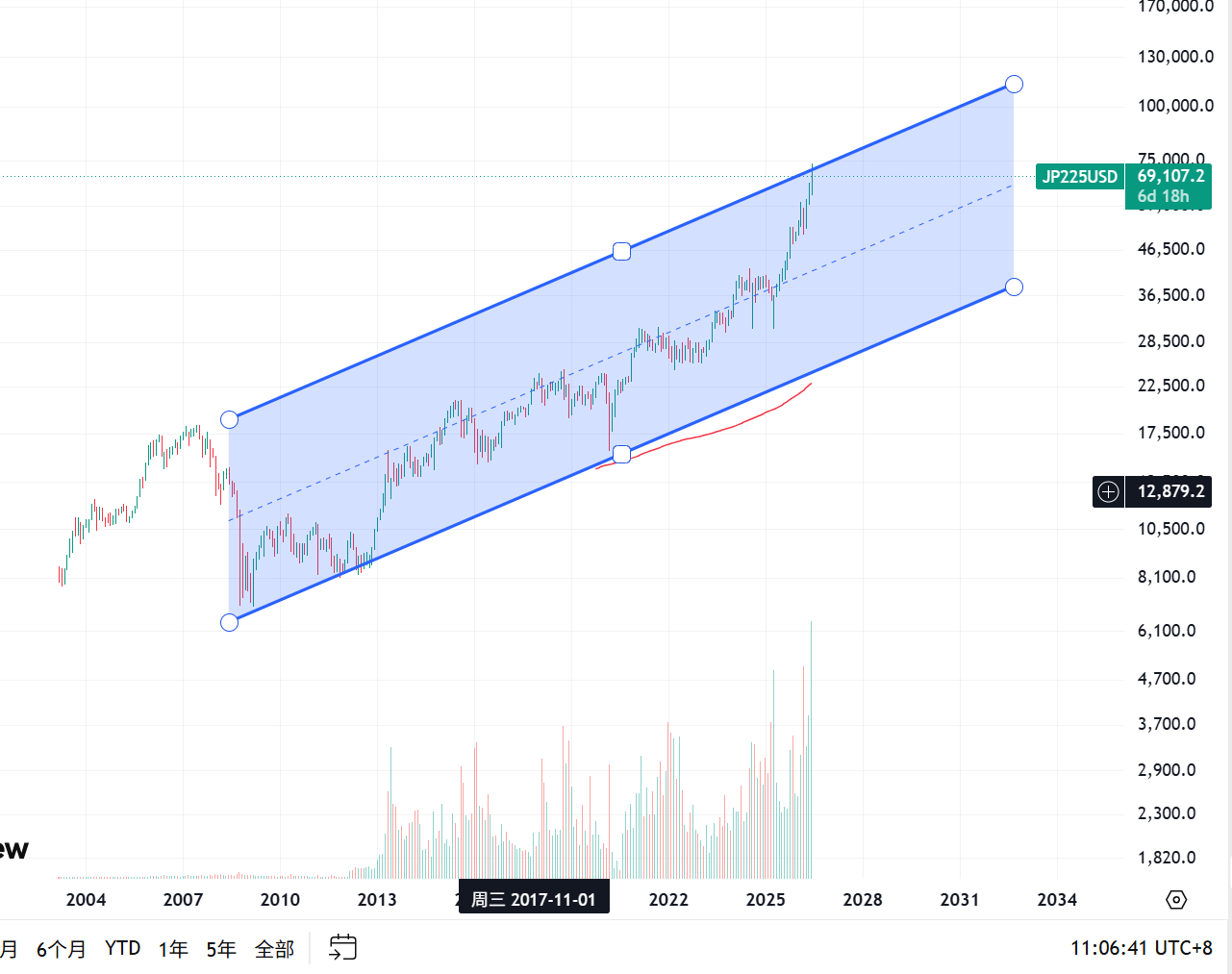
① The Japanese and South Korean stock markets, long supported by state will and sustained transfer payments, have hit significant resistance levels on their long-term channels:
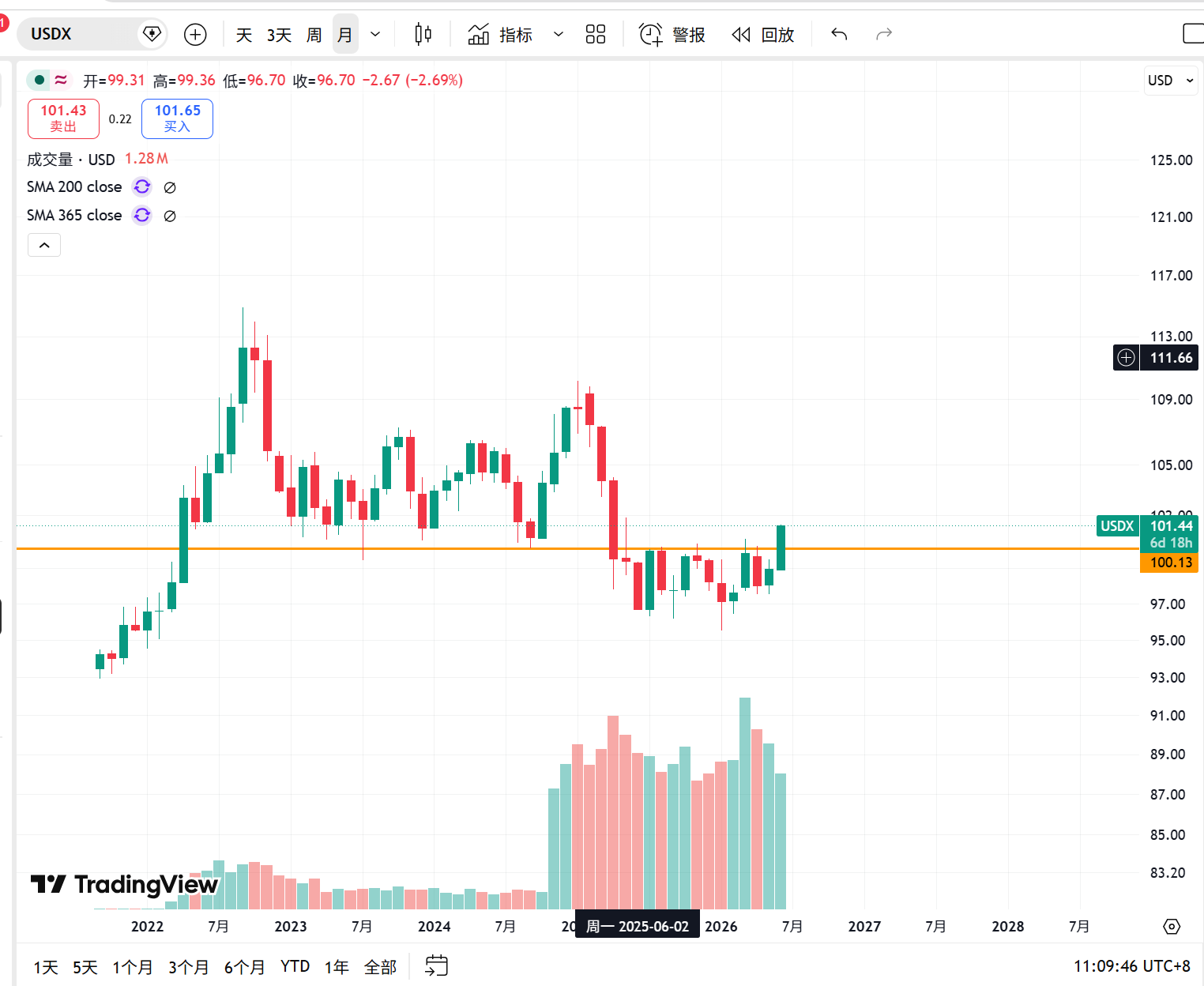
② The US Dollar Index has broken above its one-year resistance level:
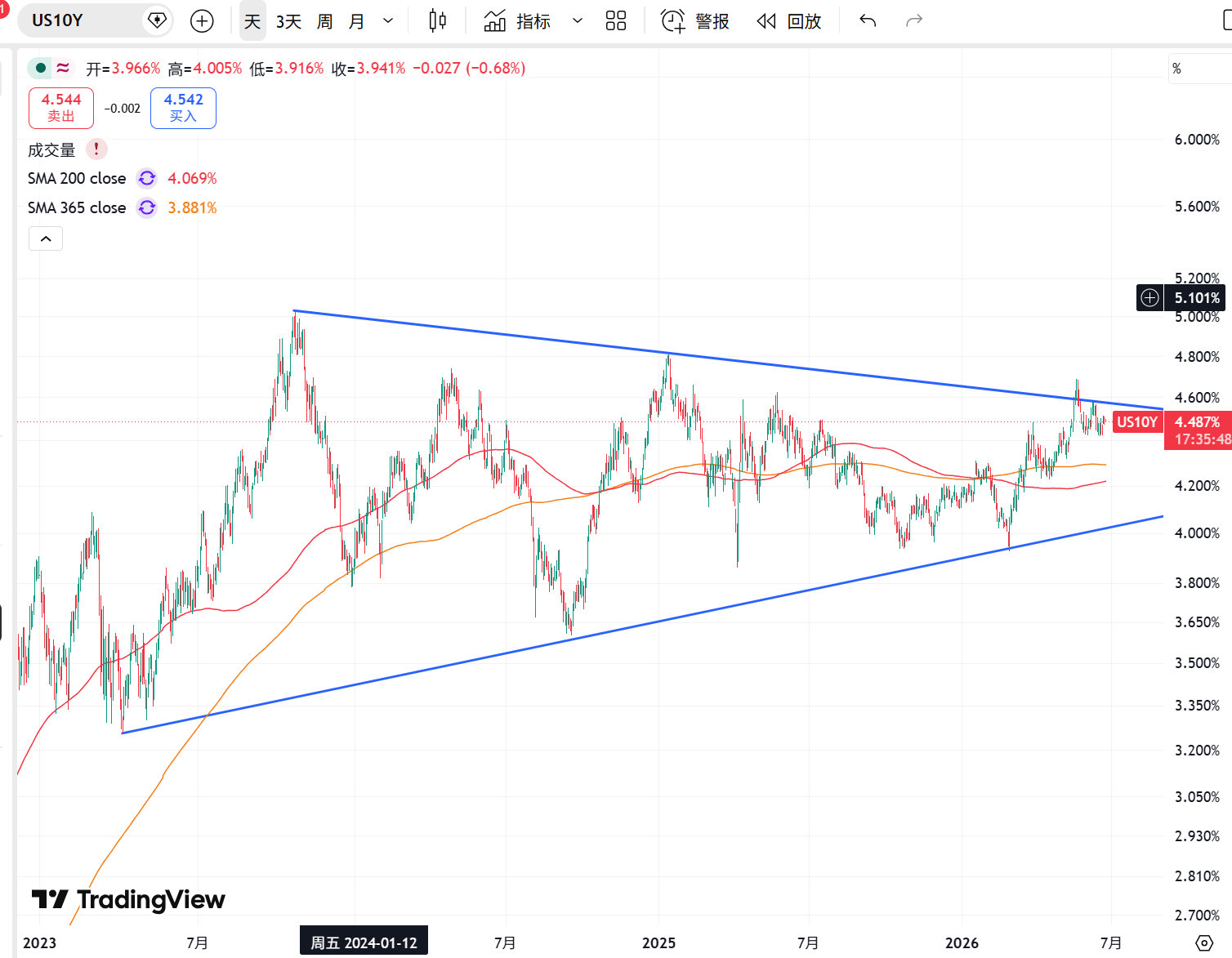
③ While the 10-year US Treasury yield remains stable, the 2-year yield has formed an upward trend:
At this moment, we see that leveraged funds for SK Hynix have surpassed those for Tesla. A massive number of white-collar workers are rapidly losing the valuation premium of their individual human capital, forced into the endless game of capital markets. Meanwhile, numerous countries deeply integrated into the global trading system and trusting in capitalist globalization are paying the price for that trust: the deterioration of global supply chains and the disintegration of international economic and trade alliances will severely impair their fiscal and monetary systems' ability to effectively regulate their economies. After all, printing money cannot produce oil, cannot mine copper, and cannot manufacture optical modules. Ultimately, globalization’s division of labor has turned into a noose tightening around their own necks.
Someday, when liquidity suddenly contracts again—either preemptively or substantially—a wave of leveraged funds will begin algorithmically cashing out starting from the Asian trading session. This shock will inevitably transmit to the global VIX (fear index) and trigger broader repercussions. Underlying national unrest and economies weakened by long-term reliance on short-term fixes will be further exposed during the turmoil, amplifying emotional volatility. This will not end prettily.
For the non-ferrous metals we have been tracking, gold and silver, under such macro pressure, will face short-term constraints due to the strong will of various countries to exchange for dollars to stockpile commodities. This is particularly evident in central banks led by Turkey. However, this shock is precisely the preparatory dip before the true major rally for gold and silver. The complete failure at Hormuz marks the beginning of the dollar's unravelling. The market turmoil following interest rate hikes will ultimately steer towards a looser future. For copper and many other minor metals, the dynamics are more complex. We lean towards the view that once the market's expectations for rate hikes are fully priced in, there could be a sweet spot period ahead.
For Bitcoin, for the first time, we need to seriously assess whether MSTR might activate the "evil button" when facing future cash flow pressures or the risk of other participants front-running its potential sale of its ~800,000 BTC holdings. In the scenario described above, Bitcoin will hardly remain unscathed. Therefore, we need to more carefully contemplate Bitcoin's positioning and tradable directions during this risk-unwinding process. Perhaps the bottom of this cycle will seem unbelievable to many right now, but a deeper correction level is not merely a figment of panic.
Standing at the start of the year, it was difficult to predict the events at Hormuz, nor to foresee global capital markets entering H2 in this manner. But risks also bring opportunities. Let us all stay the course.