BitTorrent launches BTTInferGrid, building a decentralized AI inference computing power base, poised to drive a comprehensive leap in BTT's value.


- Core Thesis: BitTorrent launches BTTInferGrid to build a decentralized AI inference computing network (DePIN). By aggregating idle global GPU resources and using crypto-economic incentives to reshape computing power allocation mechanisms, it aims to alleviate the computing power shortage and centralization monopoly issues faced by the AI industry, while driving the BTT token towards an upgrade to the core value carrier of the AI computing ecosystem.
- Key Elements:
- BTTInferGrid employs a modular "Application Layer - Computing Layer - Settlement Layer" architecture to achieve a closed loop for AI inference task requests, scheduling, and automated incentives, providing efficient pay-as-you-go services.
- The network features permissionless access and a dynamic supply mechanism; all qualifying GPUs can participate. Incentive distribution is based on a multi-dimensional scoring system (workload, latency, stability), breaking the monopoly of large-scale computing power.
- The BTT token plays multiple roles within the ecosystem, including payment, incentive, and staking, throughout the entire process of computing power usage, contribution rewards, and network security assurance. It is set to upgrade from a transmission token to the core token of the AI computing network.
- A clear phased roadmap is planned: Network launch and support for mainstream open-source models by 2026; Expansion to a comprehensive computing platform by 2027; Positioning as an AI-native infrastructure from 2028 onwards.
- BTTInferGrid is natively compatible with mainstream open-source models like Alibaba Cloud's Tongyi Qianwen (Qwen) series and Meta's Llama series. Developers can directly call inference services via standardized APIs, lowering the barriers to application implementation.
On June 17, BitTorrent, the world's leading decentralized file transfer ecosystem, officially launched its core AI strategic product, BTTInferGrid, building a decentralized computing network for AI inference scenarios.
BTTInferGrid is a major AI product strategically upgraded by BitTorrent based on its mature decentralized storage service, BTFS. It consolidates BitTorrent's extensive technical expertise accumulated over years in core areas such as P2P network protocol design, global distributed node governance, and large-scale resource scheduling. This gives the platform inherent advantages for large-scale application and commercial deployment from its inception. The official launch of this product not only marks BitTorrent's entry into the decentralized AI infrastructure赛道, but also officially heralds a new era where distributed computing empowers the AI industry.
Leveraging a cryptoeconomic incentive system and distributed consensus mechanisms, BTTInferGrid seamlessly connects global idle GPU computing resources with the diverse inference needs of AI developers. It provides next-generation AI applications with open, verifiable, on-demand, and efficient inference services, while also enabling idle GPU holders to easily monetize their resources, creating a win-win scenario for both supply and demand of computing power.
From a technical infrastructure perspective, BTTInferGrid reconstructs the traditional centralized computing supply system through distributed computing aggregation and intelligent scheduling mechanisms, endowing AI infrastructure with greater resource elasticity and resilience against risks. From an industry structure perspective, it pushes computing power away from scarcity and monopoly towards becoming a freely circulating digital production asset. This allows every GPU holder to participate in value co-creation and revenue distribution, fostering a new industry landscape centered on the universal sharing and efficient circulation of computing resources.
BitTorrent Launches BTTInferGrid: Building a Decentralized AI Inference Computing Base
"Computing power, algorithms, and data" are the three core elements of AI development. By 2026, the strategic value of computing power has reached unprecedented heights. The "computing shortage" is no longer just a long-term warning for the industry but has evolved into the primary bottleneck hindering AI advancement.
Globally, rental costs for high-end NVIDIA GPUs continue to rise, and hardware supply remains chronically tight. Leading AI companies like OpenAI and Anthropic frequently experience server outages due to insufficient computing reserves. Even tech giants and top academic institutions struggle to secure adequate computing power. In a recent Nasdaq IPO filing, SpaceX acknowledged that the computing demands of its supporting AI systems had substantially exceeded market supply, even considering reclaiming computing resources previously lent to Anthropic. Meanwhile, Microsoft's Azure cloud platform was reportedly forced to urgently seek computing resources from competitor AWS to cope with the massive surge in code submissions from GitHub in the AI era. Concurrently, AI labs at top universities like Stanford and MIT have had to suspend multiple large model training projects due to computing shortages, leading to delays in many graduate thesis defenses.
It is precisely against this backdrop of intensifying global supply-demand contradictions for computing power that BTTInferGrid was conceived. It aims to build a Decentralized Physical Infrastructure Network (DePIN) for AI inference. By aggregating globally dispersed, idle GPU computing resources in a decentralized manner, it accurately matches the business needs of AI developers. This breaks down the barriers and monopolies formed by traditional centralized computing service providers, maximizes the utilization of global idle hardware, establishes a new generation of universal, open, and shared underlying computing infrastructure, and fully unleashes the potential of idle hardware globally, ensuring every unit of computing power is utilized efficiently and its value is maximized.
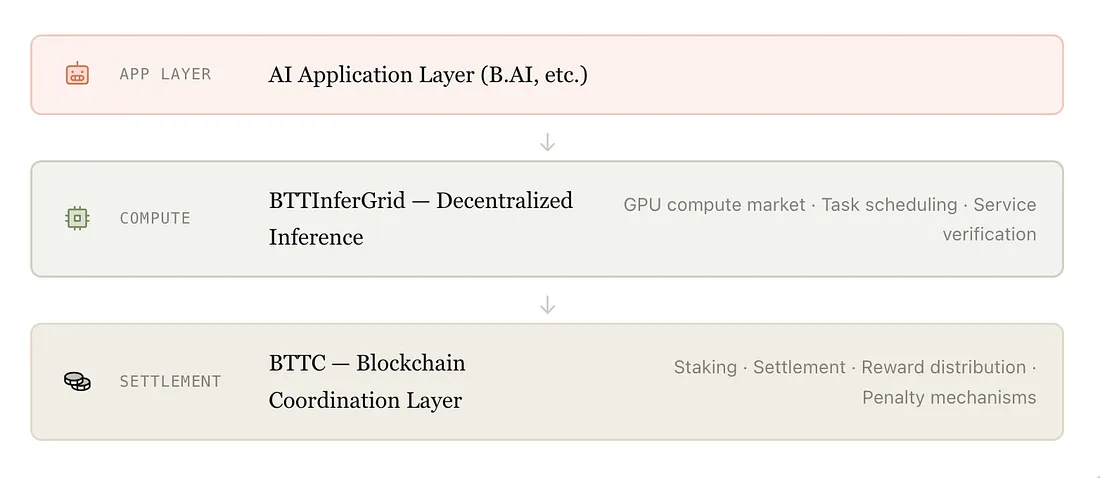
To ensure the efficient implementation of the entire operating system, BTTInferGrid adopts a modular, layered architecture design, building a three-layer collaborative system: "Application Layer - Compute Layer - Settlement Layer".
- Application Layer: Serving as the entry point for developers, the Application Layer provides a user-friendly deployment environment supporting the rapid implementation of various native AI applications, such as AI chatbots, intelligent agents, and other diverse scenarios.
- Compute Layer: This is the core computing hub of the entire ecosystem. The Compute Layer handles the critical responsibilities of AI model inference operations, real-time request responses, and task scheduling.
- Settlement Layer: The Settlement Layer is responsible for the automated operation of the entire economic system, covering the full process including computing staking, task settlement, contribution reward distribution, and malicious node penalties. This layer executes on-chain transactions in a trustless manner, ensuring fair and transparent value exchange between computing supply and demand without intermediaries, providing a solid foundation of economic trust for the entire network.
The three layers collaborate efficiently through standardized interfaces: the Application Layer initiates inference requests, the Compute Layer schedules computing resources for execution, and the Settlement Layer automatically distributes incentives based on execution results. These three layers support each other in a closed-loop operation, collectively constituting a high-performance, highly trustworthy, and sustainable decentralized AI inference infrastructure.
Based on its three-layer architecture, BTTInferGrid offers multiple advantages, including distributed node autonomy, demand-driven permissionless access, and end-to-end verifiable trust, establishing an efficient, robust, and open distributed computing environment without barriers to entry.
From a network architecture perspective, BTTInferGrid employs a globally distributed node deployment strategy. All nodes are collectively owned and managed by the community in a decentralized manner, with no single data center or operating entity controlling the network core. This inherently decentralized design completely eliminates the common risks of single points of failure and operational interruptions found in traditional centralized platforms, granting the network strong censorship resistance and 7×24 uninterrupted service resilience. This provides a highly available operational foundation for various AI inference tasks.
Regarding computing resource access and scheduling rules, BTTInferGrid implements a permissionless open mechanism: all GPU devices meeting performance standards can freely join the network without central authority approval. Furthermore, the overall computing supply is entirely driven by actual business demand, with incentive calculations based on nodes' actual computing usage and comprehensive service performance, supported by a dynamic supply adjustment mechanism that flexibly allocates resources according to real-time network load. This mechanism not only improves the turnover efficiency of computing resources but also ensures long-term, stable returns for providers proportional to their contributions.
At the trust mechanism level, BTTInferGrid integrates trust logic throughout the entire business process. Relying on a well-designed cryptoeconomic system, the network automatically handles operations like computing scheduling, task assignment, and revenue settlement. Every AI inference computation task can be traced end-to-end, and computation results support on-chain cross-verification. Through its underlying mechanism design, the network eliminates malpractices such as false reporting of computing power and data tampering from the source, ensuring the authenticity and integrity of all computation tasks. This allows demand-side users to confidently utilize the service and supply-side participants to engage securely.
In summary, the distributed node architecture endows the computing network with autonomy and high stability. The demand-driven, permissionless access model ensures efficient resource circulation and long-term economic sustainability. The fully verifiable end-to-end trust system secures the ecosystem's safety baseline. These three core characteristics are deeply integrated, making BTTInferGrid not just a technologically advanced distributed computing network, but a long-term stable, highly trustworthy, and future-oriented decentralized AI infrastructure.
BTT Poised to Become Core Value Token for Decentralized AI Computing Network, Potentially Broadening Ecosystem Application Boundaries
As the native value token of the BitTorrent ecosystem, with the official launch and continuous expansion of BTTInferGrid, BTT's strategic positioning is set for a crucial upgrade. Its application scenarios are expected to extend from traditional distributed transmission and storage tracks into the entire industry chain of AI computing infrastructure, continuously broadening the ecosystem's value boundaries.
Previously, BTT was the circulating token for BitTorrent, the world's leading decentralized file transfer network. Now, leveraging the new AI computing network BTTInferGrid, it is poised to evolve into the core token for scheduling the decentralized AI computing network, assuming dual functions of value transfer and ecosystem governance.
BTTInferGrid's cryptoeconomic incentive mechanism is the underlying engine driving the network. It connects off-chain idle GPU computing power with the inference needs of AI developers, automating task scheduling, result verification, and revenue settlement through token incentives, ensuring transparency in supply-demand matching and governance.
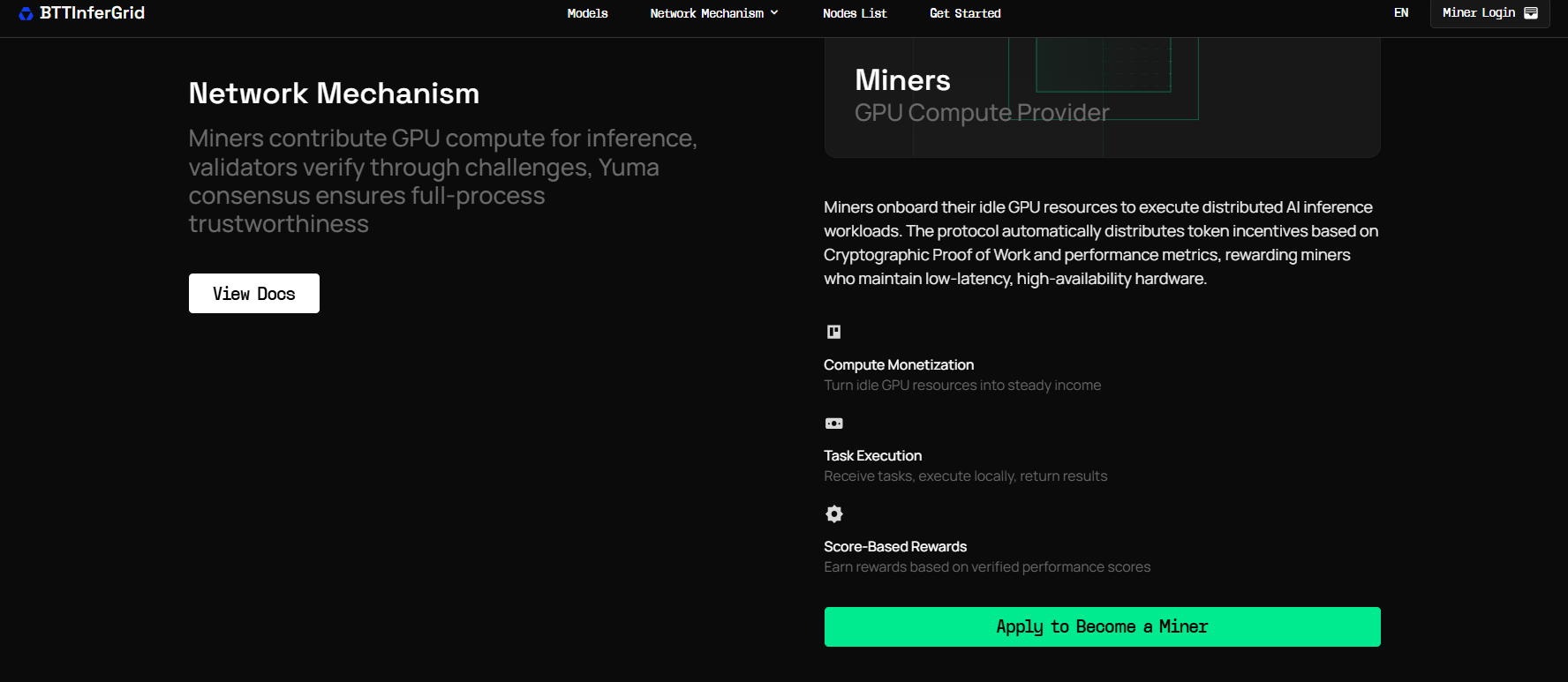
Within the BTTInferGrid system, the continuous operation of the ecosystem relies mainly on the collaborative participation and division of labor among three core roles – Miners, Users (AI developers), and Verifiers – jointly building an autonomous decentralized computing network:
- Miners (Computing Supply Side): Contribute idle GPU resources, undertake and execute AI inference tasks, earning rewards based on actual workload, task completion quality, and dynamic performance scores.
- AI Developers (Computing Demand Side): Can access the global distributed computing pool via a unified standard API, significantly reducing the cost of accessing computing power.
- Verifiers (Network Guardians): Audit and perform random challenges on miners' computational performance, identifying anomalies like node cheating or low-quality computing. They receive rewards for maintaining network security and service quality.
These three participant types form a complete loop of shared interests and mutual constraints based on decentralized consensus mechanisms, collectively driving the continuous evolution and virtuous cycle of the BTTInferGrid ecosystem. The core link connecting the interests of all parties and driving the ecosystem's healthy operation is the cryptoeconomic incentive system tailor-made for BTTInferGrid.
This system achieves precise quantification and fair distribution of computing value through token circulation, converting behaviors like computing supply, task execution, and result auditing into clear, quantifiable incentive signals: Miners contribute idle GPUs and complete high-quality inference tasks to earn token rewards; Verifiers earn income by maintaining network security; AI Developers pay fees based on actual computing consumption. The interests of the three parties achieve dynamic balance within the circulation of the token economy, thus constructing a sustainable value loop.
Within this framework, BTT is expected to become the unified native incentive and settlement base token for the BTTInferGrid ecosystem, running through the core aspects of the entire computing ecosystem. It will comprehensively cover the usage payment, contribution incentive, and dynamic allocation processes for AI computing resources, ultimately building a closed-loop economic system where "computing contributors earn rewards, computing users pay conveniently, and ecosystem participants share value".
Specifically, the BTT token can assume multiple core roles within the BTTInferGrid network: As a Payment Medium, AI developers pay for inference services using BTT (or its equivalent), achieving "pay-as-you-go, consumption-based billing". As an Incentive Tool, Miners receive token rewards based on verified actual computing contributions, and Verifiers earn income from audit and challenge services, continuously attracting global idle resources to the network. As a Staking Asset, Verifiers need to stake tokens to participate in scoring and verification, and computing nodes also need to stake a certain amount of tokens to qualify for task acceptance. Any improper behavior triggers slashing penalties, effectively ensuring network security and fairness from an economic perspective.
From this perspective, BTT is not only expected to be the value carrier matching computing supply and demand in the future, but also the fundamental core driving force supporting the efficient, fair, and long-term operation of the entire decentralized AI computing economy. On one hand, Token incentives continuously attract more idle GPU resources to join the network, expanding computing supply. On the other hand, the supporting staking and slashing mechanism ensures the stability and reliability of inference services. Furthermore, all settlement, reward, and penalty logic is automatically executed by smart contracts, effectively addressing common pain points of centralized computing platforms, such as information opacity and high trust costs.
As the BTTInferGrid ecosystem develops and thrives, BTT is poised to become a universal value anchor connecting distributed computing power with AI application demands, ushering in a new paradigm for the decentralized AI economy.
BTTInferGrid Restructures Global Computing Allocation, BitTorrent Opens New Chapter in Decentralized AI
Against the backdrop of continuously intensifying global AI computing supply-demand contradictions and increasing monopolization of centralized computing, BTTInferGrid reconstructs the computing supply model through distributed technology: It efficiently aggregates fragmented global idle GPU resources to build an open, shared computing infrastructure. This allows AI developers to seamlessly access elastic computing power while enabling every unit of idle computing power globally to realize its inherent value. Simultaneously, leveraging its innovative cryptoeconomic incentives and collaborative governance mechanisms, it establishes a closed-loop value flow between the computing supply and demand sides, forming a virtuous ecological cycle where both sides promote each other and operate healthily.
For Miners (Computing Supply Side), BTTInferGrid acts as a "value converter" transforming idle computing power into continuous income. Any qualified idle GPU can join the network permissionlessly, contributing computing power to earn revenue.
Unlike traditional distributed computing platforms that simply allocate rewards based on "raw hardware power" in a crude manner, BTTInferGrid employs a multi-dimensional scoring weighted incentive model. The network comprehensively evaluates core indicators such as actual effective workload, task response latency, service stability, and result accuracy for each node, dynamically calculating and distributing corresponding rewards. This mechanism fundamentally breaks the "big computing power monopolizes rewards" paradigm, allowing smaller miners providing high-quality, highly reliable services to also earn superior returns, ensuring the network's service quality institutionally. Furthermore, miners participating in the network's early stages will enjoy ecosystem incentives like exclusive reward multipliers, gaining first-mover advantages.
For AI Developers, BTTInferGrid offers accessible, verifiable, on-demand, and flexible pay-as-you-go AI inference computing services – a computing solution entirely different from traditional cloud providers. It effectively solves multiple industry-wide pain points like "high computing costs, poor elasticity, and trust issues", significantly lowering the trial-and-error barrier for deploying AI applications.
Firstly, BTTInferGrid provides elastic computing scheduling, dynamically allocating resources based on AI inference load. Developers do not need to pre-purchase hardware or sign long-term contracts, completely breaking free from vendor lock-in by centralized cloud providers, achieving true on-demand usage and flexible scaling. Secondly, it adopts a decentralized market-based pricing and precise token-based billing model, eliminating the high premiums charged by centralized platforms, substantially reducing inference costs, and bringing computing expenditure back to reasonable levels. Most critically, BTTInferGrid establishes a decentralized multi-verifier audit network. Through mechanisms like random challenges, cross-verification, and staking/slashing, it technically prevents computing fraud and result tampering, ensuring each inference computation is traceable and results are verifiable. These synergistic advantages make BTTInferGrid not only a cost-effective computing access channel but also a trustworthy decentralized AI inference infrastructure for developers.
In terms of product development, BTTInferGrid has formulated a clear, actionable short-term, medium-term, and long-term development roadmap to steadily advance the iterative upgrade and ecosystem expansion of the decentralized AI computing network:
Short-Term Goal (2026): Focus on network launch and foundational service deployment, gradually increasing the number of online GPU nodes while completing core node deployment and inference service validation. This phase will also add support for mainstream open-source models like DeepSeek and Qwen, and launch API services for developers and enterprise clients.
Medium-Term Goal (2027): Focus on ecosystem closure and capability boundary expansion. With stable inference services, this phase aims to comprehensively enhance network performance and ecosystem richness, upgrading from a single inference service to a comprehensive computing platform (e.g., model fine-tuning, cross-chain resource access). It will also build a complete developer toolchain and ecosystem support system.
Long-Term Goal (2028 and beyond): Strive to become a native AI infrastructure, building a collaborative network integrating computation, storage, and smart contracts. This will provide underlying support for AI Agents and automated applications, ultimately becoming the preferred decentralized inference layer for global open-source AI applications, providing elastic, universal, and trustworthy computing power for large-scale, high-concurrency next-generation AI application scenarios.
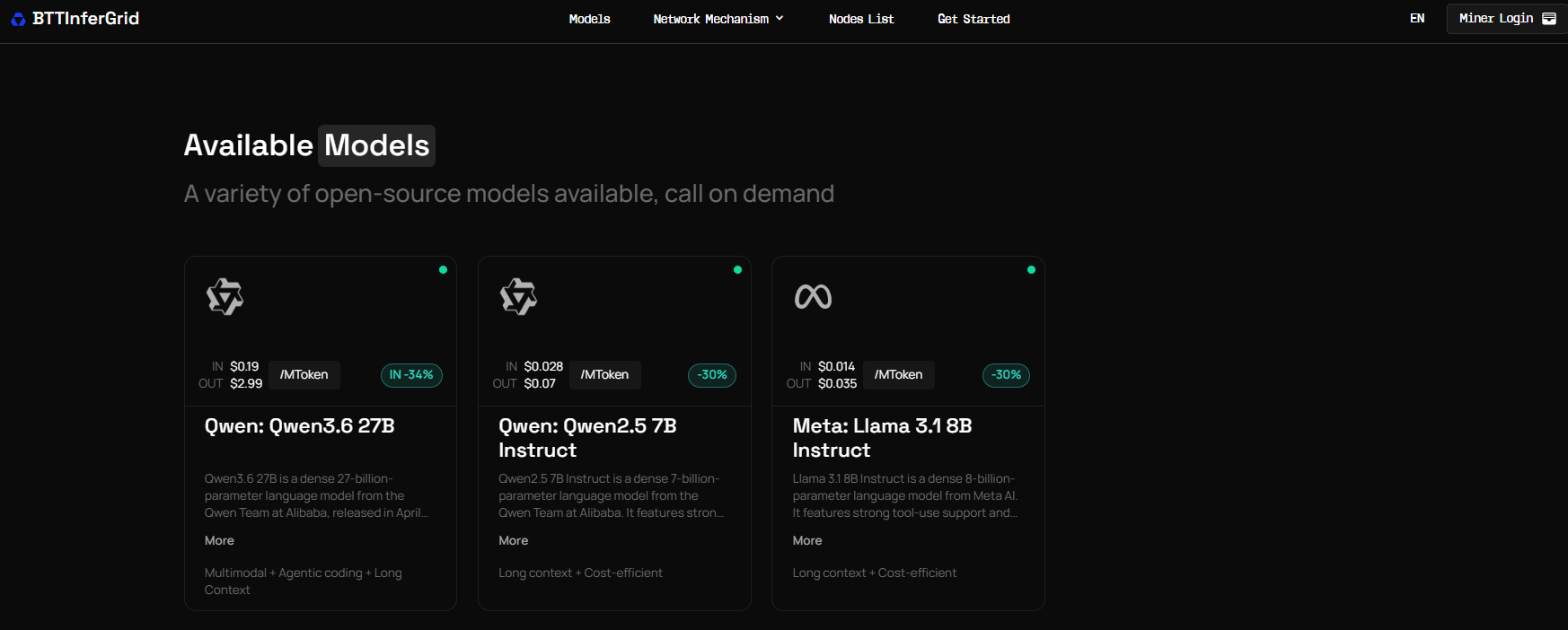
In ecosystem development, BTTInferGrid has already completed native adaptation for several industry-leading open-source large models, including Alibaba Cloud's Qwen3.6 27B, Qwen2.5 7B Instruct, and Meta's Llama 3.1 8B Instruct. These models cover diverse business scenarios like general conversation, code generation, and content creation. Developers can flexibly invoke these models on-demand via standard APIs without deploying or debugging models themselves, further lowering the entry barrier and significantly shortening AI application development and deployment cycles.
Currently, users can submit miner access applications through the BTTInferGrid official website, participating early in network building and sharing in ecosystem development dividends.