Tom Lee's Faith Recharged: Crypto Spring Has Arrived, ETH Could Reach $250,000


- Core Thesis: Tom Lee believes the crypto market has entered a "Crypto Spring," with bearish sentiment signaling a bottom. He predicts ETH could eventually reach $250,000, driven primarily by the transformative power of artificial intelligence (especially agentic AI) and tokenized financial infrastructure.
- Key Elements:
- Five Major Macro Catalysts: End of the Iran war lowering oil prices, passage of the US Clarity Act, White House support for crypto, a pro-crypto new Fed Chair, and a long-term bullish outlook for the stock market.
- AI and Blockchain Integration: Agentic AI and robotics will dominate internet traffic, with blockchain offering superior solutions for identity verification and payments compared to traditional systems. Rising software stocks will positively impact ETH prices.
- Tokenized Market Size Prediction: The tokenized securities market could reach $300 trillion, with only a handful of blockchains capable of operating at such scale. ETH, as the leading smart contract platform, stands to benefit.
- The Rise of the Ethereum Treasury: The Ethereum Foundation's holdings have dropped to 0.1%, while corporate treasuries like Bitmine now hold 7% of the total supply, becoming key network stewards and funding the ecosystem.
- Bitmine Business Progress: As the largest ETH treasury (holding 4.47% of the supply) and the largest staking operator, it has been listed on the Russell 1000 Index and expects to trigger institutional allocation on June 26.
Original article by Tom Lee
Compiled by Odaily Planet Daily & Qin Xiaofeng (@QinXiaofeng 888 )

Tom Lee, the new generation staunch ETH bull, is here again to boost market confidence.
On June 2, Beijing time, Tom Lee, Chairman of the Board of BitMine (NYSE: BMNR), the publicly-listed company with the largest Ethereum treasury, attended the "Proof of Talk 2026" conference at the Louvre in Paris and delivered a speech: "Crypto Spring: ETH is the Future of Money".
In his speech, Tom Lee argued that the current bearish sentiment signals a market bottom for Bitcoin and Ethereum. He stated that as artificial intelligence and tokenization drive major changes in financial infrastructure, ETH could ultimately reach $250,000. (Odaily Note: On the day Tom Lee gave his speech, BTC fell below $66,000, and ETH dropped to a low of $1,820. As of that day, Bitmine's ETH holdings were showing a loss of approximately $8.86 billion.)
Furthermore, he mentioned that Bitmine recently purchased 111,942 ETH, boosting its holdings to nearly 5.4 million ETH, representing approximately 4.47% of the circulating supply. In contrast, the Ethereum Foundation has been selling off over the years and now holds only 100,000 ETH, a negligible 0.1% of the total supply. He believes that corporate validators will replace the shrinking Ethereum Foundation as the key stewards of the network.
Below is the full text of Tom Lee's speech (with some edits), compiled by Odaily Planet Daily. Enjoy~
——————————
Good afternoon, everyone. I've prepared a 30-minute speech, and there's a lot to cover because there's much worth discussing.
I believe we have entered a crypto spring. Many of you might have lost faith in crypto because prices haven't gone up. Your friends might be exiting, and the crypto space is filled with anger. Many think the market's main character this year will be AI. I believe these are all typical signs of a market bottom. In fact, I have a few slides to explain why Agentic AI is a major pillar of the crypto narrative, a trend that will unfold this year.
So, I will divide this presentation into three parts:
- The first part is a macro explanation, five reasons I firmly believe crypto spring is here. Even if you don't believe in the many products being built in blockchain and crypto, there are five major tailwinds that will play out this year;
- The second part explains why Ethereum is likely the best example of the future of money. I'll talk about the foundations and the role they should play in this new system;
- The third part covers that if you want exposure to this, instead of buying the underlying token, you should buy crypto treasury stocks (mainly Bitmine).
1. Has Crypto Spring Arrived?
Why do I think crypto spring is already here?
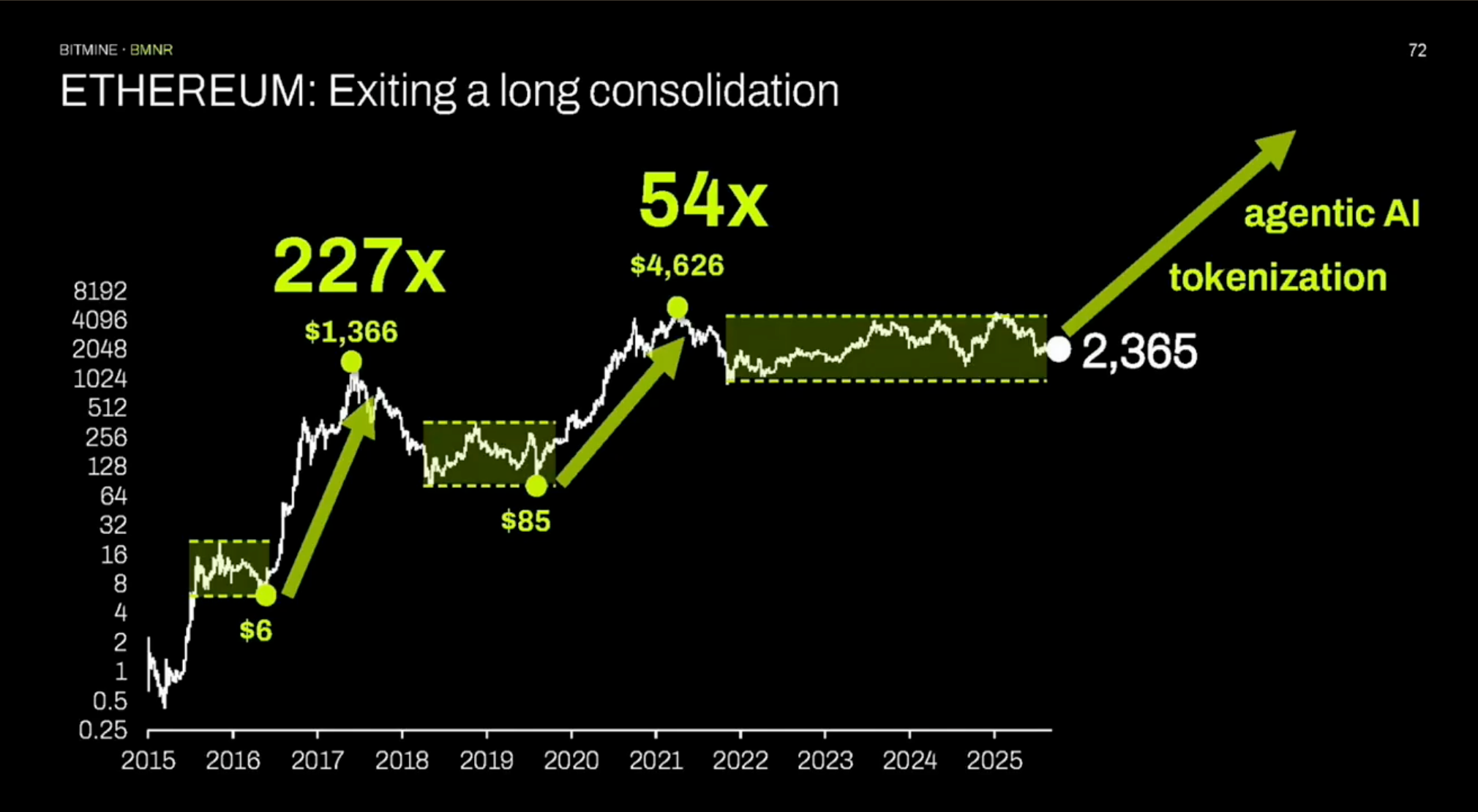
Take a look at the price chart of Ethereum below. You can see it has been consolidating for nearly five years, trapped in this range, waiting for a decisive breakout. If you are bearish, you might think it will break downwards. I will explain why I believe we will see a bullish breakout.
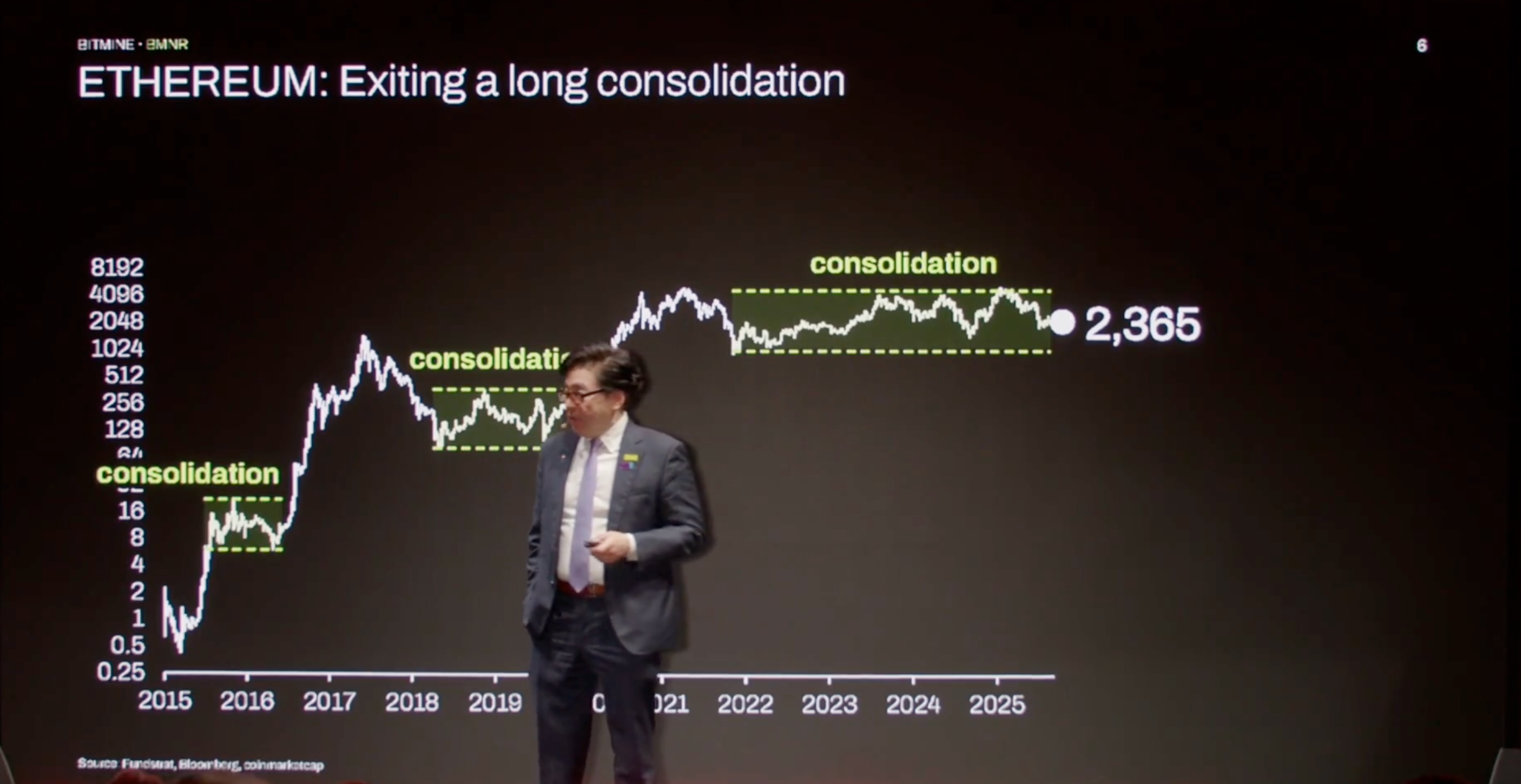
(Odaily: This chart is outdated; ETH has now fallen to the $1800-$1900 range)
The first catalyst is: The Iran war is nearing its end.
I know many people think crypto prices have nothing to do with the Iran war. But actually, the Iran war has already caused problems for oil prices and supply.
Oil is a fundamental driver of inflation. If oil causes inflation problems, it means global central banks must tighten policy: oil prices rise, supply of petroleum products is severely impacted, and policymakers have to raise interest rates. So once the war ends, the fear premium on oil will disappear. Oil prices could fall to $40 per barrel.
Ethereum is currently highly negatively correlated with oil prices. In fact, this is the highest negative correlation in Ethereum's history. So clearly, rising oil prices are bearish for the ETH price. We can see this from the statistical data.
If you don't believe me about inflation and oil prices, look at the chart below. This chart starts in 1985. The top part shows oil price changes, and the bottom shows Core CPI. As we can see, every time oil prices spike persistently, Core CPI accelerates.
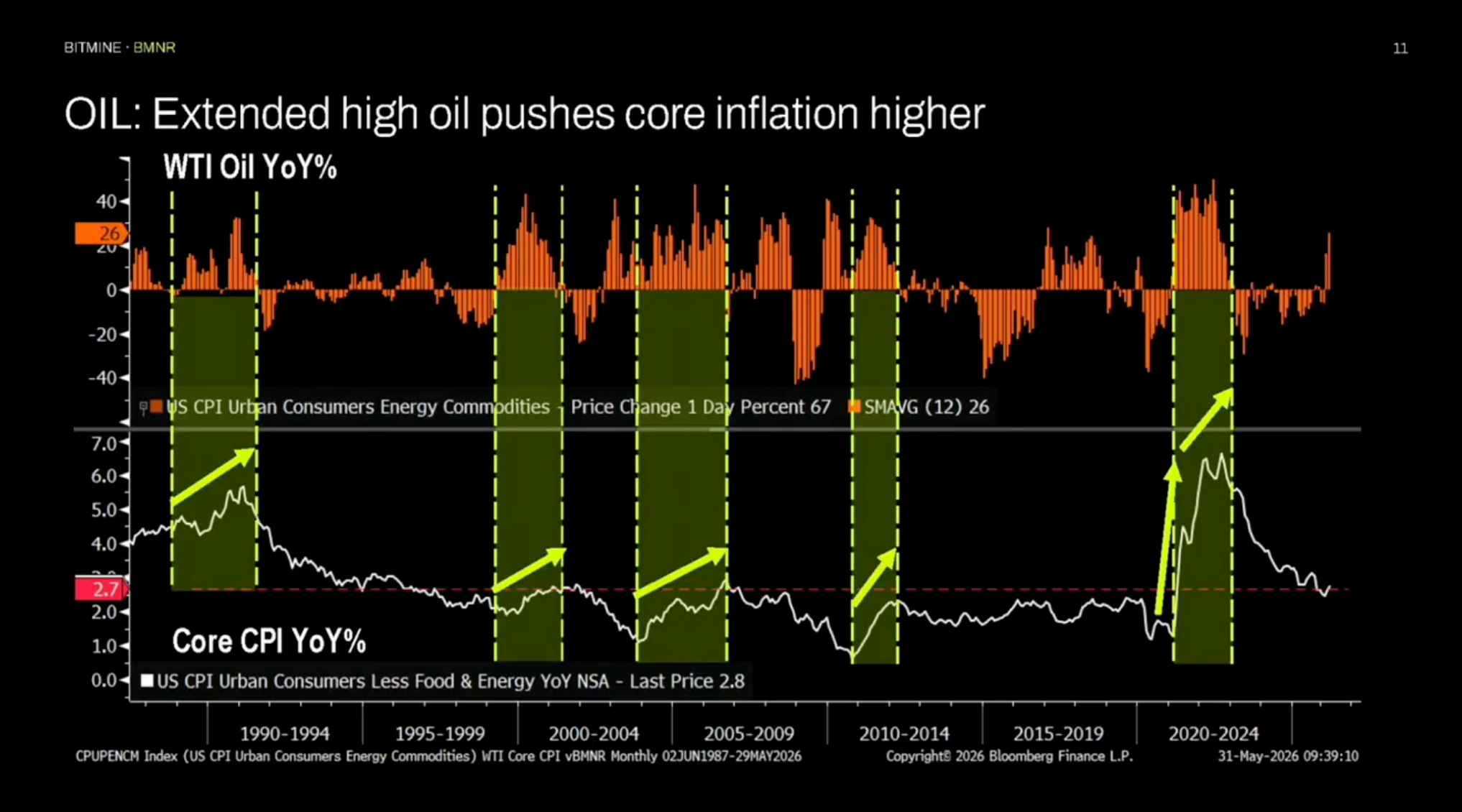
Therefore, if this were a prolonged conflict, inflation would follow. In fact, last month the FOMC said the same thing in its meeting minutes: if inflation persists and stays above 2%, then appropriate policy tightening is suitable. Central banks don't want inflation above 2%, and if oil prices stay high, they will remain hawkish.
So, we are betting that the war will end soon.
The second positive macro catalyst is the Clarity Act, which provides a legal framework for the adoption of crypto in the US and the participation of financial institutions.
Unfortunately, the market believes the probability of the bill being signed this year is only 56%. I've spoken with many people in Washington, including our own policy experts. The actual probability seems much higher. Prediction markets are trying to find an equilibrium, but I think the actual probability is far higher than 56%.
Of course, I know big banks don't want this to happen. But remember, policies aren't made by big banks; laws serve the people. There are many voters who want to see the Clarity Act passed. If it passes, it will be a massive catalyst.
The third positive catalyst is the government. Don't forget, the White House is pro-Bitcoin and crypto, which is also very favorable for the US dollar policy, especially concerning stablecoins.
Fourth, we have a new Federal Reserve Chairman, Kevin Warsh, and Kevin Warsh is pro-Bitcoin.
Finally, there are also huge bullish factors facing the stock market. I know many of you might be bearish on stocks because they've already risen too much. But at Fundstrat (Odaily Note: the independent research firm founded by Tom Lee), we have been structurally bullish on the stock market.
The chart below relates to the US population aged 30-50. Every time this number goes up, the US economy grows faster than trend. Due to Millennials, Gen Z, and Gen Alpha, we are seeing this super-trend growth. As the chart shows, if you overlay stock returns with the number of people aged 30-50, the stock market always rises parabolically.
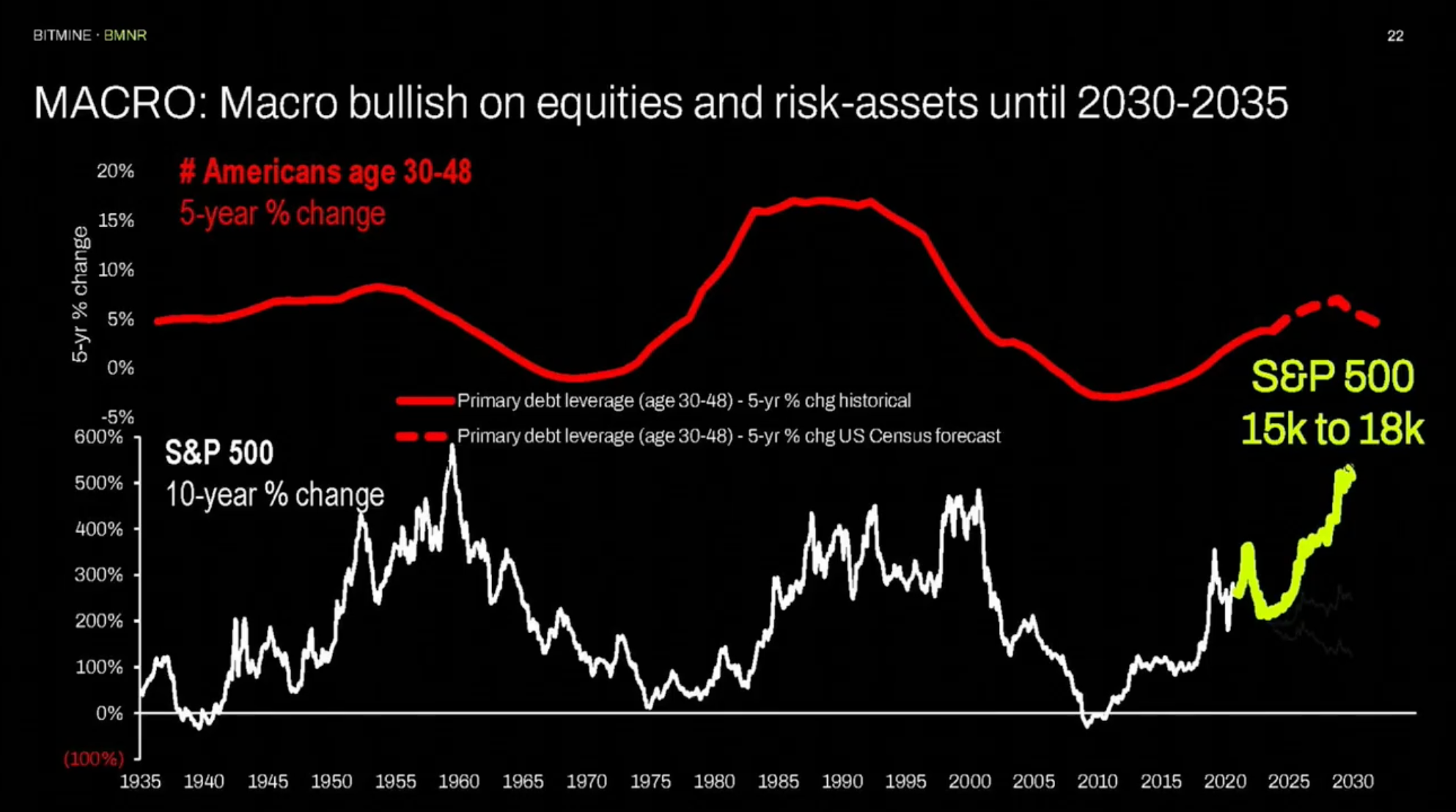
This tells us that by the end of this decade, the S&P 500 could reach 15,000 to 18,000 points.
These are all favorable factors for crypto. Of course, you might still be wondering why crypto is so weak. I think it's because people have forgotten that crypto is the future of money.
2. The Future of Money
The first point I want to discuss: Agentic AI and Robotics.
The chart below is a list of milestones since the launch of ChatGPT in 2023, marking significant progress made in the past three years.
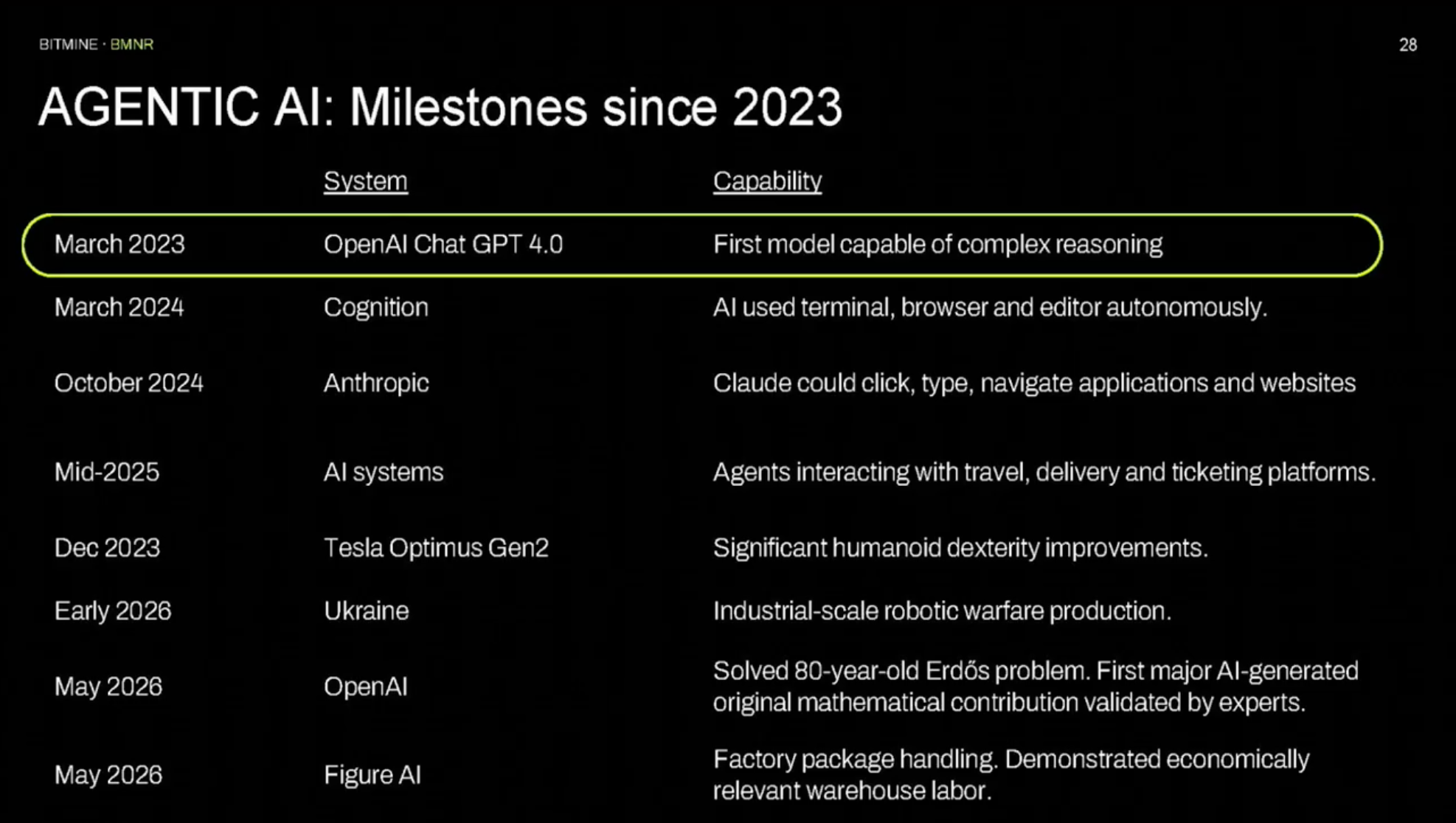
The first milestone was the launch of ChatGPT; the second occurred in 2024, when agentic systems began to gain the ability to interact with and operate websites; the third major advance was in robotics—Optimus Prime's progress in dexterous manipulation. And, of course, Ukraine manufacturing drones at an industrial scale.
Finally, we are seeing the development of superhuman capabilities. OpenAI solved an 80-year-old puzzle. Figure AI unveiled a robot capable of actually building and operating on a massive scale in a warehouse. This means that in the future, robots will dominate most traffic on the internet.
That's why people like Marc Andreessen refer to this trend as "the great unification." Because if you have robot systems, you need to control them. And blockchain is far more effective than traditional systems at controlling robotic behavior. For example, whether it's authentication, identity verification, or payment speed, all of these work better on crypto systems.
You might ask, why isn't this reflected in crypto prices yet? Because the stock market is still gradually transmitting the impact.
The first group to truly benefit from the AI ecosystem were semiconductor companies, which are still rallying. Then last year, it was storage stocks, which are undergoing a revaluation. But as you can see, the market is now beginning to see the benefits of AI for large-cap tech stocks and is transmitting to the software sector. People previously thought software would be hurt by AI, but this slight parabolic rise shows that software companies are benefiting from AI because they are developing for the future AI infrastructure, which will be built on crypto.
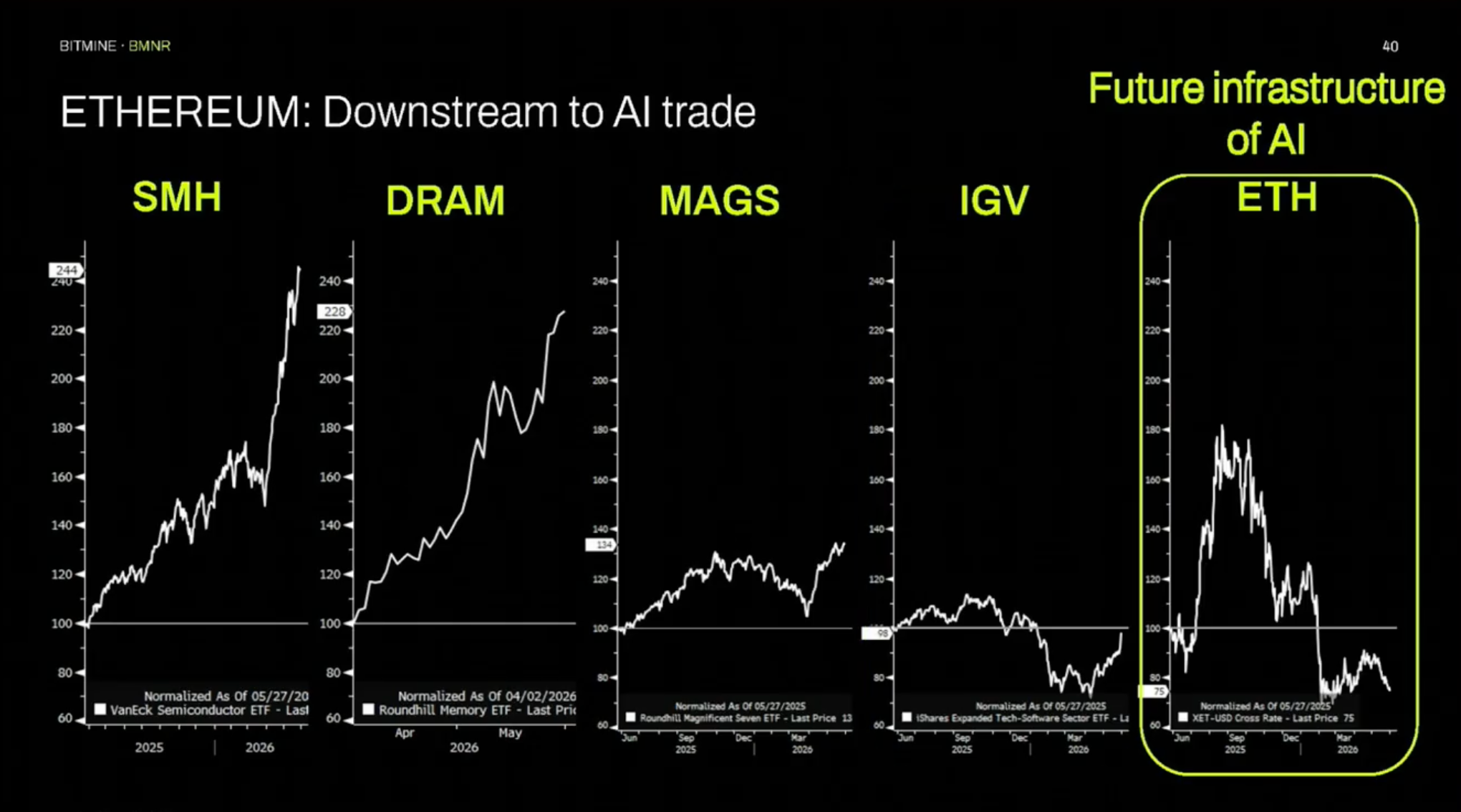
So in my view, this is entirely logical; we are just advancing step by step. I think this will only take a few months. If you think it's impossible, look at the relationship between Ethereum and software stocks; they have been moving in sync over the long term.
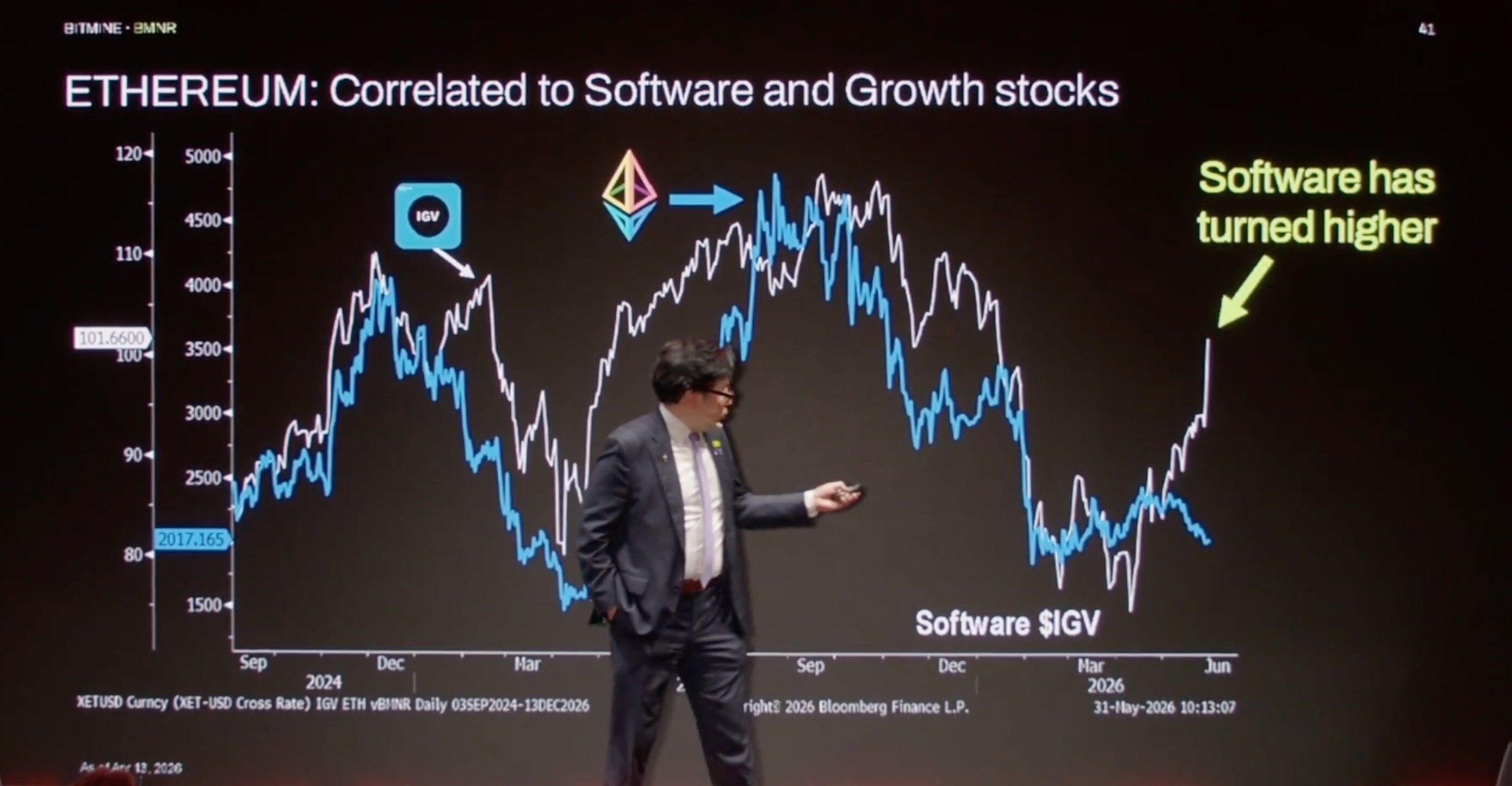
Now we see divergence, with software stocks having gone parabolic. I believe in a few more weeks, the price of Ethereum will reflect this.
The second key point is Tokenization. Wall Street today wants tokenization, and they also believe the future of money is computing power. In fact, many tech founders already see this. Partly because we have already seen the future.
Today, the transaction volume of stablecoins has surpassed that of Visa. In the future, it is believed that the tokenized securities market could reach $300 trillion. This would include the tokenization of real estate, fixed income, equities, derivatives, land, and gold.

You can see that the current tokenization market size is very small. If the market size reaches $300 trillion, how would that bring more value to crypto assets or benefit them? Remember, crypto asset prices are highly correlated with the amount of tokenized assets. Therefore, if the market value of assets reaches $300 trillion, Ethereum's Total Value Locked (TVL) won't stop at $100 billion or $200 billion.
This is the reality: there are only a handful of blockchains currently capable of operating at scale. What does this mean? I believe that crypto technology, which can provide enormous efficiency, will replace many of today's most profitable banks.
Let me give you a few examples. JP Morgan is the world's most profitable bank, with annual revenue of $60 billion. But there's a company called Jane Street that basically only does money transfer business, and this year they will make $40 billion. That's almost as much as JP Morgan, but they only have 3,000 employees.
Therefore, with one-thousandth of the employees, they achieved profit levels comparable to JP Morgan. This also shows that mere money transfer is more valuable than custodial services.
Crypto technology is very good at money transfer. Take Tether as an example. Tether might make $15 billion this year. It's a crypto-native company with only 300 employees; combined with Jane Street, they make more profit than JP Morgan.
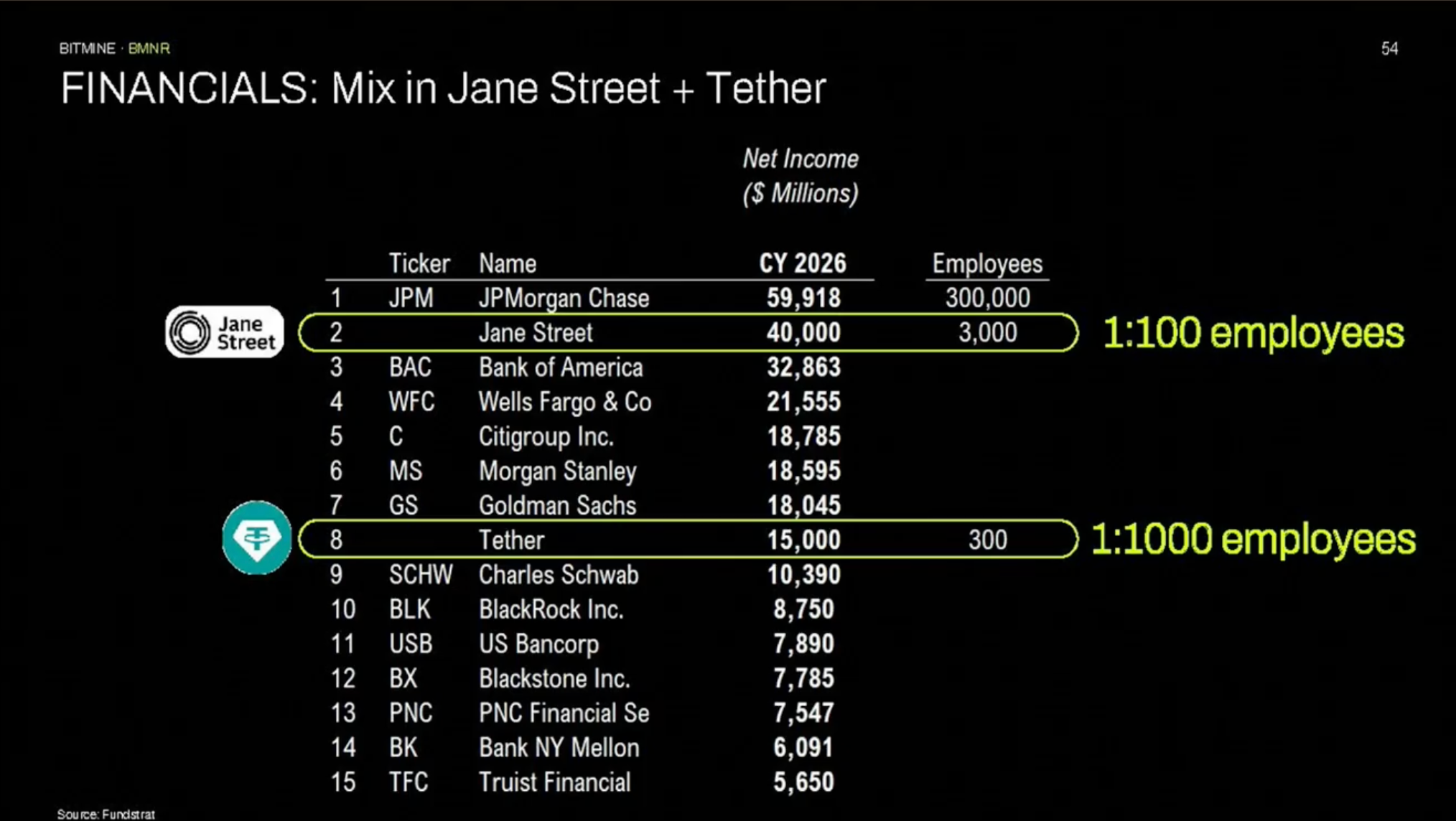
Investors always tend to support existing giants, always overvaluing them. But as you can see, the new entrants are the ones that eventually capture all the value. Therefore, I believe that in the next 10 years, five of the world's top ten financial institutions will be crypto-native companies.
This leads to my third point: these smart contract platforms are very likely to become the unit of value for monetization. Because holding ETH for transactions is arguably easier than holding USD.
Elon Musk says that in the future, we won't use the dollar as currency; it will just be a measure of energy. Standard Chartered published a report on Ethereum this week. They compared Ethereum to Amazon, pointing out many tailwinds are driving the accumulation of ETH, just like Amazon back then — Amazon's stock was once stuck at $6; today Amazon's stock has increased over 1000 times.
So, one metric worth watching in this regard is the ETH/BTC ratio.
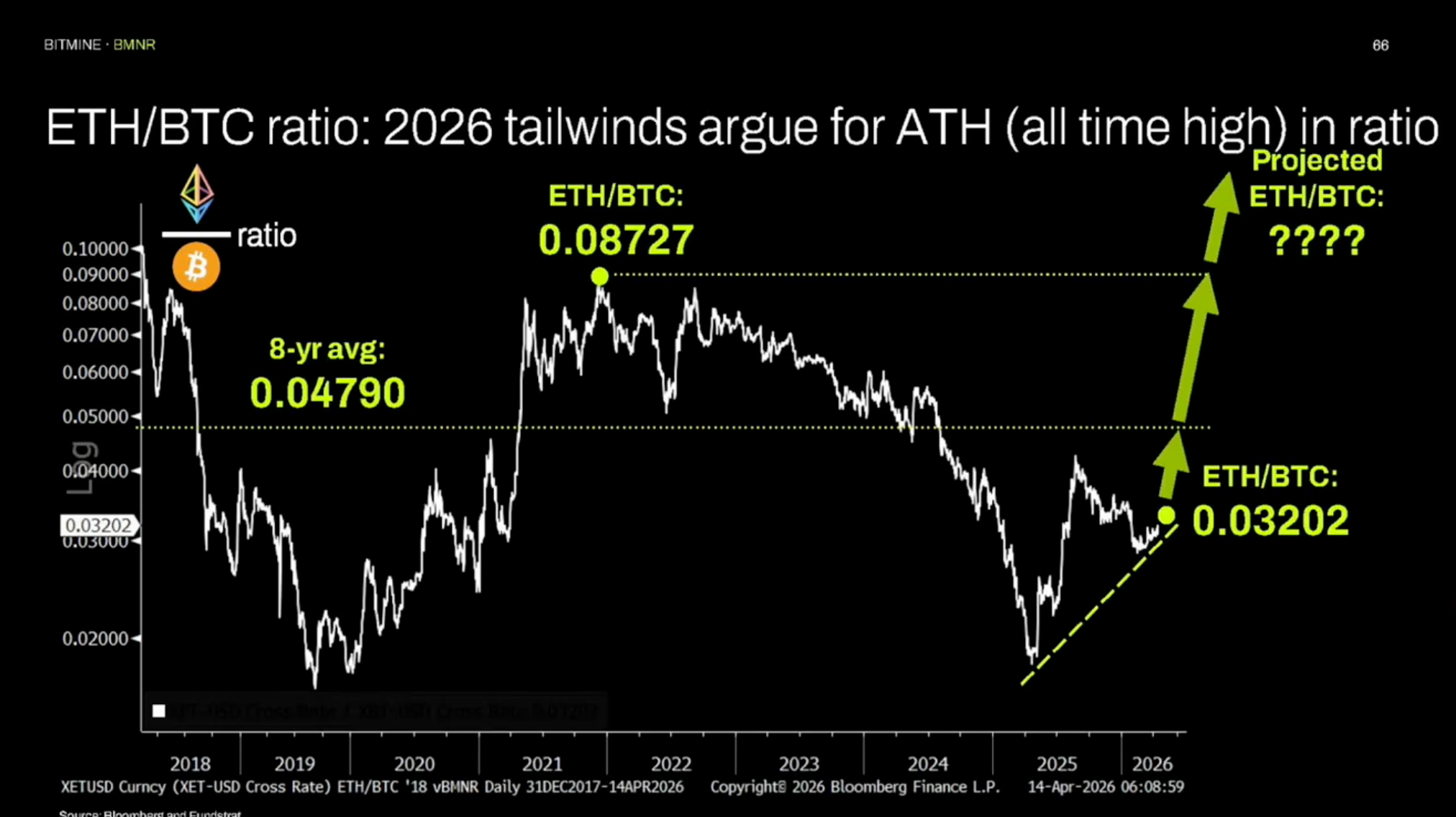
If our view is correct, as tokenization and AI develop, ETH will break out. And I think, roughly a 50x gain represents a significant upside for Ethereum.
Finally, I want to talk about the Ethereum Foundation. Because in this new world, the foundation should no longer be the centralized node of the cryptocurrency. Vitalik wrote about this earlier this year. He said the Ethereum Foundation will streamline its role; it won't be the only centralized manager of everything on Ethereum.
This makes sense because the EF's share of holdings is no longer what it used to be. It once held 17% of the supply; by 2020, that number had dropped to 1%; last year, when Bitmine started its treasury operations, the number dropped to 0.3%; today, the Ethereum Foundation only holds 100,000 ETH, 0.1% of the supply.
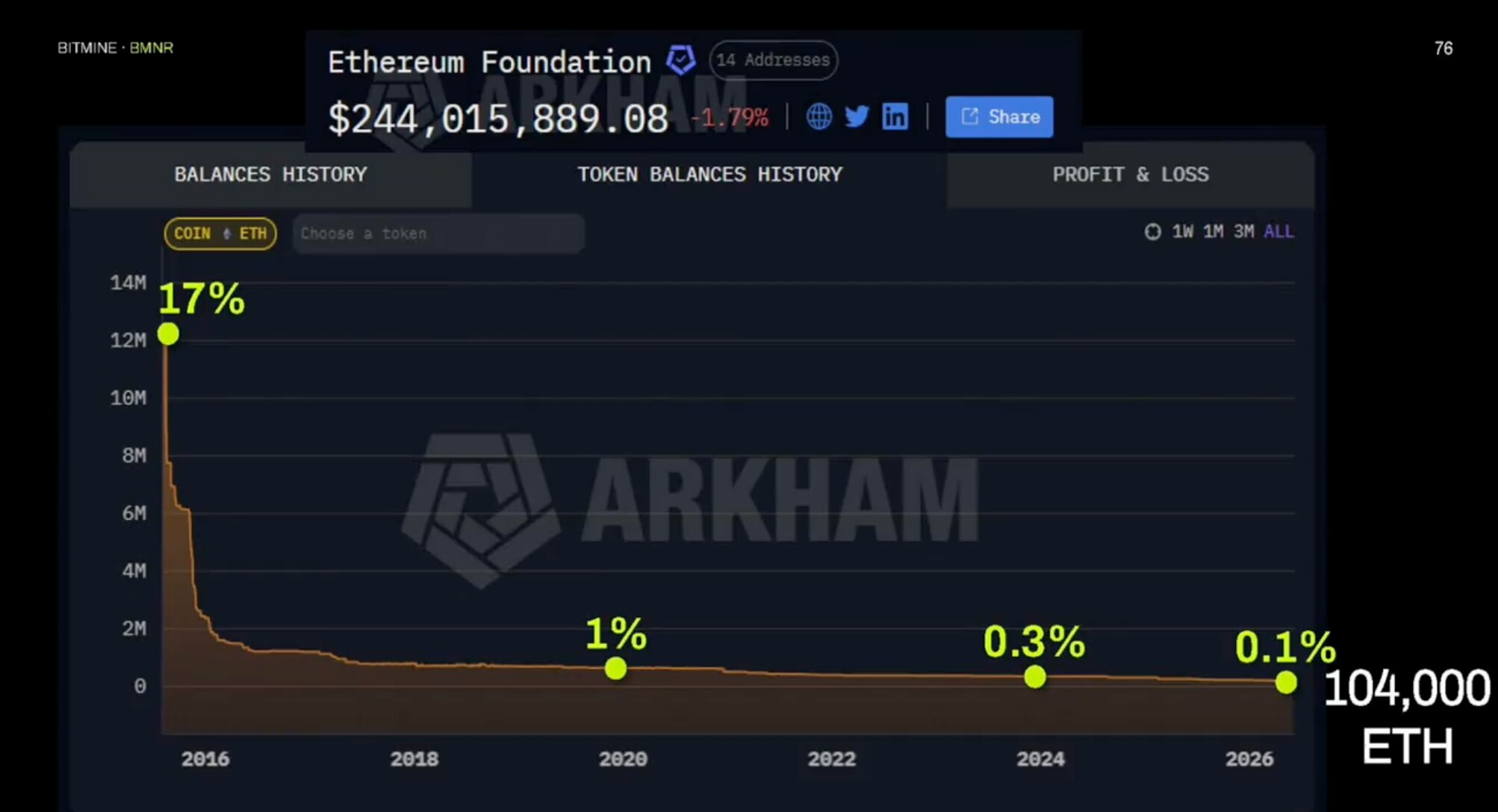
If we follow the typical foundation model — a 5% return rate — they could only sustain about $10 million worth of grant programs. But this is exactly where corporate treasuries come into play. The Ethereum treasuries I'm referring to include Bitmine, Sharplink, etc. — they now hold 7% of the ETH supply.
If you're an accountant, you know what treasury stock is. Treasury stock is essentially supply permanently withdrawn from the ecosystem. We also now have yield — about a 3% yield. So these public treasuries generate $500 million per year in rewards, which is exactly the capital we can use to fund the crypto ecosystem. By the way, Bitmine holds 4.5% of the total ETH supply, representing 65% of all ETH treasury holdings.
To summarize, before 2024, before we had a friendly White House, foundations played an important role. They funded public goods and provided a lot of legal and operational infrastructure. They also coordinated the ecosystem, maintained neutrality, and tried to drive adoption. These were indeed very important functions. It made sense in the DeFi world.
But now in 2026, in this new world, the role of the foundation has evolved.
Firstly, they still want to manage long-term research: things like quantum resistance, privacy, how to keep this blockchain relevant. They want to coordinate efforts within the private sector. They want to set standards and best practices. And I believe they will play a public role in representing the ecosystem.
But they want to enhance decentralization. Why is this so necessary? An entity with a $240 billion network value has been running for 11 years without a single day of downtime. It has 1,500 nodes spread across 89 different countries and 15,000 developers.
I think this is too big to be coordinated by a single foundation. In fact