






Jensen Huang and Marvell CEO Discuss on Stage: The Future of AI Depends Not on Computing Power, but on "Connectivity"


- Core Thesis: As AI enters the era of intelligent agents, the bottlenecks in data center computing power and memory have been broken. The next decisive battleground has shifted to "connectivity" demands, which is driving a boom in optical communication infrastructure and benefiting core suppliers like Marvell.
- Key Elements:
- NVIDIA CEO Jensen Huang predicted Marvell could become the "next trillion-dollar company" and has already made a strategic investment of $2 billion, highlighting its strategic importance for AI data center interconnection.
- Marvell's data center business share has soared from less than 10% a decade ago to over 75%, and is accelerating at 40% annual growth. The market expects its revenue to reach $16.4 billion next year.
- The core consensus is that the bottlenecks in AI infrastructure have shifted sequentially from computing power to memory, and now to connectivity. Top cloud service providers are replanning their network architectures as a result.
- Jensen Huang proposed a strategy of "use copper when possible, and use optics only when necessary," predicting that copper cables and optical components will coexist for the next 5-10 years. Marvell provides complete solutions in both areas.
- Physical limitations drive optical communication demand: when single-channel speeds reach 400Gbps, copper cables will be unable to connect an entire rack, causing optical communication demand to grow by orders of magnitude.
- Marvell is placing a major bet on CPO (Co-Packaged Optics) technology, having already launched a 51.2T switch based on CPO, aiming to eliminate copper traces and break the physical boundaries of data centers.
- NVIDIA and Marvell have collaborated to launch NV Link Fusion, designed to integrate NVIDIA's technology platform with Marvell's solutions to build decoupled, heterogeneous, customized AI data centers.
Original author: Dong Jing, Wall Street News
As AI models evolve into the era of vast "agents," the computing power bottleneck in data centers is shifting towards "connectivity," triggering a comprehensive revolution in underlying infrastructure—a leap from copper cables to optical fibers.
On the second day of the Computex conference in Taipei, China, Matt Murphy, Chairman and CEO of Marvell, a leader in AI custom chips, optical communications, and data center interconnection, delivered a keynote speech.
Nvidia CEO Jensen Huang made a surprise appearance as a special guest. The two leaders, standing at the pinnacle of AI computing power and network interconnection, shared the stage, highlighting the deep strategic bond between their companies. This joint appearance quickly became the most talked-about moment of the exhibition so far.
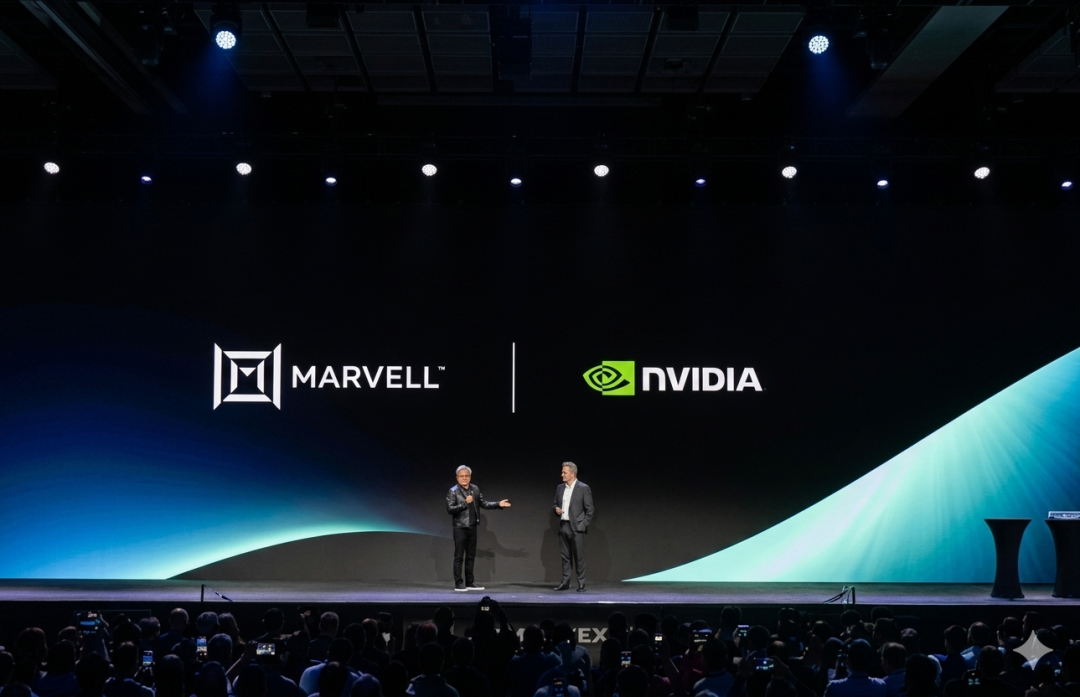
(Marvell CEO Matt Murphy and Jensen Huang in a joint dialogue at Computex)
Once on stage, Huang set the tone with a single statement: "Ladies and gentlemen, the next trillion-dollar company" — referring to Marvell.
The audience erupted in applause. According to an article by Wall Street News, this underscores the deep partnership forged when Nvidia announced a strategic investment of $2 billion in Marvell months earlier, and serves as the latest testament to their joint efforts in the AI data center infrastructure space.
Following the release of the previous quarter's earnings, the market is highly focused on the extent to which Marvell will benefit from the AI supercomputing cycle.
In response, Murphy delivered a report card that captured the market's attention: Ten years ago, Marvell's data center business revenue accounted for less than 10% of its total. Last quarter, that figure exceeded 75% and is accelerating at roughly 40% annually.
Based on the latest earnings guidance, Wall Street generally expects Marvell's revenue to reach a staggering $16.4 billion next year.
Behind this rapid growth, Huang and Murphy revealed the core investment theme for AI infrastructure in their discussion: After the bottlenecks of computing power and memory have been successively broken, "connectivity" will define the ultimate system performance. The key consensus between the two CEOs is:
The next decisive battleground for AI infrastructure is not computing power, nor memory, but connectivity. Marvell sits at the heart of this revolution.
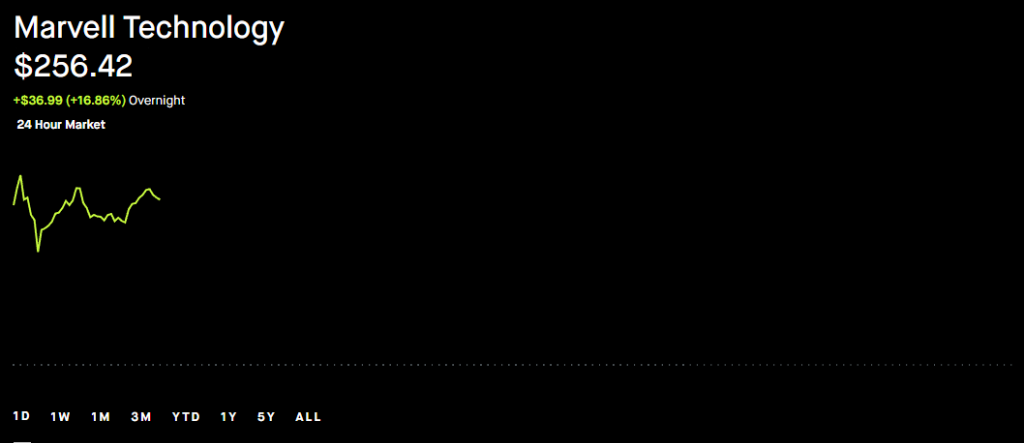
Notably, Marvell's stock price surged over 16% in after-hours trading.
The End of Computing Power is Connectivity: AI Enters the "Useful Phase," Igniting Infrastructure Interconnection Demand
Why has connectivity become so critical today?
In his speech, Murphy used a clear logical chain to explain why "connectivity" is the most crucial constraint currently:
The bottlenecks in AI infrastructure appear sequentially and are broken through in order — computing power (led by Nvidia, which became the world's first company to reach a $5 trillion market cap) → memory (recently giving rise to three new trillion-dollar companies in the memory sector) → connectivity (happening now).
"The world's leading hyperscale cloud service providers are rethinking their entire network architecture. They realize that scaling AI infrastructure has become the primary connectivity challenge," Murphy stated. "This isn't just my opinion; it's feedback we're getting directly from our largest customers."
Jensen Huang provided the most straightforward business logic during their talk:
"Useful AI has arrived. It's profitable now, and tokens can be profitable too.
When producing tokens becomes profitable, everyone wants to produce more tokens. That's why Marvell's demand is so strong, and why our demand is so strong."
Huang pointed out that current AI is moving towards an "Agent" model, which requires breaking down tasks and deploying them across massive computing clusters. "When you decompose a computing problem into multiple parts and distribute them across an entire data center, the most indispensable element is connectivity."
Huang was generous in his praise for his partner, even stating on stage: "Ladies and gentlemen, (Marvell) this is the next trillion-dollar company."
Murphy added that a single processor can no longer meet AI workloads; the future requires millions of processors working in coordination.
"Scaling computing power is fundamentally a connectivity challenge. The industry has solved the computing bottleneck, is working on the memory bottleneck, and the next bottleneck limiting infrastructure is connectivity."
"Use Copper Where You Can, Use Optics Where You Must"
Among the most market-relevant parts of the dialogue between Murphy and Huang was their discussion on the timeline for transitioning from copper cables to optical fibers.
Huang's strategic framework was direct and clear: "You use optics wherever you must, you use copper wherever you can."
He explained that copper cables have physical limits in bandwidth and transmission distance. Before hitting that boundary, copper is a simple, low-cost, practical choice. Once the tipping point is crossed, optical fiber takes over to meet the scaling needs between racks, data centers, and across data centers.
His key conclusion was:
"For the next 5 to 10 years, we will still use a lot of copper cables, but we will also use a massive number of optical components. These data centers are already part of the infrastructure."
This judgment of "using copper and optics side-by-side, each with its own boundary" implies that Marvell is in a position to benefit continuously from both sectors — and Marvell is one of the few companies in the industry capable of providing complete solutions in both directions simultaneously.
Behind the timeline for the copper-to-optical switch lies unavoidable physical laws. Murphy explained: The transmission distance of a copper cable is inversely proportional to its bandwidth; doubling the bandwidth halves the transmission distance.
Current fastest mass-produced systems have a single-lane speed of 200 Gbps, corresponding to a copper cable length of about 2.5 meters, while the rack height is around 2 meters — considering internal cabling, 2.5 meters is already at the limit.
"When we upgrade to 400 Gbps, copper cables won't be able to fully connect an entire rack. The 'Copper Wall' is moving, and it's starting to move now." Each time the Copper Wall shifts one step to the right, the number of connections increases by at least an order of magnitude, directly igniting demand for optical communication.
To tackle this physical limit, Marvell is heavily investing in CPO (Co-Packaged Optics) technology, integrating optical fibers directly into the package alongside computing chips to solve density and power consumption challenges.
On the day of the conference, Marvell officially launched a new 100T Ethernet switch designed for AI data centers with the industry's lowest power consumption, and showcased a 51.2T switch based on CPO technology, completely eliminating copper traces at the board level.
"This isn't some future concept; it's being implemented right now," Murphy said. Once optical interconnection completely removes distance limitations, future data centers will no longer have rigid physical boundaries for computing and memory. Infrastructure will be able to dynamically combine on a large scale based on the needs of AI models.
NV Link Fusion Builds a Heterogeneous Ecosystem: Marvell Aims to Be the 'Switzerland' of the AI Era
To address the extremely complex networking architecture requirements, Nvidia previously made a strategic investment of $2 billion in Marvell. Their collaboration is expanding across multiple dimensions, including optical communications, silicon photonics, and NV Link Fusion.
The emergence of NV Link Fusion aims to solve the customization pain points of cloud service providers (CSPs). Huang explained that while cloud providers design their own custom chips (ASICs), they still want access to Nvidia's system architecture.
"You don't have to buy everything from us, just a part. By integrating Nvidia's technology platform with Marvell's solutions, we can essentially build a decoupled, distributed, and heterogeneous data center."
Within this ecosystem, Marvell has found its irreplaceable niche.
Murphy emphasized Marvell's neutral and critical position:
"We work deeply with computing companies, and we also work deeply with storage companies. In many ways, we are like the 'Switzerland' of the industry, collaborating with all players."





