From Coinbase to Upbit: A Token’s 28-Day Journey to the Exit


- Key Insight: Under the 2026 bear market, CEX listings have shifted from traffic-driven to validation-driven, forming a structured path of Coinbase/Bybit (Discovery) → Binance Perps (Validation) → Binance Spot (Confirmation) → Korean Exchanges (Exit). Listing events now serve more as a redistribution of existing capital rather than a catalyst for incremental growth, allowing investors to identify alpha opportunities.
- Key Elements:
- Coinbase, Bybit, and Binance Perps form the first tier for initial listings, with 67%, 39%, and 48% of tokens, respectively, being listed there first, assuming the role of price discovery; Binance Spot listed only 19 tokens, with an initial listing rate of 28%, prioritizing security validation.
- Korean exchanges (Bithumb, Upbit) are systematically positioned at the end of the listing path, with an average delay of approximately 28 days from the initial listing, a follow rate as high as 85%, and often at high entry positions, leading to users frequently buying at the top (Upbit entry premium reaches up to 27.4%).
- The core precursor signal for Binance Perps listings is the listing activity on Coinbase and Bybit (conversion rates of 75% and 70%), with a very fast response time (average 4.9 days), and it preferentially selects popular projects with stable price performance, avoiding tokens with sustained weakness or excessive speculation.
- Post-listing price performance is generally under pressure: the 30-day average return is negative across all exchanges, with losses deepening over time, reflecting liquidity distribution rather than growth; initial listing exchanges (e.g., Bybit) achieved an average peak of +86%, while subsequent exchanges (e.g., OKX) only saw +25%.
- Exchange selection significantly impacts the risk-return structure: users on initial listing exchanges (Coinbase/Bybit) enjoy the lowest entry prices and highest peak potential, while users on Korean exchanges face buying at the top and deep drawdowns (30-day return of -25.7%), with a profit-loss gap of up to 4.5 percentage points.
Original Authors: Xinyang & Ethan @ IOSG
Every bear market is quietly reshaping the listing logic of CEXs. When liquidity tightens and retail enthusiasm wanes, each listing decision by exchanges becomes more cautious and, therefore, carries greater signal value. We systematically tracked new listing data from six major exchanges' spot markets—Coinbase, Binance Spot, ByBit, OKX, Bithumb, and Upbit—as well as Binance Perpetual, from the beginning of 2026 to mid-May. This yielded a total of 207 listing records covering 92 unique tokens. The data clearly reveals a core fact: listings follow a highly structured path of validation and liquidity transmission.
Who discovers and prices a project first? Who picks up the baton mid-way and amplifies liquidity? Who completes the market coverage at the end? Different exchanges play distinctly differentiated roles along this chain. By the time a token is finally listed on Binance Spot, it has often undergone multiple rounds of validation across various exchanges. This report deconstructs this listing path from three core dimensions:
- Landscape & Pathways: The differentiation of exchange roles in listings and the flow patterns of tokens between different exchanges
- Binance Perps' Screening Logic: What types of tokens are more likely to be listed on Binance Perp
- Price Impact: How listing timing determines investors' entry points, and the actual return differences after listings on various exchanges
For projects, understanding this path means a more precise and efficient listing strategy; for investors, identifying the positional differences within the path could be one of the most important Alpha sources of 2026.
2026 CEX Listing Landscape & Pathways
Overview of Exchange Listings
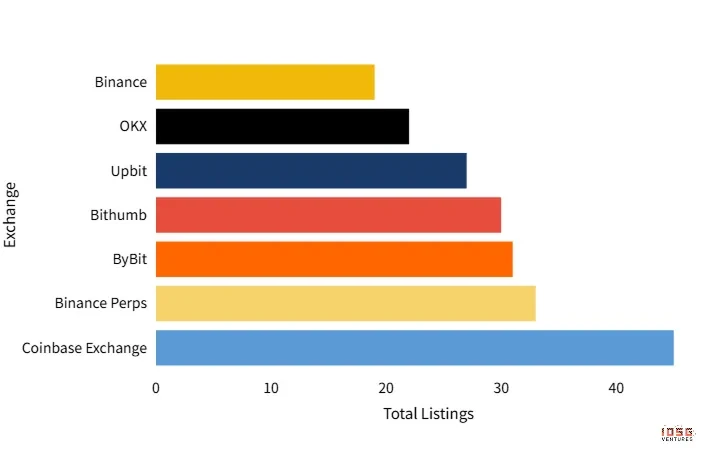
▲ Total Listings by Exchange
From the start of 2026 until now, we tracked new listing data from the spot markets of six major exchanges—Coinbase, Binance Spot, ByBit, OKX, Bithumb, and Upbit—as well as Binance Perp, accumulating 207 listing records covering 92 unique tokens.
The number of listings per exchange shows a clear stratification. Coinbase leads solidly with 45 new listings, closely followed by Binance Perps (33) and ByBit (31). Bithumb (30) and Upbit (27) form the second tier, while OKX listed 22 tokens. Binance Spot listed only 19, the fewest among all observed exchanges.
Looking at monthly cadence, January was the peak listing period of the year. Binance Perps listed 15 tokens in a single month, and ByBit listed 14. From February onwards, the overall pace slowed significantly, with the average monthly listings per exchange dropping to 5-8, entering a more cautious and stable screening phase. Coinbase exhibited a different rhythm compared to other exchanges, with two concentrated listing peaks in February and April (13 in each month), showcasing its independent and rapid listing decision-making characteristics.
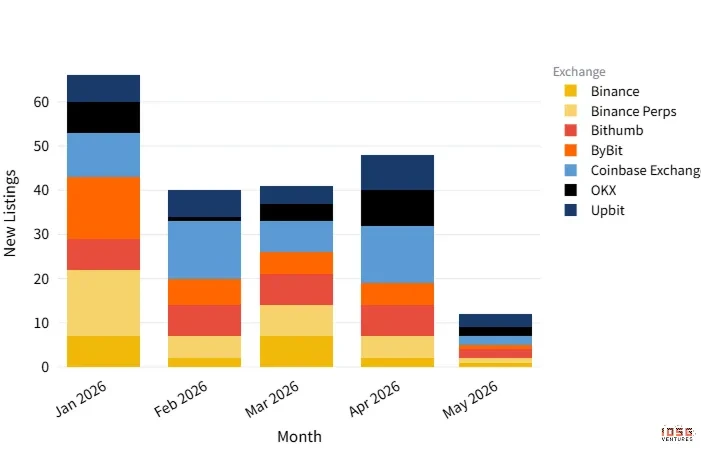
▲ Monthly Listings by Exchange
Pure quantitative differences only reflect surface-level activity. More important is the profound differentiation in listing chronology and roles among exchanges, which will be further analyzed in the following sections.
Role Differentiation: Discoverers, Screeners, and Confirmers
Among tokens listed on multiple exchanges, there is a significant sequential order. We define the earliest exchange within our tracking scope as the "Pioneer" and the rest as "Followers."
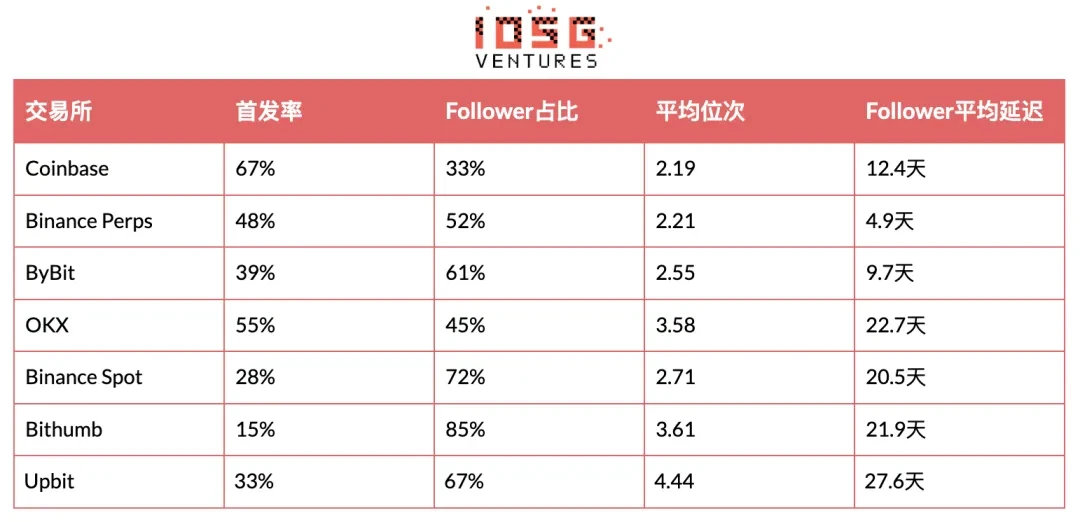
Coinbase is the most prominent pioneer listing venue in 2026, with 67% of its listings being the first among the tracked exchanges, shouldering the market's first round of price discovery. ByBit (39% pioneer rate) and Binance Perps (48% pioneer rate) also maintain high activity levels. The three often list the same token densely within the same week, collectively forming the first echelon for new project listings.
Korean exchanges (Bithumb and Upbit) are systematically positioned at the end of the listing path. Bithumb's Follower ratio is as high as 85%, and Upbit's average position rank is 4.44, with a high probability of being the last exchange to list among all tracked, averaging approximately 28 days behind the pioneer exchange. This is closely related to the longer regulatory review process in Korea and the tendency of local exchanges to only introduce projects after they have achieved widespread market consensus.
Binance internally forms a clear funnel-like division of labor: Binance Perps either takes the initiative to pioneer half the time, or follows up extremely quickly (average of just 4.9 days) after a spot listing in the other half, making it the most responsive among all exchanges. Its main function is to quickly test liquidity and market demand via the derivatives market. Conversely, Binance Spot lists the fewest tokens (only 19) with a pioneer rate of just 28%, clearly preferring to wait for sufficient market validation before strategically listing.
OKX demonstrates a relatively strong independent token selection capability with a 55% pioneer rate, but its overall listing volume is relatively restrained (22), and its average position rank is 3.58, indicating high screening thresholds and a more cautious strategy.
Listing Path Paradigm
Based on the sample of tokens listed on 3 or more exchanges, the listing sequence shows a highly stable tiered characteristic: early discoverers represented by Coinbase and ByBit pioneer first; Binance Perps follows up within days for rapid validation; then Binance Spot selectively lists for confirmation; while OKX, Bithumb, and Upbit mainly provide supplementary coverage in the later stages of the path.
Typical Case Study: ROBO (Fabric Protocol)
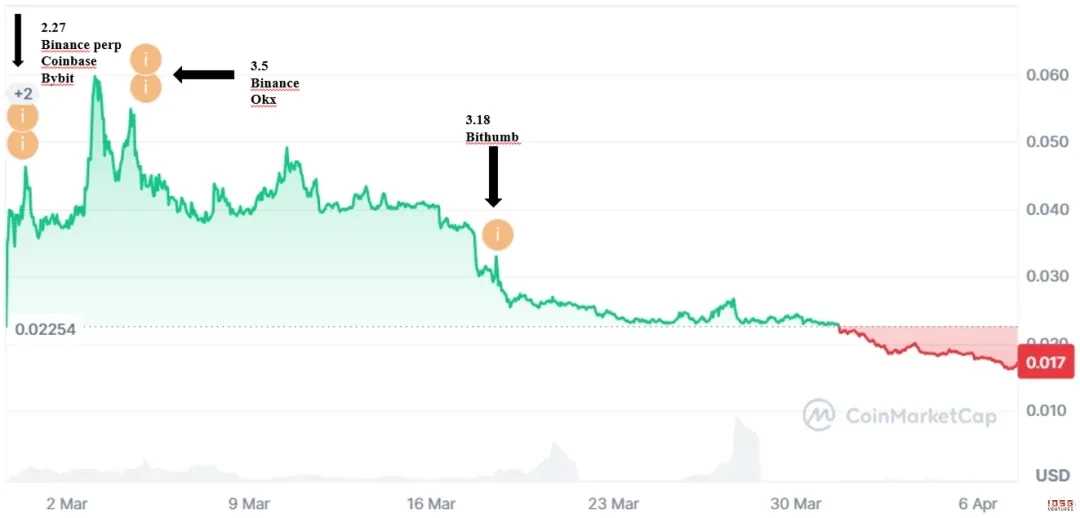
On February 27th, the DePIN project Fabric Protocol (ROBO) was first listed on Binance Perp. Coinbase and ByBit followed up on the same day. The opening price was $0.022, and it surged over 80% on its first day, with the opening price the next day already rising to $0.0405, nearly double the pioneer price. The project led a $20 million funding round by Pantera Capital, focusing on the intersection of blockchain and the robotics economy. Its attention was further boosted by the Kaito public sale hype and the "AI + Robotics" narrative.
On March 5th, Binance Spot officially listed ROBO, with the price reaching $0.0493 on that day. This became the highest price point for ROBO for the entire period. By the time OKX entered, the opening price was already lower than the Binance Spot price. When Bithumb listed on March 18th, the price was $0.0303. Although it briefly triggered a spike, the token price subsequently fell back and is now below its pioneer opening price.
From its pioneer listing to the Bithumb listing, ROBO took only about 20 days to fully traverse a typical 2026 listing path:
Binance Perps, Coinbase, and ByBit Pioneer → OKX and Binance Spot Confirm at Peak → Korean Exchanges Buy at the End.
ROBO is not an isolated case. Among the sample of tokens in the first five months of 2026, 28 tokens completed listings on 3 or more exchanges. The rank distribution of these cross-exchange cases also shows a tiered pattern highly consistent with ROBO. Although the specific order may vary slightly depending on project characteristics, the overall path structure is stable and predictable.
This path clearly reflects the differing risk appetites of each exchange: Coinbase, ByBit, and Binance Perps tend to proactively seize the early window; Binance Spot focuses on security post-validation; while Korean exchanges and OKX prefer to enter only after the market has built sufficient consensus.
Binance Perps Listing Conditions
As a crucial entry point for the derivatives market, Binance Perps' listing decisions directly influence the direction of significant leveraged capital flows. Through an analysis of 33 Perps listing cases, we can clearly distill the core logic behind Binance's token screening in a bear market environment.
Leading Indicators: Coinbase and ByBit Listings
▲ Exchanges Listed Before Perps
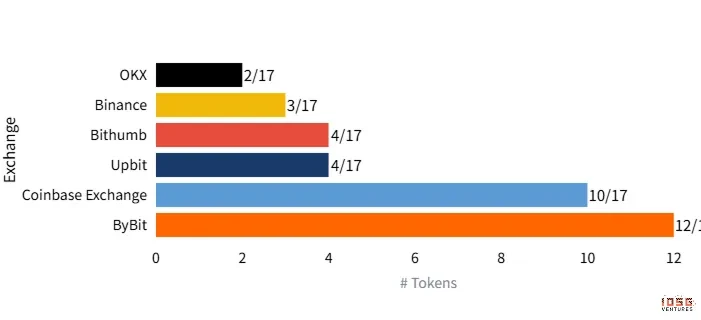
Among the 33 tokens listed on Binance Perps, 17 were listed on other spot exchanges before being included in Perps. Tracking these tokens reveals that Coinbase and ByBit are the most significant leading indicators for Perps.
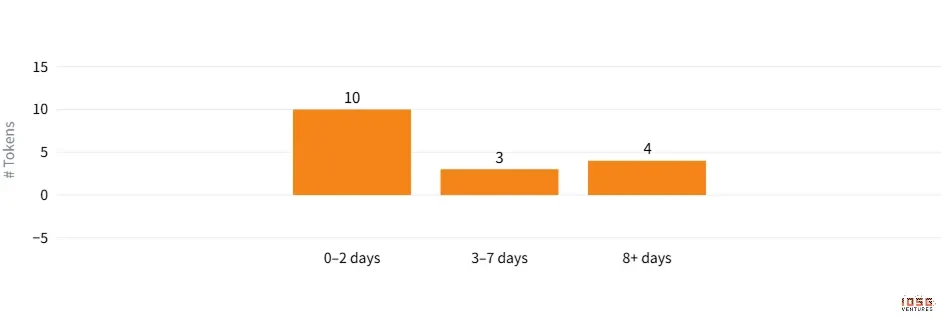
▲ Days from First Spot to Perps
Specifically, ByBit listed before Perps in 71% of these cases, and Coinbase in 59%. More importantly, the speed of response is notable: in the 17 follower cases, 10 were listed on Perps within 0-2 days of the spot listing, with an average delay of just 4.9 days. This extremely fast follow-through indicates that Binance Perps closely monitors the listing activities of Coinbase and ByBit, using them as a significant reference for its own decisions.
Looking at a larger sample, 75% of tokens listed on Coinbase eventually ended up on Binance Perps, compared to 70% for ByBit. When a token simultaneously gains support from both Coinbase and ByBit, and its price performance is relatively stable, it has a high probability of landing on Binance Perps within a week. This is currently one of the strongest and most directly observable leading signals in the market.
Price Performance is the Core Screening Criterion
▲ Post-Listing Mean Return (Converted vs Perp Only)
Projects listed on Coinbase and ByBit generally have an opening FDV above $100M, so FDV itself is not a differentiating factor. What truly determines whether a token enters Perps is its post-listing price performance.
Examining tokens listed on Coinbase and ByBit that did *not* make it to Perps reveals three main characteristics:
- First, projects whose price weakened continuously post-listing and lacked market momentum;
- Second, overly speculative meme coins (e.g., WHITEWHALE, ELON), towards which Binance's screening is noticeably stricter than ByBit's;
- Third, tokens that have not passed through Binance Alpha. Alpha, as a pre-screening channel within the Binance ecosystem, is an important prerequisite step for entering Perps.
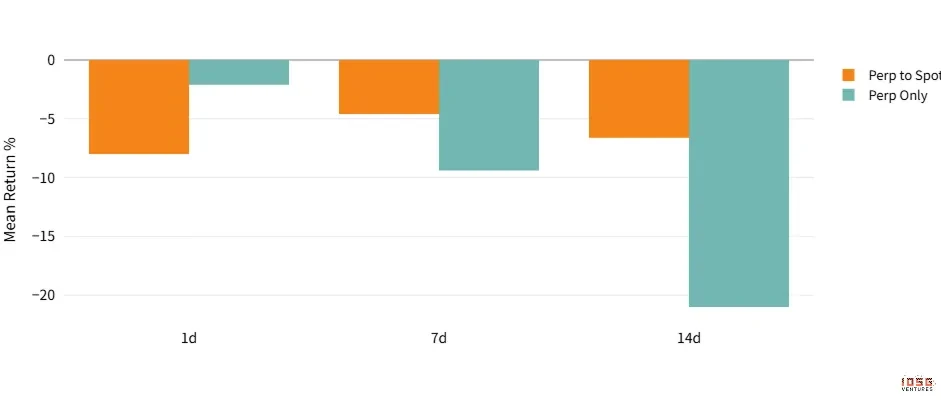
The impact of price performance extends beyond "getting on Perps" to the subsequent "Perps-to-Spot" transition. Data shows that tokens that successfully transitioned to Binance Spot (the Converted group) had a 7-day return of -4.6% and a 14-day return of -6.6% after their Perps listing. In contrast, tokens that did not convert to Spot (the Perp Only group) had a 7-day return of -9.4% and a significantly worse 14-day return of -21.0%. Although both groups showed negative returns under the bear market influence, the Converted group demonstrated significantly better price maintenance ability, indicating that Binance considers "sustainability" an important factor even during the Perps stage.
Price Impact of Listings
The actual impact of a listing event on a token's price is the most crucial issue for projects, institutions, and traders. We analyze this from two core dimensions: Price Position (the relative price level at the time of listing) and Post-Listing Return (returns after 7 days, 14 days, and 30 days).
Price Discovery Concentrated in the Pioneer Window, but Entry Prices Vary Significantly by Exchange
▲ Price Position at Listing
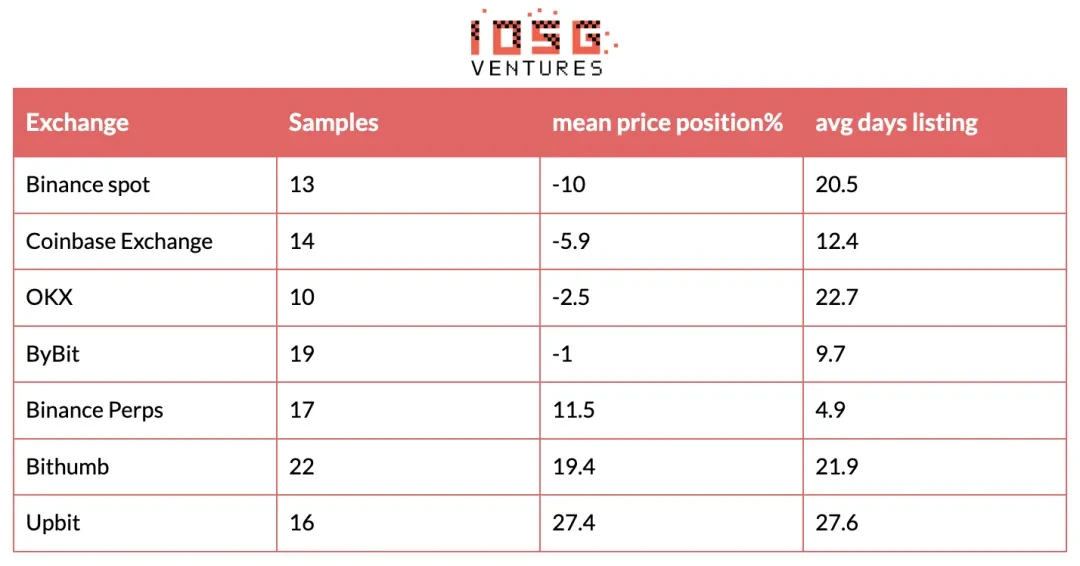
Price discovery primarily occurs in the pioneer window. When ByBit and Coinbase act as followers, their entry prices are roughly flat or slightly lower than the pioneer price, showing rapid price convergence among the first-tier exchanges.
When Binance Perps acts as a follower, its average entry price is 11.5% higher than the pioneer. However, thanks to its extremely fast follow-up speed (only 4.9 days), it remains in a relatively early position. Binance Spot's Price Position of -10% indicates a tendency to list after a price pullback, allowing users to potentially get a relatively better entry price.
Korean exchanges face the most disadvantageous entry positions: Bithumb averages 19.4% higher, and Upbit is as high as 27.4%. With an average delay of over three weeks, users often buy at significantly elevated prices.
2026 Listings Under Overall Pressure: Liquidity Unlock Rather Than Growth Catalyst
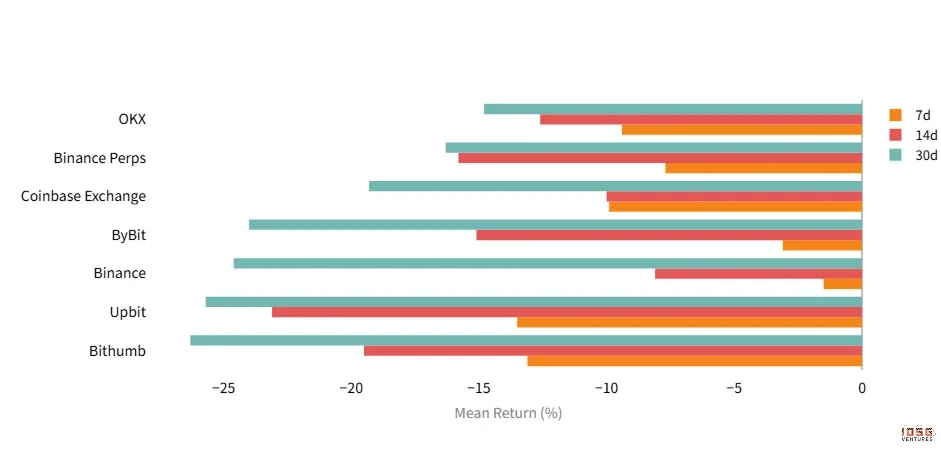
▲ Mean Return by Exchange 7d/14d/30d
In the 2026 bear market environment, the price performance of newly listed tokens is generally weak. None of the exchanges show a positive average 30-day return.
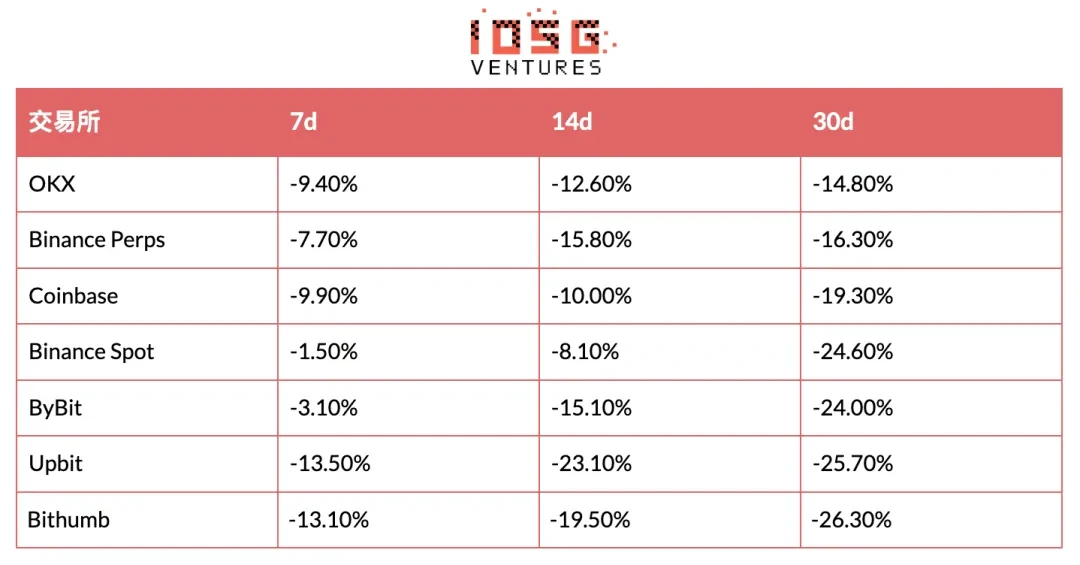
From 7d to 30d, the declines deepen gradually. This indicates that the post-listing price drop is not a short-term fluctuation but a sustained downward trend. In the current market environment, new listings primarily serve as liquidity unlock events—providing an exit window for early holders (including projects, investors, and early traders) rather than attracting continuous inflows of new capital.
The performance of the two Korean exchanges is particularly noteworthy: Upbit's 7d return is already -13.5%, reaching -25.7% by 30d. Combined with its +27.4% price position, this means Upbit users not only enter at the highest price but also bear the deepest losses.
Peak Price Performance Along the Listing Path
Although the final returns after 30 days are generally negative, the peak rebounds (Peak Return) in the early days after listing show a distinctly different distribution structure. Deconstructing the tokens' price data reveals that the listing sequence directly determines the upper limit of short-term speculative opportunities.
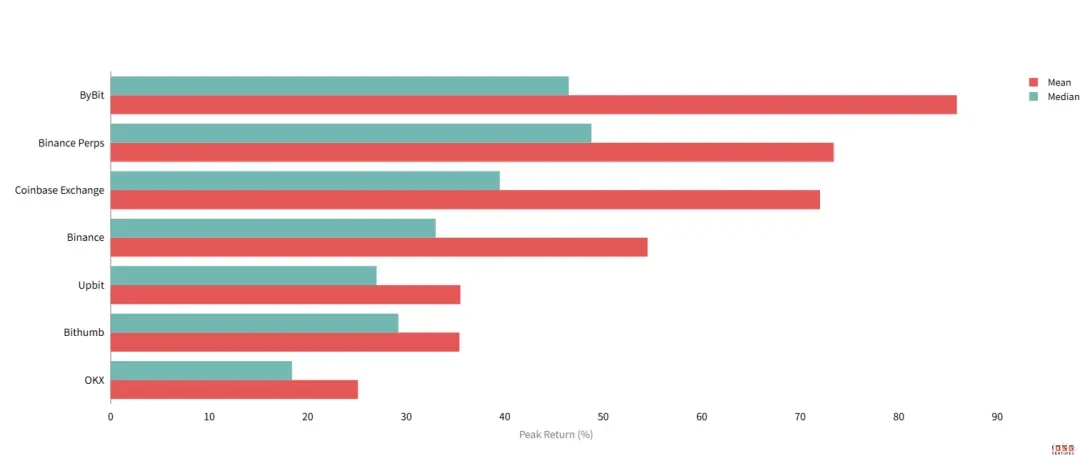
▲ Peak Return by Exchange (14d High)
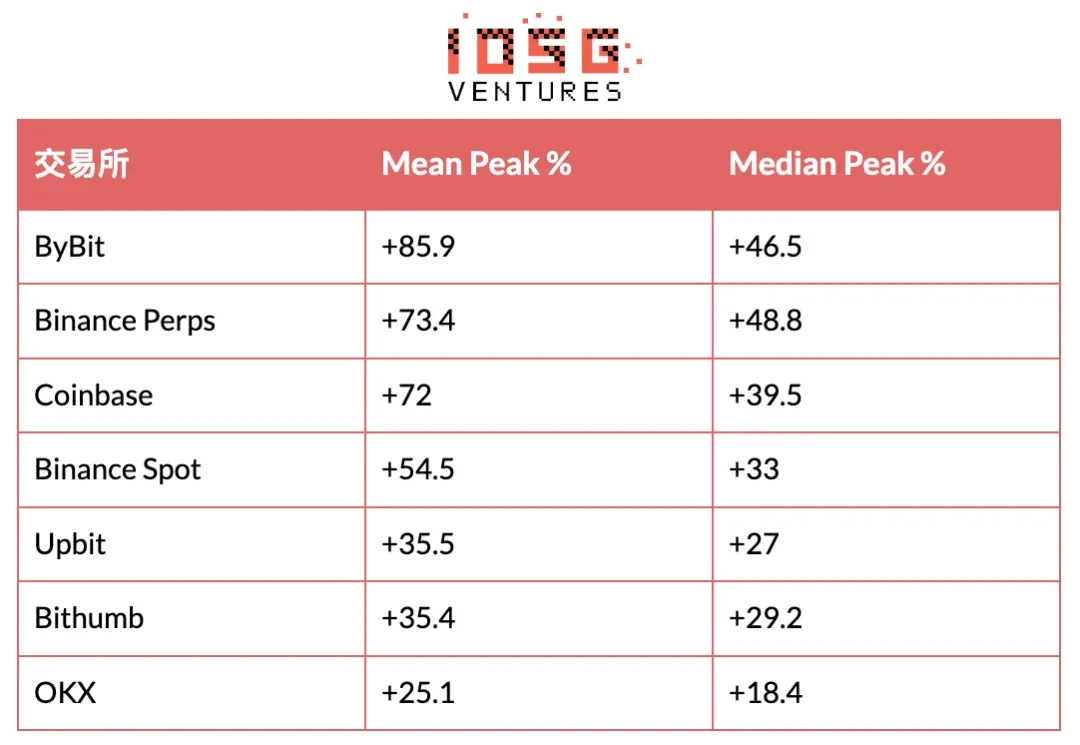
Pioneer exchanges hold an absolute advantage: ByBit's average peak return is as high as +86%, and Binance Perps' median is the highest (+49%). The first echelon of listings (ByBit, Coinbase, Binance Perps) commands the highest price elasticity, providing early holders with a substantial liquidity premium. Even if the price subsequently collapses to zero, there is ample time to exit at the peak.
Late followers face limited upside: The peak returns for Bithumb and Upbit are suppressed to around +35%, while OKX's is only +25%. Due to their delayed entry timing, the buying pressure on these platforms mainly absorbs profit-taking orders rather than initiating the upward move.
This difference confirms the transmission path of liquidity: Pioneer exchanges bear the primary price discovery function, offering the best exit liquidity for early holders. As time goes by, buying pressure on subsequent exchanges mainly absorbs already realized gains, leading to diminishing marginal utility. For traders, this means the later one enters the listing cycle, the lower the probability of capturing excess returns.
Exchange Choice Determines the Risk-Return Profile
Combining Price Position (entry point), Peak Return (upside potential), and Mean Return (final outcome), users on different exchanges face completely different risk-return structures.
Users on pioneer exchanges (Coinbase/ByBit) also face negative returns but have the best risk buffer. Thanks to the lowest entry prices (-10% to -5.9%) and the highest peak potential in the entire market (average over +70%), even if they fail to perfectly time the exit, their absolute losses calculated from the pioneer price are relatively manageable, and they even have opportunities to lock in profits during the upward surge.