Capturing 94% Market Share: Who is the Real Winner Behind the Crypto-Stock Race?


- Core Thesis: The stock tokenization services of platforms like Binance, Bitget, Gate, and Ondo all rely on the technological infrastructure of Alpaca, a US-regulated broker. Leveraging its API-first model and first-mover advantage, Alpaca commands a 94% market share in this niche, effectively playing the role of the "pick-and-shovel seller" and potentially reaping the greatest rewards in this sector.
- Key Elements:
- Binance launched a service offering trading in over 8,000 US stocks and ETFs for non-US users, supporting purchases with cryptocurrencies like USDT, with Alpaca as its partner broker.
- Bitget and Gate's stock token platform Reality and their real stock trading services both use Alpaca as their underlying brokerage partner.
- Ondo in the DeFi space and Kraken's xStocks protocol also announced partnerships with Alpaca in 2023 for US stock tokenization.
- Founded in 2015, Alpaca has raised over $320 million in cumulative funding, serving hundreds of institutions across more than 40 countries and helping open over 7 million brokerage accounts.
- Through its Broker API, Alpaca offers "Brokerage as a Service," helping partners resolve backend issues like account opening, KYC, and order execution, allowing partners to focus solely on users and traffic.
- Alpaca's core advantage lies in its API-first philosophy and high compatibility with the crypto industry, creating a first-mover advantage and a network effect moat amid the wave of stock tokenization.
Original by Odaily Planet Daily (@OdailyChina)
Author: Azuma (@azuma_eth)

On June 1, Binance officially unveiled its long-awaited new product: offering trading in over 8,000 U.S. stocks and ETFs to non-U.S. users, with a minimum investment of $5 for zero-commission fractional shares, purchasable using cryptocurrencies such as USDC, USDT, and BNB. (Recommended reading: Binance Makes a Major Move: 5*24H Trading of 8,000 U.S. Stocks & ETFs, Stocks on the Blockchain?)
Odaily Planet Daily noted a key detail: Binance has chosen Alpaca, a U.S. compliant brokerage, as its partner to handle asset custody, dividend distribution, and corporate actions. This company, Alpaca, may hold a far greater market position in the tokenized stock narrative than you might imagine; Bitget, Gate, Ondo, xStocks, and others are among its clients.
The Hidden Giant with a 94% Market Share
Alongside Binance's new product launch, exchanges like Bitget and Gate are also making significant strides in the tokenized stock space.
On May 28, Bitget officially announced the launch of its stock token platform, Reality, which will issue derivative tokens, rTokens, pegged 1:1 to stock assets. According to Bitget's Chinese spokesperson Xie Jiayin, Reality's underlying brokerage is Alpaca.
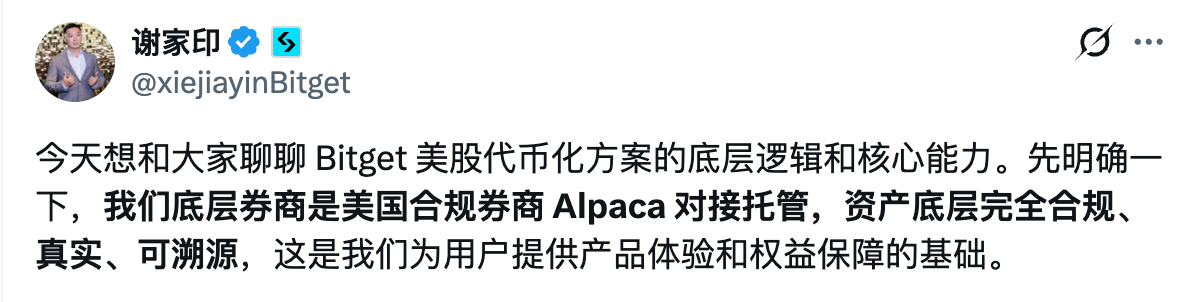
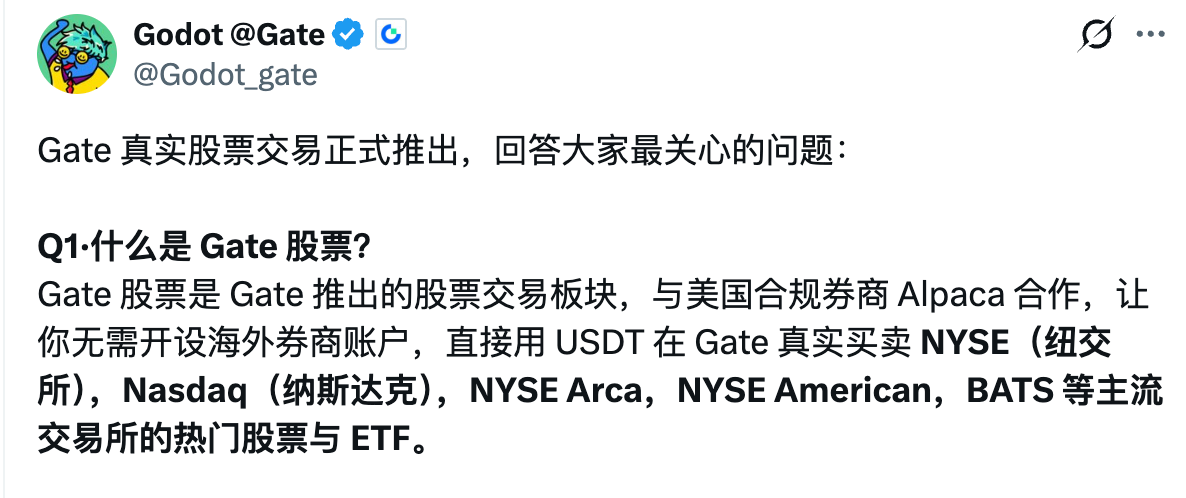
On June 1, Gate officially announced the launch of its real stock trading service, allowing users to trade stocks and ETFs in major U.S. securities markets directly using USDT. Gate official Godot also confirmed that Gate's brokerage partner is Alpaca.
Now, looking at the DeFi side. First is Ondo, the absolute leader in the stock token market, which announced in September last year that it would partner with Alpaca to tokenize U.S. stock and ETF assets.

Ondo's direct competitor, Kraken's stock token protocol xStocks, also announced in December last year that it would partner with Alpaca to accelerate the promotion and global adoption of xStocks outside the United States.

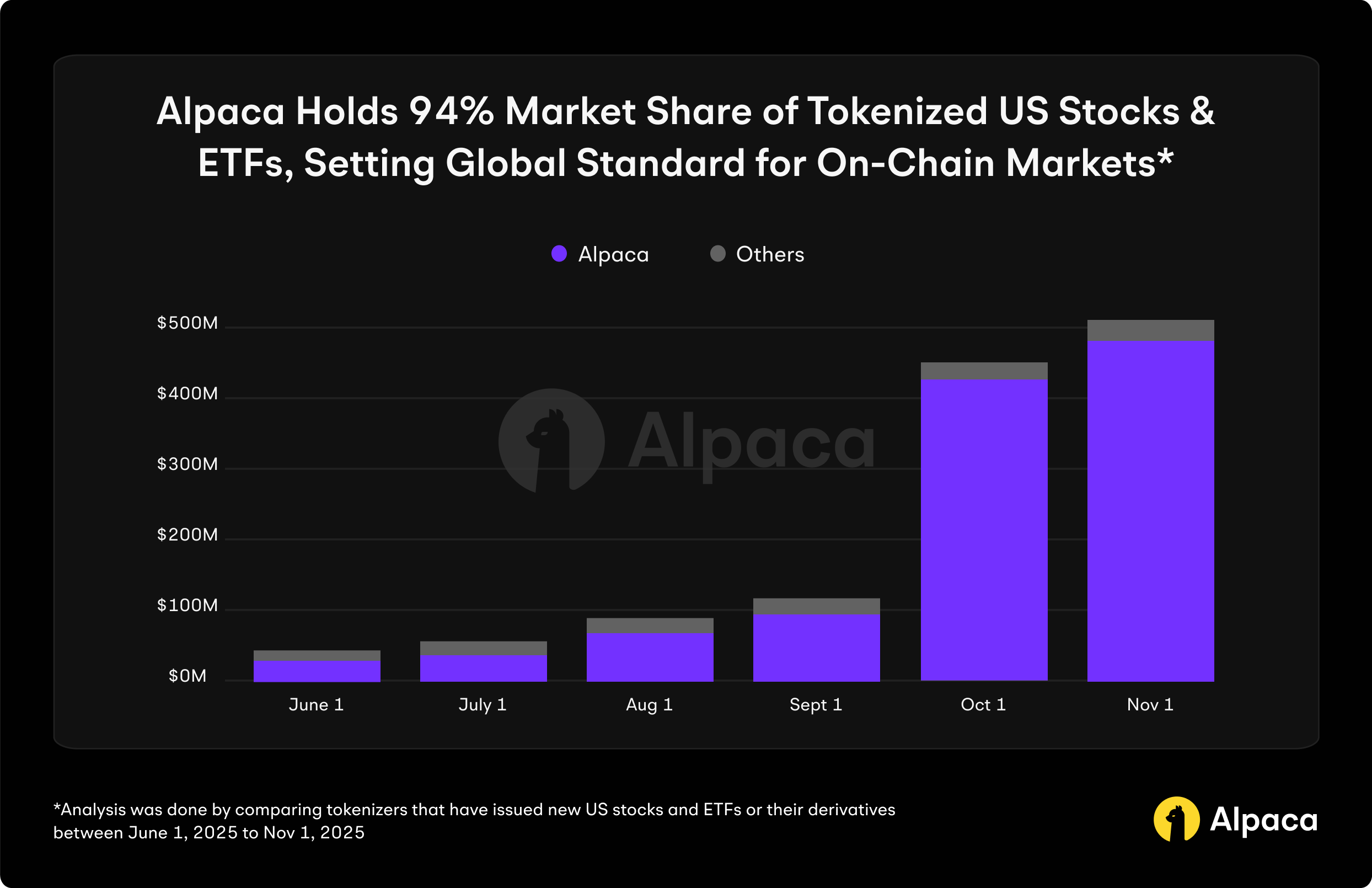
More examples need not be given. In short, whether in CeFi or DeFi, virtually every stock token trading service you see has Alpaca's fingerprints on it. According to data disclosed by Alpaca on December 4 last year, the company holds a 94% market share in the tokenized stock and ETF asset market.
Who Exactly is Alpaca?
Founded in 2015 and headquartered in California, USA, Alpaca was founded by former Lehman Brothers employee and serial entrepreneur Yoshi Yokokawa (now CEO) and engineer Hitoshi Harada (now CPO). Alpaca employs a global remote-distributed work model common in the crypto space, with over 250 employees across 25 countries.

Initially, Alpaca was a startup focused on financial databases and machine learning, developing technology to run and process large market datasets for predictions. Early on, Alpaca's main product was a trading API for quantitative traders. However, as the business expanded, the company evolved from a pure trading interface provider into a comprehensive financial infrastructure provider, now supporting asset classes like stocks, ETFs, options, and cryptocurrencies, and offering services such as market data, securities lending, high-yield cash accounts, and 24/5 U.S. stock trading.
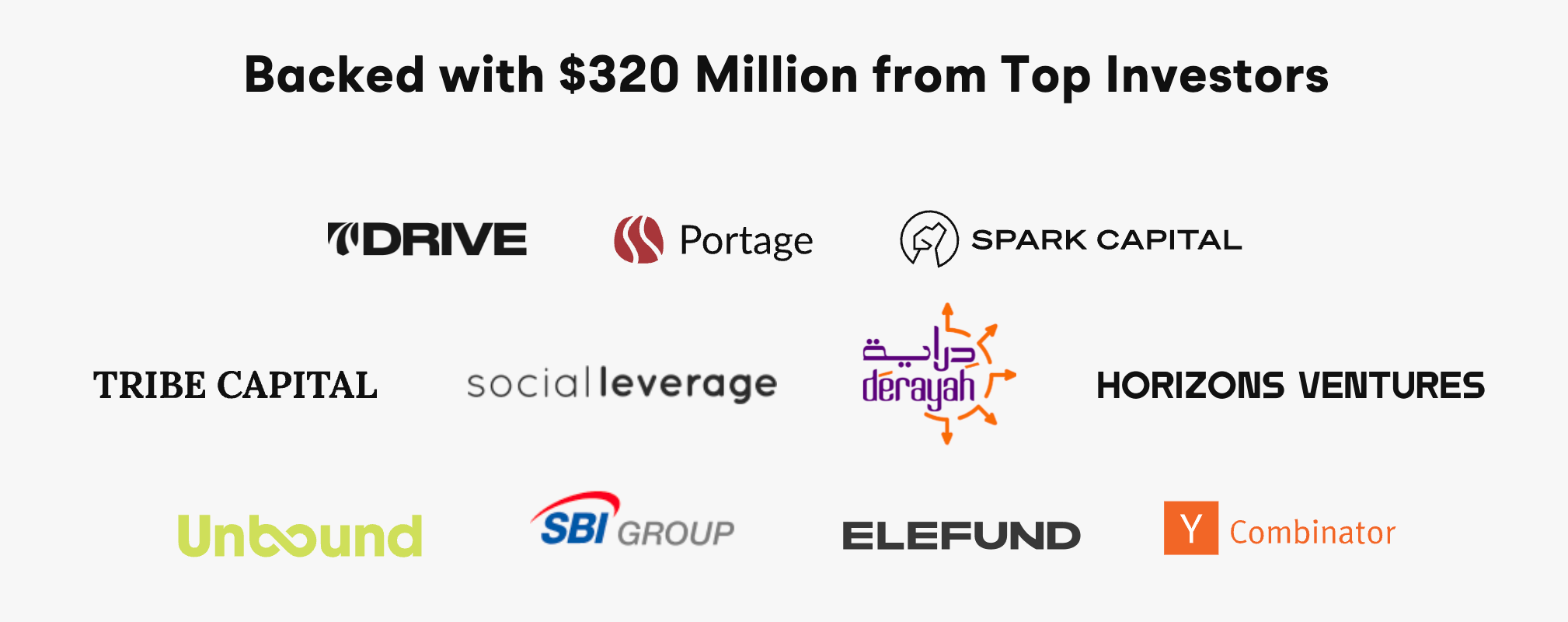
FundBet data shows that since 2019, Alpaca has raised over $320 million in cumulative funding from notable investors including Y Combinator, Spark Capital, Portage Ventures, Tribe Capital, and SBI Group.
- Seed round completed in 2019;
- $10 million Series A round completed in 2020;
- Two consecutive Series B rounds completed in 2021 and 2022;
- $52 million Series C round completed in 2025;
- Received an additional $150 million Series D round in early 2026, reaching a valuation of approximately $1.1 billion.
According to official data, Alpaca now serves hundreds of financial institutions and fintech companies in over 40 countries and regions, and has helped partners open more than 7 million brokerage accounts.
More Accurate Positioning: "Brokerage-as-a-Service"
Unlike traditional brokerages that directly serve end investors, Alpaca's core clients are developers, fintech companies, and other brokerage institutions. Alpaca's Broker API allows partners to quickly build a complete securities trading service system, including account opening, KYC, account management, order execution, clearing and settlement, and market data services.
Simply put, if Binance, Bitget, Gate, or Ondo want users to trade U.S. stocks, they would theoretically need to address issues like brokerage licenses, compliance reviews, stock custody, clearing and settlement, market data, and order routing. These tasks are both expensive and complex. Alpaca provides a comprehensive set of API solutions, allowing developers to "plug in" these complex backend capabilities by simply calling the interfaces.
In a sense, this is more like a "Brokerage-as-a-Service" model. With Alpaca's support, platforms like Binance, Bitget, Gate, and Ondo can focus on traffic and users, leaving all backend work connecting to the real-world securities market to Alpaca.
First-Mover Advantage and Network Effects
At this point, you might wonder why crypto institutions favor Alpaca. Can't other brokerages do it?
Admittedly, the U.S. compliant financial market is not short of brokerages. According to FINRA data, there are thousands of registered brokerages in the U.S., and traditional financial giants like Charles Schwab, Interactive Brokers, and Fidelity have far greater brand influence and asset scale globally than Alpaca.
However, when the wave of stock tokenization began to rise, the dominant players were not these Wall Street stalwarts but Alpaca, founded just over a decade ago. The reason may be that Alpaca was never a traditional brokerage from the start. For traditional brokerages, customers are investors; for Alpaca, customers are developers.
Alpaca's product design revolves almost entirely around APIs. Developers simply need to call the interfaces to quickly gain complete capabilities like account opening, KYC, order execution, clearing and settlement, and market data. This "API-first" philosophy highly aligns with the needs of Binance, Bitget, Gate, and Ondo, who want to embed securities trading functionalities into their own trading platforms or protocols.
Compared to many traditional financial institutions that are cautious about the crypto industry, Alpaca was also one of the earliest U.S. licensed brokerages to actively embrace digital assets and the tokenization narrative. Even before stock tokenization became a market hotspot, Alpaca had already begun building bridges with the crypto industry and actively exploring ways to combine the securities market with blockchain technology.
This first-mover advantage, combined with industry alignment, is the core reason Alpaca has secured its current market position.
Now, as more CeFi and DeFi players choose Alpaca's infrastructure, the network effects accumulating around Alpaca are further solidifying the company's moat.
For latecomers, choosing Alpaca means the fastest time-to-market and the most mature compliance path, fueling a virtuous cycle: more platforms integrating with Alpaca leads to more accounts and trading volume, which drives Alpaca to further improve its products and infrastructure, attracting more latecomers to continue integrating...
Stock tokenization is an undeniable trend. Within this specific track, it's uncertain how many Binances or Ondos will emerge in the future. But one thing seems increasingly clear: When more and more platforms compete for the stock token market, the one selling "shovels" to all platforms might just be the biggest beneficiary of this race.