






Bitcoin’s weak bounce fails to reverse adjustment trend; HYPE shows top signal, caution against short-term risks |特邀分析


- Core View: Bitcoin’s technical structure has weakened this week, with limited potential for short-term bounces. The key is whether it can break through the $75,000–$76,000 resistance zone. HYPE’s seven-wave rally may have peaked; monitor the effectiveness of the $62.5–$64.57 support zone.
- Key Factors:
- Bitcoin’s daily chart has broken below the mid-band of its ascending channel, indicating a structural weakening. It is currently in a weak rebound within a short-term descending channel, targeting the upper trendline (approximately $75,000–$76,000).
- The hourly chart (4H) shows a 10-wave corrective structure, including two descending consolidation zones. If the price faces rejection after rebounding to $75,000–$76,000, it is highly likely to continue declining and test the $69,500–$70,500 support area.
- This week’s strategy: For medium-term positions, consider initiating shorts after the price faces resistance in the $75,000–$76,000 zone, with initial position size below 30%. For short-term trades, a 30% position can be used for range trading within the specified area.
- HYPE has formed a seven-wave rally structure on the 4-hour chart (including consolidation zones). Waves 46-47 show waning upward momentum, triggering a top alert from the spread trading model, with a high probability of “momentum divergence.”
- If the HYPE price effectively breaks below the $62.5–$64.57 support zone, a short-term top signal will be confirmed. The correction could then escalate to the daily timeframe, with a downside target of $54–$56.3.
- Last week’s validation: A short-term Bitcoin short trade was successfully executed. Based on a model signal, the position was opened at $77,449 and closed at $73,519, yielding a profit of 5.07%.
Core of the Week: Has Bitcoin’s daily structure weakened? Can a short-term rebound effectively break through the upper rail of the descending channel? Has HYPE’s seven-wave upward move reached its end? Starting from multi-cycle structural analysis, this article systematically reviews the current market patterns and formulates short-to-medium-term trading strategies for the week, for reference.
Summary of Key Trading Views for the Week:
• Multi-cycle structure analysis of BTC. (Detailed in Part 1)
• BTC price forecast for the week and short-to-medium-term trading strategies. (Detailed in Part 2)
• Hourly-level structure analysis of HYPE. (Detailed in Part 3)
• HYPE price forecast for the week and short-term trading strategies. (Detailed in Part 4)
Market Validation of Last Week’s Trading Strategies and Core Views:
• BTC Short-term Trading Performance: Last week, a short-term short trade on Bitcoin (1x leverage) was executed, successfully yielding a profit of approximately 5.07%. (Details in Table 1)
• Market Validation of BTC Trend Forecast: Last week’s article indicated that Bitcoin continues its pattern of oscillating downward, with a short-term strategy focusing on “selling on rallies.” The current market movement has validated our previous assessment.
1. Bitcoin Multi-cycle Structure Analysis
1. BTC Daily Level Structure Analysis
Bitcoin _ Daily K-line Chart:
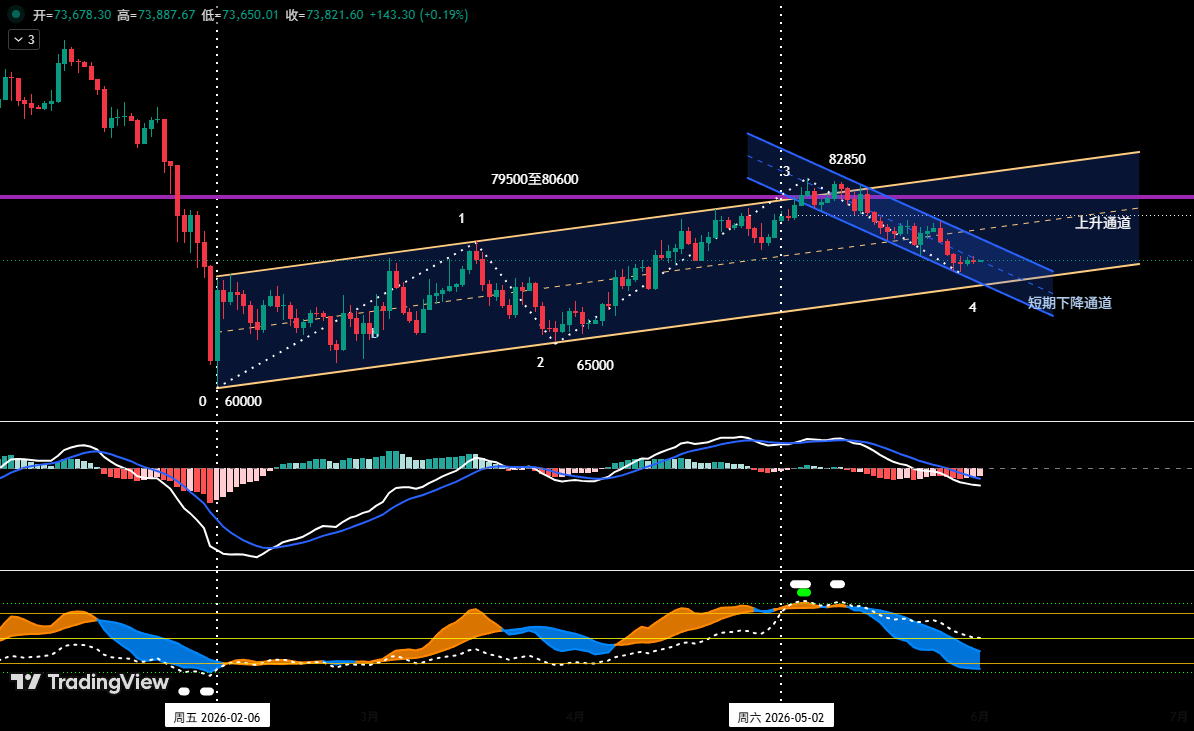
Figure 1
• Upward Channel (Yellow): As shown in (Figure 1), since the low on February 6, 2026, Bitcoin has oscillated upward within an ascending channel. (Lower rail: line connecting the lows of Feb 6 and Mar 29; Upper rail: line drawn parallel to the lower rail through the high of Mar 17)
• Short-term Descending Channel (Blue): After hitting a high of $82,850 on May 6, Bitcoin entered a short-term descending channel. (Upper rail: line connecting the rally highs of May 14 and May 26; Lower rail: line connecting the correction lows of May 7 and May 23)
• Based on the ascending channel (Yellow) analysis, the price has lost the channel’s midline and is now seeking stronger support at its lower rail.
• Based on the short-term descending channel (Blue) analysis, the price found temporary support at the channel’s lower rail (around $72,500) and is currently in a weak rebound phase targeting the channel’s upper rail.
Integrated Judgment: From a technical structure perspective, Bitcoin is currently influenced by the interplay of both long and short-term cycles. The current rebound is primarily a correction of short-term oversold conditions, aiming for the upper rail of the short-term descending channel (Blue). However, as the price has broken below the midline of the ascending channel (Yellow), the overall technical structure has weakened. It is expected that after the rebound concludes, the price will likely resume its previous downtrend and further test the support strength of the ascending channel’s lower rail.
2. In-depth Analysis of BTC Hourly Level Structure: (Using 4-hour analysis cycle)
Bitcoin _4-hour K-line Chart
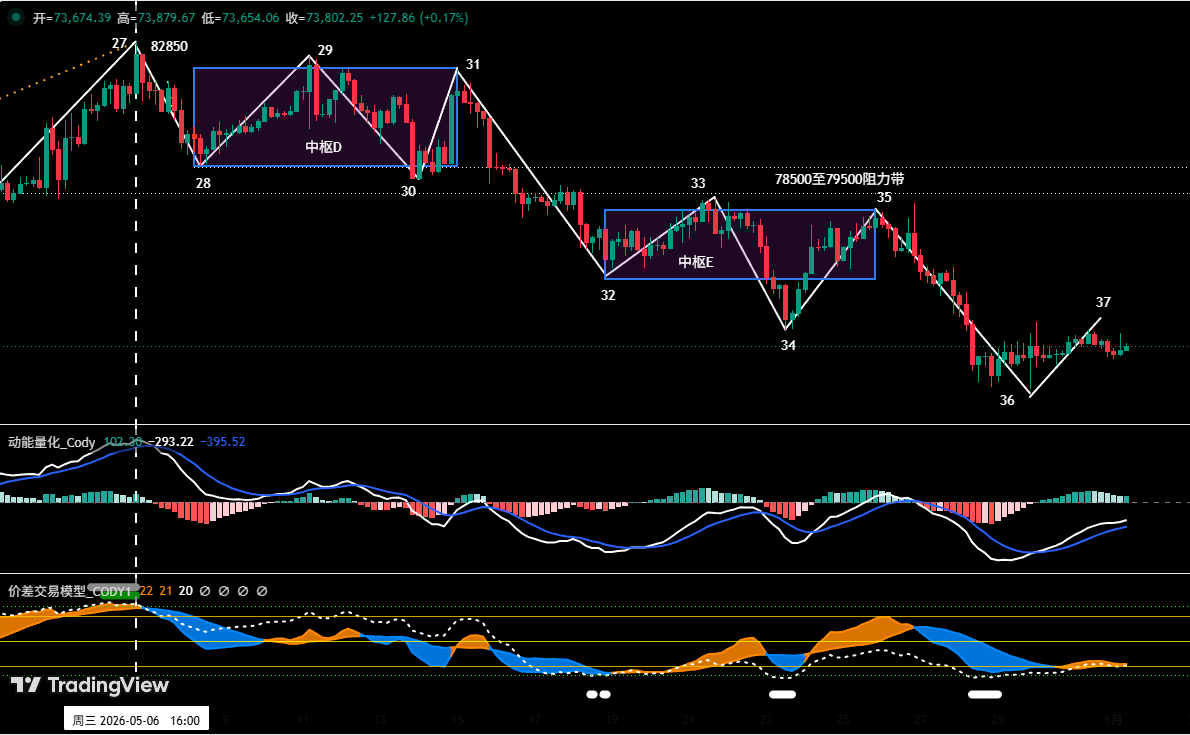
Figure 2
①. As shown in (Figure 2), since the adjustment began from the May 6 high of $82,850, the 4-hour chart reveals a 10-segment adjustment structure detailed from “segment 27-28” to “segment 36-37”. This includes two descending consolidation zones:
• Consolidation Zone D: Formed by the overlap of segments 28-29, 29-30, and 30-31.
• Consolidation Zone E: Formed by the overlap of segments 32-33, 33-34, and 34-35.
②. From the 4-hour structure perspective, the 36-37 rebound segment is currently underway. If the price meets resistance and pulls back after reaching the $75,000 – $76,000 area, failing to form an effective breakout, the market will likely continue its previous oscillating downtrend and test support at $69,500 – $70,500.
2. Bitcoin Price Forecast and Trading Strategy for the Week
1. BTC Price Forecast for the Week:
Core View for the Week: Focus on the market’s test of the $75,000 – $76,000 resistance zone and the $69,500 – $70,500 support zone.
2. Key Resistance Levels:
• First Resistance Zone: $75,000 – $76,000 area (Near the lower rail of Consolidation Zone E)
• Second Resistance Zone: $78,500 – $79,500 area (Near the rails of both consolidation zones)
3. Key Support Levels:
• First Support Zone: $69,500 – $70,500 area (Previous key support level)
• Second Support Level: Around $65,000 (Previous key support level)
4. Weekly Trading Strategy (Excluding Sudden News Events)
①. Medium-term Strategy:
Bitcoin _ Daily K-line Chart: (Position Monitoring Model)
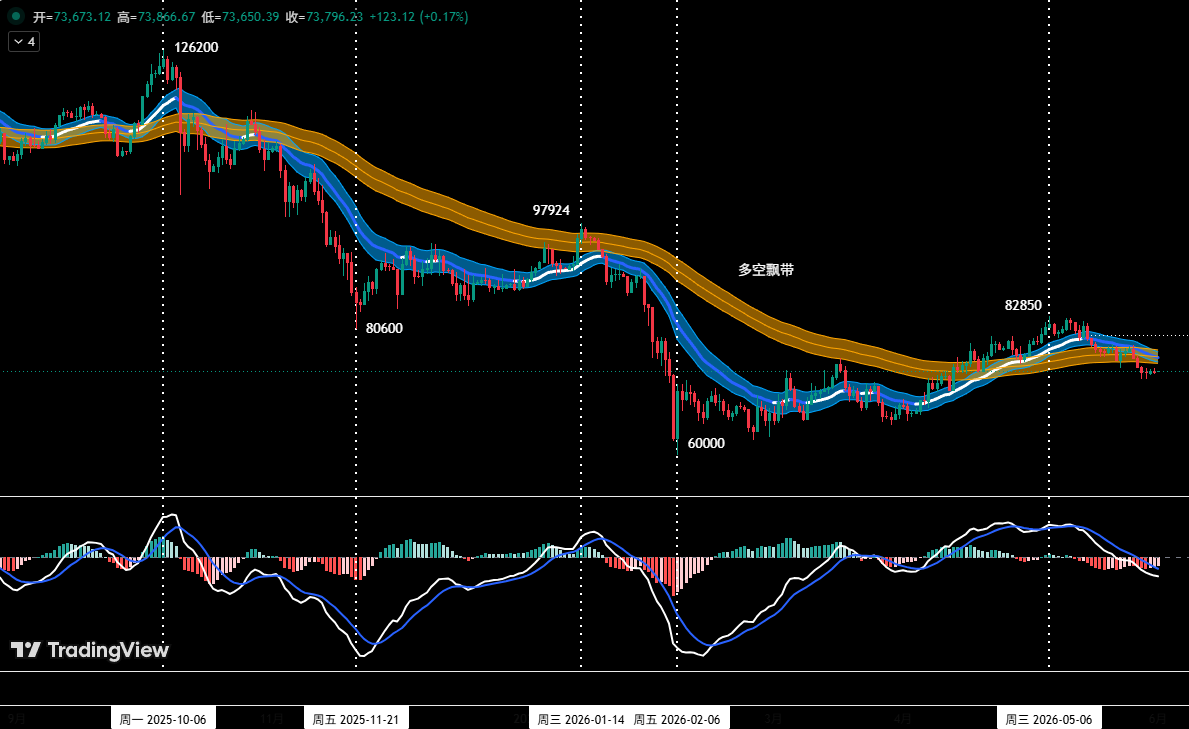
Figure 3
Position Monitoring Model: As shown in (Figure 3), the price has fallen below the "Bull-Bear Channel," entering a technically weak zone. This week, attention should be paid to the retest result of this channel (approximately $75,000 – $76,000). If the price shows signs of stagnation or pulls back after rallying to this level, a medium-term short position setup will begin. To control risk, initial positions can be kept below 30% of total capital; subsequently, once the price loses the lower rail of the ascending channel (Yellow), the medium-term position can be increased to around 60%.
②. Short-term Strategy: Use 30% of capital with set stop-loss orders, seeking “spread” opportunities based on support and resistance levels. (Using 30-min/60-min as operation cycle).
③. For short-term operations, to dynamically adapt to complex market changes, two specific action plans, A/B, have been prepared in advance.
• Plan A: Rebound meets resistance, sell on rally.
• Entry: When the price rallies to the $75,000 – $76,000 area and encounters resistance, combined with a top signal from the quantitative model, establish a short position below 30%.
• Risk Control: Initial stop-loss set above $77,000.
• Exit: When the price adjusts near a key support level, combined with a model signal, gradually close the position to take profits.
• Plan B: Effective breakdown of support, follow the trend short.
• Entry: When the price effectively breaks below the $69,500 – $70,500 support zone, combined with a model top signal, establish a short position below 30%.
• Risk Control: Initial stop-loss set above $72,000.
• Exit: When the price declines to a key support level, combined with a model signal, gradually close the position to take profits.
3. HYPE Hourly Level Structure Analysis:
HYPE_4-hour K-line Chart
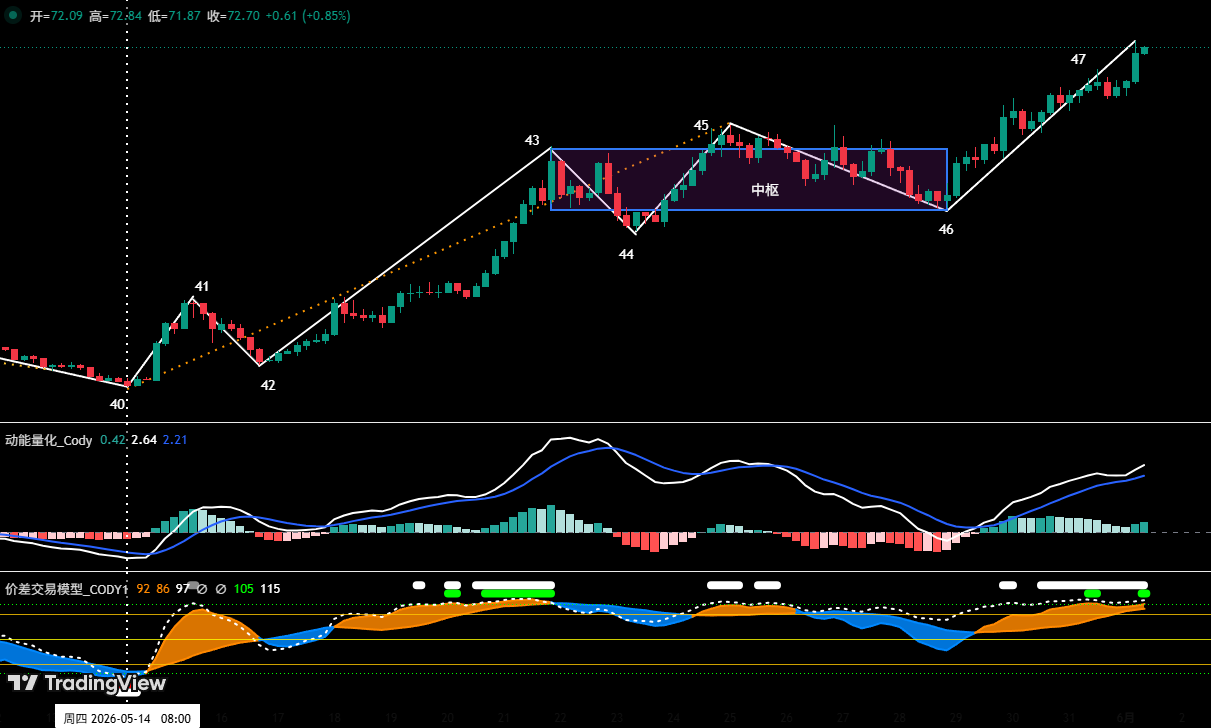
Figure 4
1. As shown in (Figure 4), on the 4-hour timeframe, since its rally from the low of $38.14 on May 14, HYPE has clearly formed a seven-wave structure (i.e., 40-41 to 46-47) including an "upward consolidation zone." Segments 43-44, 44-45, and 45-46 overlap to form this "upward consolidation zone."
2. Last week’s review had already warned: as “point 45” showed momentum divergence at its peak, combined with a top warning signal from the “spread trading model,” creating a confluence. Thus, the probability of forming a short-term high at this location was high. The market movement confirmed this judgment: the price corrected from “point 45” ($64.75) to “point 46” ($56.30), a maximum decline of 13.05%.
3. Currently, comparing the departure segment (46-47) from the consolidation zone with the entry segment (42-43), its upward momentum appears weak, suggesting a high probability of a potential “momentum divergence.”
4. From our proprietary “spread trading model” analysis, “point 47” has triggered a strong top warning signal (red dot + white dot).
5. In summary, if a topping signal forms at “point 47” while the “momentum divergence” signal remains valid, the probability of this point becoming the stage endpoint of the rally since “point 40” will significantly increase. Subsequent movements require close attention to the price retest of the key $62.5 to $64.57 area.
4. HYPE Price Forecast and Short-term Trading Strategy for the Week
1. HYPE Price Forecast for the Week:
Core View on HYPE for the Week:
• Observe whether the "momentum divergence" is confirmed when "point 47" sends a clear topping signal.
• If this phenomenon occurs, and the price subsequently breaks effectively below the $62.5 to $64.57 support zone, "point 47" can be considered the endpoint of the uptrend that started from the May 14 low.
2. HYPE Short-term Trading Strategy for the Week (Long on Support):
This week’s HYPE short-term trading should follow the strategy of “accumulate on dips, avoid chasing rallies.” The core is to observe the price retest of the $62.5 to $64.75 area:
Strategy 1: Enter long on stabilization at the support zone
If the price pulls back to this zone and shows signs of bottoming and stabilization, combined with bottom signals triggered by the two models, consider a light long position. Position size must be controlled below 30%, and strict stop-loss discipline must be maintained.
Strategy 2: Support failure leads to a larger degree correction
If the price effectively breaks below this zone, the short-term correction will escalate into a larger degree correction (e.g., daily level), with extended time and space for adjustment. The initial downside target would be the $54 to $56.3 area.
5. Bitcoin Trade Review
1. Short-term Trade Review: (See Table 1)
We strictly followed the operational plan, acting on trading signals from our proprietary “spread trading model” and “momentum quantification model.” Last week, we executed one short-term trade (short), yielding a profit of 5.07%.
①. Bitcoin Short-term Trade Details Summary: (Leverage 1x)
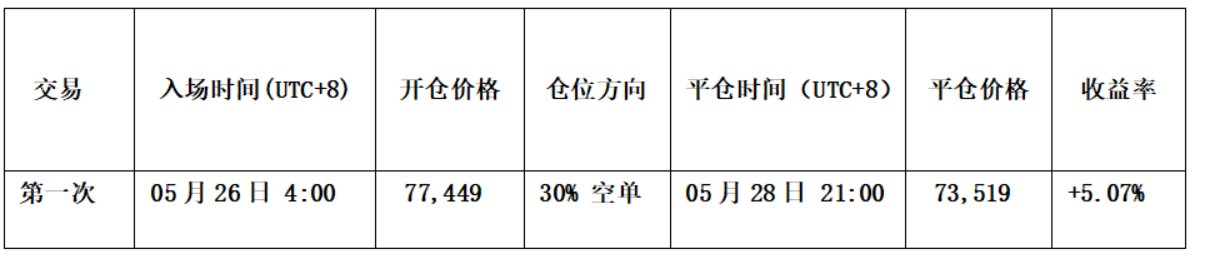
Table 1
②. Short-term Trade Review: (See Figure 5)
• Entry Strategy:
a. When the price rallied to around $78,000 and showed signs of resistance, with the K-line forming a bearish “top divergence” pattern;
b. The “spread trading model” triggered a top warning signal (white dot);
c. The “momentum quantification model” issued a bearish momentum divergence signal.
Therefore, we established a 30% short position at $77,449.
• Exit Strategy:
a. When the price fell to around $73,000 and showed signs of bottoming, with the K-line forming a “bottom divergence” pattern;
b. The “spread trading model” triggered a strong bottom warning signal (red dot + white dot), forming a bottoming confluence with the “momentum quantification model.”
Therefore, we closed the entire position around $73,519.
• Summary: This trade yielded a profit of approximately 5.07%.
BTC_60-minute K-line Chart: (Momentum Quantification Model + Spread Trading Model)
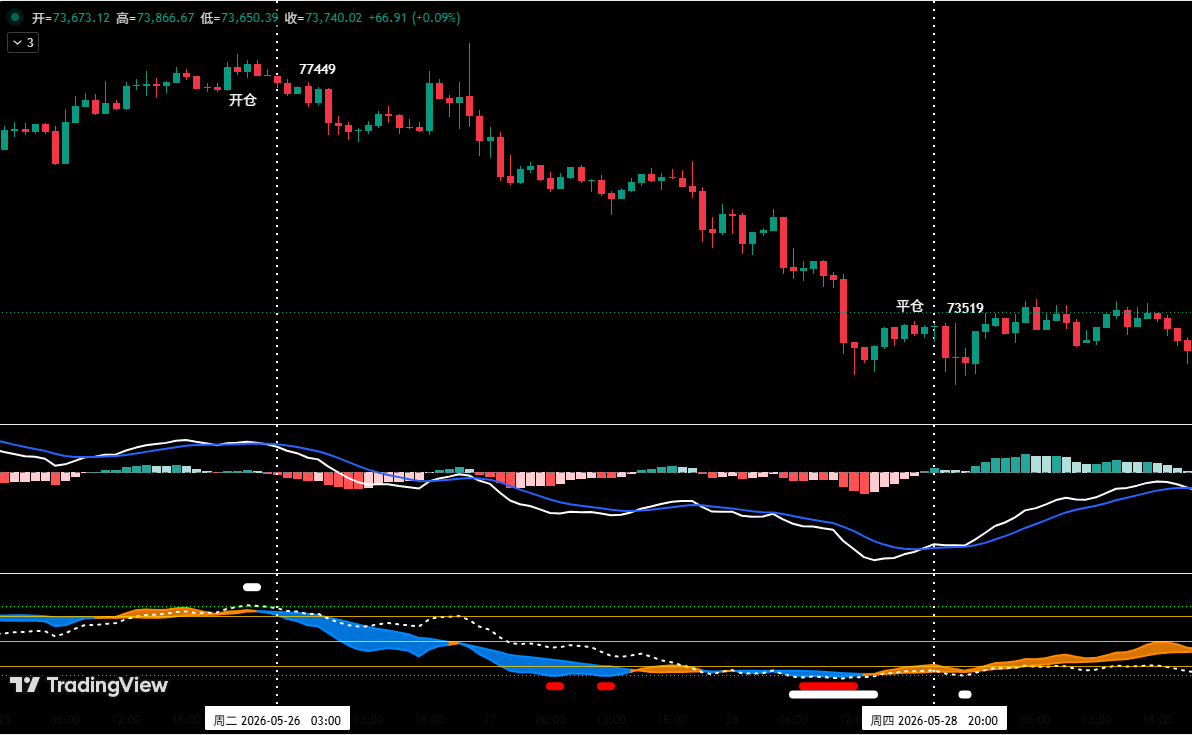
Figure 5 (Short-term Trade Illustration)
6. Special Reminders:
1. When entering a trade: Immediately set the initial stop-loss.
2. When profit reaches 1%: Move the stop-loss to the entry cost (breakeven point) to secure the principal.
3. When profit reaches 2%: Move the stop-loss to the 1% profit level.
4. Continuous tracking: Subsequently, for every additional 1% profit, move the stop-loss by 1% simultaneously to dynamically protect and lock in profits.
Financial markets are highly dynamic; all market analysis and trading strategies require constant adjustment. All views, analysis models, and trading strategies mentioned in this article are based on personal technical analysis, serve solely as a personal trading journal, and do not constitute any investment advice or operational basis. Market risk exists; invest cautiously. Please do not make decisions based solely on this content.





