






原生隐私功能,以太坊的救命稻草?


- Core Thesis: The downturn in Ethereum is attributed to the complete transparency of on-chain data, prompting developers to accelerate the implementation of native privacy features. Industry insiders warn that privacy upgrades must be completed within 12 months, or risk losing users and capital flows to privacy coins and competitors.
- Key Elements:
- Market Divergence: ETH has fallen approximately 30% year-over-year to $2,000, while privacy coins like ZEC have seen double-digit gains, indicating market capital rotating towards the privacy sector.
- User Exodus: Holdings by mid-sized investors (100-1000 ETH) have dropped from 16.2 million in 2023 to 8.75 million, with large holders also continuing to reduce their positions.
- Competitive Pressure: GSR data shows blockchain revenue flowing to Solana, Tron, etc., with the ETH/BTC ratio falling to mid-2025 lows.
- Privacy Roadmap: Vitalik is driving a short-term roadmap focused on account abstraction, the FOCIL mechanism, secret nonces, and the Kohaku toolset, aiming to enable native private transactions.
- Institutional Demand: Lawyer Gabriel notes that privacy upgrades are crucial for the asset tokenization market, as enterprises require confidentiality for financial data such as supply chains and transaction routes.
- Urgency: Dunleavy, Head of Varys Capital, warns that if privacy features are not implemented within 12 months, ETH will lose its competitive advantage.
Original Author: Oluwapelumi Adejumo
Original Translation: Chopper, Foresight News
TL;DR
- Amid a sluggish ETH market, privacy coins are bucking the trend and gaining strength, prompting Ethereum developers to accelerate the implementation of native privacy features.
- The complete transparency of asset balances and transaction history on the Ethereum chain not only deters institutional investors but also weakens its core competitiveness as the industry's default settlement layer.
- Industry insiders state that Ethereum's privacy features must be implemented within 12 months; otherwise, the project risks remaining a mere theoretical research exercise, allowing competitors to continuously capture market flow and attention.
With market capital gradually shifting towards privacy-focused assets, compounded by negative sentiment and questions about its developmental direction, Ethereum is struggling to retain investor interest. Consequently, developers are全力 building native privacy capabilities for the world's largest smart contract blockchain.
The price of ETH has fallen approximately 30% year-to-date, recently trading around the $2,000 mark. In contrast, Zcash (ZEC) has recorded double-digit gains over the same period, creating a stark divergence in performance.
This contrasting market performance has transformed privacy protection from a long-standing vision of the cypherpunk community into a hard product requirement that Ethereum must deliver on schedule.
Currently, Ethereum still dominates stablecoin settlements, asset tokenization, decentralized finance (DeFi), and Layer 2 ecosystems. However, the complete transparency of on-chain data presents a major pain point for both retail users and institutions, as asset balances, counterparties, and transaction histories are publicly traceable in real-time.
Tom Dunleavy, Head of Venture at Varys Capital, is highly optimistic about Ethereum's privacy upgrades but emphasizes the need for speed. "I'm extremely bullish on Ethereum implementing privacy features, but the entire solution must be delivered within 12 months, otherwise, it all becomes meaningless. Ethereum is currently in a fierce product race against well-funded, highly executable competitors who possess industry resources that Ethereum lacks. Only by delivering on time can it avoid being left behind."
This warning comes as Ethereum's market position is already under pressure. GSR Research data shows that revenue streams in the blockchain sector are increasingly flowing to competitors like Solana, Tron, and Hyperliquid. The ETH/BTC ratio has also fallen to its lowest level since mid-2025.
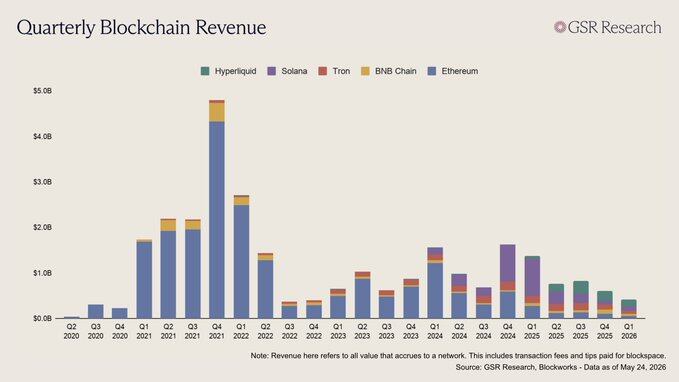
Blockchain industry quarterly revenue, Source: GSR Research
Data from CryptoQuant also reflects the crisis, showing a large-scale exodus of smaller ETH holders. In the past three years, the total assets held in wallets containing between 100 and 1,000 ETH have nearly halved, dropping from a peak of 16.2 million ETH in 2023 to roughly 8.75 million ETH today.
Large holders are also reducing their positions. Addresses holding between 1,000 and 10,000 ETH, which helped drive the ETH price surge in 2024, have been gradually decreasing their holdings since the end of last year.
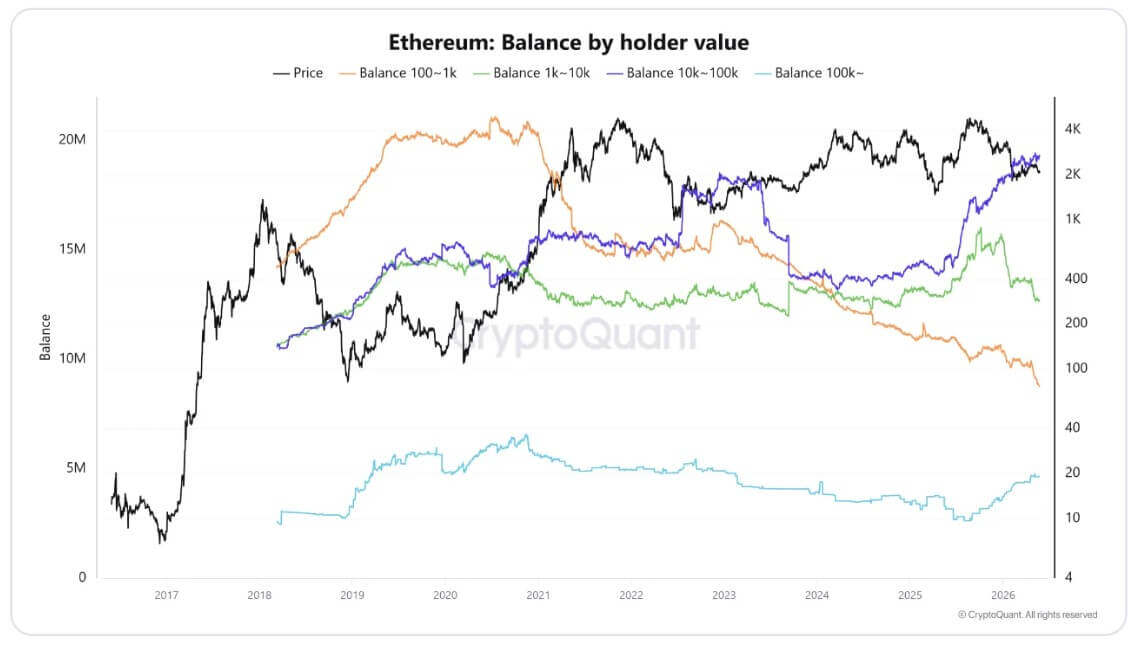
Ethereum holder balances
While capital outflow cannot be solely attributed to increased demand for privacy, the loss of holdings intensifies the developmental pressure on Ethereum, especially at a time when interest in privacy coins is rising and investors are searching for catalysts to boost ETH's performance.
Privacy Has Become the New Market Narrative in Crypto
As Ethereum pushes forward with privacy features, a consensus is forming across the industry: financial privacy will dominate the next major cycle in the crypto market.
A recent analysis by Grayscale Research indicates that the digital asset industry is about to enter a third wave of mass interest in financial privacy.
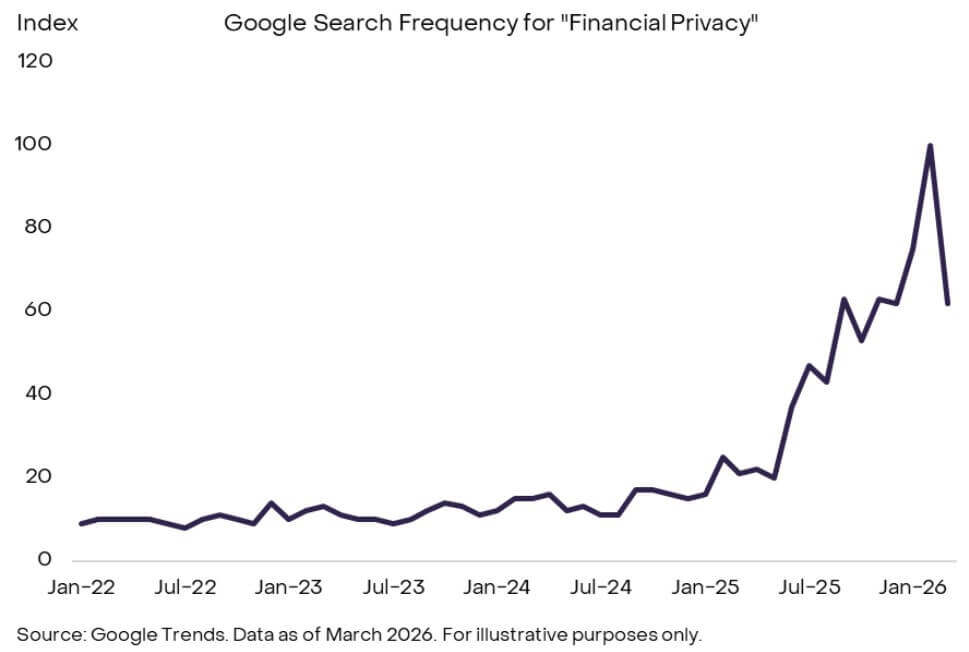
Google search volume for financial privacy, Source: Grayscale
This trend is driven by the widespread adoption of stablecoins, the implementation of on-chain applications, and the rapid advancement of artificial intelligence technology. Grayscale warns that AI tools have facilitated more sophisticated financial surveillance, while on traditional public blockchains, asset balances, counterparties, and transaction history are permanently public.
The market demand for privacy stems not only from those seeking complete anonymity but also from the general public and businesses with legitimate needs for financial information confidentiality.
Regular users do not want their spending habits to be public; businesses need to keep supplier payments, payroll, and internal fund flows confidential; institutions cannot accept that their wallet address structures are traceable and analyzable in real-time.
However, implementing privacy features also requires balancing business trade-offs. Historical experience shows that strong privacy attributes often reduce asset liquidity and create friction in areas like exchange listings, regulatory compliance, and wallet integration.
Despite the challenges, Barry Silbert, Chairman of Grayscale Investments, stated that the privacy era for the digital asset industry has officially arrived.
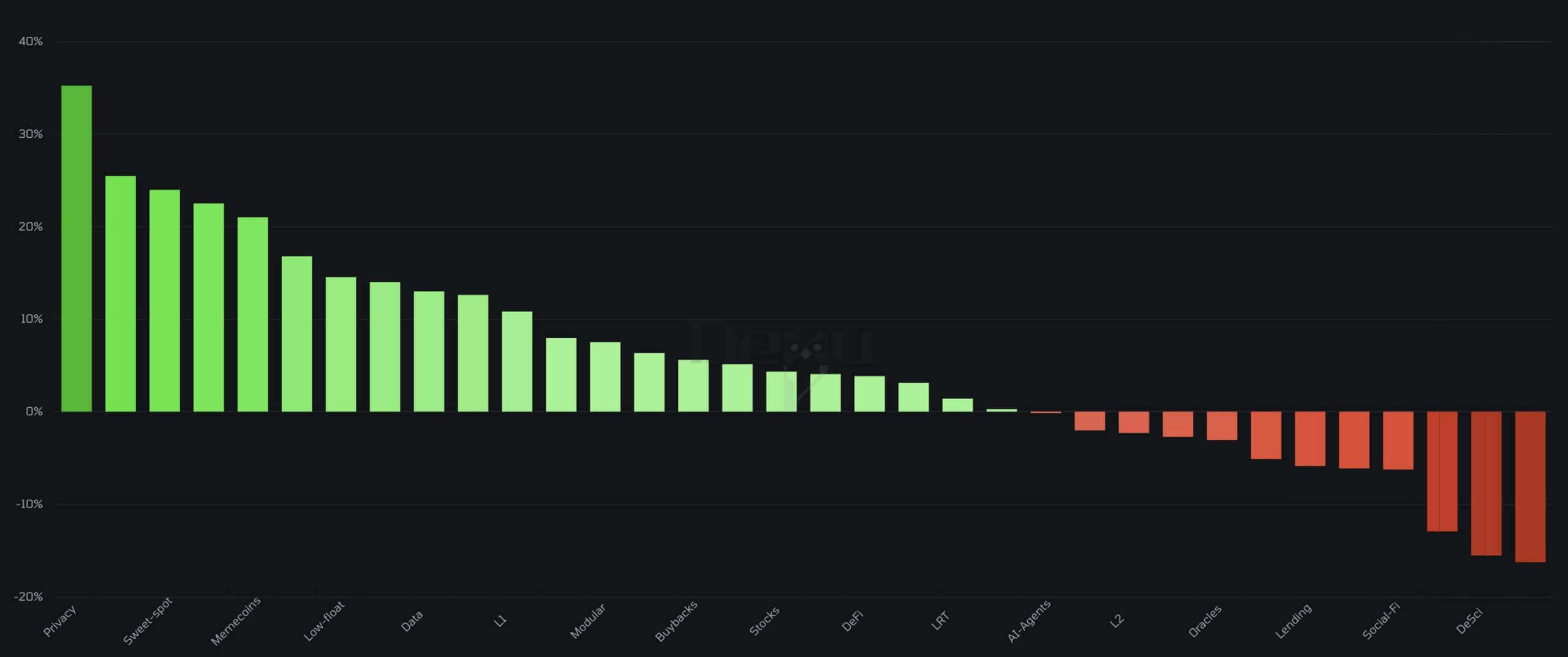
Privacy coins begin to dominate the crypto industry
The change in market narrative is vividly reflected in price performance: over the past year, ZEC's market cap has surged over 900%, approaching $100 billion. Monero (XMR), which has long been plagued by regulatory concerns, has also seen its price double.
Ethereum Co-founder Pushes for Privacy Upgrades
Recently, Ethereum co-founder Vitalik Buterin has re-prioritized privacy development to the top of the technical agenda. After years of research and discussion, he is urging developers to accelerate the realization of the cypherpunk vision of privacy.
Ethereum's short-term privacy roadmap focuses on three main areas: account abstraction and FOCIL, secret nonces, and access layer privacy modifications. The overall solution aims to enhance the censorship resistance of on-chain transactions, break address linkability, and reduce reliance on trusted third-party infrastructure.
FOCIL, or Forced Inclusion List, is designed to address the issue of transaction censorship.
Currently, transactions enter a public mempool before being included in a block. Block builders and intermediaries can view pending transactions, enabling them to censor, front-run, and monitor data. The FOCIL mechanism allows a committee of validators to propose an inclusion list. Block builders must include these listed transactions, and blocks violating this rule are rejected by the network, thus reducing the risk of censorship for privacy transactions at the source.
Account abstraction addresses another flaw in Ethereum's current design, where most users rely on externally owned accounts (EOAs) controlled by a single private key. Account abstraction makes accounts behave more like programmable smart contracts, enabling features such as social recovery, multi-signature authorization, and sponsored transaction fees.
On the privacy front, this feature can optimize wallet behavior patterns to avoid exposing all actions through a single account and also facilitate third-party fee sponsorship.
Secret nonces aim to solve a narrower but critical metadata leakage problem. Ethereum uses nonces to prevent replay attacks; these nonces increment sequentially, allowing observers to link seemingly unrelated transactions and trace back to the same account. The new proposal divides the account counter into multiple independent domains, using different secret nonces for different types of transactions, significantly increasing the difficulty of address deanonymization.
Furthermore, the Ethereum Foundation has introduced an open-source toolset called Kohaku, which represents the most ambitious component of this privacy upgrade. This project is not merely focused on achieving transaction privacy but addresses data leakage at the access layer before transactions are even submitted to the chain.
Even if transactions themselves are made private, when a user queries on-chain balances, interacts with smart contracts, or submits a transaction, their wallet still leaks information like IP addresses and wallet identity to the Remote Procedure Call (RPC) node. Kohaku provides privacy and security components for wallet developers that can be directly integrated into existing products. Its features include private transfers, secure key management, private on-chain queries, and is accompanied by a reference wallet implementation. The toolset can also integrate with existing Ethereum privacy protocols like Railgun and the still-in-development Privacy Pools. The goal is to allow users to experience private transfers and private DeFi services without needing to switch their regular wallet or use niche tools.
Ethereum researcher soispoke.eth stated that if these proposals are implemented simultaneously, Ethereum could enable native, trustless, and censorship-resistant private transactions as early as next year.
Why Privacy Features Are Crucial for Ethereum
Crypto lawyer Gabriel Shapiro believes that privacy upgrades will help Ethereum compete for the institutional asset tokenization market. Businesses have strong confidentiality requirements in scenarios like securities tokenization, treasury management, and DeFi interactions.
This also touches upon Ethereum's core investment thesis. Historically, Ethereum's advantage has been its comprehensive ecosystem, covering stablecoins, lending, decentralized exchanges, asset tokenization, Layer 2 networks, and various development infrastructures. However, if all financial interactions remain fully transparent by default, ecosystem breadth alone will be insufficient to sustain its lead.
For institutions, public settlement without privacy is inherently risky: companies don't want competitors tracking their supply chain interactions; asset managers don't want their trading strategies monitored; banks cannot expose their clients' tokenized securities activity on a public blockchain.
Ethereum possesses the underlying infrastructure to serve institutional clients, but the market demands a deliverable product, not just theoretical research.
This underscores Dunleavy's 12-month countdown warning. Zcash has already established a clear privacy narrative, and Monero maintains its status as a leading privacy coin despite regulatory pressures. Meanwhile, competitors like Solana, Tron, and Hyperliquid continue to capture market attention, while Bitcoin still dominates institutional capital preference.
Currently, the value of tokenized assets on the Ethereum chain exceeds $350 billion, and its application ecosystem remains the deepest in the industry. However, this lead is not permanent.
If Ethereum can launch mature and usable privacy products within a year, it will further cement its position as a settlement infrastructure for both individuals and institutions. Conversely, if the privacy upgrade remains stuck in the planning phase, market capital will continue to flow towards projects that have positioned privacy as a core feature since their inception.


