






The core power of crypto exchanges is being willingly handed over by OKX


- Core Thesis: OKX launches the Exchange OS protocol, aiming to protocolize core exchange capabilities by redefining the "right to create markets." This pushes the industry from a centralized structure back towards a decentralized order, addressing structural challenges like narrative exhaustion and liquidity fragmentation in the crypto market.
- Key Elements:
- The crypto market faces three major structural challenges: narrative exhaustion (L1s, NFTs, etc., have been disproven in succession), liquidity fragmentation (users trapped in silos), and operating in a closed loop (poor circulation with traditional finance).
- New industry benchmarks are emerging: Perp DEXs like Hyperliquid, prediction markets like Polymarket, and RWA platforms like Ondo stand out as the market's few bright spots. CEXs need to proactively adapt to change.
- Exchange OS is built on X Layer, protocolizing capabilities such as matching, clearing, and settlement. It supports users in independently deploying three types of markets: spot, perpetual contracts, and prediction.
- The protocol aims to grant users the "right to create markets," allowing quant teams, RWA institutions, and individual users to create markets based on verifiable events, thereby reshaping the barriers to financial participation.
- OKX is also launching the Agent Trade Kit and an in-app payment protocol. Coordinating at the tool and payment layers, the intent is to build a "crypto App Store" ecosystem.
- Potential challenges include: initial liquidity activation, the performance ceiling of X Layer, and forming a sustainable commercial model (similar to an Apple tax or HYPE buyback mechanism).
Original | Odaily (Jupiter) (@OdailyChina)
Author | Wenser (@wenser 2010)
The divide between traditional and emerging markets is accelerating: on one side, the US stock market, Korean index, and Nikkei are all surging, with many hot sectors and individual stocks hitting new highs; on the other side, mainstream cryptocurrencies are experiencing volatile declines, with BTC spot trading volume dropping over 80% since October last year.
Despair among crypto investors is spreading, leading to capital flight; builders, meanwhile, are persistently searching for new answers — Hyperliquid, initially positioned as a Perp DEX, has expanded its ecosystem into traditional financial asset sectors, with RWA asset trading volume experiencing exponential growth; prediction markets like Polymarket and Kalshi have started to warm up for the World Cup, with monthly trading volumes hitting new all-time highs — these are the "only two bright spots" in the crypto market, narratives that have passed initial tests.
What about CEXs, the industry's liquidity hubs? Leading players are actively connecting with traditional financial markets and expanding the boundaries of the crypto market. This includes introducing channels for RWA asset trading and adding entry points for prediction markets. The common goal of these initiatives is to address industry-wide issues such as fragmented liquidity, siloed user experience, and low capital efficiency in the crypto market.
Listing new assets and adding new entry points are certainly necessary parts of industry development, but some seek a different path, a new way to build. Recently, OKX's launch of Exchange OS presents a new possibility — that of activating the industry ecosystem by redefining the "right to create markets".
As Crypto Narratives Run Dry, CEXs Proactively Adapt
A closer look at the major structural challenges facing the current crypto market:
First, there are no new stories in the crypto market. Narratives from previous cycles like L1 blockchains, NFTs, and DAOs have been debunked one after another. DeFi security incidents are frequent, the BTC ecosystem has fallen quiet, Meme coins and AI Agent-related tokens are languishing. The successive appearances of concepts like Desci, the x402 payment protocol, and recently the Uniswap V4 Hook ecosystem have failed to generate sustainable momentum.
Second, liquidity is fragmented. Users are trapped within closed DApps and protocol silos, unable to cope with the complex and high friction costs associated with moving between different chains, platforms, applications, and protocols.
Third, the crypto market is an echo chamber. Although ETFs and DATs for major coins have opened channels between the crypto and traditional financial worlds, the scale of capital, coupled with the inherent high risk and volatility of crypto assets, further hinders efficient and convenient exchange and circulation between the two. The crypto market is increasingly mired in the awkward situation of industry insiders preaching to the choir.
Over the past decade plus, the crypto industry achieved decentralized value transfer through Bitcoin, enabled decentralized asset issuance through Ethereum, and unlocked decentralized financial liquidity through AMM protocols. But old answers clearly cannot be directly applied to the new stage.
It is for this reason that new industry archetypes are emerging: on-chain Perp DEXs like Hyperliquid and Aster have pushed the ceiling for derivatives across all-chain assets; Polymarket and Kalshi have scaled "prediction" as a social activity into a financial pricing mechanism; RWA platforms like Ondo have gone a step further by packaging traditional on-chain assets into derivative products.
Facing the impact of new markets, many industry players have made different choices: Binance recently launched "Event Rush" ; Bitget introduced its self-developed RWA protocol product, Reality, directly connecting to US stock liquidity and supporting dividend distributions; Bybit successively listed perpetual contracts for CSCO, RKLB, etc., and launched various airdrop campaigns. However, while most platforms are focused on listing more RWAs (including pre-market US stocks) to sustain traffic, OKX has taken a series of decidedly different actions. Judging by its product release cadence in recent months, its market role has gradually evolved from a singular "product builder" to a "system explorer":
1. Agent Trade Kit: Aims to solve the "machine trading" problem in the AI era, allowing users to connect AI agents to on-chain execution systems via a native AI trading suite.
2. Agent Payments Protocol (APP): Aims to define a payment standard for AI agents on-chain, enabling crypto asset movement without the constraints of complex wallet operations, expanding AI agent payments into business workflows, and supporting multiple payment modes.
3. Exchange OS: An open trading protocol built on X Layer, achieving the "protocolization" of capabilities like matching, clearing, settlement, and unified accounts. It allows users to deploy spot, perpetual, and prediction markets independently, bridging CEX assets and the Web3 on-chain market.
If Agent Trade Kit represents efforts at the infrastructure and tooling level, the launch of the APP and Exchange OS reveals OKX's greater ambition. As a leading exchange, it hasn't chosen a "single-point breakthrough" at the asset level. Instead, it's targeting an "overall strategy" that balances tactics and strategy. The launch of Exchange OS, in particular, signifies the CEX bypassing the old question of "which assets to list" and instead contemplating the key proposition: "Who gets to create new markets?"
OKX is essentially prying open the core "trading black box" of a crypto exchange, pushing it down to the protocol layer, and driving the crypto industry from a centralized paradigm back towards a state of active decentralized order.
With the protocol-layer capabilities of Exchange OS, the vision of on-chain egalitarianism becomes attainable, further unleashing users' "right to create markets." Quantitative teams could open perpetual markets based on arbitrage spreads, RWA institutions could package assets like stocks, private equity fund shares, or unlisted company equity into on-chain assets, and individual users could launch a verifiable social event as a prediction market contract.
Simultaneously, cross-market unified accounts will integrate fragmented liquidity, improving capital efficiency. Regarding fund security and mechanism guarantees, "code-level escrow" ensures funds are locked within the protocol contract, preventing market creators from installing backdoors or absconding. The design where OKX's proprietary markets and external markets adhere to the same protocol rules sets a precedent for on-chain egalitarianism.
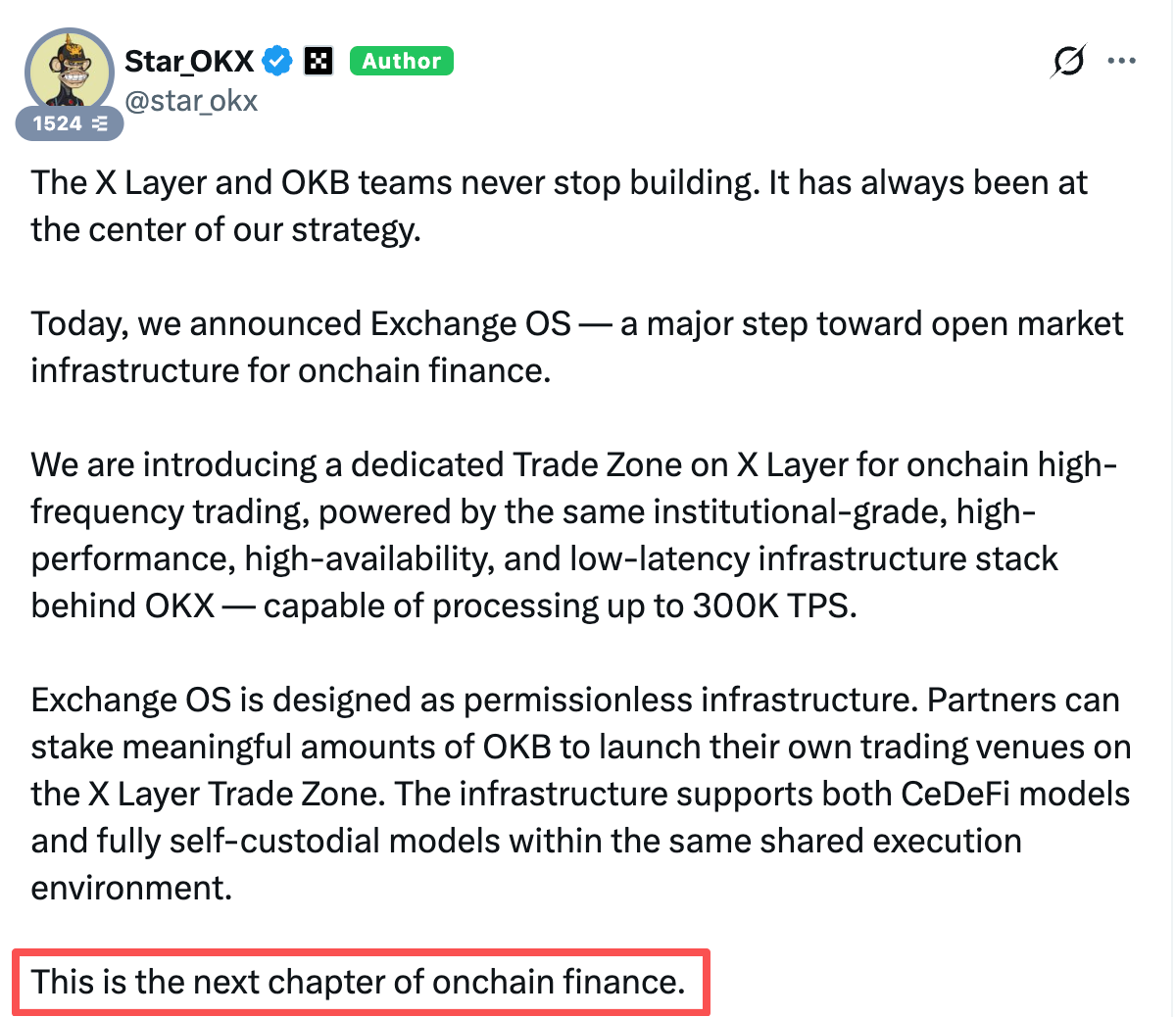
OKX CEO Star also expressed high hopes for the Exchange OS vision , stating: "The next chapter of on-chain finance shouldn't be written by any single platform. It should be written by everyone who wants to build a market."
A New Industry Coordinate: The "Crypto App Store" Takes Shape
In the past, power over asset types, asset classes, and asset pricing resided firmly with CEX platforms. Users and institutions could only adhere to platform rules, powerless to influence or demand changes. However, as TradFi assets become deeply coupled with CeFi and DeFi assets, asset types and issuance models are no longer scarce resources. The true barrier is whether the "right to create markets" can be distributed among various participants.
Now, as long as an event is verifiable, it can theoretically be transformed into an independent event market via the Exchange OS protocol. The barriers to financial participation and the power of market pricing are being systematically reshaped.
Just as iOS activated a vibrant developer ecosystem within the App Store, Exchange OS, as a foundational trading operating system, holds the potential to unlock the creativity of quantitative teams, RWA institutions, developers, and even ordinary individual users. It solves not just the "who creates the market" problem, but is a crucial step towards expanding the boundaries of the crypto market and breaking through the operational capacity ceiling of past CEX platforms.
Based on this transformation, the production relations of the crypto market will also be restructured.
From "Universal Investment" to "Universal Production"
The main evolutionary thread of the crypto market is the leap from transformation of productive forces to transformation of production relations.
In the industry's early stage, blockchain technology solved the productive force issue of "how to launch a token."
In the second stage, various crypto ETFs emerged, transforming cryptocurrencies into intermediary currencies linking "traditional financial assets." Productive forces were further unleashed, and production relations regressed from the decentralized era back to a phase controlled by centralized institutions.
In the third stage, the emergence of US stock assets, commodities, and event contracts enriched the range of assets and investment targets. However, the problem the crypto industry needs to solve has shifted to "how to efficiently establish market organization forms."
Against this backdrop, market participants—including retail traders, CEX users, and cryptocurrency investors—must undergo a "role upgrade." They need to evolve from "traders" who passively accept and invest in platform assets, into "producers" who define market rules and innovate market mechanisms. Complex markets for prediction markets, RWA assets, pre-market US stocks, and more will rapidly emerge through various "market-oriented APIs."
However, with opportunities come challenges. OKX's attempt to expand the boundaries of the crypto industry and explore the future of on-chain finance will inevitably face a series of tests. For the Exchange OS protocol and OKX's entire product suite to become the "App Store of the crypto world," success depends on overcoming the following bottlenecks:
● First, the liquidity challenge. In the early stages of the market ecosystem, can liquidity activation achieve a synergistic effect, building an economic closed loop based on spontaneous trading demand within the ecosystem?
● Second, the performance ceiling. Despite technical foundations like millisecond matching latency, unified settlement, and throughput of up to 300,000 TPS, how can the X Layer ecosystem sustainably host a staggering number of "financial applications" and remain stable?
● Third, the closed-loop business model. Creating an intra-ecosystem economic closed loop akin to "Apple App Store - Apple Apps - Apple Tax" is highly challenging. Can the Exchange OS ecosystem form an effective feedback mechanism similar to "Hyperliquid - HLP Vault - HYPE Buyback - HYPE Price Support"?
Of course, the existence of various challenges only underscores the necessity of industry development. Many problems often find new solutions precisely by confronting challenges head-on. Even if there are short-term setbacks, the steadfast progress in the right direction is commendable. Based on OKX's established brand reputation, market position, technical strength, and product capabilities, the long-term vision of "everything is a market" is undoubtedly promising.
A Courageous Industry Experiment, A Ticket to the New Era
As an industry participant commanding a massive user base, the various attempts by leading platforms like OKX, in the current market environment, can seem somewhat like "an uphill battle with little to gain." If successful, it's often dismissed as mere commercial behavior with little praise. If it fails, it invites ridicule and criticism, and the harsh words from industry insiders caught in a zero-sum game can chill the hearts of innovators.
Narratives always age and fade. Yet, someone must walk a different path, shouldering the responsibility of "advancing the industry" outside the spotlight, exploring, iterating, and taking risks without pre-determining the returns.
I believe the future of the crypto space is far more than listing how many new tokens. It lies in how many barriers to financial investment it levels, and how many efficient, fair, and open trading markets it creates. The future direction explored by industry players shouldn't just be finding the next hot narrative to grab temporary headlines, but establishing a foundational trading operating system that accommodates asset flow and achieves financial autonomy.
Exchange OS, along with many other industry experiments, is a forward-looking experiment in transforming the production relations of the crypto world. In a sense, it is a ticket to the era of "everything is a market," and a high-profile return to the crypto ethos of "decentralization, openness, and liberalism."
Whoever defines the new coordinate system for trading will secure the dominant position in the future of crypto, and even global finance.


