






SUN.io Multi-Dimensional Value Acceleration: SunSwap V4 Drives Liquidity and Trading Volume Surge, SUN Cumulative Buyback and Burn Nears 700 Million Tokens


- Core Insight: In the first quarter of 2026, the TRON ecosystem bucked the trend and grew amidst deep corrections in the broader crypto market. Its core DeFi platform, SUN.io, achieved a positive cycle of liquidity, trading volume, and token value through the technical upgrade of SunSwap V4, a sustained buyback and burn mechanism, and ecosystem synergies.
- Key Elements:
- TRON's DEX market share rose from 0.6% to 1%, climbing against the market trend, underscoring its market resilience.
- SunSwap V4 introduced six major underlying innovations (such as native TRX direct routing, singleton architecture, and flash settlement), optimizing transaction costs and scalability, and reducing gas fees (e.g., the cost for a TRX/USDT LP position dropped from $3.83 to $0.9).
- Within two months of launch, SunSwap V4's TVL surged from millions of dollars to $112 million, with average daily trading volume skyrocketing to $29.72 million.
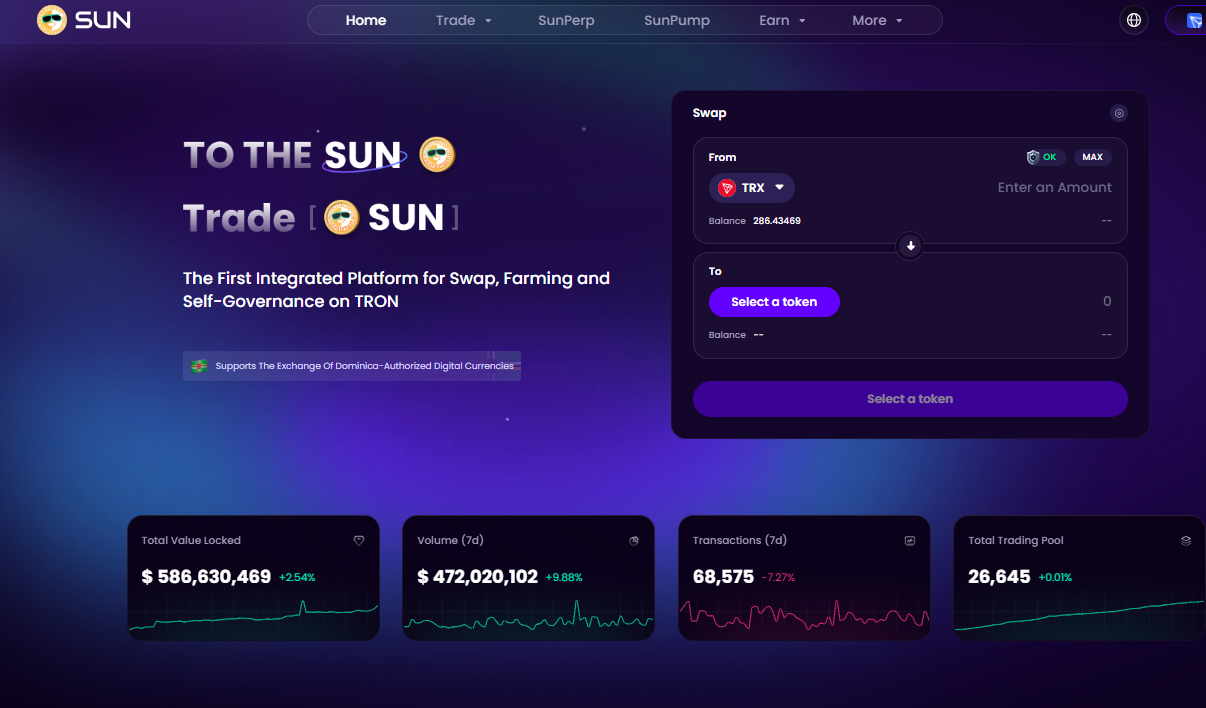
- SUN.io's total platform TVL reached $587 million, with a 7-day trading volume exceeding $472 million and processing over 68,500 transactions.
- The SUN token completed its 50th round of buyback and burn, cumulatively destroying nearly 700 million tokens, with funds sourced from three business lines: SunSwap V2, SunPump, and SunX.
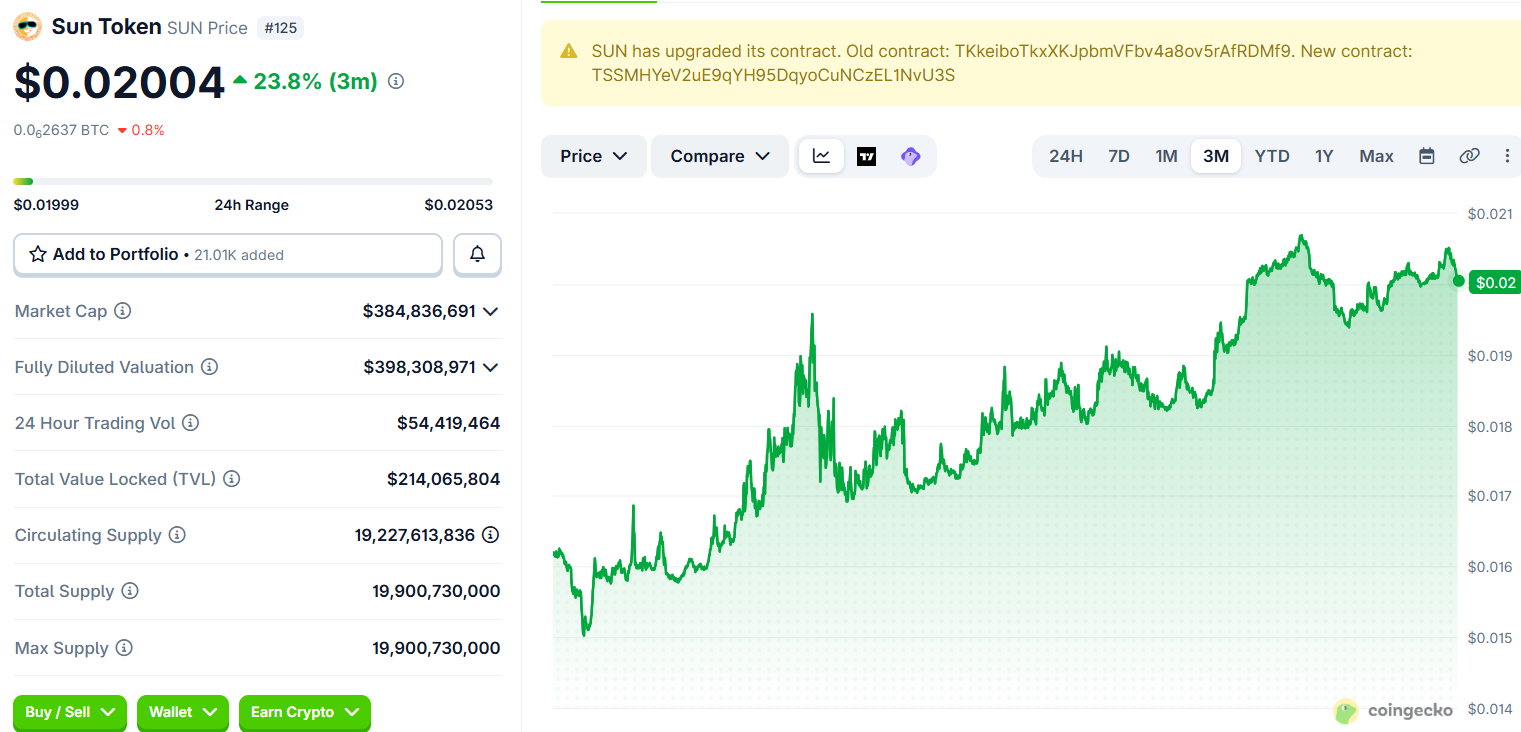
- The SUN token price rose from $0.015 to $0.02, achieving a market cap of $384 million, demonstrating a positive correlation between technology and asset value.
- SUN.io handles over 99% of the asset trading volume on the TRON network, leveraging the $89 billion USDT circulation to build a closed loop for sustained value capture.
In the first quarter of 2026, the global crypto market underwent a deep cyclical correction, with overall trading sentiment cooling and market activity continuing to decline. Against this backdrop, major public chains generally fell into a state of competition for existing users, industry infighting intensified, and growth headwinds became more pronounced. However, the TRON ecosystem demonstrated remarkable market resilience and structural growth vitality, charting an independent upward growth trajectory.
According to data from the "TRON Q1 2026 Quarterly Report" released by CoinDesk, amidst a global contraction in spot DEX trading volume, TRON's market share in DEX trading defied the downtrend, climbing significantly from 0.6% to 1%. This growth, which completely diverged from the broader market trend, directly provides tangible evidence of a substantial increase in on-chain trading activity on TRON, fully showcasing its core competitiveness in a sluggish market.
This counter-trend growth report card is inseparable from the powerful empowerment and drive of SUN.io, the core liquidity infrastructure of the TRON ecosystem. As the central DeFi hub within the TRON ecosystem, SUN.io, leveraging its comprehensive DeFi business model, continuously iterated disruptive technological advantages, and solid value capture and profit-enabling capabilities, has not only stabilized the fundamental base of the TRON ecosystem during the industry's deep reshuffle, assuming the crucial functions of value anchoring and risk buffering, but has also served as the core growth engine activating its ecosystem trading activity. This fully validates its solid and sustainable long-term value in the Web3 domain.
SunSwap V4's Six Foundational Innovations Reshape the DEX Efficiency Revolution, Achieving Extreme Cost Reduction and Scalability Leap
Within the TRON ecosystem landscape, SUN.io has always been the core liquidity hub and benchmark for DeFi infrastructure. After several iterations, the SUN.io platform has evolved into a fully functional, ecologically diverse, integrated DeFi service platform, aggregating core functions such as the DEX asset exchange SunSwap, the innovative Meme asset issuance platform SunPump, the decentralized perpetual contract platform SunX, and the decentralized governance protocol SUN DAO. It comprehensively covers multiple scenarios including asset exchange, asset issuance, derivatives trading, and ecosystem governance, constructing a complete DeFi ecosystem service map for TRON.
While horizontally expanding ecological boundaries and enriching the product matrix, SUN.io has never ceased its vertical deep-dive into underlying technology, continuously innovating and refining core product capabilities. In March this year, SunSwap, the core DEX sector of the SUN.io ecosystem, launched the epoch-making V4 version. This version, while fully inheriting the core advantages of the V1, V2, and V3 series, innovatively implements six foundational core mechanisms, reconstructs the traditional AMM architecture, and precisely targets and solves common industry pain points of traditional decentralized exchanges such as sluggish multi-route trading, fragmented liquidity, insufficient scalability, and high transaction costs. This leads the DEX within the TRON ecosystem through a technological paradigm shift, sparking a revolution in DeFi trading efficiency.
SunSwap V4 incorporates six foundational innovation mechanisms: Native TRX Support, Singleton Architecture (unified pool management), Flash Accounting (unified net settlement), Hooks (customizable trading rule plugins), Custom Accounting (customizable settlement strategies), and Subscribers (real-time position change notifications). It achieves comprehensive breakthroughs across multiple dimensions, from transaction logic optimization and liquidity pool management efficiency to settlement model innovation and developer customization expansion. While significantly reducing on-chain energy consumption and transaction costs, it grants the ecosystem extreme scalability, fully upgrading the user trading experience and developer innovation space:
- Native TRX Support: Supports direct pairing and trading between TRX and TRC-20 tokens, eliminating the need to forcibly wrap TRX into WTRX, thereby simplifying operations and further reducing transaction energy consumption.
- Singleton Architecture: Consolidates all liquidity pools under a single contract for unified centralized management,颠覆ing the traditional DEX model of deploying separate contracts for each trading pair. This innovative architecture not only significantly lowers the cost of creating liquidity pools but also optimizes routing efficiency for cross-pool trades, effectively solving the problem of liquidity fragmentation.
- Flash Accounting: A novel settlement mechanism built on the Singleton Architecture. For complex multi-step asset swaps, it no longer requires individual transfers for each step. Instead, net balance changes are recorded in an internal ledger, and a single net settlement occurs upon transaction completion. This drastically reduces energy consumption for complex strategies, making it suitable for high-frequency and complex trading scenarios.
- Hooks: Allows developers to embed customized trading logic directly into liquidity pools (e.g., dynamic fees, customized oracles). Each liquidity pool can be bound to its own specific Hooks contract. Developers can flexibly configure personalized features like dynamic fees, customized oracles, and exclusive trading rules without modifying the core protocol code, enabling a flexible "one pool, one configuration" possibility and unlocking the innovative potential of the developer ecosystem.
- Custom Accounting: This mechanism works in deep synergy with Hooks, empowering professional market makers and institutional users to build their own specialized settlement systems, flexibly adapting to complex hedging strategies and fee models.
- Subscribers: Liquidity Providers (LPs) can join subscriber contracts to receive real-time notifications about dynamic data changes, such as fund position updates. This mechanism provides core technical support for third-party liquidity management tools and automated market-making systems, helping drive on-chain liquidity towards more professional, refined, and intelligent operational upgrades.
Relying on these six underlying technological innovations, SunSwap V4 has successfully achieved a two-way breakthrough: extreme optimization of transaction costs and comprehensive upgrade of protocol scalability, completing a full-spectrum iterative upgrade covering product experience, underlying performance, and ecological capabilities.
In terms of cost optimization, core technologies like Native TRX Support, Singleton Architecture, and Flash Accounting extremely compress on-chain transaction paths and streamline settlement processes, significantly reducing on-chain energy consumption and fee costs, pushing TRON’s inherent advantages of low cost and high efficiency to new heights.
Simultaneously, SUN.io has long been offering up to 99% energy subsidy incentives, creating a dual benefit of "technological cost reduction + policy subsidies." On May 19, the platform also successfully completed the iterative upgrade of its general router contract, with the new contract also eligible for the 99% high energy subsidy. The strong linkage between internal performance optimization and external energy subsidies has drastically reduced on-chain transaction costs for SunSwap V4 users, driving energy consumption infinitely close to zero.
Currently, when users conduct asset swaps on SunSwap, the system automatically matches the optimal trading path through intelligent routing to minimize transaction costs. In the common scenario of swapping TRX for USDT, the on-chain energy cost has trended towards zero. In the TRX/USDT liquidity addition scenario, for the same amount of capital, the single-transaction Gas cost for the V1 version is $3.83, while the V4 version costs only $0.9, a very significant reduction, meaning users can perform approximately 6 times more on-chain operations under the same budget.
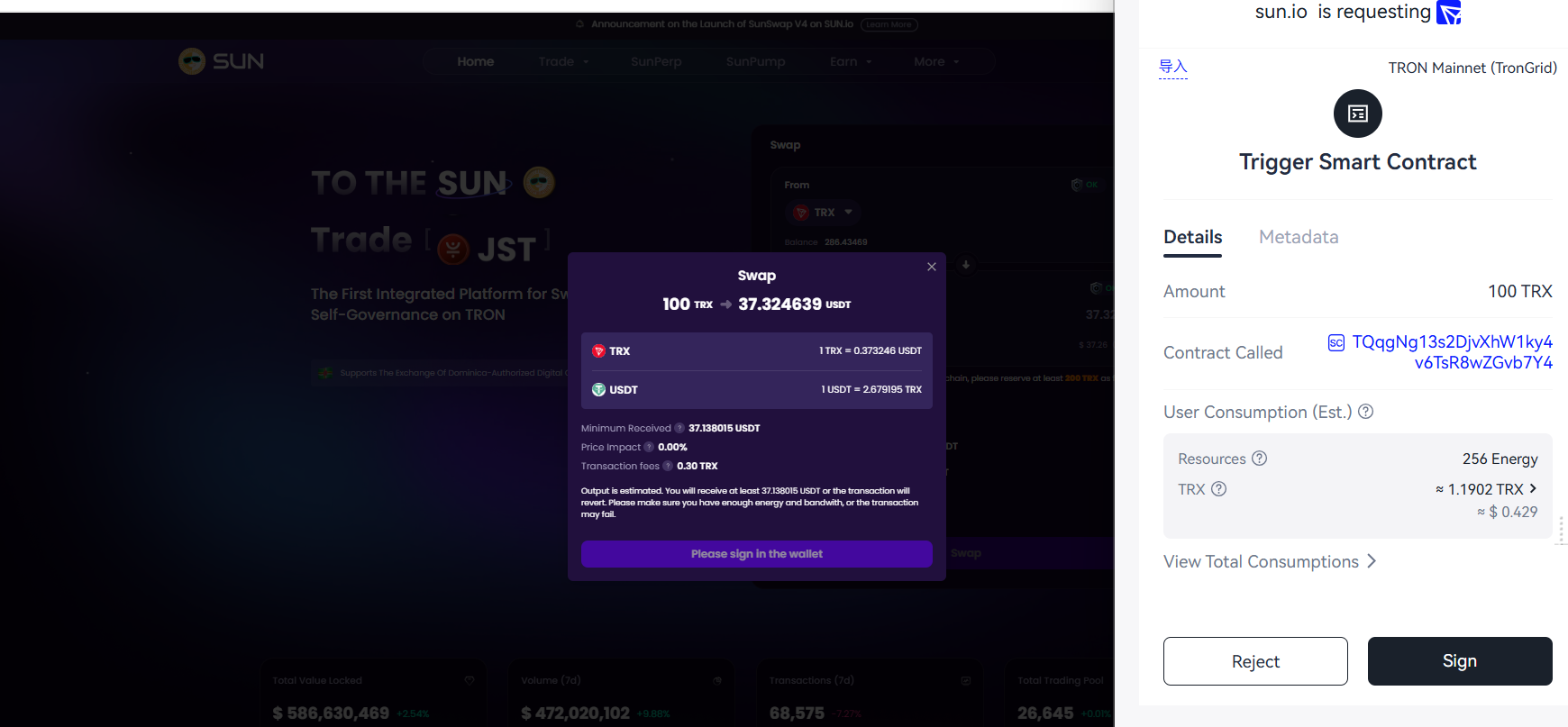
[TRX to USDT Token Swap Scenario]
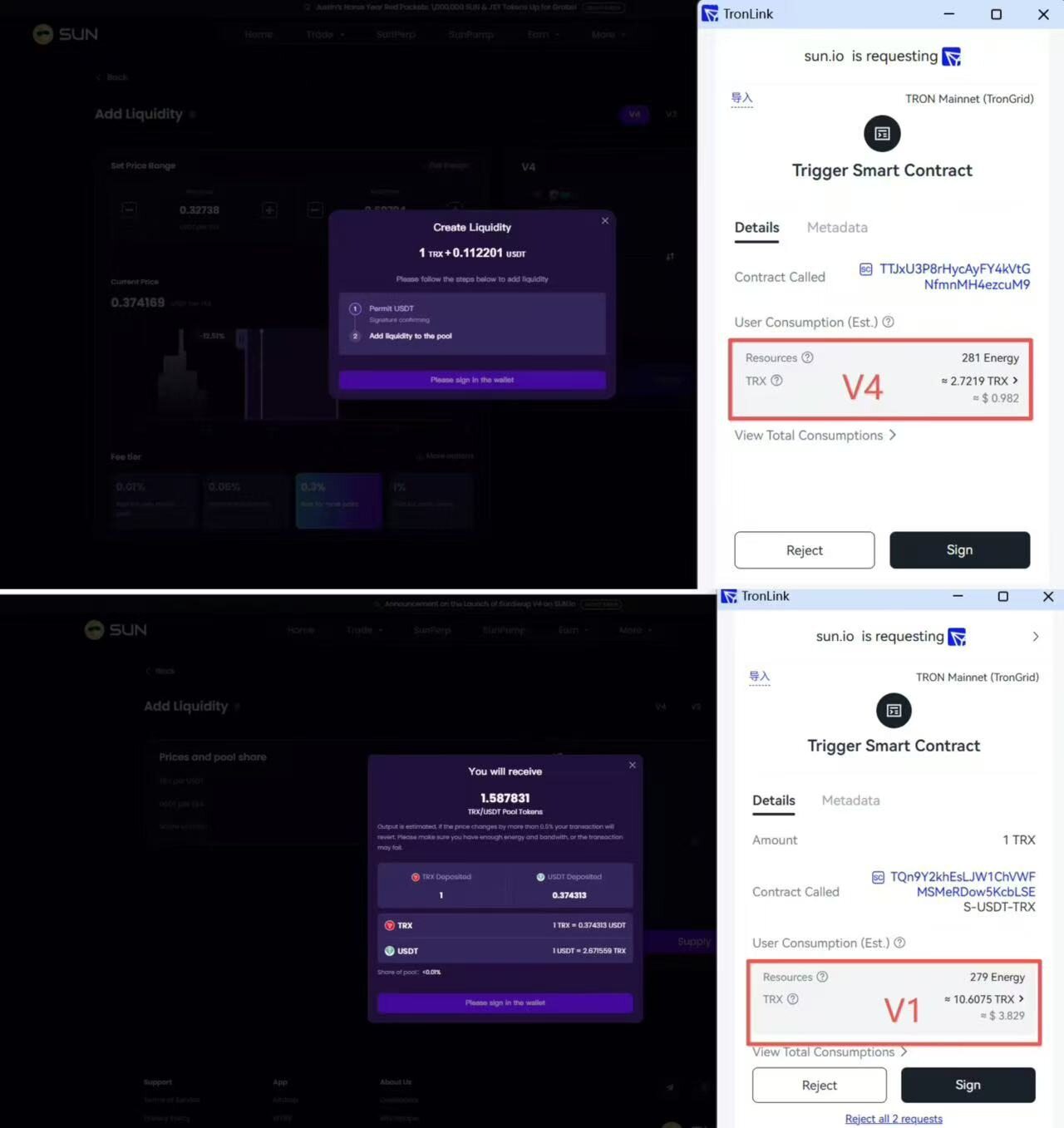
[Gas Consumption Comparison: V4 Adding LP (Top) vs. V1 Adding LP (Bottom)]
In terms of ecological expansion, the platform has fully opened a comprehensive suite of developer tools, including Hooks, Custom Accounting, and Subscribers mechanisms, granting the ecosystem extremely high autonomy for customization. Developers can flexibly build personalized liquidity pools, innovative DeFi products, and exclusive trading strategies based on their specific needs, continuously enriching the TRON DeFi ecosystem and laying a solid foundational infrastructure for full-scenario ecological innovation.
From the disruptive reconstruction of the underlying architecture to the full-scale opening of the developer toolset, SunSwap V4 is not only the epitome of TRON network's core advantages of low cost and high efficiency but also validates its core value and growth certainty through tangible technological breakthroughs and implemented results.
SunSwap V4 Achieves Explosive Growth in Liquidity and Trading Volume Within Two Months of Launch
The leading technical architecture and extreme cost advantages have now been fully translated into tangible business growth momentum and market competitiveness for SunSwap V4. Since the launch of the V4 version, within just two months, both its liquidity pool TVL and trading volume have achieved exponential explosive growth, carving out an independent upward trend in an otherwise flat overall market environment, significantly outperforming the broader market.
According to data from the Sunscan block explorer, the TVL of SunSwap V4 liquidity pools has steadily climbed from an initial few million dollars to nearly $112 million currently. The average daily trading volume has also surged from tens of thousands of dollars initially to a recent $29.72 million. This set of high-growth data directly confirms the substantial breakthroughs made by SunSwap V4 in optimizing transaction costs and upgrading protocol scalability, serving as strong proof of its technological iteration achievements being implemented and its product competitiveness being fully realized.
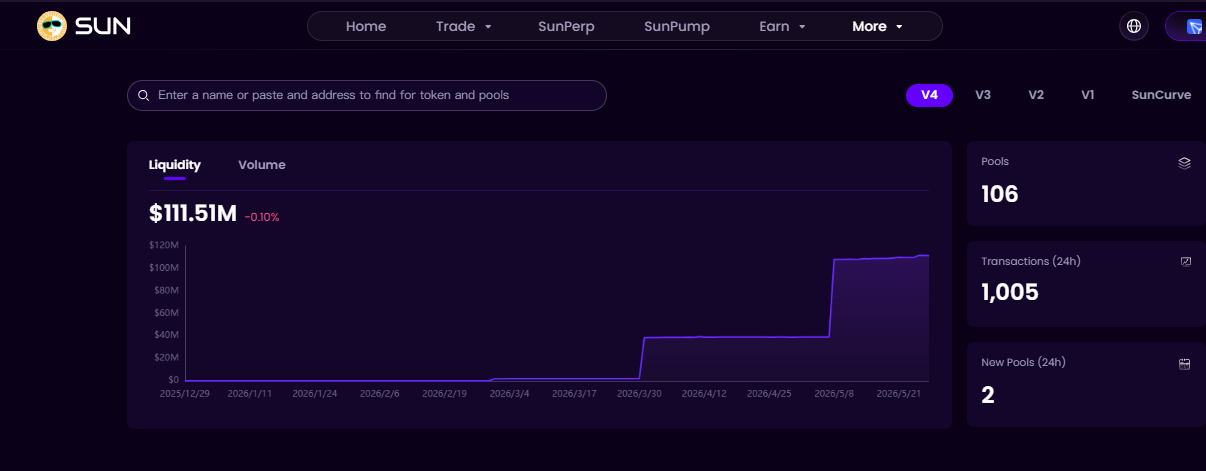
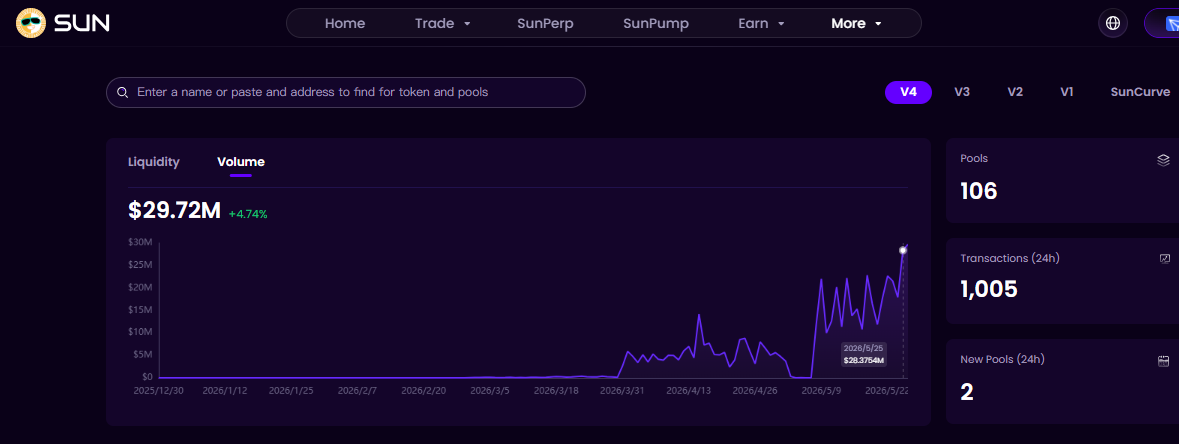
The remarkable growth of the SunSwap V4 platform has garnered widespread attention and high recognition from the global crypto industry. Several crypto KOLs have posted on platform X, expressing astonishment that SunSwap V4 achieved a dual explosion in liquidity and trading volume just two months after its launch, noting its growth rate is exceptionally prominent and even quite astonishing within its market segment.
Reputable industry KOL @Tonys further deconstructed the core logic behind this rapid growth: Relying on the dual core advantages of the 99% high energy subsidy and native TRX one-click connectivity, SunSwap V4 has pushed on-chain transaction fees to historic lows, creating extremely low transaction costs and a simple, smooth operational experience. At the same time, the V4 upgrade simultaneously optimized the rights system for liquidity providers, offering users higher and more flexible yield returns. Moreover, users can monitor on-chain fund dynamics in real-time, efficiently conducting liquidity operations backed by the platform's secure non-custodial mechanism and intelligent market-making strategies. With these multiple advantages combined, the explosive growth of SunSwap V4 has become an inevitable industry trend.
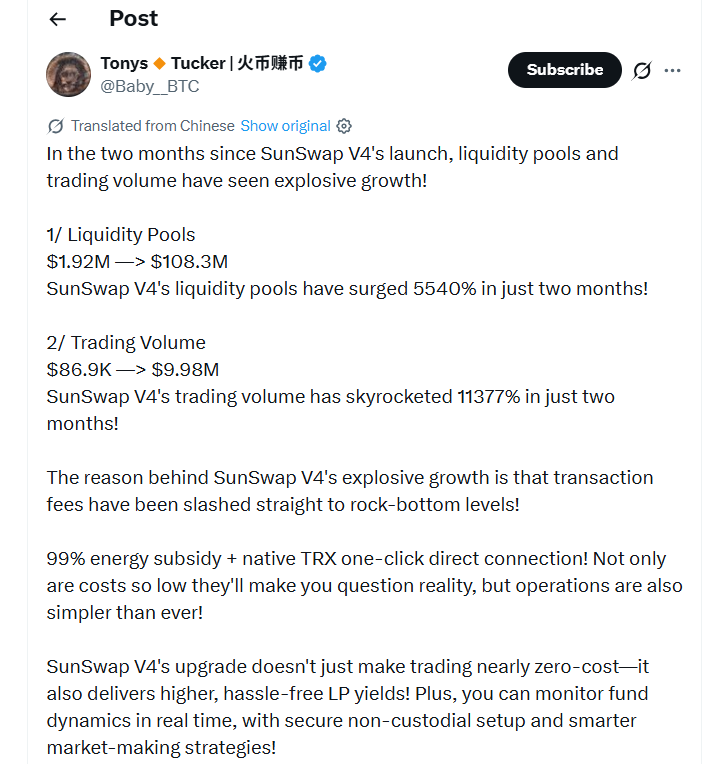
With the brand new launch of SunSwap V4, SunSwap has formed a synergistic structure where V2, V3, and V4 versions work together, each complementing the other's strengths to drive the continuous expansion of the platform's trading scale. According to the latest data from May 26, the core performance of each version is clearly stratified with strong growth momentum:
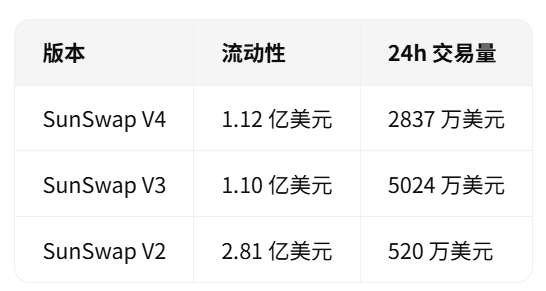
The V4 version, launched just two months ago, has already rapidly caught up with the mature V3 version in terms of liquidity and trading volume, fully unleashing the growth potential of the new technological version and becoming the core engine for new platform growth.
Relying on the ecological advantages of multi-version synergistic development, SUN.io's overall business data will continue to be robust. As of May 27, the total TVL on the SUN.io platform reached nearly $587 million, the total number of ecosystem liquidity pools exceeded 26,600, the 7-day total trading volume surpassed $472 million, and over 68,500 transactions were processed, with the ecosystem scale continuing to expand. Breaking it down, the SunSwap V4 single version has already established over 106 liquidity pools. Supported by a liquidity base of approximately $112 million, it achieved a 24-hour trading volume of $29.72 million and 24-hour transaction count of 1,005, with its incremental new value continuously becoming prominent.
This rapid business growth and continuous ecological improvement have also directly driven a steady increase in the value of the platform's native asset. CoinGecko data shows that since the launch of SunSwap V4 in March, the price of the SUN token has steadily risen from $0.015 to $0.02, achieving a cumulative increase of over 30%. Its current overall market capitalization stands at $384 million, realizing a positive cycle of technological iteration, ecosystem growth, and asset value.
SUN.io Ecosystem Value Continues to Deliver: Cumulative SUN Buyback and Burn Approaches 700 Million Tokens, "Three Pillars" Drive Token Deflation
In the crypto world, determining whether a DeFi platform is a "castle in the sky" or possesses "enduring value" hinges on whether its tokenomics are backed by real revenue. SUN.io is continuously releasing multi-dimensional value through its three pillars: SunSwap, SunPump, and SunX. Tangible business revenue drives the SUN token into an era of deep deflation. As of May 26, the SUN token has completed 50 rounds of buyback and burn, with the cumulative amount burned surpassing 600 million tokens.
On April 25, SUN officially completed its 50th round of buyback and burn, burning over 18.83 million SUN tokens (18,835,780.1486). Since the initiation of the SUN buyback mechanism on December 15, 2021, the total cumulative amount bought back and burned has reached nearly 700 million tokens (specifically 669,522,160.92 tokens). Among this, SunSwap V2 fees have contributed a cumulative burn balance of 374 million tokens; SunPump has contributed nearly 285 million tokens burned; and SunX has contributed approximately 9.12 million tokens burned.
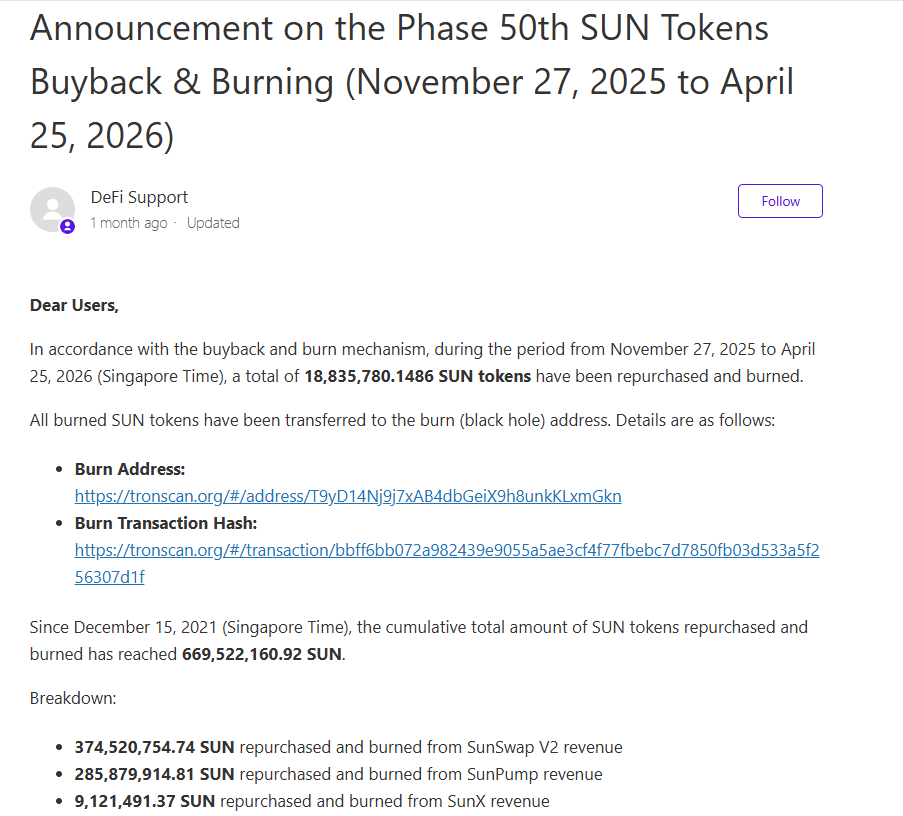
In stark contrast to the vast majority of projects that rely on inflation or simply "shifting" governance tokens around, SUN's buyback and burn funds all originate from diversified, real business revenue. From the current burn data, the funds used to buy back and burn SUN tokens primarily come from three core business lines: SunSwap V2, SunPump, and SunX. This means that regardless of how asset swapping, Meme mania, or PerpDEX derivatives evolve, these three engines can continuously capture on-chain value, steadily injecting healthy "deflationary momentum" into the SUN token.
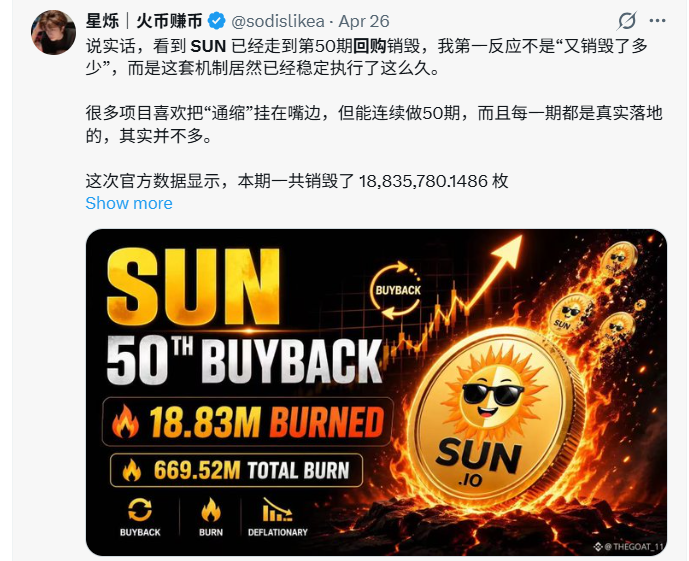
It is this buyback mechanism, grounded in real revenue and consistently executed for 50 consecutive rounds, that constitutes the most powerful value validation and fully confirms SUN.io's long-term favorable deflationary resilience and the platform's firm commitment to long-termism. As crypto KOL Xingshuo stated: "Seeing SUN complete its 50th buyback and burn, my first reaction wasn't how much was burned, but that this mechanism has actually been running stably for so long. Many projects like to talk about 'deflation,' but not many can actually execute 50 rounds consecutively with real implementation. The significance of the 50th round is it proves this isn't a periodic action, but a long-term value loop that has been proven to work and can continue operating."
While stabilizing its fundamentals, SUN.io is also actively expanding into new asset types. In April this year, SunSwap V4 launched and was the first to support the


