






30-day, Two-Phase Surge of Over 40%: Bitget Pre-IPO Breaks Through Skepticism to Deliver Real Returns


- Core Thesis: Through its IPO Prime products (e.g., preSPCX, preOPAI), Bitget converts the Pre-IPO expectations of unlisted giants like SpaceX and OpenAI into tradable tokens for ordinary users, generating significant wealth effects and driving CEX expansion from pure crypto assets toward global cross-asset trading.
- Key Elements:
- SpaceX’s potential IPO valuation could reach $1.75 trillion, making it one of the largest IPOs in history. The market has already begun betting on its valuation changes in advance via Pre-IPO perpetual contracts launched on platforms like Bitget.
- Bitget’s IPO Prime products — preSPCX (subscription price: $650) recorded a maximum gain of 45.8%, while preOPAI (subscription price: $725) saw a maximum gain of 48.8%, delivering clear paper returns.
- Returns are derived from three layers of value: the price difference between subscription price and secondary market price; lower participation thresholds (traditional Pre-IPO is limited to institutional investors); and VIP airdrops (a total of 950 preSPCX across two rounds, valued at over $610,000).
- Bitget connects directly to U.S. stock liquidity through the RWA protocol Reality and supports dividend distributions, further expanding the scope of global assets into trading scenarios, reflecting its UEX (Universal Exchange) strategy.
- The three major exchanges are diverging in strategy: Binance leans toward contracts, OKX expands its perpetual product categories, while Bitget focuses on real asset backing and a user-centric rights ecosystem (subscription + spot + contracts + airdrops).
Author: White Runner

SpaceX's IPO prospectus went viral overnight.
This super unicorn has finally laid its books bare before the public market: Starship, Starlink, Elon Musk, the Mars mission, and a target valuation that could reach a staggering $1.75 trillion. According to Reuters, a SpaceX IPO could become one of the largest in history, potentially reshaping the pricing mechanisms for fundraising and exits by later-stage tech companies.
As one of the most recognized private companies globally, all eyes are on SpaceX. Yet, only a select few insiders, institutions, and primary market investors have ever had early access to its equity.
But the market has already grown impatient.
On Bitget, the SpaceX-related product preSPCX (formerly preSPAX) has surged over 40%. SpaceX's IPO is still on the horizon, but the speculative trading around it has already begun.
Wealth Effect is Shifting from "Crypto Narratives" to "Cross-Asset Opportunities"
In the past, the most effective way for CEXs to attract users largely came from within the crypto sphere: new token listings, Launchpads, Meme coins, perpetual contracts, and exchange tokens. Users focused on who could snag the next hot project and get tokens before the official launch.
However, in a weak market cycle, this logic is becoming increasingly difficult to sustain. The narrative density of purely native crypto assets is declining; new tokens often peak at launch, Meme coin hotspots rotate rapidly, and it's getting harder for exchanges to consistently create a wealth effect solely through "new listings."
Meanwhile, external financial markets are providing fresh material. On one hand, traditional avenues for accessing overseas stocks are becoming more sensitive. On the other, assets like US equities, AI, commercial aerospace, and Pre-IPO opportunities continue to attract global capital. Users haven't lost interest in high-quality overseas assets; their direct participation pathways are simply narrowing.
This creates a new misalignment: Traders don't necessarily want to trade only cryptocurrencies. They want to trade any asset that offers a compelling return narrative. This could include US stocks, gold, forex, AI, SpaceX, OpenAI, and even the *expectations* surrounding these assets before they go public.
SpaceX is the most typical example. Although it hasn't officially held its IPO, platforms like Binance, Bitget, and Trade.xyz have already launched relevant perpetual contracts based on its listing expectations, allowing users to trade the price expectations of SpaceX. As the Financial Times noted, these products don't offer stock ownership; fundamentally, they let users bet on the valuation changes around SpaceX's IPO.
Against this backdrop, the significance of Bitget's Pre-IPO offering goes beyond just listing a few new products. It signals the expanding boundary of asset offerings on CEXs: shifting from "who can list the next hot coin" to "who can package the expectations of globally hot assets into tradable products faster."
When new coins are no longer attractive, unlisted giants become the new story for exchanges.
Bitget IPO Prime: From Skepticism to Reversal of Reputation
When Bitget IPO Prime first launched, the market's initial reaction was more curiosity and skepticism.
This is normal. SpaceX and OpenAI are not yet public. When average users suddenly see the ability to subscribe to their Pre-IPO-related products on an exchange, the first thought isn't usually "opportunity," but rather "is this trading thin air?", "is this actually equity?", or "is the valuation too high?"
Subsequently, Bitget's Head of Greater China, Jason Xie, consistently and directly addressed user questions and concerns on Twitter. He explained the product logic of IPO Prime, the source of the underlying assets, the issuance role of Republic, and the boundaries between preSPAX/preOPAI and actual equity or economic rights.
On one hand, he acknowledged shortcomings in the initial rules, stating that "all rule iterations were born from being criticized." On the other hand, he repeatedly emphasized that Bitget's core purpose with IPO Prime is to lower the barrier and bring primary market opportunities – once exclusive to institutions and high-net-worth individuals – to a broader set of ordinary users.
He also emphasized in multiple tweets that preOPAI is the "only token on the entire network backed by real equity." Several KOLs also published analyses arriving at the same affirmative conclusion, making this "backed by real equity" a crucial footnote in the shift of public opinion.
Eventually, the market was convinced by actual returns. As price performance materialized, rule mechanisms improved, and users deepened their understanding of the product structure, initial skepticism gave way to discussions about "can it double?", "looking forward to the next product", and "how to upgrade VIP level?"

To some extent, preSPCX bore the brunt of the educational costs and public opinion pressure for IPO Prime, while preOPAI completed a reversal of reputation within a more mature product narrative and clearer market expectations. Consequently, Bitget IPO Prime has gradually transformed from a questioned new concept into a Pre-IPO asset gateway that users are willing to follow and participate in.
According to Bitget's announcement, preSPCX, the first IPO Prime project, had a total supply of 94,000 tokens with a total subscription value of $61.1 million at a subscription price of $650. preOPAI, the second project, had a total subscription volume of 29,082 tokens with a total subscription value of approximately $21.08445 million at a subscription price of $725. Additionally, there are perpetual contract products like SPCXUSDT and OPAIUSDT.
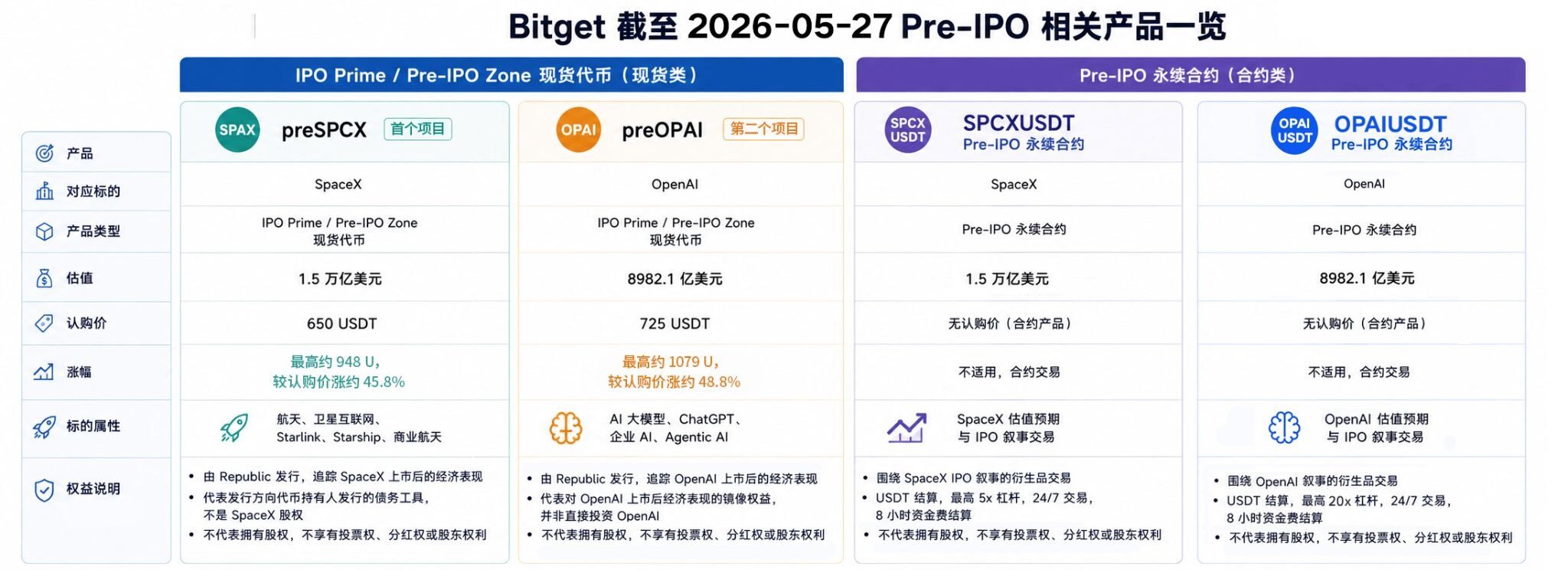
Looking at peak gains, preSPCX rose 45.8% from $650 to $948, and preOPAI rose 48.8% from $725 to $1079, which indeed constitutes clear book profits. In my view, this profit comes from three layers.
The first layer is the price difference between the subscription price and the secondary market pricing. Users participate via IPO Prime subscriptions; after the token goes live on the spot market, the market re-prices based on pre-IPO expectations for SpaceX and OpenAI. For this previously illiquid Pre-IPO exposure, spot trading also provides clearer room for exits, portfolio adjustments, and short-term trading.
The second layer is the change in the participation threshold. Traditional Pre-IPO opportunities are usually only available to institutions, high-net-worth individuals, and those who meet capital verification requirements. It's hard for ordinary users to access targets like SpaceX or OpenAI. Bitget IPO Prime transforms this semi-primary market opportunity into a subscription and trading product accessible to regular exchange users. The wealth effect doesn't just come from price increases, but also from the fact that "you couldn't participate before, but now you have an entry point."
The third layer is the additional benefit from VIP airdrops. Bitget set up two rounds of VIP airdrops for preSPCX: the first round targeted existing VIP users with a prize pool of 760 preSPCX tokens; the second round targeted users who upgraded their VIP status during the campaign, with a prize pool of 190 preSPCX tokens. The total across both rounds was 950 tokens. Based on the $650 subscription price, this corresponds to a nominal value of approximately $617,500 (which, at current prices, has risen to $860,500). This integrates IPO Prime not just as a subscription product, but also into the platform's user benefits system.

(The VIP5 user's impressive airdrop haul sparked envy; Jason Xie's "responsive" approach also boosted reputation)
These three layers of value are what make Bitget IPO Prime noteworthy: subscriptions provide early tokens, spot markets offer trading liquidity, VIP airdrops integrate Pre-IPO exposure into the user benefits system, and SPCXUSDT/OPAIUSDT further extend SpaceX's pre-IPO expectations into the derivatives market.
Thus, the market's sentiment towards Bitget IPO Prime is constantly evolving. Early skepticism focused on structure, valuation, and liquidity; current attention is more on the gains achieved by the first two products, the extra benefits from VIP airdrops, and whether access to targets like SpaceX and OpenAI can be sustained.
For now, Bitget IPO Prime has preliminarily validated its logic: transforming the expectations of top-tier private companies into a new wealth gateway that is accessible to ordinary users, distributable by the platform, and tradable by the market.
From US Stock Products to Pre-IPO: Bitget's Full-Asset Strategy
From the perspective of long-term Bitget ecosystem participation, Bitget's move into Pre-IPO is not an isolated action. Within the broader landscape of exchange competition, it appears more like a part of CEXs' expansion from native crypto assets to global asset expectations. It is also an extension of Bitget's UEX (Universal Exchange) strategy.
Previously, the competition between exchanges revolved around listing speed, perpetual contract liquidity, Launchpad quotas, and exchange token ecosystems. Now, the competition is expanding horizontally. Users don't just want to trade BTC, ETH, or Meme coins; they also want to trade US stocks, gold, forex, AI, SpaceX, OpenAI, and the *expectations* of these assets before they officially become tradable.
Looking at US stock and Pre-IPO products, Binance, OKX, and Bitget have indeed charted different paths.
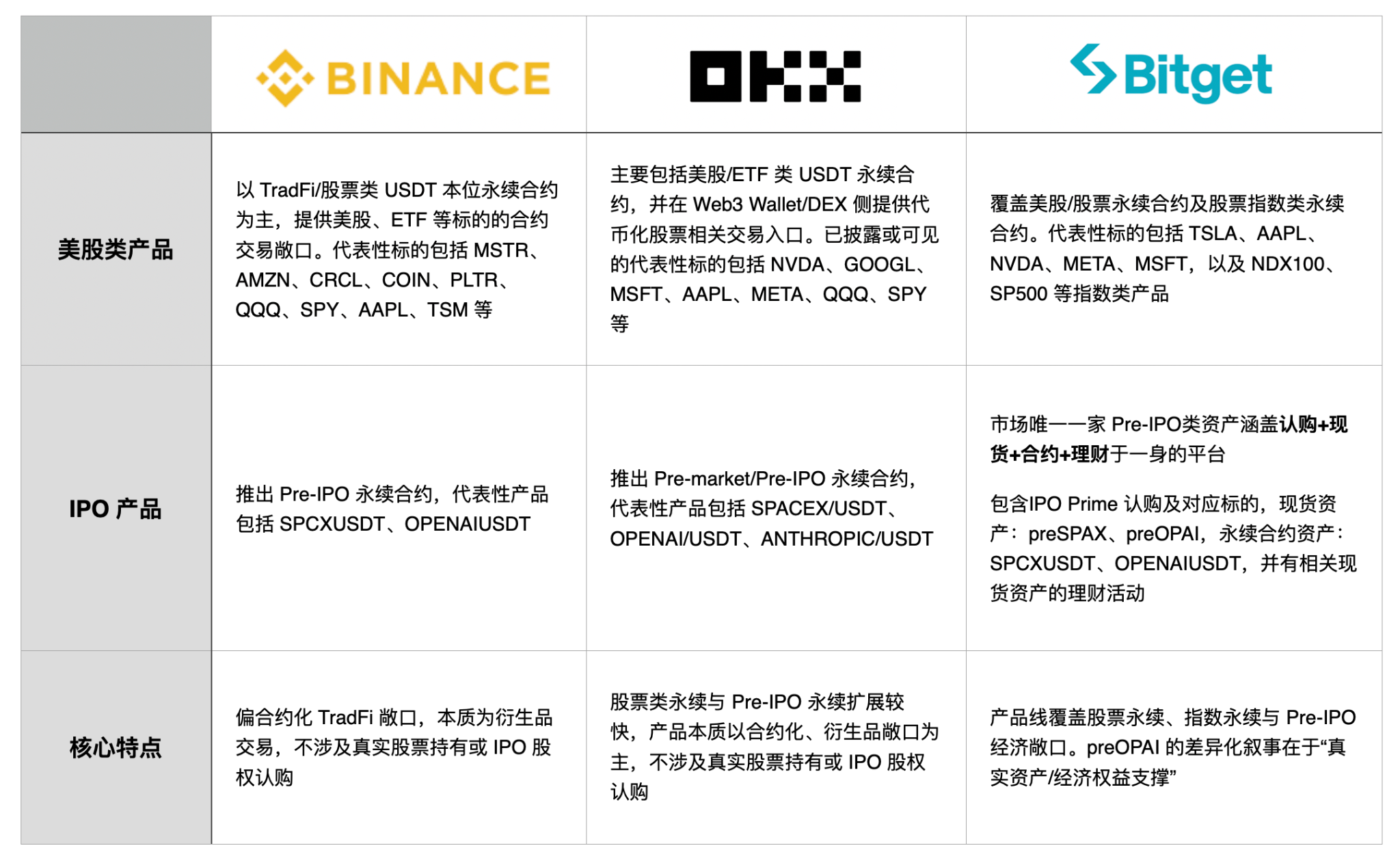
Overall, the differences between the three can be summarized as: Binance leans more towards contract-based TradFi exposure; OKX focuses more on rapidly expanding stock and Pre-IPO perpetual categories; Bitget offers a more comprehensive product type coverage, emphasizes real asset backing, and builds a richer user benefit ecosystem through mechanisms like subscriptions, spot trading, perpetual contracts, and VIP airdrops.
Observing the movements of exchanges, US stock products are clearly becoming the next frontier for CEX expansion. Pre-IPO, tokenized stocks, stock contracts, and RWA indices may look different in form, but they essentially answer the same question: How can an exchange expand users from "trading only crypto" to "trading the world's important assets"?
For exchanges, this means new asset supply, new trading scenarios, and new methods of user retention. For users, it means the objects of their trading are changing. People used to look for the next hot coin on CEXs; now, they might start looking for the next unlisted SpaceX or OpenAI, or the next global asset that can be tokenized, contracted, or indexed.
Therefore, the wealth effect of Bitget's Pre-IPO shouldn't be viewed solely within the context of individual project gains. It is more like a wedge in the CEX cross-asset competition: whoever can identify high-awareness assets faster, and package them into tradable products, will likely gain an advantage in the next round of asset supply competition.
Can the Wealth Effect Last? It Depends on Who Can Turn Global Narratives into User Opportunities
The significance of SpaceX extends beyond taking a rocket company to the capital market. What it truly brings to the public market is the combined imagination of commercial spaceflight, the Starlink network, orbital infrastructure, AI, and the future space economy. The value of an IPO isn't just allowing shareholders to exit; it's about subjecting this super-narrative, long confined to the private market, to public pricing by global capital for the first time.
Bitget's UEX strategy points to a similar logic. It's not simply about listing more US stock or Pre-IPO products, but packaging high-quality global assets – US stocks, gold, forex – into a 24/7 crypto trading gateway for its users.
We've also seen Bitget's SpaceX and OpenAI-related products surge over 40% in less than a month, distributing a combined airdrop worth $617,500 (based on subscription price) to VIP users. The subscription price discount, secondary market liquidity, VIP benefits, and perpetual contract trading together form a massive wealth effect. In the current bear market environment filled with panic, such a clear positive feedback loop is truly rare.
As this article was being written, Bitget announced another new initiative: launching the RWA protocol "Reality," directly linking to US stock liquidity and supporting dividend distributions. Bitget is increasingly integrating real-world assets into a unified trading scenario. Meme coins might cool down, but market demand for high-quality assets, liquidity, and trading efficiency will not disappear.
SpaceX's Starship keeps launching, and its IPO is channeling the imagination of commercial spaceflight into the capital market. For exchanges, the real competition is just beginning: whoever can capture the expectations of these global-level assets earlier may well define the next-generation trading gateway.
Starship soars towards the cosmos, igniting a trillion-dollar imagination for commercial spaceflight. And as capital begins to price that imagination, what Bitget aims to do is turn this narrative, once far off in the primary market, into a ticket of entry for ordinary users.





