






当富途变成相亲角,海外身份成为中产硬通货


- Core Viewpoint: In May 2026, the China Securities Regulatory Commission (CSRC) imposed heavy penalties on overseas brokerages such as Futu and Tiger, causing their stock prices to plummet. This incident directly exposed the dilemma faced by domestic middle-class investors: overseas identity has become a new hard currency, its value is being repriced, and it has even given rise to a hidden marriage securitization market where individuals seek identity through marriage.
- Key Elements:
- Regulatory Hammer Falls: On May 22, eight government departments led by the CSRC announced plans to severely penalize three overseas brokerages. Futu and Tiger saw their US stock prices fall over 30% pre-market, with existing mainland users only allowed to sell, not buy.
- Surging Identity Thresholds: Since 2022, the requirements for opening overseas accounts have escalated from utility bills to needing a foreign passport or permanent residence card. Overseas identity has become an essential ticket to enter investment markets like US stocks.
- Identity as New Asset: For the domestic middle class, an overseas identity possesses scarcity (e.g., the approval rate for Hong Kong's talent schemes is less than 0.01%), high returns (unlocking global asset allocation), and non-transferability (only inheritable through marriage or childbirth).
- Shifting Investment Logic: Over the past two decades, the logic of middle-class overseas investment has evolved from "offensive" (seeking opportunities) to "defensive" (diversifying risk), and now to "buying insurance" to hedge against the risk of being locked out of the market.
- Intergenerational Transmission Effect: As the window for individuals to obtain overseas identities narrows, the middle class is turning its hopes to the next generation. A surge in prices for services like international schools and study-abroad preparatory programs is expected.
Original Author: Xiaobing, Shenchao TechFlow
On May 22, following the China Securities Regulatory Commission's (CSRC) proposal to impose severe penalties on three offshore brokerages—Futu, Tiger Brokers, and Longbridge—their stock prices plunged.
But within Futu's own app community, the narrative took a sharp turn. Overnight, it transformed from a stock discussion platform into a matchmaking hub for investors.
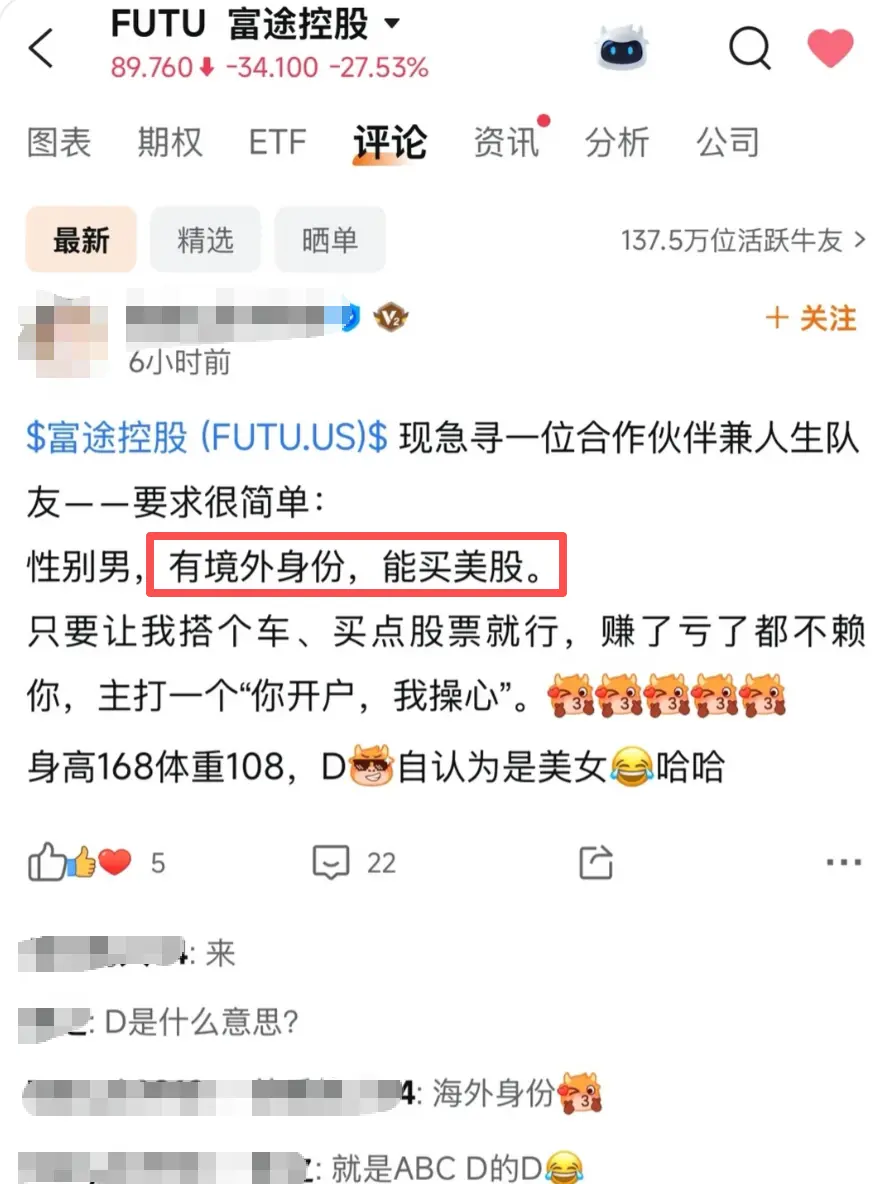
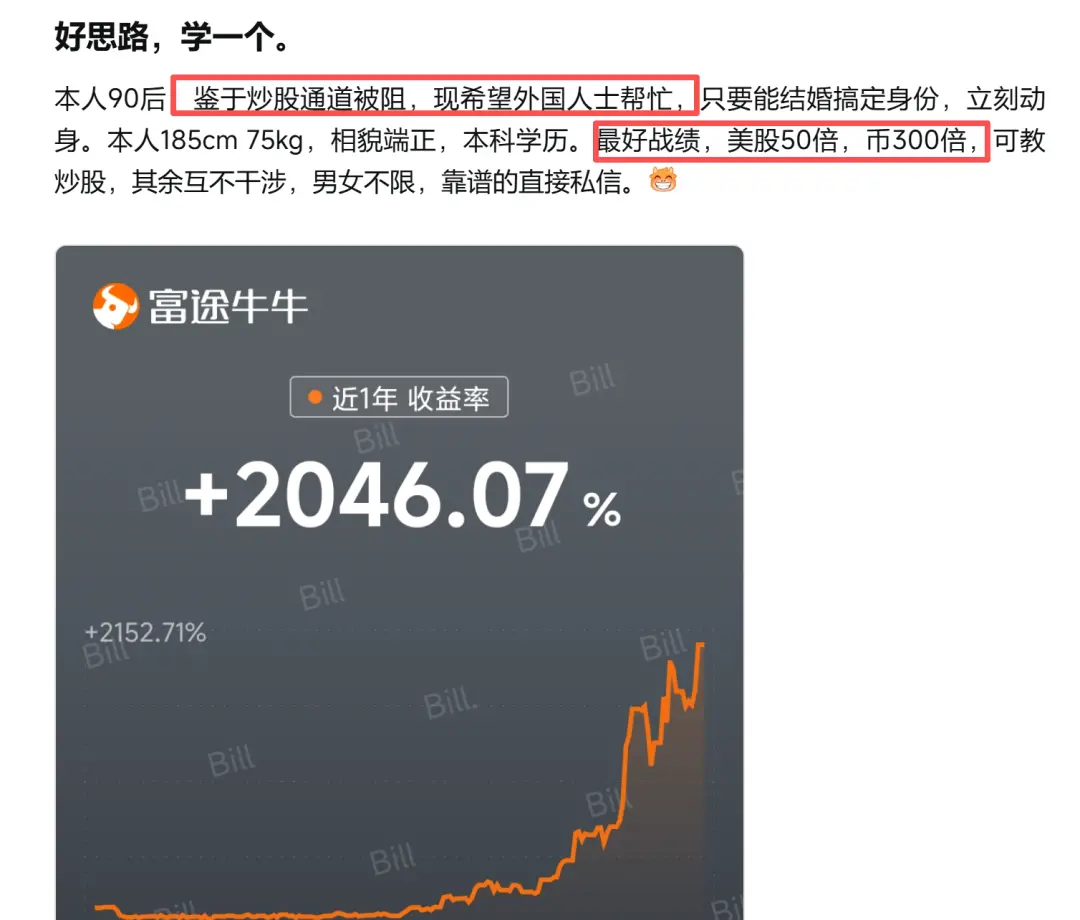
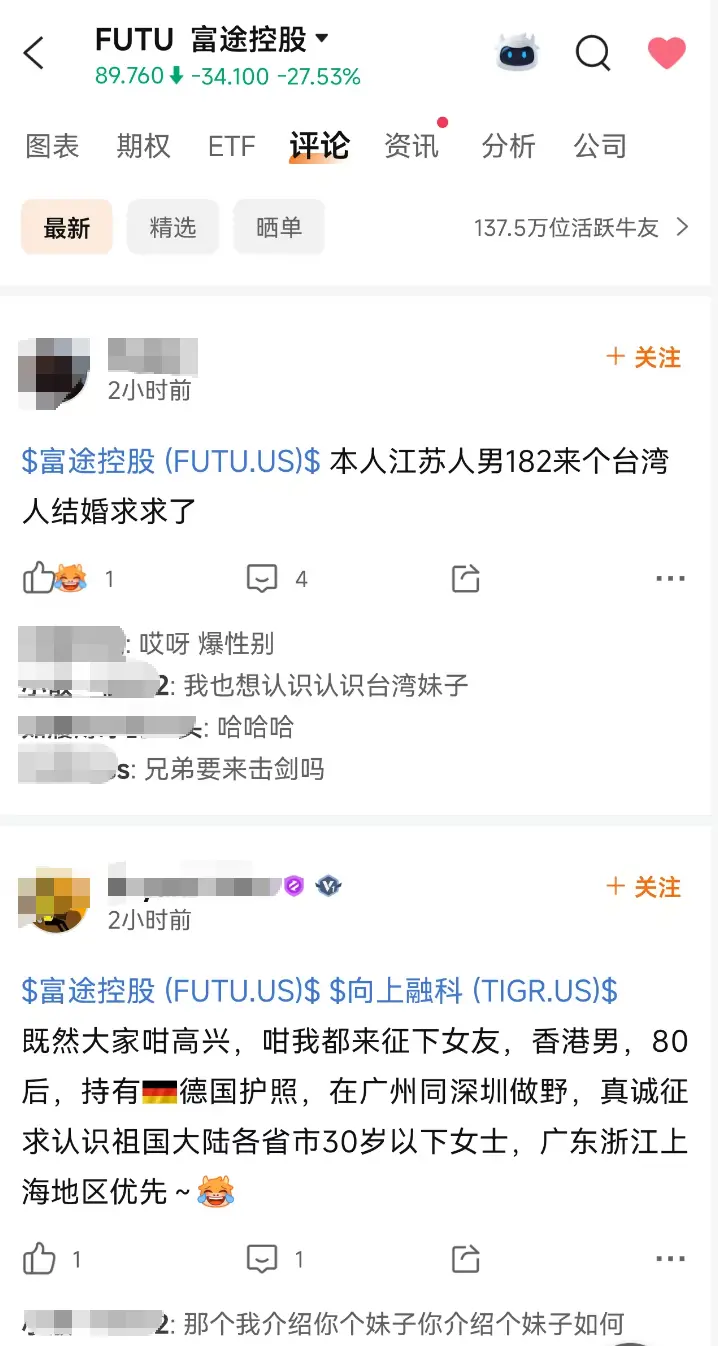
A woman from mainland China, claiming to be attractive and seeking a foreign partner; a post-90s mainlander with 2046% returns, open to partners "of any gender" to secure a different status; a Hong Kong man holding a German passport, selectively seeking partners "from Guangdong, Zhejiang, or Shanghai preferred"...
These aren't just jokes. What you're witnessing is an implicit matchmaking-securitization market taking shape in real-time within the Futu community. Demand, supply, pricing preferences, geographic filters—all forming spontaneously. This is the most honest natural language disclosure of the mindset of China's middle-class investors in 2026.
Regulatory Hammer
On May 22, eight Chinese government departments, including the CSRC, jointly issued the "Comprehensive Rectification Plan for Illegal Cross-Border Securities, Futures, and Fund Business Activities." On the same day, they announced proposed severe penalties for three offshore brokerages: Futu Holdings faces a proposed fine of approximately 18.5 billion RMB; Tiger Brokers about 4.112 billion RMB; Longbridge was also listed. Both Futu and Tiger Brokers saw their US-listed shares drop over 30% in pre-market trading.
The brokerages' responses were measured. Futu stated that as of the end of the first quarter of 2026, funded accounts from mainland China accounted for about 13% of its total funded accounts. Tiger Brokers said assets from mainland Chinese clients represented roughly 10% of the group's global total assets. Both emphasized that "business operations in all regions outside mainland China remain normal."
However, for mainland users holding US stocks in Futu or Tiger accounts, one piece of information was truly painful:
Sell only, no buying allowed.
This means, for the foreseeable future, if you want to open a new US stock account to buy Nvidia, Tesla, or an S&P 500 ETF, you must provide proof of non-mainland China residential status.
Looking back over the past three years, the account opening threshold for mainland users at offshore brokerages has been progressively raised:
- End of 2022: CSRC first named the brokerages.
- May 2023: Apps removed from mainland app stores.
- 2024 onwards: Only accepted mainland residents "actually working or living overseas," requiring overseas utility bills, credit card statements, tax documents, etc.
- September 2025: Threshold raised to require "proof of permanent overseas residency."
- End of 2025: Only accepted "non-mainland China ID documents."
- May 2026: Fines directly imposed on the brokerage entities.
The barrier to opening an account has escalated from a single utility bill all the way to a foreign passport or permanent residency card. The flip side of this curve is the repeated repricing of "identity" within the investment market.
Overseas Identity: The New Hard Currency for the Middle Class
For China's middle class in 2026, an overseas identity has become an implicit asset class. It's not as readily tradable as real estate, nor does it have a public market price like a stock, but it possesses all the fundamental attributes of "hard currency."
First, scarcity. Hong Kong's talent schemes approved approximately 140,000 people in 2024, the vast majority from the mainland. That sounds like a lot, but against a population base of 1.4 billion, the penetration rate is less than 0.01%.
Unlike a house, an overseas identity doesn't depreciate due to population outflow, policy changes, or rising interest rates. At any point in time, it corresponds to a specific set of clear rights with exceptionally high returns. It doesn't just unlock one stock; it unlocks an entire dimension of asset allocation: US stocks, overseas property, offshore insurance, foreign currency deposits, compliant channels for crypto assets.
Its most alluring feature is non-transferability. An identity, as an asset, cannot be arbitraged in a secondary market like a stock. It can only be held by the individual, or transferred through three ancient mechanisms: marriage, childbirth, or inheritance.
School-district housing once created a complete gray industry chain: agents, transfer companies, fake household registrations, sham marriages, sham divorces. The overseas identity industry chain is replicating all of this: Hong Kong Talent Scheme intermediaries, Portugal Golden Visa agents, Singapore EP fixers, Malta passport consultants, rapid citizenship programs from small Caribbean nations. Every product has a clear price list and processing timeline.
The form of the asset has shifted from a "property deed" to a "residency card," from a "school place" to "account opening eligibility."
Over the past two decades, the middle class used school-district housing to secure their social standing; in the next decade, they will use overseas identities to secure their assets.
Studying Abroad: Buying Insurance?
Stepping back, the logic behind China's middle class purchasing overseas resources has undergone three redefinitions over the past twenty years.
From 2000 to 2010, it was betting on overseas development prospects. Sending children abroad for education, relocating families overseas—this was an offensive judgment: the opportunities abroad were greater. It was an investment aimed at returns.
From 2010 to 2020, it was about diversification. After rapid domestic wealth accumulation, overseas real estate, insurance, and education were incorporated into a geographic diversification framework for family assets. This was a defensive move aimed at risk control.
From 2020 to the present, it's "buying insurance." An overseas identity is no longer just part of the asset allocation; it *is* the ticket. Even if it yields no returns, without holding it, you are disqualified from entering certain investment markets entirely. It's a premium paid to hedge against uncertainty, and its price rises as uncertainty increases.
The regulatory hammer blow on May 22 is just another jump point on this "insurance price curve."
When a generation realizes they have missed the window to secure an overseas identity for themselves, they will transfer their hopes to the next generation. The real price increases coming next might not be from talent scheme agents, but from international school tuition, overseas university foundation programs, and services for accompanying parents of younger students studying abroad. The "identity insurance" will be passed down through family generations.
I don't know which path the post-90s individual with a 2046% return ultimately chose.
Spending a year proving yourself to be the top 1% of the top 1% in the US stock and crypto markets—that evidence should have been the highlight of a resume.
But after May 22nd, it became an attachment to a matchmaking profile.
A chart that would make a fund manager envious, ultimately used in this way.
This is 2026.





