七周吸金13亿,SpaceX权重却腰斩:NASA ETF的稀释陷阱


- Core Thesis: The NASA ETF attracted massive capital through a "one-stop SpaceX holding" narrative, but in reality, SpaceX's weight in the portfolio has been rapidly diluted. Investors are actually buying other space stocks. The article highlights the risks of narrative premium, valuation inversion, and disappointed retail investor expectations.
- Key Elements:
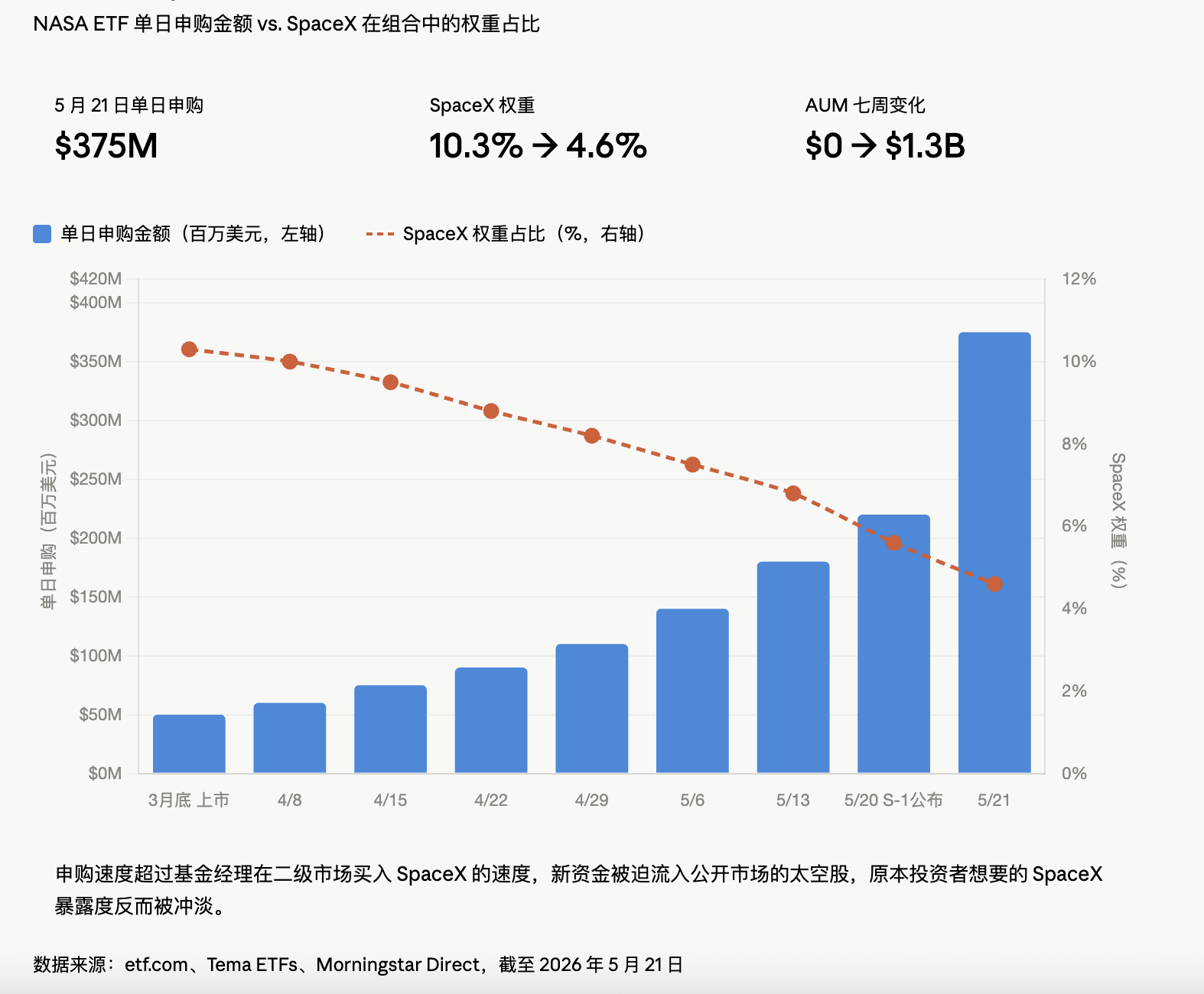
- Within seven weeks, the NASA ETF became the world's largest space-themed ETF, with AUM tripling in a week, but SpaceX's portfolio weight dropped from 10.3% to 4.6%, forcing new capital into liquid public stocks like Rocket Lab.
- The valuation mechanism for SPV holdings is opaque, updating only when Tema trades on its own behalf. Additionally, there is a 6-month lock-up period following a SpaceX IPO, potentially delaying the reflection of market price fluctuations.
- Other stocks in the sector have already surged significantly, such as Planet Labs (+979% YoY) and Rocket Lab (+357% YoY). This creates a valuation inversion between linear fundamental growth and exponential price increases, bridged by a narrative premium.
- SpaceX reported $18.67 billion in revenue for 2024 but swung to a $4.59 billion loss after incorporating xAI and X (Twitter), creating a "space + AI + social media" quadruple-play narrative.
- SpaceX is expected to IPO on June 12, raising $40-80 billion. If the stock debuts poorly, the SPV position cannot be liquidated in time to stop losses. Conversely, a massive rally would further dilute SpaceX's weight in the ETF, creating a negative feedback loop.
Original Author: ShenChao TechFlow
On May 20, SpaceX’s S-1 prospectus went live on the SEC website. The next day, a fund with the ticker “NASA” absorbed $375 million in a single day, tripling its AUM within a week. And just seven weeks prior, this fund was newly born.
Seven weeks later, it has become the world’s largest space-themed ETF, leaving the seven-year-old veteran UFO far behind. The amount it raised in seven weeks exceeds what UFO accumulated in seven years.
Everyone rushing into NASA wants to buy SpaceX. But the SpaceX they actually get in hand is shrinking.
Where Did the Money Go?
The hallmark of the NASA ETF is being "the only pure-play space ETF holding SpaceX in the entire market." As of May 21, NASA held the equivalent of 232,000 common shares of SpaceX indirectly through an SPV, with a book value of $147.4 million, implying a valuation of approximately $1.51 trillion.
The numbers look substantial. But there’s a detail ordinary investors would never notice. According to ETF.com, a week ago, NASA's allocation to SpaceX stood at 10.3%. A week later, it was diluted to 4.6%.
Because subscription money poured in so quickly, the fund manager simply couldn’t acquire enough SpaceX shares on the secondary market in time. A large influx of new capital was forced into buying publicly traded space stocks, diluting the very SpaceX exposure investors originally sought.
Retail investors stormed in wanting to buy SpaceX, only to end up with Rocket Lab, AST SpaceMobile, and a bunch of other names.
More nuanced is the valuation mechanism. The SPV holdings are only updated when Tema makes its own trades. In other words, no matter how SpaceX's secondary market quotes fluctuate, the book value of NASA’s holdings remains static.
This setup goes unnoticed in a bull market. But if the price drops after listing, the SPV portion will react in a nearly eerie "delayed" manner. Not to mention, this SPV has a 6-month lock-up period after SpaceX’s official IPO. If it tanks at the open, retail investors can flee, but the SPV cannot.
The ETF charges a 0.87% annual management fee, yet the apparent 65% gain largely comes from Rocket Lab and Intuitive Machines—stocks that had already surged. SpaceX? It contributed little.
In essence, NASA is now a thematic fund using SpaceX as bait, packed with a collection of small-cap space stocks. The bait's flavor is crucial, but the dish served is entirely different fish.
Valuation Dislocation
Many don’t realize that several major names in this sector have already rallied.
Rocket Lab is up 357% over the past 12 months; Planet Labs up 979%; LUNR up 212%. ARKX gained 62% in the past year, ROKT up 75%. SpaceX merely ignited a fire that was already smoldering.
Laying these numbers out, the question emerges. Planet Labs surged 979% in a year, yet its core business is selling satellite imagery data. Does its fundamentals justify a nearly 10x stock price?
Global orbital launches were 102 in 2019 and 342 in 2025, double the peak of the 1967 space race. Grand View Research projects the global space industry will grow from $466 billion in 2024 to $769 billion by 2030.
But the issue is: why should the industry's growth from $466B to $769B correspond to a 10x surge in secondary market stocks?
This is the classic script of valuation dislocation. Fundamentals grow linearly, stock prices grow exponentially, and the gap is filled by a "narrative premium." And that narrative premium has only one source: SpaceX's impending IPO.
What exactly are the true buyers getting?
Let’s return to SpaceX itself.
In 2024, revenue was $18.67 billion, up from $10.3 billion in 2023. But 2024 saw a loss of $4.59 billion, a sharp swing from a $791 million profit in 2023, turning profit into loss.
CNN reported a loss of nearly $5 billion last year, attributed to the AI division burning cash on building data centers.
SpaceX disclosed in its prospectus that xAI has been consolidated into SpaceX, and X (formerly Twitter) is also included. This so-called "space IPO" is essentially a massive bundling of all of Musk's assets. The prospectus also revealed that Musk controls 85% of the voting rights; unless he votes to fire himself, no one can remove him.
The $1.75 trillion valuation for SpaceX corresponds to a "Space + AI + Satellite Internet + Social Media" four-in-one narrative. The bigger the narrative, the more inflated the price.
But the secondary market doesn’t care. It cares that everyone is scrambling to board, so I must too.
After all the circling, the biggest winners are not SpaceX’s retail shareholders (they haven't boarded yet), nor the ETF investors rushing into NASA (their SpaceX exposure is getting diluted).
The biggest winners are the ETF issuers. NASA’s fee is 0.87%, the third highest among similar funds. With $1.3 billion in AUM, that means $11 million in annual management fee revenue.
Issuing an ETF is essentially the same as issuing a token: you need a story, a timing, and a seemingly reasonable benchmark. SpaceX provided all three.
Before the IPO
On June 12, SpaceX is expected to list on the Nasdaq under the ticker SPCX. The underwriting syndicate is led by the world's largest investment banks, with a fundraising scale of $40 billion to $80 billion, far exceeding the record set by Saudi Aramco in 2020.
This will be the largest IPO in human history.
If it drops on opening day, all the ETF investors who bought into the SpaceX story will find their SPV holdings still valued at "old prices" from months ago, unable to immediately stop losses or exit.
If it soars on opening day, those who missed out on the ETF will pile in, pushing the ETF premium higher, further diluting SpaceX's actual weight in the ETF, creating a comical reverse flywheel: the more people buy, the less SpaceX each person actually gets.
After SpaceX, a host of industry giants are queuing up for IPOs. Each new "narrative sector leader" listing will spawn a new batch of ETFs. Each new batch of ETFs will repeat the same dilution game.
The industry isn’t short of new stories; it’s short of people who ask, "Am I really getting what I think I’m buying?" After June 12, there will be answers. But by then, those who rushed into NASA today won’t care about the answer anymore. They’ll either be counting their money or seeking redress.