WLFI's Rescue Attempt Turns into a Sell-off Wave: Long-Term Holders Seize the Chance to Liquidate


- Core Thesis: World Liberty Financial is attempting to restore market confidence through token burns, exchange partnerships, and a stablecoin reward program. However, the resulting price rebound has primarily served as an exit opportunity for long-term holders to take profits, while the ecosystem crisis has spread to a related public company, leading to a liquidity crunch and going-concern risks.
- Key Elements:
- The WLFI token price has plummeted nearly 88% from its all-time high. The project has permanently burned 3 billion tokens (with a market value of approximately $180.8 million) and launched a reward program tied to the stablecoin USD1, offering annualized yields of up to 20%.
- On May 18, the market saw a net sell-off of 1.8 billion WLFI tokens. Both realized profits and the "Token Dormancy Consumption" indicator hit new all-time highs (reaching 17.4 trillion), suggesting that the newly injected liquidity was primarily used by existing holders to cash out their gains.
- Affiliated company AI Financial has incurred $348.3 million in unrealized losses due to its WLFI holdings. $706 million of its assets are locked up under vesting terms and cannot be moved, leading to a working capital shortfall of $5.5 million. Management has flagged significant doubts about the company's ability to continue as a going concern.
- The project is entangled in governance litigation: Crypto entrepreneur Justin Sun has accused it of having an undisclosed blacklist function, while World Liberty Financial has countersued him for market manipulation. Meanwhile, Senator Elizabeth Warren has pushed the SEC to investigate potential conflicts of interest between the project and the Trump family.
Original Author: Oluwapelumi Adejumo
Original Translation: Luffy, Foresight News
World Liberty Financial, the crypto project backed by the Trump family, is attempting to rebuild market demand and confidence in its governance token, WLFI, after it fell to an all-time low.
Facing months of pressure from governance disputes, unlock concerns, and liquidity doubts, World Liberty Financial has taken multiple measures to respond: burning WLFI tokens, integrating with exchanges, and launching a reward program tied to its stablecoin USD1, all aimed at revitalizing the WLFI ecosystem.
While these measures have boosted market sentiment, they have also created a new liquidity window for long-term "dormant" holders to take profits. This precisely reflects the core dilemma facing the token: price recovery remains highly dependent on incentive policies, exchange channels, and market confidence in the project's governance.
After Hitting All-Time Low, World Liberty Financial Initiates WLFI Burn and USD1 Reward Program
This ecosystem self-rescue stems from a severe market crash. The price of this Trump-linked crypto project has plummeted nearly 88% from its all-time high.
To restore market confidence, World Liberty Financial has accelerated the burning of WLFI tokens. On-chain data from blockchain analytics platform Arkham Intelligence shows the project has permanently burned 3 billion WLFI, erasing approximately $180.8 million in market value from circulation.

WLFI burn record
The community had previously passed a governance proposal to permanently burn 10% of the total tokens held by founders, teams, advisors, and partners, amounting to approximately 4.5 billion tokens.
Beyond the burn, the project is positioning the stablecoin USD1 as a core value carrier for the ecosystem. Instead of relying solely on native token demand, World Liberty Financial is leveraging mainstream crypto exchange infrastructure to drive USD1 commercial adoption:
Binance has listed the USD1/BTC trading pair, allowing market participants to use USD1 as collateral for Bitcoin futures contracts for the first time.
Bybit has simultaneously integrated USD1, listing it as eligible collateral for margin trading, crypto lending, institutional credit lines, and buy-now-pay-later services.
To accelerate adoption, Bybit and World Liberty Financial have jointly launched a USD1 rewards campaign, allocating a pool of 45 million WLFI tokens. Users staking or holding USD1 can earn up to 20% annualized yield, directly linking WLFI demand with the widespread use of the stablecoin.
WLFI Rally Creates Exit Opportunity for Holders
World Liberty Financial's structural token burn and exchange high-yield activities triggered a rebound in WLFI trading, but the sudden market liquidity also had unintended consequences.
Data from blockchain analytics platform Santiment shows that on May 18, World Liberty Financial recorded its highest-ever realized profit and "token dormancy consumption" metrics, far exceeding previous records.
On that day, net market sell orders reached 1.8 billion WLFI, all for profit-taking.
The "token dormancy consumption" indicator (number of moved tokens × holding period) surged to 17.4 trillion.
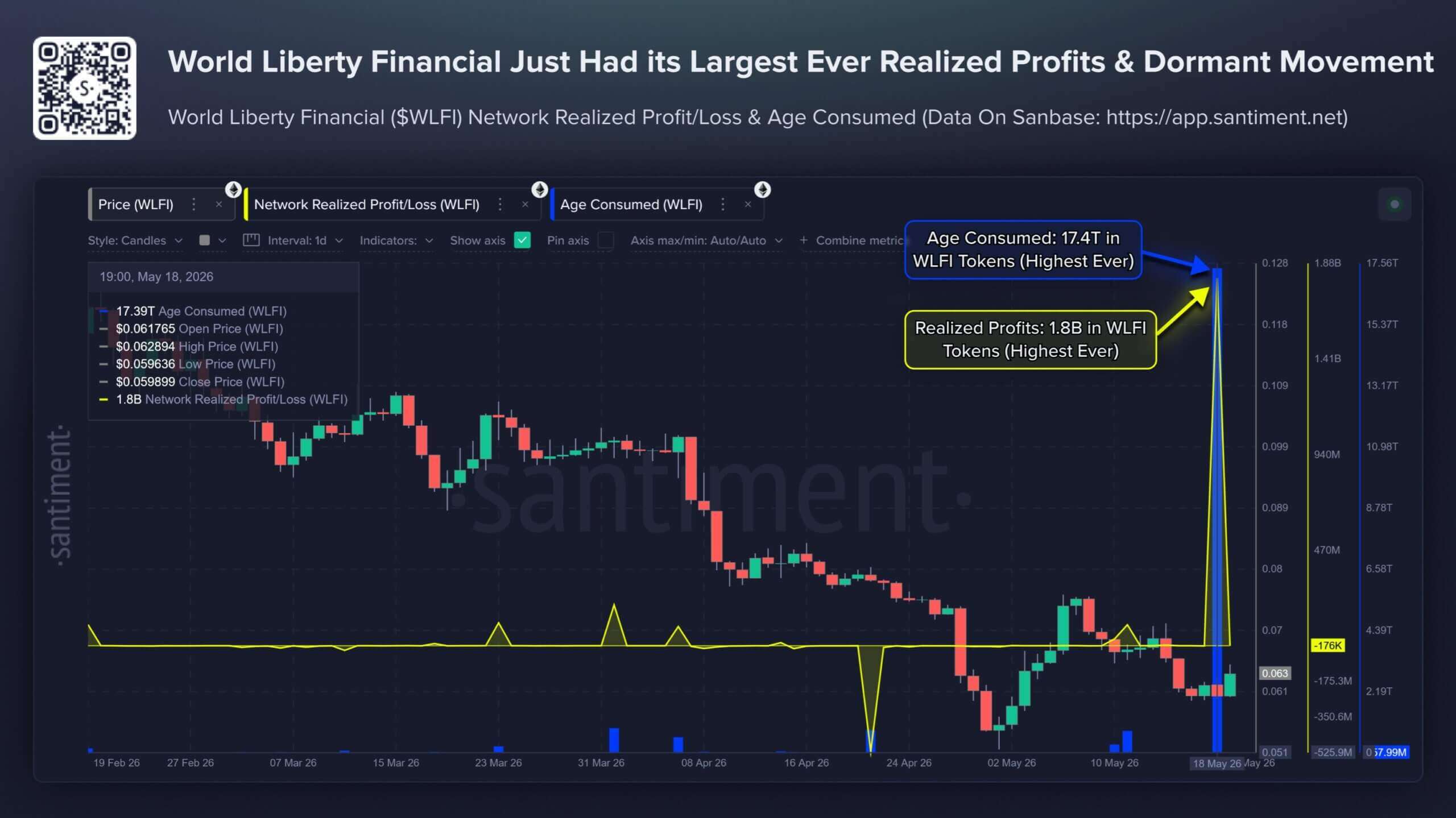
Significant WLFI profit-taking
Santiment noted that this trading peak followed closely after Binance enabled USD1 futures collateral functionality. The data suggests that while the new exchange channel successfully activated the sluggish market, it essentially became a tool for long-term dormant holders to clear their positions and exit.
Fortunately, the market absorbed most of the selling pressure. Despite the surge in both metrics, WLFI still rose by 5.5%, indicating that new demand generated by the exchange cushioned the impact of profit-taking. However, the concentrated transfer of a large number of dormant tokens also implies that for a sustained rebound to occur, the market still needs to absorb the accumulated massive sell orders from early participants.
AI Financial Warning: Risk Spills into Public Markets
The financial pressure within the World Liberty Financial ecosystem has transcended the on-chain token market, impacting the balance sheets of publicly listed companies.
Regulatory filings by fintech company AI Financial (formerly ALT5 Sigma) for Q1 2026 reveal that digital asset volatility has severely impacted the company's financial structure.
AI Financial's corporate treasury is fully centered around the World Liberty Financial ecosystem: In August 2025, it completed a $1.5 billion financing round (via PIPE and private placement, settled in tokens), purchasing 7.28 billion WLFI at a cost of $0.20 per token.
According to AI Financial's latest financial report as of March 28, 2026:
- The sharp decline in WLFI's market price led to an unrealized loss of $348.3 million, reducing the asset's book value to $706.4 million, less than half the purchase cost.
- The impairment dragged down overall performance: a net loss from continuing operations of $271.3 million for the quarter, compared to a loss of just $2.4 million in the same period last year.
More critically, contractual lock-up periods rendered $706 million in assets completely unavailable for daily operations.
Under the token purchase agreement, 3.53 billion tokens are non-transferable for 12 months.
The remaining 3.75 billion tokens are subject to the Securities Purchase Agreement and can only be sold after obtaining shareholder approval, amending the company's charter, and filing an effective resale registration statement with regulators.
Consequently, AI Financial ended the quarter with $10.5 million in cash, $32.2 million in total assets, and $39.1 million in total liabilities, resulting in a working capital deficit of $5.5 million.
The cash crisis forced management to issue a clear warning, expressing substantial doubt about the company's ability to continue as a going concern within the next year.
To sustain operations, AI Financial incurred additional related-party debt. In January 2026, it borrowed nearly $15 million directly from World Liberty Financial. Management disclosed this cash might be used for stock buybacks and increasing WLFI holdings, effectively using project debt to simultaneously support its own public equity and the ecosystem's underlying assets.
Governance Litigation Ensnares Ecosystem Amidst Ongoing Controversy
The ecosystem crisis for World Liberty Financial extends beyond price volatility, cash shortages, and accounting adjustments; governance-related lawsuits are subjecting the project to increased scrutiny.
The project is embroiled in a defamation lawsuit against crypto entrepreneur Justin Sun. Sun had publicly accused World Liberty Financial developers of hiding an undisclosed blacklist function within the smart contract.
His legal filings alleged this backdoor allowed the core team to unilaterally freeze user wallets and restrict individuals from participating in protocol governance. World Liberty Financial has denied the allegations and countersued, claiming Sun deliberately shorted the token and manipulated governance tokens to Binance during the project's public launch in September 2025 to interfere with project decisions.
Beyond the legal disputes, on-chain records show that World Liberty Financial used 5 billion WLFI as collateral to borrow over $75 million in USDC. This action has drawn significant attention from the crypto industry and U.S. lawmakers, with Senator Elizabeth Warren leading an investigation into World Liberty Financial and its ties to the Trump family.
She wrote to the SEC requesting an investigation, stating: "World Liberty Financial's actions appear to benefit the Trump family at the expense of investors, who face difficulties in normally redeeming their tokens. 80% of early investors' holdings are locked, preventing them from selling after the price crash."