Polymarket and Kalshi Dominate 97.5% of Trading Volume, Is There a Dark Horse in Prediction Markets?


Original Title: The State of Prediction Markets: 2026
Original Author: Jack Haldorsson
Original Translation: Peggy
Editor's Note: Prediction markets are evolving from niche crypto applications towards more mainstream financial and information markets.
The 2024 US presidential election brought Polymarket and Kalshi into the public eye, but what truly changed the industry narrative was that trading volume didn't vanish after the election. Sports, technology, and economic markets absorbed the traffic, proving that the long-term demand for prediction markets isn't solely driven by political events.
This article outlines the core landscape of prediction markets in 2026: a duopoly formed by Polymarket and Kalshi, with the former leveraging on-chain trading, USDC settlement, and media distribution to expand its influence, while the latter relies on CFTC compliance and channels like Robinhood to enter mainstream financial scenarios. Meanwhile, a new wave of platforms is seeking opportunities in short-cycle trading, sports predictions, media embedding, on-chain native metrics, and the infrastructure layer.
More importantly, competition in prediction markets is no longer just about trading volume; it's a comprehensive contest of liquidity, distribution capabilities, and regulatory pathways. Concurrently, issues like wash trading, disputes over volume statistics, anticipation of token airdrops, and state-level regulatory pressures indicate this sector remains in a highly uncertain phase.
Prediction markets are no longer just a DeFi experiment. They are emerging as a new asset class where financial trading, media content, and algorithmic strategies intersect. The platforms that may truly break out in the future are likely not generalized replicas, but those with clear vertical use cases and distribution advantages.
Below is the original text:
Two platforms barely heard of in 2022 settled a notional trading volume last year exceeding the GDP of New Zealand.
In 2025, Kalshi and Polymarket combined for $44 billion in trading volume. In May 2026, Kalshi raised $1 billion at a $22 billion valuation. ICE, the parent company of the New York Stock Exchange, committed to investing $2 billion in Polymarket at a $9 billion valuation. AI agents now execute over 30% of on-chain transactions. Meanwhile, a group of new teams are building vertical-specific platforms on Base, Solana, Hyperliquid, and Arweave—all betting on the thesis that the two giants cannot dominate every category.
This is perhaps the most comprehensive overview of the prediction market builder ecosystem to date.
The Numbers Rewriting the Narrative
2024 was the moment of validation for prediction markets. The US presidential election alone generated $3.3 billion in volume for Polymarket. During the campaign, nearly every major financial newsroom began reporting on prediction market odds. Bloomberg, Politico, and FiveThirtyEight all cited this data in their analyses.
But what happened after November 5th surprised many: volume didn't fall back to previous baseline levels. Sports markets absorbed this traffic.
By the end of 2025, sports markets accounted for 85% of Kalshi's volume and 39% of Polymarket's volume. Technology and science markets grew 1,637% year-over-year, while economic markets grew 905%. Political markets—the vertical widely considered the core driver of prediction markets—grew by only 43%.
Prediction markets found their long-term engine, and it wasn't elections.
The Duopoly Landscape
Polymarket runs on Polygon, settles in USDC, and intentionally charges no fees on most markets, prioritizing volume dominance. In October 2025, ICE made a $2 billion strategic investment at an approximate post-money valuation of $9 billion. In June 2025, X announced Polymarket as its official prediction market partner. In February 2026, Substack natively integrated Polymarket's real-time odds data; within weeks, one-fifth of the top 250 revenue-generating publications on Substack were using this data. The platform's CMO also confirmed that the POLY token and airdrop are forthcoming. Upon full feature launch, its estimated annualized fee revenue is expected to exceed $200 million.
Kalshi, on the other hand, secured Designated Contract Market status from the CFTC, becoming the first event contract platform to do so, and turned this into a distribution moat. This compliance status was precisely what enabled Kalshi to get listed on Robinhood. In 2025 alone, Robinhood facilitated over 4 billion event contract trades. In January 2025, Kalshi launched its Super Bowl market. Within less than 12 months, sports markets surged from roughly 10% to over 85% of its volume. In May 2026, Kalshi completed a $1 billion funding round at a $22 billion valuation, led by Coatue, with participation from Sequoia, a16z, Paradigm, Morgan Stanley, and ARK. At the time of the raise, Kalshi had approximately 2 million monthly active users, an annualized trading volume of around $178 billion, and annualized revenue of about $1.5 billion.
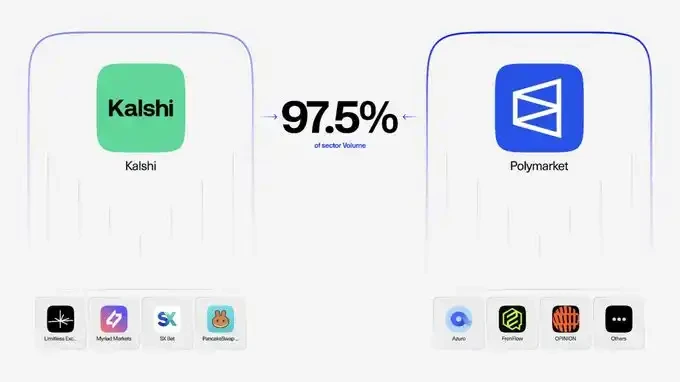
In 2025, these two companies collectively controlled approximately 97.5% of the entire prediction market industry's volume.
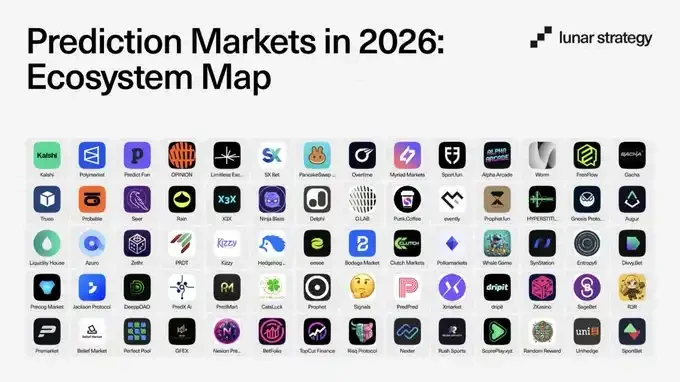
Ecosystem Map
The Challengers
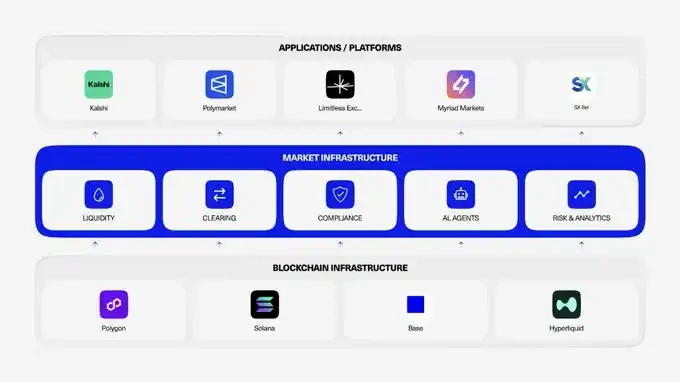
Beyond the duopoly, over a dozen teams are building new prediction market platforms. Each targets a specific gap.
@trylimitless is deployed on Base, focusing on short-cycle markets like 15-minute, hourly, and daily markets, catering to crypto and stock traders seeking quick settlement. The project raised $10 million from investors including 1confirmation, Coinbase Ventures, F-Prime, DCG, and Arrington. In Q1 2026, its monthly volume reached $1.1 billion. After the $LMTS token launch, its fully diluted valuation hit $800 million.
@MyriadMarkets runs on the Abstract chain, with integrations for Linea, Celo, and BNB. It's betting on "media-native" prediction markets. Its first distribution deal occurred in December 2025, embedding prediction functionality into Trust Wallet. It now has over 430,000 users who have made more than 1.7 million predictions. The project was founded by the team behind Decrypt and Rug Radio.
KASH, via @kash_bot, is embedded in X, allowing users to create and trade prediction markets within reply posts. In February 2026, KASH raised $2 million from Big Brain Holdings, Spartan, Coinbase Ventures, Animoca, and the Sui Foundation. Its core thesis: whoever provides the shortest path to the user's existing context wins.
@DriftProtocol builds on top of Drift Protocol's $500 million Solana liquidity pool. It supports over 30 collateral assets, allows cross-margined positions, and offers FUEL rewards.
@HedgehogMarket targets on-chain native metrics like Base fees, funding rates, and validator performance, while also offering general binary options on Solana and Eclipse. The platform supports permissionless market creation and previously peaked at a TVL of roughly $20 million.
@HyperliquidX's HIP-4 went live on May 2, 2026, co-designed with John Wang, former head of Kalshi's crypto business. The mechanism is fully collateralized in USDH, uses a CLOB order book model, and charges no taker fees. The first market, officially deployed by Hyperliquid, centered on a BTC outcome and generated $6 million in volume on its first day. Currently, @Outcomexyz is the primary frontend for HIP-4, contributing over 10 times the volume of any other interface.
@azuroprotocol functions more as infrastructure than a user-facing frontend. It provides a sports prediction market layer for other teams, utilizing a Liquidity Tree pool design. The project has raised $11 million from Delphi Digital, Gnosis, and Arrington Capital.
@Overtime_io operates on Optimism, Arbitrum, and Base. All protocol revenue goes towards buying back the $OVER token.
@RobinhoodApp, powered by Kalshi's backend, facilitated over 2 billion event contract trades in Q3 2025 alone.
The infrastructure layer is also heating up. In August 2025, @theclearingco completed a $15 million seed round from Union Square Ventures, Haun Ventures, Coinbase Ventures, and Variant. The company was founded by former executives of Polymarket and Kalshi. Capital flowing into the clearinghouse layer typically signals an asset class maturing.
Key Drivers for 2026
Regulated platforms are seeking on-chain rails. Kalshi is tokenizing markets and deploying them on Solana, Polymarket is pursuing US CFTC compliance through its acquisition of QCEX, and Hyperliquid's HIP-4 was co-designed by Kalshi. These moves point in the same direction: a global liquidity layer at the base, with different regional regulatory shells layered on top.
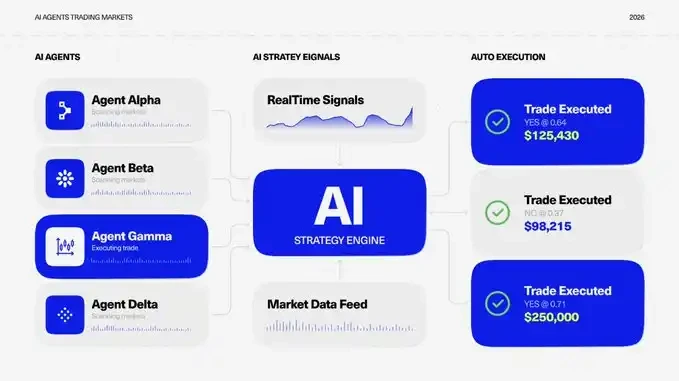
AI Agents have become an undeniable part of prediction market activity. According to analytics platform LayerHub, over 30% of wallets on Polymarket are running AI agents. Olas's Polystrat Agent executed over 4,200 trades in its first month, achieving a maximum single-position yield of 376%. Elastics also raised $2 million to build a natural language trading interface.
Whether platform teams initially designed it this way or not, prediction markets are transforming into venues for algorithmic trading.
Media platforms are treating prediction odds as high-engagement content. X's official partnership, Substack's native integration, and Google Finance displaying real-time odds all serve the same function: transforming financial questions into media events that can be collectively discussed, thereby driving organic user acquisition.
Sports remain the most sustainable vertical. The 2024 US election brought in the first wave of users; sports kept them there. Any new platform raising funds in 2026 without a sports strategy is either building deep infrastructure or making a highly concentrated bet on a specific niche.
Real Challenges
Three risks are worth pointing out directly.
First, the volume metrics themselves are controversial. A December 2025 analysis by Paradigm pointed out that Polymarket's NegRisk architecture causes most third-party data trackers to double-count. CertiK estimated that wash trading accounted for a peak of nearly 60% of some Polymarket volumes in 2024. Therefore, the $44 billion figure is best used as a directional reference, not a rigorously audited data point.
Second, state-level legal friction is real. As of January 2026, there were over 19 related federal lawsuits. In March 2026, Ohio ruled that Kalshi's sports products constituted gambling. The attorneys general of Wisconsin and Arizona have also taken action against the two major platforms respectively. A federal tailwind from the CFTC coexists with strong headwinds at the state level, and this tension won't disappear quickly.
Third, token speculation is inflating platform activity. Throughout 2025 and into early 2026, a significant portion of trading volume was related to market expectations for the POLY airdrop. Any platform publishing impressive volume figures without disclosing this context is being misleading.
Conclusion
In 2024, prediction markets made the leap from an "interesting DeFi experiment" to a financial asset class. By 2025, they began building institutional-grade pipelines: strategic investments from exchange parent companies, CFTC-related settlements, Robinhood integration, and seed rounds for the clearinghouse layer.
By 2026, the real question this sector must answer is: besides Kalshi and Polymarket, who else has a chance to win?
The current answer is: teams that deeply cultivate verticals, have clear distribution advantages, and can find a path to regulatory protection or on-chain liquidity density.
The opportunity for generalized replicas is over. Beyond that, other paths remain open.
If you are building in this space and looking for the right growth architecture for your vertical, feel free to reach out.