






Space Review | When GasFree Eliminates the "Gas Barrier," Will the Next Phase of Web3 Be Mass Adoption or Complete Web2-ization?


- Core Thesis: The TRON ecosystem wallet's GasFree feature lowers the barrier to entry for Web3 by allowing transaction fees to be deducted directly from transferred tokens. However, this "seamless" experience has sparked an industry debate over the preservation of decentralized values versus the convenience of user onboarding.
- Key Elements:
- GasFree’s core innovation lies in allowing users to pay transaction fees directly with tokens like USDT, eliminating the need to hold native assets such as TRX in advance, thereby solving a long-standing barrier for new users.
- Proponents argue that lowering the technical barrier (e.g., abstracting away Gas and private key logic) is essential for Web3's path to mass adoption, and successful technology should feel as "seamless" as a Web2 application to users.
- Opponents warn that an excessive focus on convenience may lead users to lose their understanding of private keys and the underlying chain, falling into a "trust illusion" that erodes Web3’s core values of decentralization and self-custody of assets.
- GasFree's design seeks a balance between user experience and decentralization. Its product logic includes optimizations at the smart contract level without altering the user's private key control or asset custody model.
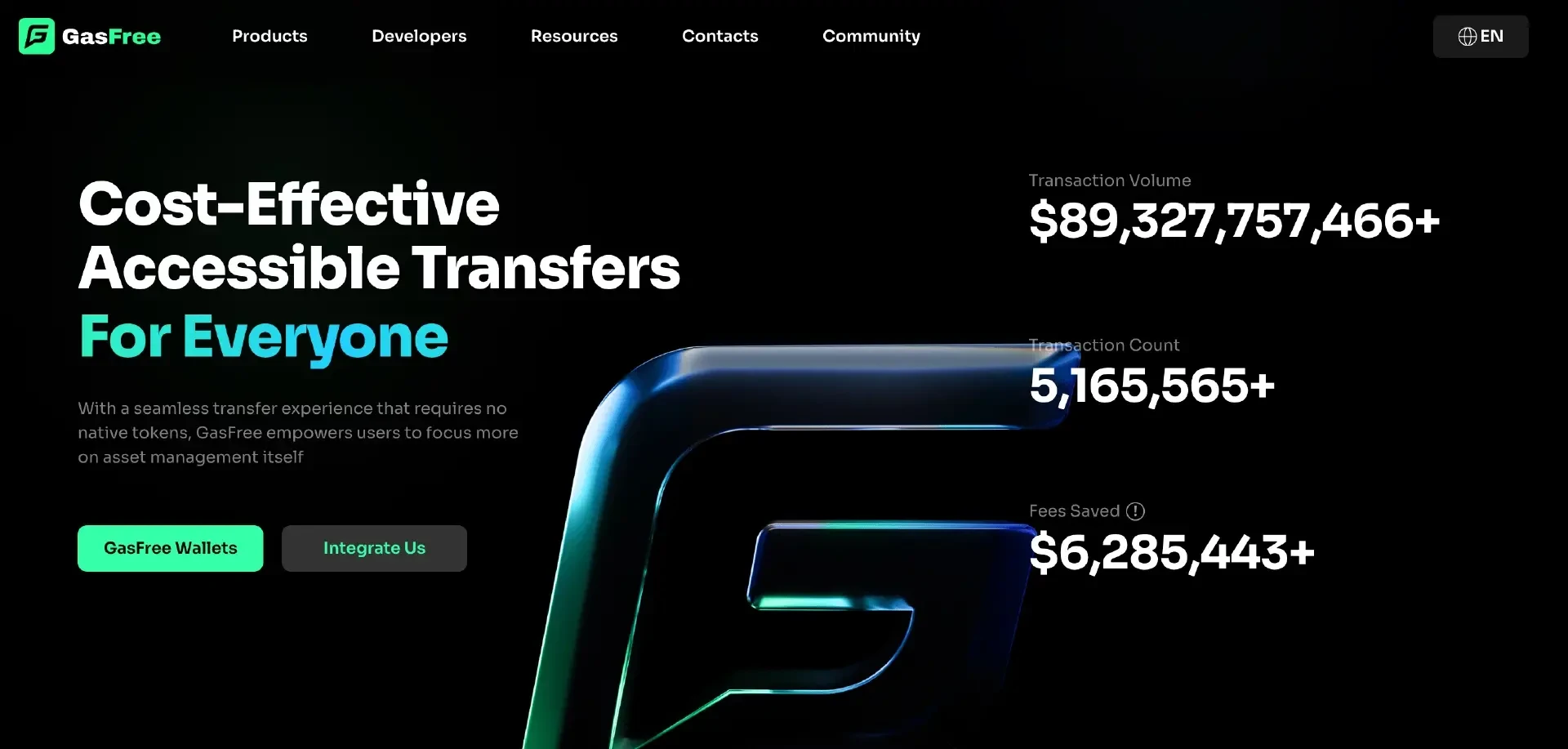
- As of 2025, cumulative transactions through GasFree have exceeded 5.16 million, with a total transaction volume of $89.3 billion, saving users over $6.28 million in fees, thereby validating the market demand.
As a smart wallet built by the core protocol of the TRON ecosystem, JustLend DAO, the emergence of GasFree undoubtedly brings a substantial breakthrough to the Web3 interaction experience. It directly targets the long-standing industry pain point of "having to pre-purchase native tokens for on-chain transfers" and innovatively implements the function of directly deducting Gas fees from the transferred tokens. Now, when ordinary users use GasFree for USDT transfers, they no longer need to hold extra TRX; instead, they can automatically settle on-chain fees directly with USDT.
Since its launch, GasFree, with its minimalist and "seamless" experience, has quickly broken down the barriers for newcomers entering the crypto space. It has thoroughly ignited community participation in the recent "JUST 6th Anniversary × GasFree Super Carnival Month" event. However, it is this extreme convenience that perfectly hides complex underlying logic that has also sparked profound reflection within the industry.
A special X Space discussion revolved around this phenomenon: By lowering the barrier for "first-time Web3 use," will the next phase of Web3 usher in mass adoption, or will it completely Web2-ize in the pursuit of convenience? Some believe that truly great technology should inherently leave complexity to the underlying layer, allowing ordinary users a "seamless" experience. However, others worry that when users no longer perceive the chain, Gas, or asset control rights, Web3 will lose its unique value of decentralization. During this Space dialogue, several seasoned industry KOLs gathered for an in-depth debate and exploration centered around "pursuing a seamless user experience" versus "upholding on-chain maximalism."
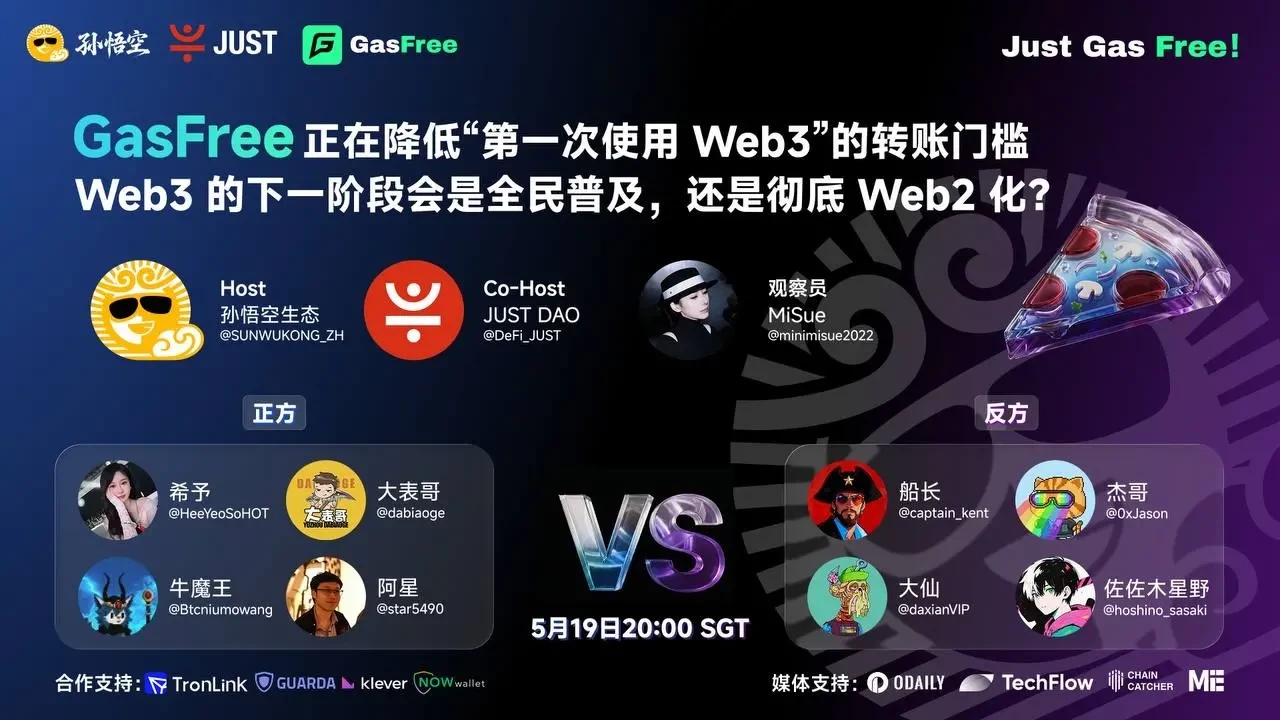
Core Clash: Is the "Seamless Experience" of Web3 the Essential Path to Mass Adoption, or a Breeding Ground for Web2-ization?
The affirmative speaker, Xiyu, pointed out that truly successful technology should naturally feel "seamless" to users. The fundamental reason Web3 has yet to see genuine large-scale adoption is the excessively high user barrier. Just as in the Web2 era, the general public doesn't need to understand TCP/IP protocols or routing node matching logic to use WeChat or browse the web. In the Web3 era, if every new user is forced to first learn how to buy native tokens, understand cross-chain logic, and authorize private keys, this precisely indicates that the industry's development is not yet mature enough. Treating complex technical barriers as a form of "elitist arrogance" not only hinders the inflow of new blood but also contradicts the original intention of decentralization to benefit the masses.
Furthermore, the affirmative side emphasized that a "seamless" user experience by no means equates to underlying centralization or a loss of decentralization spirit. The second affirmative speaker, Niumowang, argued that mandating users to use native tokens for transfers is, in essence, a form of "coercion" by the rules. GasFree's innovation allows transfers to return to the asset itself, for example, enabling users to directly use USDT to cover fees, bypassing the cumbersome step of being "coerced" by native tokens like TRX or ETH. This does not eliminate Gas fees, nor does it alter the core essence of blockchain assets being on-chain, transparent, and immutable. On the contrary, only by dramatically lowering the usage threshold, transforming Web3 from a niche hobby for geeks into a readily accessible infrastructure for the general public, can Web3 truly discuss future ecological prosperity and value realization.
However, behind the beautiful vision of "mass adoption" painted by the affirmative, the opposing side sees latent risks that cannot be ignored. They retorted that Web3's greatest value has never been about "more convenience," but rather absolute asset sovereignty and decentralization. If thresholds are lowered without limit to cater to the masses, making users completely oblivious to private keys, Gas, and the existence of the chain, then Web3 will inevitably degenerate back into the custodial logic of Web2.
The second opposition speaker, Jiege, clearly stated that without understanding, there can be no respect. When users are no longer aware of the underlying operational logic, they easily fall into an "illusion of trust" towards the platform or wallet service provider. Once the platform acts maliciously or suffers a hacker attack, users will again face the centralized risk of asset loss with nowhere to seek recourse.
Additionally, based on experiences from past bull runs, Sasakiboshi noted that appropriate thresholds and friction are not only part of blockchain security mechanisms but also a driving force for industry innovation. Looking back at history, what truly attracts large-scale users are often breakthroughs in underlying technology and the resulting wealth effects (such as DeFi, NFTs, Inscriptions, etc.), rather than mere experience optimization. If we hide Gas for ease of use today, we might sacrifice decentralization and immutability for efficiency tomorrow. When the entire Web3 experience becomes indistinguishable from Web2 products like Alipay or WeChat, blockchain loses its irreplaceable unique value. The opposition firmly believes that the industry's core soul should not be sacrificed for short-term user growth.
Bridging the Divide: How Does GasFree Find Balance Between Experience and Sovereignty?
While the debate was intense, the real-world construction of the industry often requires finding a delicate balance between idealism and pragmatism. If we step away from the binary opposition of black and white and examine real business scenarios, we find that lowering barriers and upholding decentralization are not necessarily a zero-sum game. The GasFree smart wallet, built by the TRON ecosystem protocol JustLend DAO, is precisely attempting to provide the optimal solution at this stage, seeking balance between an "extreme seamless experience" and "transparent on-chain sovereignty."
In the traditional logic of on-chain transfers, users wanting to transfer USDT must first buy TRX on an exchange and then withdraw it to their wallet to pay "Gas fees." This process is not only lengthy but also carries risks of asset loss due to price fluctuations or operational errors. As the affirmative debaters mentioned, this rule of being "coerced" by native tokens represents the highest barrier preventing outsiders from entering the space.
GasFree's core product logic does not deprive users of their private key control rights, nor does it move assets to centralized custodial servers. Instead, it performs a thorough "subtraction" at the smart contract interaction layer. In terms of specific functions, it innovatively implements a mechanism where the transferred token directly covers the fee. When users initiate a transfer (e.g., TRC20-USDT), they no longer need to hold additional native tokens like TRX to pay for Gas, simplifying the operation to a smooth experience of "sending what you have." More importantly, effectively addressing the opposition's concerns, GasFree's "seamlessness" is limited to the operational experience, not asset custody. The flow of funds is completely transparent and on-chain, ensuring users maintain absolute control over their private keys and assets.
This underlying logic, which balances sovereignty and convenience, is now deeply integrating into users' daily interaction interfaces. Wallets currently supporting the GasFree feature include TRON's official wallet, TronLink, as well as Klever, Guarda, NOW Wallet, and other crypto wallets. In specific use cases, USDT holders and users within the TRON ecosystem can all perform transfers via these wallets using GasFree, significantly lowering the barrier to entry for new users.
The market always has the keenest nose for products that truly solve pain points. Since the official launch of the GasFree smart wallet in March 2025, this "seamless" experience targeting core pain points quickly ignited the market, leading to a significant rise in new user retention and activity rates. To date, GasFree has facilitated over 5.16 million cumulative transactions, with a total transaction volume of $89.3 billion, and has saved users more than $6.28 million in fees. This impressive set of data proves that when unnecessary technical barriers are removed, the real payment demand within Web3 is being substantially unleashed.
Regardless of whether the ultimate future of Web3 is complete "mass adoption" or maintaining its "geek barrier" within the financial track, one thing is certain for now: Infrastructures like GasFree, which are dedicated to enhancing the "user experience" while "safeguarding sovereignty," are genuinely expanding the boundaries of the industry. GasFree demonstrates with practical action: It is possible to achieve an excellent experience while firmly upholding asset sovereignty. Instead of worrying about Web3 being assimilated by Web2, it is more accurate to say that it is precisely because of infrastructures like GasFree, which silently perform subtraction at the underlying layer, that Web3 truly gains the confidence to accommodate large-scale users.


