The giant falls: Crypto ATMs say goodbye to the era of expansion


- Core Thesis: Bitcoin ATM giant Bitcoin Depot has filed for bankruptcy due to stricter regulations, rampant fraud, and a collapsed profit model, highlighting the inherent flaws of high fees and high compliance costs in the industry. It is being relegated to a niche channel serving only small-scale cash transactions.
- Key Elements:
- Bitcoin Depot filed for Chapter 11 bankruptcy. In Q1 2026, its revenue plummeted 49.2% year-over-year, posting a net loss of $9.5 million, compared to a profit of $12.2 million in the same period last year.
- The U.S. Federal Bureau of Investigation received 13,000 complaints related to crypto ATMs in 2025, with total losses reaching $389 million, a 58% increase year-over-year. Losses suffered by the elderly accounted for $257.5 million.
- Multiple U.S. states have enacted bans or heavy penalties, such as a complete ban in Indiana and classifying the operation of such machines as a Class A misdemeanor in Tennessee, fueling regulatory crackdowns.
- In 2025, the global number of Bitcoin ATMs increased to 39,000, but growth in the U.S. has nearly stalled at just 1.65%. In contrast, Australia saw a 43% growth rate due to more lenient regulatory attitudes.
- FinCEN regulations have led to ATM fees as high as 7%-20%, far exceeding online exchanges. Furthermore, compliance costs like KYC have completely eroded any profit advantages.
Original Author: Gino Matos
Original Translation: Saoirse, Foresight News
On May 18, 2026, Bitcoin Depot, a leading Bitcoin ATM operator, filed for Chapter 11 bankruptcy protection in the U.S. District Court for the Southern District of Texas, announcing a full shutdown of operations and the liquidation of its assets. Its over 9,000 machines deployed globally as of August 2025 ceased operations on the same day.
Financial data disclosed by the U.S. Securities and Exchange Commission on May 12 shows the company's Q1 2026 revenue plummeted 49.2% year-over-year, while gross profit crashed 85.5% YoY. Management stated there is significant uncertainty regarding the company's ability to continue as a going concern. The company reported a net profit of $12.2 million in the same period last year, but directly swung to a loss of $9.5 million in Q1 this year.
Bitcoin Depot attributed the operational deterioration to restrictive policies enacted by various states and local governments, lowered transaction limits on its platforms, tightened KYC standards for users, a barrage of legal lawsuits, and accumulated legal judgments exceeding $20 million that the company must pay out.
This cascade of operational chaos ultimately drove the company into bankruptcy, vividly illustrating how increasingly stringent compliance regulations have completely dismantled the original profit logic of Bitcoin ATMs.


The Original Positioning of Bitcoin ATMs
Bitcoin ATMs allow users to exchange cash for cryptocurrencies without needing a linked bank account. This serves people who prefer cash transactions, those lacking access to formal banking services, and users who want to complete crypto transactions offline rather than through online exchanges.
However, this business model had structural flaws from its inception. The U.S. Financial Crimes Enforcement Network stipulates transaction fees for cryptocurrency ATMs range between 7% and 20%, far exceeding the fee structures of mainstream online crypto exchanges.
Such high fees can only support niche demands like emergency transactions or one-time small cash conversions, making large-scale adoption fundamentally impossible. These offline machines were inherently a high-cost entry point into crypto, and relying on them for low-cost, high-frequency user transactions to generate profit was never feasible from the start.
Data from the U.S. Federal Trade Commission shows that in the first half of 2024, total losses from reported Bitcoin ATM-related scams nationwide exceeded $65 million, with an average loss of around $10,000 per scam case. According to FBI statistics for 2025, they received 13,460 complaints related to offline crypto machines, with total losses reaching $389 million, a 58% increase year-over-year.
Of this total, fraud losses for individuals aged 60 and over amounted to approximately $257.5 million. The large number of elderly victims has provided strong public and policy support for regulatory crackdowns, which are far more aggressive than standard anti-money laundering measures.
Currently, several U.S. states have implemented strict controls: Indiana has completely banned the operation of all virtual currency kiosks within its borders; Tennessee has classified the installation and operation of such machines as a Class A misdemeanor; Minnesota has also passed a related ban set to take effect in 2026.
Strict user identity verification mechanisms have drastically reduced machine transaction volume. Fraud risk warnings and lowered transaction caps further compress the revenue of individual machines. Combined with various litigation costs, this exacerbated the company's existing $20 million legal debt burden, which is the core reason Bitcoin Depot went bankrupt.
The very compliance measures intended to regulate the industry and reduce transaction risks ultimately eliminated the remaining profit advantage of the high-fee model.
Data compiled by industry research institutions shows that the global number of Bitcoin ATMs increased from 37,722 to 39,158 in 2025, with an average daily net addition of about 4 machines.
By the end of 2025, the number of cryptocurrency ATMs in the U.S. reached 30,617, accounting for 78% of the global total. However, this represented an annual growth rate of only 1.65% compared to 30,119 machines at the start of the year, indicating a nearly stagnant market.
In contrast, other overseas markets showed completely different trends: Australia added 601 new crypto ATMs during the year, a growth rate of 43%; Canada's market grew by 8.4%; and the European market saw a 6.5% increase. The core reason these regions continue to deploy crypto ATMs is that local regulators view them as tools to enhance inclusive financial services rather than taking a harsh stance against them.
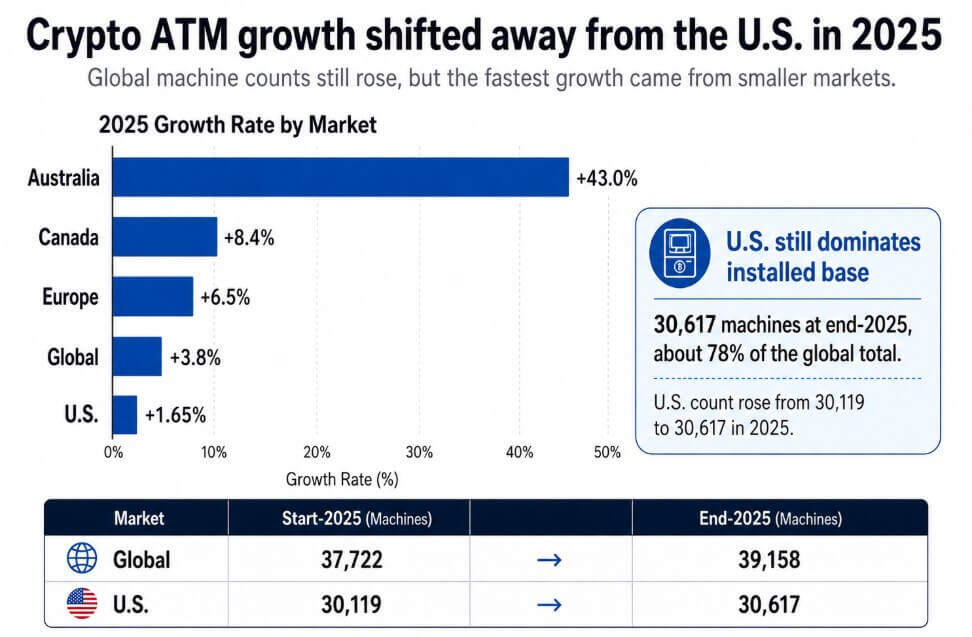
Global crypto ATM numbers grew 3.8% to 39,158 in 2025, with Australia surging 43% while the U.S. grew only 1.65%.
Two Major Future Development Paths for the Crypto ATM Industry
Optimistic Development Scenario
Capital entities acquire Bitcoin Depot's high-quality existing assets, gradually restarting offline machine operations in U.S. states without bans. The global crypto ATM market continues its steady expansion.
Entrant operators proactively bear high compliance operating costs, transforming offline machines into regulated, compliant cash exchange channels. Although transaction volume shrinks and profit margins are significantly compressed, stable operations remain possible.
Industry-wide profits continue to dwindle, but crypto ATMs persist in the market, specifically serving niche users unable or unwilling to use online crypto exchanges. They become legally compliant channels for cash-to-crypto transactions in a segmented field.
Bitcoin Depot has also clearly stated its plan to dispose of all its assets in an orderly manner, meaning its large inventory of offline physical machines could potentially re-enter the market after ownership changes.
Under this model, crypto ATMs would function like physical cash exchange outlets, maintaining their high-fee, low-volume operational characteristics, surviving by catering to fixed niche demand. This path is only suitable for operators accepting a thin-profit business model.
Pessimistic Decline Scenario
If the strict regulatory bans seen in Indiana, Tennessee, and Minnesota become a mainstream trend across the U.S., rather than exceptions in individual states, the scale of the crypto ATM market within the U.S. will shrink dramatically.
The existing 30,617 crypto ATMs in the U.S. account for nearly 80% of the global market share. Progressive state-level bans would directly lead to the decommissioning of a large number of machines. Bitcoin Depot's nearly 9,000 offline machine locations represented 23% of the global market share by the end of 2025. If these machines are permanently shut down, the global total installed base would suffer a severe blow even before new regulations are enacted in other states.
Even without outright operational bans, strict KYC rules, transaction limits, liability for transaction fraud, and endless legal disputes would completely eliminate profit margins for high-fee crypto ATMs, leading to a voluntary, gradual market exit for the industry's machines.

The Cash Transaction Channel Struggling to Scale
Today, the channels for cryptocurrency adoption extend far beyond offline kiosks. According to data from blockchain analytics firms, fiat capital flows into major mainstream online crypto exchanges exceeded $1.2 trillion between July 2024 and June 2025.
Spot crypto ETFs, mobile digital wallets, stablecoins, and various institutional compliant trading channels have become core drivers of crypto adoption. In the 2025 Crypto Adoption Index rankings, India, the U.S., Pakistan, Vietnam, and Brazil topped the list, all relying predominantly on online exchanges, mobile trading, and institutional compliant pathways for adoption.
When Bitcoin ATMs first emerged, they built an offline transaction channel for cash-accustomed users, bringing cryptocurrency into physical offline consumption scenarios and filling a market gap for physical crypto transactions.
However, the vast fee disparity between offline machines and online exchanges destined them never to enter the mainstream mass market. Meanwhile, the high-profit potential of offline transactions fueled fraud schemes involving hundreds of millions of dollars in losses.
In the future, only compliant crypto ATMs operating in regions with looser regulatory policies are likely to survive, persistently serving the niche group with essential needs for offline cash transactions.
Looking back at the industry's development history, it's clear that crypto ATMs were always just a high-cost entry point for transactions. They demonstrated the possibility of offline crypto trading but consistently failed to deliver low cost, high security, and high convenience, ultimately missing the opportunity to become mainstream transactional infrastructure for the public.