






After Claude Code, what will be Anthropic's next breakout hit?


- Core Thesis: Following Claude Code, competition in the AI industry has shifted from "model capabilities" to "system capabilities." The key is whether model capabilities can be organized into scalable work systems. Anthropic Labs is exploring a fundamental restructuring of AI from a chat tool into a production interface centered around task execution. This marks a structural inflection point as the industry transitions from a "model race" into a "systems competition."
- Key Elements:
- Product paradigms are shifting from "chat" to "tasks." The critical factors for AI products are now task decomposition, contextual continuity, tool invocation, and result validation, rather than simply the quality of answers.
- Anthropic Labs operates on a "small team, rapid experimentation" model, conducting project reviews on a two-week cycle. It leverages models to lower the cost of building, focusing scarce resources on judgment and decision-making speed.
- The boundary between platform and application is being redrawn. By defining application paradigms firsthand through products like Claude Code and Co-work, Anthropic may trigger boundary conflicts with ecosystem partners (e.g., Figma).
- The more capable AI becomes at execution, the scarcer human judgment, product taste, and the ability to define problems (e.g., asking the right questions, understanding users) become. This is because the speed of AI amplifies the impact of moving in the wrong direction.
- Anthropic Labs' goal is not to create a single blockbuster product, but to establish a sustainable methodology for transforming model capabilities into production systems. It uses high-frequency iterations to validate what capabilities the model should develop next.
Video Title: Anthropic's hunt to find the next Claude Code
Video Author: ACCESS Podcast
Compiled by: Peggy, BlockBeats
Editor's Note: As the capabilities of large models continue to leap forward and AI coding tools rapidly proliferate, the industry discourse is shifting from "Can the model complete the task?" to "How can model capabilities be organized into products, workflows, and business systems?"
Over the past year, products like Claude Code, Codex, and Co-work have successively entered the scenes for developers and knowledge workers. AI is no longer just a chatbox that answers questions; it is becoming a production interface capable of invoking tools, executing tasks, and verifying results. But as the consensus that "agents will become the next software paradigm" gradually solidifies, a more critical question emerges: Who can first translate model capabilities into reusable, distributable, and scalable work systems?
This article is compiled from an interview with Mike Krieger on the ACCESS Podcast. Mike Krieger, co-founder of Instagram, is currently the Chief Product Officer at Anthropic, leading Anthropic Labs. His team explores Anthropic's next frontier product directions following Claude Code.
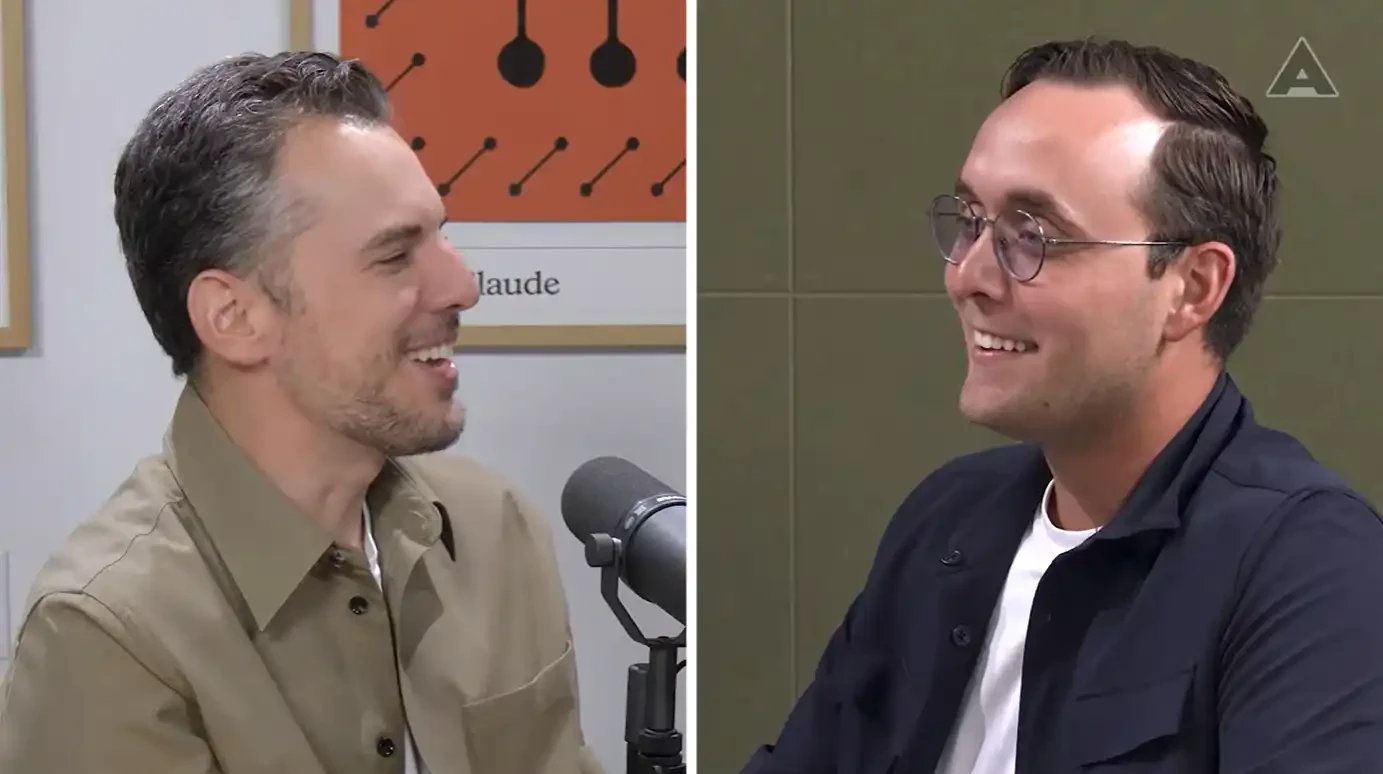
Alex Heath (left) and Mike Krieger (right)
In this conversation, Mike Krieger doesn't just speculate on Anthropic's next product. Instead, he deconstructs the AI product competition into a set of more fundamental structural questions: How do model capabilities integrate into real workflows? How should AI companies internally organize innovation? How should platform companies navigate boundaries with ecosystem customers? And as AI execution capabilities grow stronger, where will human judgment be repositioned in the production chain?
First, the product paradigm is shifting from "chat" to "tasks." Previously, large models primarily existed as dialog boxes where users input prompts and models generate responses. Now, Claude Code, Co-work, and Claude Design represent a different product logic: enabling AI to work persistently towards a goal, invoking tools, generating results, and performing validation along the way. This means the key metric for AI products is no longer just answer quality, but task decomposition, contextual continuity, tool invocation, and result verification capabilities. Whoever can package these capabilities into a smooth workflow is closer to becoming the next productivity gateway.
Second, organizational methods are shifting from "large team planning" to "small team experimentation." Anthropic Labs operates more like a startup unit embedded within a large company: starting with two or three people, conducting bi-weekly reviews, and using high-frequency feedback to decide whether to continue a project. In the past, innovation labs in big companies often suffered from long cycles, ambiguous responsibilities, and delayed projects rated "okay." Now, models have lowered construction costs. What's truly scarce is judgment, taste, and speed of decision-making. This means organizational efficiency in the AI era depends not just on the number of engineers, but on the ability to validate directions faster with smaller teams.
Third, the boundary between platform and application is being redrawn. The success of Claude Code means Anthropic is no longer just a model supplier; it is beginning to define application forms itself. The controversy surrounding Claude Design and Figma shows that when model companies directly build applications, they inevitably touch the interests of customers and ecosystem partners. Previously, foundational model companies primarily provided underlying capabilities, with vertical applications like Cursor and Figma handling the UI and scenario packaging. Now, model companies also need their own products to showcase the agent-first future. This means AI platform competition is not just an API competition, but also a product paradigm competition.
Fourth, the stronger AI gets, the scarcer human judgment becomes. Mike repeatedly emphasizes that Claude can write code faster, generate prototypes, and execute tasks, but it cannot replace the most difficult part of the "0 to 1" process: asking the right questions, understanding real users, defining the product North Star, and judging what is "right." Previously, execution capability was the main bottleneck in knowledge work. Now, execution is being accelerated by models, and human value is more concentrated in upfront judgment, creativity, relationship networks, and organizational ability. AI will not automatically eliminate tough decisions; instead, it will amplify wrong directions faster.
If this conversation can be compressed into one judgment, it is this: After Claude Code, what Anthropic is searching for is not a single blockbuster product, but a methodology to transform AI model capabilities into production systems. In this sense, the subject of this article is no longer just Anthropic's next product roadmap, but a structural turning point for the entire AI industry, moving from a "model race" to a "system race."
The following is the original content (edited for readability):
TL;DR
· AI product competition has shifted from "stronger models" to "how capabilities translate into impact," fundamentally meaning large model companies are now competing for workflow gateways.
· The significance of Claude Code extends beyond writing code; it proves that agents can persistently execute tasks toward a clear goal, pushing AI from a chat tool to a production system.
· Anthropic Labs' core value isn't measured by how many products it launches, but by using small teams to rapidly validate what capabilities the model should have next.
· Co-work represents Anthropic's ambition to extend Claude Code's methodology to non-programmers, essentially abstracting "coding capabilities" into work automation capabilities for ordinary people.
· OpenAI Codex's pursuit means Claude's advantage is no longer just technical leadership; it depends on whether Anthropic can integrate Claude Code, Co-work, and Claude.ai into a unified experience.
· Model companies directly building applications will intensify boundary conflicts with customers, but it's also their inevitable path to defining the next generation of AI product paradigms.
· The faster AI executes, the more human value concentrates on upfront judgment, product taste, and problem definition, because wrong directions will also be amplified faster by AI.
· AI's impact on employment is not a problem a single company can solve. It fundamentally forces society to re-discuss skill reshaping, distribution mechanisms, and irreplaceable human capabilities.
Original Content
Alex Heath (Host): After Claude Code, what is Anthropic's next big product? On this week's show, we have Mike Krieger. He is the co-founder of Instagram and now leads the team doing "moonshot projects" inside Anthropic.
Mike Krieger (Chief Product Officer, Anthropic):
One of my darkest days at Anthropic was naming it 3.5 v2. I can explain why we ended up with that name.
Alex Heath: Mike and I recorded this conversation in person in San Francisco during Anthropic's recent Claude Code conference. At that conference, Anthropic announced a new large-scale computing partnership with Elon Musk. So, are you guys going to space with Elon now?
Mike Krieger: Exactly right. Yes, we are looking for new and somewhat unexpected sources of compute.
Alex Heath: We talked about what Mike is working on now, the intense competition between Anthropic and OpenAI, and where Mike believes human roles will still be important even as AI gets more powerful.
This is Access.
Mike, great to see you here at the Claude Code conference in San Francisco. I was just thinking back to our last conversation. You had just taken over Labs not long ago, but it's been a few months now, right?
Mike Krieger: Yes, almost four months.
How Labs Operates: Bi-weekly Triage, Small Teams Validating Big Products
Alex Heath: Almost four months. For people unfamiliar with Labs, I wanted to start here because it's a pretty unique organizational structure. When I visited your office a few months ago, we talked about it. What exactly is Labs? What is its mission within Anthropic?
Mike Krieger: Simply put, my understanding of Labs is – for the current version, I'd call it Labs v2. We can talk later about what Labs v1 did and what Labs v2 aims to do.
But I think Labs does two main things.
First, it narrows the gap between Claude's theoretical capabilities and how ordinary people actually use it day-to-day. That is, Claude can theoretically do many things, but how do these capabilities truly enter people's daily work and life? What products, prototypes, or projects do we need to build to demonstrate how to unlock more of this potential, to shrink that gap as much as possible?
Second, we act more like a "frontier scouting team," judging which direction the model needs to evolve next to meet the needs of different users.
So, a successful Labs project doesn't necessarily have to launch as a product. It could also be a prototype. We build it and find out: the model isn't good enough yet and can't currently complete this task. So we set it aside, re-evaluate it when the next generation model is released, or turn it into an evaluation metric for future model development, and then iterate.
Therefore, unlike product labs in pure product companies, where success might be measured by "did you launch a product?" At Anthropic, Labs' value can also manifest in other ways: it can influence Anthropic's future direction.
Alex Heath: Labs has made some hits, right? Claude Code is one, MCP is another. What else?
Mike Krieger: Agent Skills was also a very important thing Labs did. I can also mention a project that wasn't released at the time but was very helpful for research: computer use, which lets Claude use a computer.
I joined Anthropic in May 2024. Next week marks my two-year anniversary, which we call "antiversary" internally.
Alex Heath: Is it anniversary?
Mike Krieger: It's antiversary. Everything at Anthropic has to be related to "ant." I was resistant to it at first. We don't say "dogfooding"; we say "antfooding."
After I joined, we started building Labs. One of the earliest projects proposed was: Why not try letting Claude use a computer?
Alex Heath: That's computer use.
Mike Krieger: Correct.
Alex Heath: What model era was that?
Mike Krieger: That was Claude Sonnet 3.5. That was also the first generation model I helped launch. I joined in my third week and started working on that launch. We often joke that Anthropic doesn't have an onboarding program; it just throws a difficult project at you. And I was helping with the launch in my third week.
Sonnet 3.5 was a very interesting model because it was one of the first to truly unlock some coding scenarios. Not quite full agentic coding yet, but you could see the beginnings.
So, we took Sonnet 3.5 and built a computer use product around it. But it had many problems. It was too slow to use the computer, its accuracy wasn't high enough, and its vision capabilities weren't good enough. It would look at the screen, say "I need to click that button," and then end up clicking somewhere else.
But building this "not fully functional" test framework was incredibly helpful. Because later, when we got to Sonnet 3.5 v2 – I can explain that naming later, truly one of my darkest days at Anthropic – we could put the new model into this framework and test it.
Later we tried 3.6; it still wasn't good enough, but showed a bit of improvement. Then came 3.7. I remember that day vividly. I was on a business trip in New York meeting the NYC team. Suddenly someone messaged me saying, we think that thing Labs built, the computer use project that had been sitting for nine months, is actually showing signs of life on Sonnet 3.7. We think it's time to open up computer use as a capability for public discussion.
This took about nine months. Every few months, we'd put the new model into the same test framework and try again. Even though Labs had temporarily shelved the project, it was still very useful because it became a test set for evaluating the evolution of computer use capabilities in models.
Alex Heath: When you first joined Anthropic, you were the Chief Product Officer. I remember thinking at the time: Mike Krieger, the co-founder of Instagram, who I associate very much with consumer products, why would he join an enterprise AI company?
Mike Krieger: Yes.
Alex Heath: We probably talked about this then. I thought it was a very interesting choice. In hindsight, it was the right choice. Of course, the timing was also very good.
I'm curious, you joined as CPO, responsible for the entire product line. And the concept of an "AI product" is inherently a bit fuzzy and changes very fast. How did you transition to Labs about four or five months ago? As I understand it, you're more of an IC now, a personal contributor? Do you still manage people?
Mike Krieger: I don't manage anyone now. We're just about to enter the performance review cycle.
Alex Heath: So this is what you wanted, right? To escape writing performance reviews?
Mike Krieger: Exactly. I opened the system to see who I needed to review and found out: I only need to write a self-review and reviews for my manager.
Alex Heath: That's it?
Mike Krieger: That's it.
Alex Heath: Now Claude writes the performance reviews.
Mike Krieger: Claude does help write some reviews, which is helpful. It won't write everything for you, but at least it helps you remember: What did I actually do in the last six months?
I think companies go through different stages, and the match with what I'm truly passionate about changes accordingly.
When I first joined, the entire product and engineering team was maybe 30 people, perhaps split evenly. Of course, we had engineering teams working on research infrastructure, scalability, etc. But if you looked at just the people building products, it was primarily Claude.ai and what we then called the API – we didn't even call it Claude Platform yet – probably a total of 30 to 35 people, very, very small.
At that time, it still felt very much like an early-stage startup. Many things were still being defined. What this product even was hadn't solidified. The Claude.ai back then didn't have Projects, didn't have Artifacts. It was basically a list of your conversations with Claude, with almost no extra features.
So joining Anthropic then felt like joining a startup trying to find its product form. Of course, it already had tailwinds.
Alex Heath: When you joined, the Claude 3 family was already released, right? Including Opus, Sonnet, and Haiku.
Mike Krieger: Yes. That was the first time Anthropic put out a model family that was at least close to frontier level. There was still so much product work to be done: What is this product going to become?
Even though my background is more consumer products, I was excited because during the period between Instagram and Anthropic, I did a lot of investing with Kevin, Instagram's co-founder. We had a whole set of investment theses, one of which was the "future of work" – how will work be done in the future?
And Anthropic seemed very likely to unlock this thesis: What happens when you have a very smart assistant to help you with work? I didn't even foresee at the time how disruptive this would become.
Alex Heath: You probably thought: This is a pretty interesting small AI company, maybe it can help me understand some investment themes.
Mike Krieger: Right, maybe it would help us understand some themes we were thinking about. But in reality, it changed far more than I imagined.
That was Phase One: a very small team, projects you could count on one hand. Then fast forward to the end of last year, the product team had a few hundred people. We had a whole portfolio of projects. A lot of the work shifted to deployment, understanding customer needs, customer-facing activities, management layers, and all the things that come with company growth.
I gradually realized that some people love this kind of work and are very good at it. I deeply respect them. But for me, I had a good coach who described this state as the "competence zone" – things you're good at, you do well, and you can handle, but it's not what truly ignites you, not what drives you.
This is actually a dangerous position. Because you can stay there for a long, long time and appear to be doing well, but it's not where you have the most fire or motivation.
So, in Q4 of last year, I started discussing this with Daniela. I said the company has grown. We definitely compressed the typical five-year growth journey into a much shorter time. Though it's only been about two years.
Alex Heath: Yes, I think you've grown quite well.
Mike Krieger: Yes, growth is okay. The team size and product portfolio expanded rapidly. So I said I felt I wanted to start a new company.
Daniela asked me: Is this because you want to leave Anthropic, or because you want to change what you do within the company? I said I really like this company. The people are great, and I love the technology, the mission, etc.
Coincidentally, around that time, we were also restarting Labs. Because Labs v1 was so successful, all projects graduated, and eventually, no one was left. So Labs was essentially put aside for a while.
So we decided to restart Labs, and I returned to the builder role. Everyone who saw me, inside or outside of work, said, "Mike, you look so happy."
Alex Heath: Some of your colleagues told me earlier today too. They said Mike is in such a great state, having a great time.
Mike Krieger: Yes. Of course, I'm still my own harshest critic. So every day I think: How can I do better? What can we


