Meme Shell Contracts: Is alt.fun a True Innovation or a Fake Need?


- Core Insight: alt.fun, a novel Meme token issuance platform within the Hyperliquid ecosystem, offers a dual experience of "playing Memes + trading contracts" by linking Meme tokens with leveraged tokens. However, its mechanism faces bottlenecks such as homogeneous underlying assets and a lack of community consensus, limiting its future development potential.
- Key Elements:
- The alt.fun platform mechanism resembles a combination of Pump.fun and leveraged tokens. When users create or purchase a Meme token, the platform simultaneously mints a corresponding leveraged token (e.g., 3x Long HYPE) on BounceTech. The token price is driven by both trading sentiment and the performance of the underlying asset.
- The market cap threshold for a token to "graduate" (migrate to HyperSwap V2) is $9,000. This can be achieved through buying pressure or an increase in the underlying asset's price. However, leveraged decay and price wicking can cause the token's value to go to zero, making it only suitable for one-sided trending markets.
- Currently, the platform has only 41 graduated tokens. Only ALT (5x Long HYPE) and STONKS (5x Long S&P 500) have market caps exceeding one million dollars. With roughly 1,000 users and only 14 underlying assets, token homogeneity is a significant issue.
- The core pain point is that Meme tokens lack community consensus. Investors buy based on price expectations rather than narrative or culture, making it difficult to create a viral effect. Furthermore, users can issue their own leveraged tokens to avoid paying a premium.
Original by Odaily (@OdailyChina)
Author: Golem (@web3_golem)
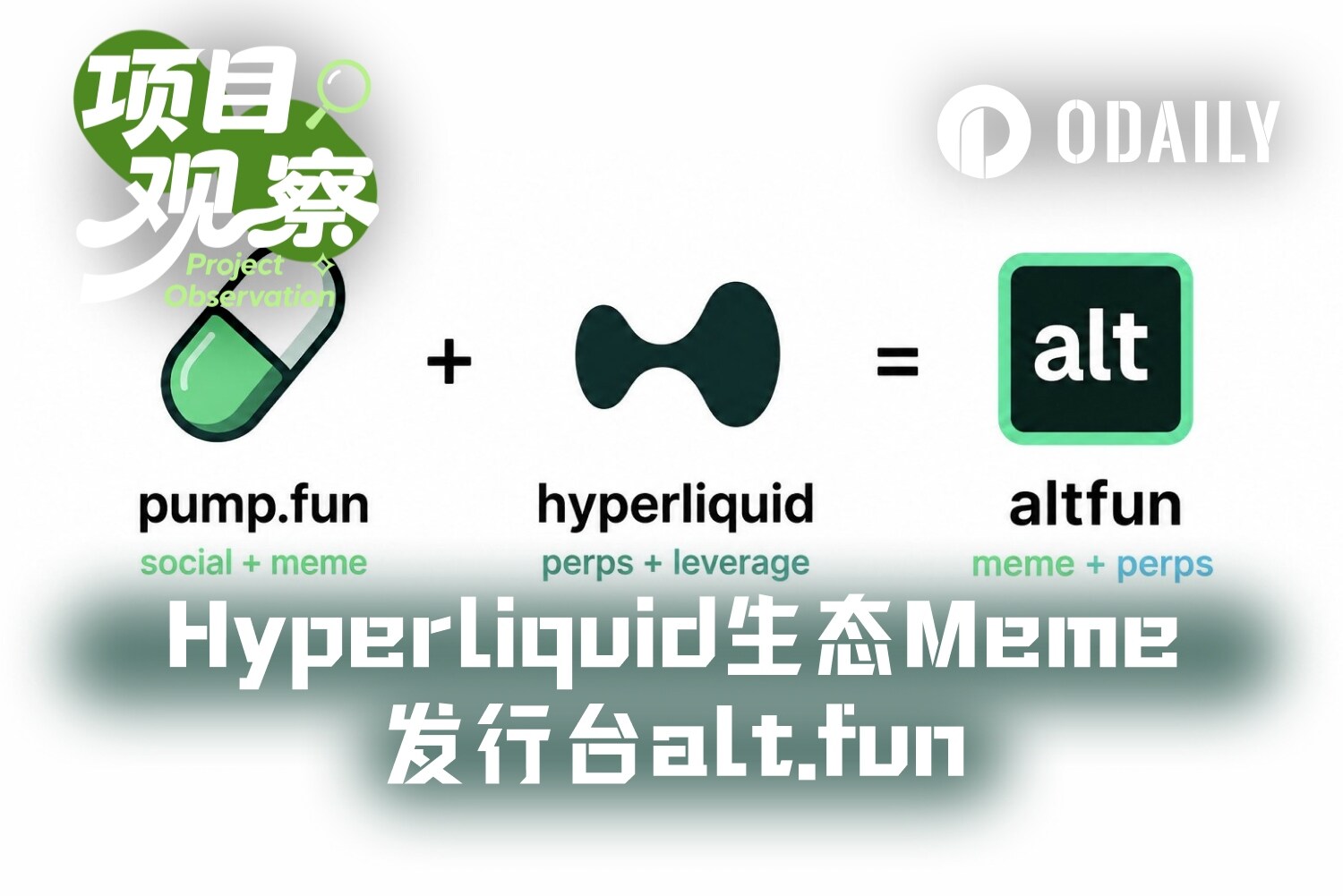
Last week, a new meme launchpad on the Hyperliquid ecosystem named alt.fun garnered significant attention from meme traders. Within just a week of its launch, its leading token, ALT, reached a market cap of up to $8.8 million before settling back to around $6.7 million.
The novelty of alt.fun can be understood as a fusion of Pump.fun and Hyperliquid, allowing users to experience the dual excitement of trading memes and opening perpetual contracts simultaneously on the platform.
How the alt.fun Platform Works
Specifically, each meme token launched on alt.fun is backed by a corresponding perpetual contract position on Hyperliquid.
Similar to Pump.fun, any user can use the alt.fun platform to launch a meme coin on HyperEVM in one click. The token price is still influenced by a bonding curve, with a total supply of 1 billion tokens. Once 75% of the tokens are sold, the token successfully "graduates" and is migrated to a HyperSwap V2 liquidity pool.
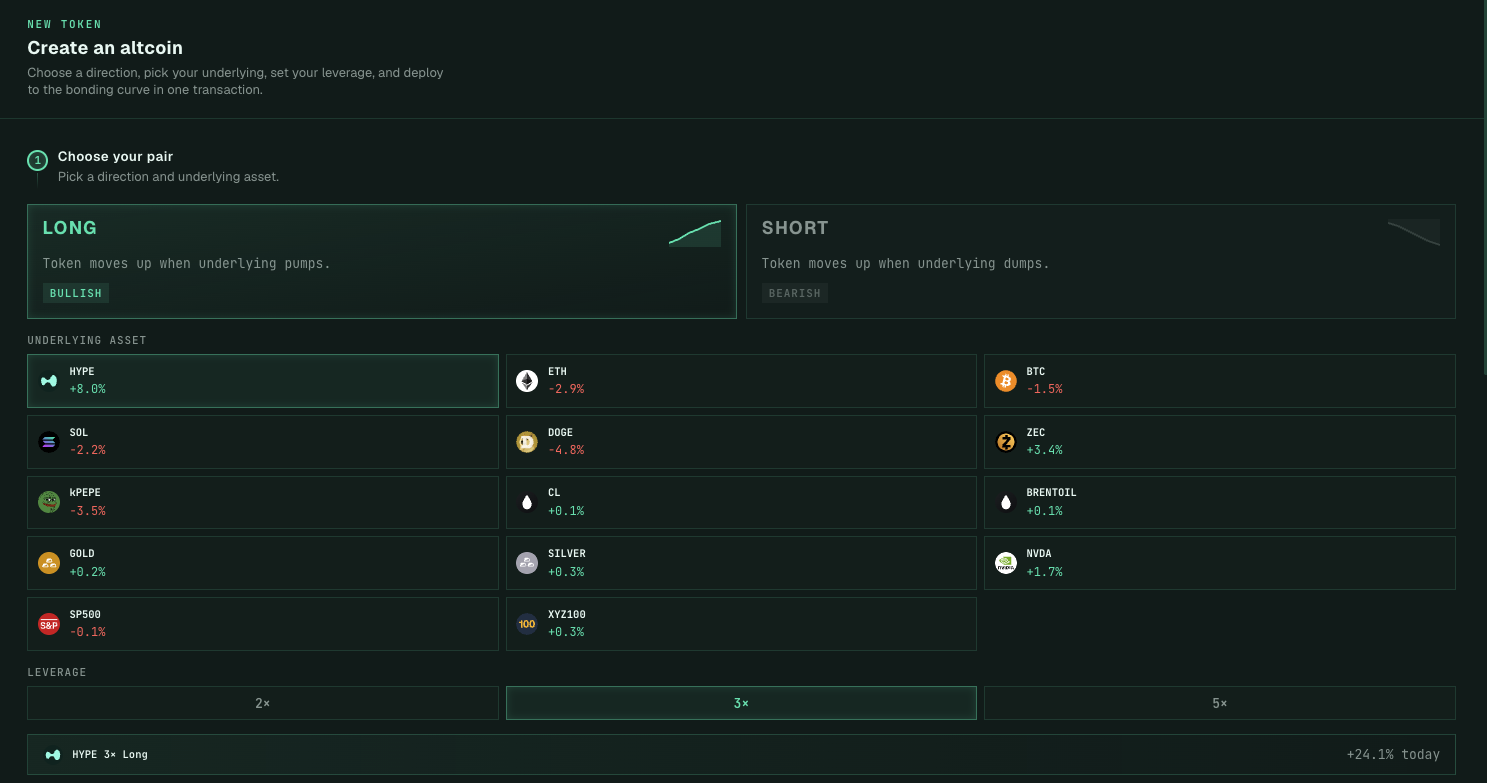
The key difference from Pump.fun is that when creating a token on alt.fun, users must also select an underlying asset and choose a direction (long/short) with a limited leverage multiplier (2x/3x/5x). At the time of token creation, the platform mints a corresponding amount of Leveraged Tokens (LTs) on BounceTech (Odaily note: a permissionless leveraged token platform on Hyperliquid) and sends them to the user. These LTs correspond to a perpetual contract position established on Hyperliquid. For example, if a user creates a token based on going 3x long HYPE, they essentially receive a leveraged token tracking 3x the returns of a long HYPE position.
As shown below, users can currently choose from 14 different underlying assets when creating tokens on alt.fun. Similarly, when players purchase meme tokens on this platform, the platform mints corresponding LTs on BounceTech. When a player sells, the process is reversed: the LTs are redeemed, and the user receives USDC.
This model of packaging leveraged tokens as underlying assets and then selling them is analogous to traditional finance, where specific risk exposures from derivatives like futures and options are securitized, such as 3x Short Nasdaq ETFs or 5x Short Crude Oil products. In this process, the alt.fun platform acts similarly to an asset management company, managing the long-term positions behind the leveraged tokens for its users.
While the price of such financial products primarily tracks the Net Asset Value (NAV), the tokens issued on the alt.fun platform are also simultaneously influenced by the meme coin's bonding curve mechanism. Therefore, the graduation model and price drivers for meme coins on this platform are not singular.
Dual Graduation Model and Price Drivers
This means the token price on the alt.fun platform is influenced by two factors: first, the trading sentiment in the buy/sell market, and second, the performance of the underlying asset. So now you can probably understand the meaning behind alt.fun's slogan: "Your token pumps even when nobody's buying."
For instance, if a user creates a token based on going 3x long HYPE with an initial capital of $20 (the platform's minimum buy-in), and HYPE subsequently rises by 10%, the user's position value would increase by 30% to $26, even if no one else buys the token.
Due to this dual price driver, the graduation model for tokens on alt.fun is not limited to just one path. Specifically, a token's graduation condition requires its market cap to reach $9,000, which essentially calculates the value of the leveraged token. Besides reaching graduation through token purchases, a token can also successfully graduate if its market cap driven by a rise in the underlying asset reaches $9,000. Therefore, whether a token can reach the graduation threshold is often the combined result of both price mechanisms.
Ideally, an increase in the underlying asset drives the leveraged token up. Combined with the catalytic effect of meme market sentiment, the token could potentially experience a self-reinforcing upward spiral. However, if the underlying asset declines, the value of the leveraged token shrinks continuously, potentially triggering panic selling in the market and causing the token price to crash instantly.
Therefore, while alt.fun's mechanism can effectively amplify leverage, it only works effectively in directional markets and requires users to accurately predict the trend. If the underlying asset experiences choppy, sideways price action, users will also suffer from leverage decay. This is because when the underlying asset price fluctuates, the platform must "rebalance" to manage the position and avoid liquidation. This means that even if the underlying asset price drops and then recovers, the leveraged token incurs a loss from being force-reduced during the decline, gradually eroding its value.
In extreme cases like flash crashes or wicks, the platform might be unable to respond in time, potentially leading to the leveraged token's value becoming zero.
Meme or Not Meme
Currently, alt.fun has a total of 41 graduated tokens, with only two having market caps exceeding one million dollars: ALT, based on 5x long HYPE, and STONKS, based on 5x long the S&P 500. The platform has approximately over 1,000 total users. While alt.fun is still in its early stages, we can already identify some of its current growth bottlenecks.
First, the platform offers too few underlying assets. Based on the current 14 assets, the maximum number of different leveraged token combinations is only 84. Already, alt.fun has seen multiple leveraged tokens shorting/longing the same underlying asset at the same multiplier. For example, the current highest market cap token ALT is based on 5x long HYPE, and another all-time high token, ATH, is also based on 5x long HYPE. Aside from their token names and creation times, they are identical. If so, why would investors buy ATH, which has a lower market cap?
While alt.fun might support more underlying assets in the future, its core pain point is its inability to build community consensus, which is essential for meme coins.
The fundamental reason investors choose to buy leveraged tokens on alt.fun rather than opening leverage directly on Hyperliquid is to gain greater price leverage. Furthermore, because the platform handles backend rebalancing for user positions, individual users can act as "armchair generals," free from worrying about individual liquidation risks.
However, this is also the problem. An investor buying an alt.fun token is essentially betting on the future price expectation of its underlying asset, not on narrative, market dynamics, or attention. These "meaningless things" are precisely what constitute the core value of a meme. A meme often rises or gains market recognition not because of its underlying value support or financial engineering, but more importantly because of its community propagation attributes.
As a meme trader, I find it hard to develop affection for a leveraged token similar to the cultural attachment one might feel for a meme community. If one truly has conviction in the underlying asset of a leveraged token, they would be better off issuing their own leveraged token rather than buying existing ones and paying an unnecessary premium.
Therefore, while alt.fun's mechanism seems novel, in my view, it is merely mechanical innovation. If alt.fun pivots its focus towards developing as a DeFi platform, it might have a chance. However, if it insists on competing in the meme launchpad track, it is destined to be a flash in the pan.