Gate Research: Long Put – An Options Trading Strategy for Bear Markets


- Core Viewpoint: In a bear market or when a decline is anticipated, buying a put option (Long Put) is a strategy that uses a limited premium cost in exchange for elastic downside profit potential. It is best suited for the initial phase when prices are expected to drop rapidly, rather than during periods of high volatility or when premiums are excessive.
- Key Elements:
- Core Advantage of the Strategy: Maximum loss is locked in at the premium paid, avoiding the unlimited loss risk of short selling, making it suitable for investors sensitive to tail risk.
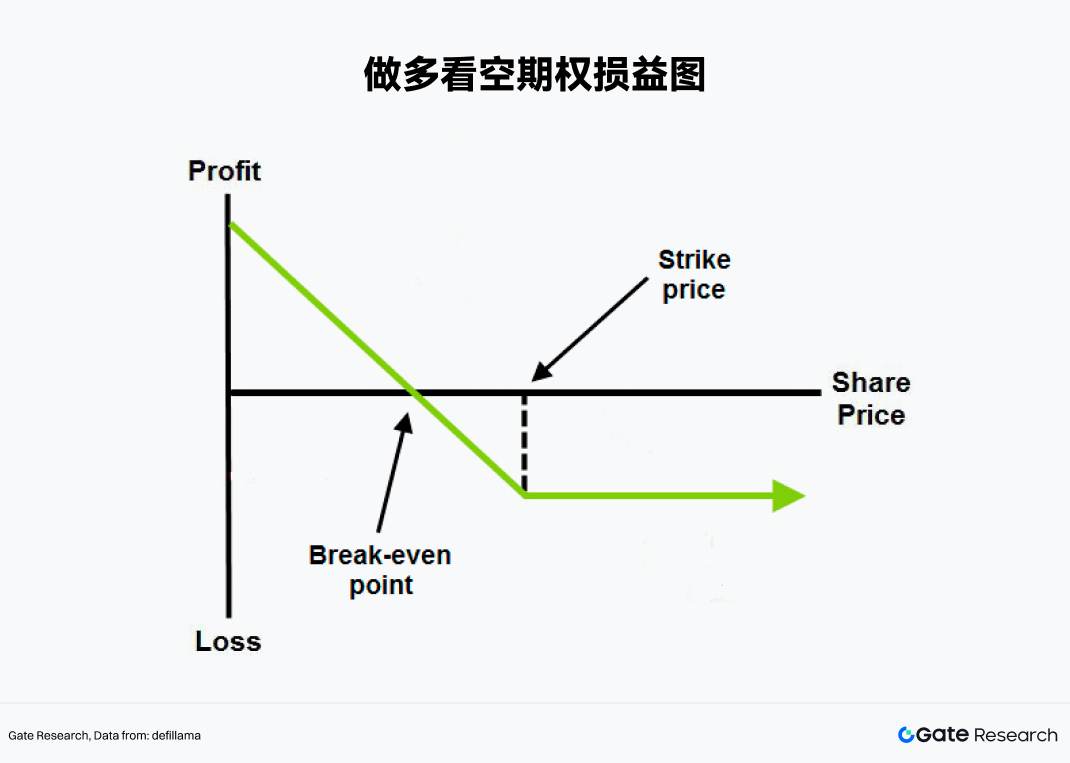
- Profit Structure: Losses are limited (to the premium) if prices rise, while profits scale elastically if prices fall. The breakeven point is the "strike price minus the premium."
- Time Sensitivity: Options have an expiration date. Prices need to decline quickly and effectively before expiration; otherwise, time value gradually erodes, potentially leading to losses even if the directional view is correct.
- Volatility Impact: Market panic can drive up implied volatility, raising put option prices. Entering at a high premium cost later on could offset a portion of the potential profit.
- Applicable Scenarios: Most suitable for the phase when a trend has just turned bearish but panic has not yet been fully released, rather than after the market has already crashed and premiums are excessively high. A comprehensive judgment of direction, timing, and volatility is required.
Summary
• In a bear market or an environment with strong downward expectations, buying put options (Long Put) is a classic strategy with limited downside and high convexity on the downside.
• Compared to directly shorting the spot asset, the biggest advantage of buying put options is that the maximum loss is predetermined; the investor only bears the cost of the premium.
• This strategy is suitable not only for expressing a clear bearish view but also for hedging directional risk within an existing long portfolio.
• Buying put options is not simply "betting on the direction"; its success depends on the magnitude of the price decline, the timing of the decline, and changes in market volatility.
• In a bear market environment, this strategy is more suitable for phases where "prices are expected to fall relatively quickly" and less suitable for blindly chasing shorts when volatility is high and option premiums are excessively inflated.
Introduction
In a bear market environment, investors often face a practical question: If you believe the market will continue to fall, how should you participate in this downward trend?
The most direct approach is, of course, to sell the spot asset, or to short via margin trading, perpetual contracts, or other instruments. However, these methods often involve higher capital requirements, more complex risk management demands, and in some cases, the risk of theoretically unlimited losses. For investors who do not wish to take on excessive tail risk, shorting, while directionally clear, is not always the easiest strategy to execute over the long term.
This highlights the crucial role of put options. Buying a put option essentially involves paying a fixed cost in exchange for the right, but not the obligation, to sell an underlying asset at a predetermined price within a specified future period. The investor is not obligated to exercise the option, but if the market does fall, this right becomes more valuable.
Therefore, buying a put option is fundamentally a strategy of "exchanging a limited cost for convexity in a downward move." It has an offensive attribute, as gains can amplify rapidly during a market crash, but also a defensive attribute, as the maximum loss is capped at the initial premium paid, even if the market forecast is wrong.
The Long Put Strategy
1.1 Strategy Characteristics
A Put Option gives the buyer the right to sell the underlying asset at a specified strike price on or before the expiration date. Buying a put option is what the market commonly calls a Long Put.
This strategy is best suited for a very clear market judgment: an investor expects the price of an underlying asset to decline in the future, ideally a significant decline within a limited timeframe. Unlike spot assets, options are time-bound instruments. When an investor buys an option, they pay a premium, which is essentially the cost of purchasing "insurance" for their market view that is valid for a specific period. If the underlying price moves favorably within the option's lifespan, this "insurance policy" appreciates. If the market does not decline as expected, or the decline is too slow, the time value of the option will steadily erode, potentially making it worthless at expiration.
From a payoff structure perspective, the Long Put strategy has several very distinct characteristics.
• Limited maximum loss. No matter how high the underlying price rises subsequently, the buyer's maximum loss is limited to the premium paid for the option.
• Significant downside gains. As long as the underlying price continues to fall, the value of the put option increases correspondingly, although maximum gain is also capped (by the underlying price hitting zero).
• Clearly defined breakeven point. The trade only becomes profitable at expiration if the underlying price falls below the "strike price minus the premium paid."
• High time sensitivity. Getting the direction right is insufficient; the price decline needs to occur effectively before the option expires.
For these reasons, while Long Put is a bearish strategy, it is not a tool that is suitable simply "whenever you think the market will fall." It is more of a comprehensive bet on the direction, timing, and volatility of the price over a specific future period.
1.2 Strategic Advantages
A bear market is more than just falling prices. It is often accompanied by valuation compression, liquidity contraction, declining risk appetite, and a significant increase in volatility. In such an environment, buying put options is often considered a classic bear market strategy for three main reasons.
First, it amplifies the efficiency of expressing a bearish view. If an investor directly shorts the asset, the profit is typically a one-to-one relationship with the price decline. However, after buying a put option, during phases of accelerating declines and rising volatility, the option value often exhibits higher convexity (non-linear returns).
Second, it controls the worst-case scenario. One of the most common occurrences in a bear market is that, while the overall trend is weak, there are frequent sharp bounces. Many direct short trades fail not because the direction was wrong, but because they were stopped out by large interim price swings. The advantage of a Long Put is that even if the market experiences a sudden short-term rally, the buyer does not face the prospect of unlimited losses like a leveraged short seller.
From a practical standpoint, the Long Put strategy is often most suitable, not necessarily during the phase "after a market has already crashed," but more often during the period "when the trend has just turned weak, but widespread panic hasn't fully set in." This is because once the market is in a state of high panic, implied volatility for options typically spikes significantly. Buying puts at that point is often very expensive, and the risk-reward ratio may not be ideal.
1.3 Strategy Example
Gate currently supports bearish options for several major tokens. Taking BTC as an example, assume at a specific point in time, BTC's spot price is 84,000 USDT. An investor believes that over the next month, the market may enter a further downward phase due to weakening macroeconomic expectations, capital flight to safety, and profit-taking at high levels. Instead of directly shorting a perpetual contract, they choose to buy one BTC put option with a strike price of 80,000 USDT, expiring in one month, paying a premium of 4,000 USDT.
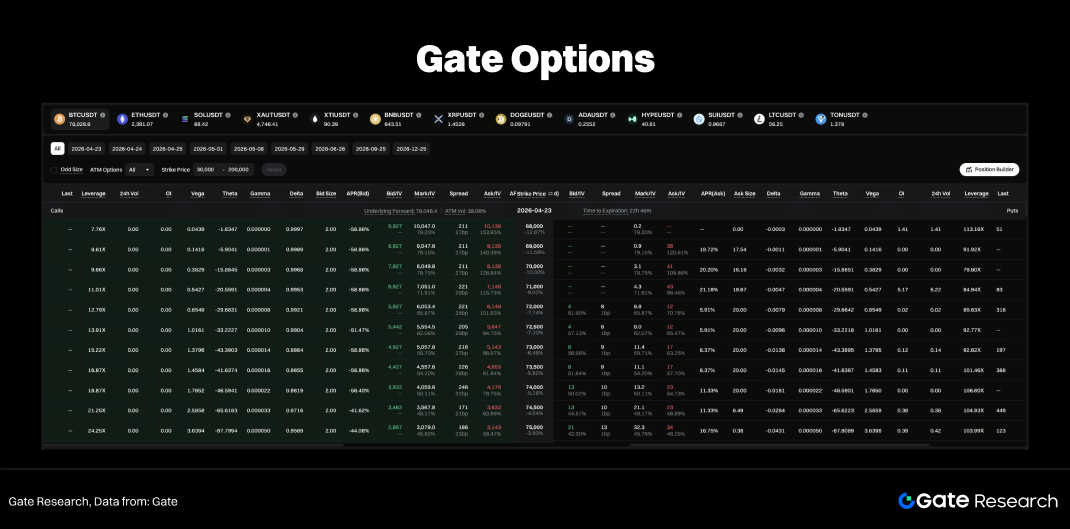
For this trade, the key parameters are as follows:
• Spot Price: 84,000 USDT
• Strike Price: 80,000 USDT
• Premium: 4,000 USDT
• Time to Expiration: 30 days
• Breakeven Point: 76,000 USDT
This means that at expiration, this trade only starts to net a profit if BTC falls below 76,000 USDT.
If, after one month, BTC drops to 70,000 USDT, the intrinsic value of this put option is:
80,000 - 70,000 = 10,000 USDT
After deducting the initial premium of 4,000 USDT paid, the net profit is:
10,000 - 4,000 = 6,000 USDT
Conversely, if at expiration the BTC price is still above 80,000 USDT, this put option has no intrinsic value, and the investor's maximum loss is the initial premium of 4,000 USDT.
Returns, Risks, and Key Variables of Long Puts
To truly understand this strategy, the key is not just remembering that "puts can make money," but understanding *why* they make money and under what circumstances they fail.
2.1 Source of Return: Price Decline
The most direct source of return for a Long Put is a decline in the underlying price. Assume an asset's current price is $36.25. An investor buys a put option with a strike price of $35, pays a premium of $2, and the remaining time to expiration is 90 days. The breakeven point for this trade is $33, calculated as:
Breakeven Point = Strike Price - Premium = 35 - 2 = 33
If the price falls to $30 at expiration, the intrinsic value of this put option is $5. After deducting the initial premium of $2, the net profit is $3. If the price is still at or above $35 at expiration, the option has zero intrinsic value, and the maximum loss is the initial $2 premium paid. This is the core structure of a Long Put: limited loss on the upside, and expanding gains on the downside.
2.2 Time Decay: Getting the Direction Right May Not Be Enough
The biggest difference between options and spot assets is the dimension of "time."
For the buyer of a put option, time is often an adversary. If the market does not decline immediately as anticipated, the time value embedded in the option will gradually erode. Even if the directional view is ultimately correct, the trade result might be unfavorable if the decline is too slow or occurs too late.
This means that buying a put option involves not just forecasting "whether it will fall," but also "when it will fall."
2.3 Volatility Changes: Another Layer of Impact in Bear Markets
Besides price and time, volatility is a critical variable in options trading.
Generally, the more panicked the market, the more expensive options become, especially puts. This is because, during downturns, investors are more willing to pay a premium for protection or speculation. Therefore, Long Put positions typically benefit from rising implied volatility. However, this presents another challenge. If an investor buys puts *after* the market has already crashed significantly, when panic is high and put premiums are clearly expensive, a subsequent decline in volatility (vol crush) could offset some of the profit even if the direction remains correct. In other words, Long Put is not just a bet on falling prices; to some extent, it is also a bet that "the decline hasn't been fully priced in" yet.
Conclusion
The Long Put is one of the most classic directional option strategies for bear market conditions. Its appeal lies in using a limited loss to gain significant convexity during price declines. Compared to direct shorting, it is easier to control tail risk; compared to simply selling the spot asset, it retains stronger offensive potential.
However, it is not a tool that guarantees easy profit just because you are bearish. The difficulty of a Long Put is that it requires the investor to have a reasonable assessment of direction, timing, and volatility. If the market doesn't fall fast enough, deep enough, or if the entry point is too crowded (i.e., premiums are too high), the actual effectiveness of the trade can be severely diminished.
As a typical high-volatility asset class, cryptocurrencies provide a natural application scenario for Long Puts. Once the market enters a phase of declining risk appetite, weakening price trends, and increasing event-driven risks, buying put options can become a strategic choice that combines both defensive and offensive properties. Ultimately, however, it is not a "copy-trading tool," but rather a trading method that demands discipline and a sense of timing.
References
• Gate, https://www.gate.com/help/other/options/28363/introductions-of-gate.io-s-options
• Investopedia, https://www.investopedia.com/terms/l/long_put.asp
• InteractiveBroker,https://www.interactivebrokers.com/campus/trading-lessons/bear-market-long-put/
• Optionclue, https://optionclue.com/en/tradinglossary/long-put/
Gate Research is a comprehensive blockchain and cryptocurrency research platform providing readers with in-depth content, including technical analysis, hot topic insights, market reviews, industry research, trend forecasts, and macroeconomic policy analysis.
Disclaimer
Investing in the cryptocurrency market involves high risk. Users are advised to conduct independent research and fully understand the nature of the assets and products they purchase before making any investment decisions. Gate is not responsible for any losses or damages arising from such investment decisions.