Iran collects Bitcoin at the surface, threatens to cut off internet underwater – Tehran is 'strangling' the dollar system


- Core Insight: By launching the state-backed digital maritime insurance platform "Hormuz Safe," Iran is attempting to settle transit fees in Bitcoin, aiming to bypass the dollar-dominated financial system. This strategy seeks to convert its geopolitical control over the Strait of Hormuz into financial gains, thereby building a parallel financial order.
- Key Elements:
- Iran's Ministry of Economy has launched the "Hormuz Safe" platform, offering maritime insurance for vessels transiting the strait, settled in Bitcoin or other cryptocurrencies. This move is intended to establish a "quasi-financial infrastructure" as an alternative to Western intermediary systems.
- The platform bypasses Western institutions such as SWIFT and Lloyd's of London, allowing Iran to evade sanctions. If it captures a significant market share, it could generate over $10 billion in revenue, serving as a starting point for "de-dollarization."
- Practical implementation faces international credit hurdles. The global trade system relies on US-led credit and enforcement power. Insurance from Hormuz Safe, operating outside the dollar system, may be rejected by ports and other institutions, and carries the risk of secondary sanctions.
- In parallel, Iran is financializing its geopolitical control by threatening to charge fees for access to undersea communication cables beneath the Strait of Hormuz. This transforms physical control (e.g., oil tanker insurance, fiber optic data) into sustainable financial revenue, creating multiple layers of economic deterrence.
- This move represents an escalation in Iran's strategy from mere "blockade" threats to "re-ordering" the regional framework, using its geographic advantage to force adversaries to face dual anxieties in the financial and physical domains.
Original by Odaily Planet Daily (@OdailyChina)
Author: Golem (@web3_golem)
Last month, during the US-Iran ceasefire, Iran announced that it would levy transit fees in Bitcoin on oil tankers passing through the Strait of Hormuz. The news sparked discussions among crypto enthusiasts, who believed that Bitcoin had finally played the role of "digital cash" in the most extreme geopolitical environment. At the time, Odaily analyzed that Iran's move might be a geopolitical tactic, with Bitcoin acting as a smokescreen in this game, the core purpose being a public provocation against the dollar system. (Related reading: Is Iran Just Bluffing About Paying Strait Transit Fees with Bitcoin?)
However, looking back a month later, what Iran has thrown out is a genuine "financial bombshell." On May 18, Iran announced the launch of the state-backed digital marine insurance platform Hormuz Safe, providing marine insurance for vessels passing through the Persian Gulf and the Strait of Hormuz, settled in Bitcoin and other cryptocurrencies.
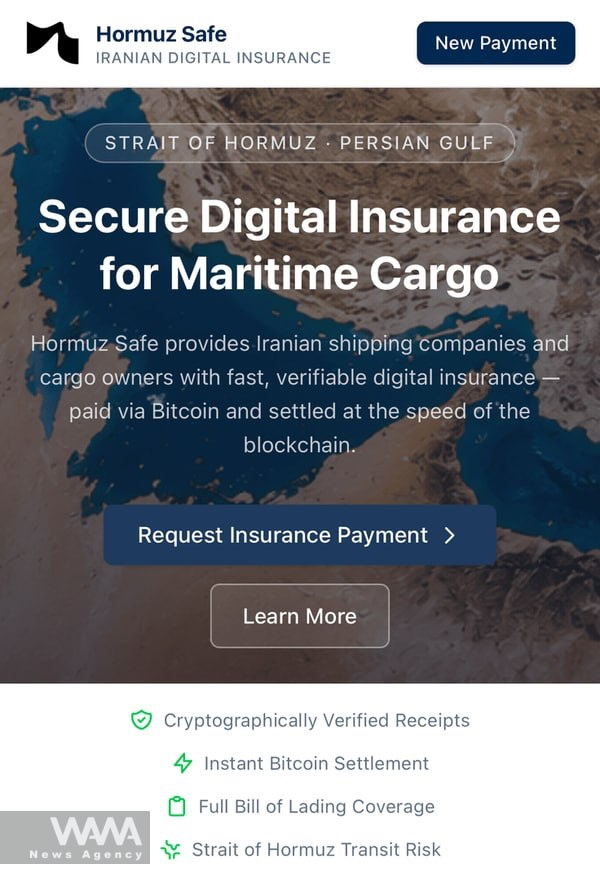
An image circulating online shows the official Hormuz Safe page, indicating that the digital insurance service targets Iranian shipping companies and cargo owners. Goods are insured from the date of shipment confirmation, and a signed receipt will be provided to the cargo owner.
Although the website is currently inaccessible (possibly due to node restrictions), the very plan to launch this platform proves that Iran's intention to collect Strait transit fees via Bitcoin is no longer just lip service. Instead, it is already building a set of "quasi-financial infrastructure" to gradually turn it into a viable and executable commercial reality.
Iran Aims to Reshape the Financial Order of the Strait of Hormuz
When Iran first announced its intention to collect Strait transit fees in Bitcoin, my mind conjured up an extremely comical scene: countless oil tankers in a "traffic jam" in the Strait of Hormuz, caused by an elderly captain at the front of the queue staring at his phone at a Bitcoin transaction languishing unconfirmed by miners...
While this rough, amusing imagination amplifies Bitcoin's characteristics and importance, considering the reality of "paying Strait transit fees with Bitcoin," Iran wouldn't be foolish enough to collect them on the spot like highway tolls or parking fees. In fact, it might not even need to be paid under the guise of transit fees. This is because modern international crude oil shipping truly relies on insurance.
The Strait of Hormuz chokes off approximately 20% of the global oil supply. Every oil tanker passing through this narrow waterway between Iran and Oman must purchase marine insurance. Without insurance, banks won't provide financing, and no shipowner or port would dare to sail or provide berthing.
Traditionally, for the past few decades, these insurances have been underwritten and settled by Western financial institutions. Lloyd's of London, European and American reinsurance companies, SWIFT, and others have jointly constructed an intertwined international oil tanker insurance order, from which Iran is largely excluded.
Now, Iran is preparing to tear a hole in this insurance system from the payment perspective. The digital marine insurance platform Hormuz Safe, supported by Iran's Ministry of Economic Affairs and Finance, intends to settle policies directly using Bitcoin and cryptocurrencies, requiring neither the SWIFT network nor any Western intermediaries.
This is a sanctions-evasion scheme. The platform features blockchain-based instant settlement and digital signature receipts, creating a parallel insurance infrastructure that can operate without permission from any Western regulatory body. Simultaneously, it allows Iran to gain financial sovereignty, successfully bypassing the dollar-based financial system and avoiding pressure from the US leveraging that system. The Iranian government believes that if this platform captures a significant share of the Persian Gulf shipping insurance market, it could generate over $10 billion in revenue.
This could even become the starting point for Iran's "de-dollarization," from restructuring the settlement system to the insurance system, and ultimately shaking the entire financial order of the Persian Gulf region. However, rationally speaking, the obstacles to achieving this are immense.
Hormuz Safe attempts to use Bitcoin and blockchain technology to bypass the SWIFT network and Western intermediaries, reducing dependence on Western financial infrastructure. The ideal is good, but reality may not accept it. This is because the global trade system is not merely a technical system; it is a power system built on credit and force.
Therefore, bluntly speaking, without the nod of the United States, perhaps no institution or port would dare to recognize the insurance provided by Hormuz Safe. Even if a shipowner is willing to accept Hormuz Safe, once they leave the Persian Gulf and the Strait of Hormuz, most of the world's ports, banks, insurance companies, and exchanges still operate within the dollar system, rendering any insurance issued by Iran worthless. Furthermore, following the US "way of doing things," if any shipowner, trading company, or port authority dares to interact with Hormuz Safe, it would very likely trigger the risk of secondary sanctions.
Therefore, Hormuz Safe's actual customer base may be limited to vessels already operating in the gray areas of US sanctions.
Iran is Financializing Its Geopolitical Control
However, even though Iran holds various disadvantages in the international financial system, it still possesses geopolitical control. At least concerning the opening of the Strait of Hormuz, the US can no longer dictate the situation unilaterally.
Regarding the current US-Iran situation, the Trump administration has consistently projected an attitude of optimism and determination to the outside world. On May 19, Trump canceled the planned strike on Iran, stating that "very positive progress" had been made in negotiations. Conversely, Iran has projected an unyielding stance. Military Advisor to Iran's Supreme Leader, Yahya Rahim Safavi, responded strongly to Trump's cancellation of the latest military strike, saying, "The iron fist formed by the powerful armed forces and the great Iranian nation will force them to retreat and surrender."
Moreover, on May 19, Iran's Supreme Leader, Mojtaba Khamenei, reiterated on social media that if the "state of war" continues, they would consider opening new fronts in areas where the enemy lacks expertise, emphasizing that "the enemy has very little experience and is extremely vulnerable in these areas." The core of these new fronts Iran speaks of may lie in the continuous financialization of geopolitical control.
When the US-Iran confrontation first took shape, Iran used the threat of blocking the Strait of Hormuz as a strategic bargaining chip, causing significant disruption to both international financial markets and US politics. However, "blockade" is actually the most rudimentary way of exercising geopolitical control. Completely closing the Strait would impose huge costs on Iran as well. The truly sophisticated approach is to directly convert this geographical advantage into sustainable financial gains and financial rulemaking. The former only destroys the existing order, while the latter rewrites the rules. Combining geopolitical threats with economic threats makes the adversary even more anxious.
Iran is already doing this. Besides formulating navigation rules for oil tankers on the sea surface, Iran has also set its sights on the submarine communication cables lying beneath the surface.
In early May, Iranian military spokesman Ebrahim Zolfaghari stated on X that Iran would "charge a fee for internet cables" (the specific charging method has yet to be disclosed). Beneath the Strait of Hormuz lie submarine cables connecting Arab countries with Europe and Asia, carrying massive amounts of internet and financial data traffic. This data impacts financial systems, AI, and people's daily work and lives, generating economic value that is incalculable.
Furthermore, Iran has threatened that if companies using the submarine cables do not pay the license fee, it might implement a "network disconnection" strategy. US tech giants like Google, Microsoft, Meta, and Amazon have been specifically named. Following the news, according to maritime intelligence and data provider Windward, Iran's statement has prompted ASN (Alcatel Submarine Networks), one of the world's largest submarine cable installers, to suspend all maintenance operations in the region.
From oil tanker insurance policies on the surface to fiber optic data beneath the sea, everything passing through the Strait of Hormuz is being redefined by Iran as a "chargeable asset." "Trick or treat," the physical vulnerabilities of capital and financial markets have, in this moment, become Iran's most convenient weapons.
The surface of the Strait of Hormuz may seem calm, but Iran has already put a knife to America's throat.