何一的星飘: 我的野心,是有一个配得上我的世界


- Core Insight: He Yi shares her journey from a rural girl to Binance's co-CEO, emphasizing the importance of agency, ambition, and execution. She identifies cognition, execution, courage, and ambition as the four pillars of growth, and explains how Bitcoin reshaped her understanding of money and the future of finance.
- Key Elements:
- He Yi's early experiences (e.g., insisting on starting school at age 4, repaying gambling debts after losing) shaped her strong sense of agency and proactive mindset.
- She attributes her growth to the four pillars of "cognition, execution, courage, and ambition," believing they drive each other forward, and highlights the methodology of "daring to dream" and "working backward from the outcome."
- After researching Bitcoin in 2013, her worldview was redefined. She saw it as a trust network based on global consensus rather than a currency backed by national credit, leading her to go all-in on the blockchain industry.
- Choosing to resign from a thriving TV hosting career to join the crypto space, He Yi believes her core strength lies in "optimizing and iterating existing things to their maximum potential," rather than innovating from zero to one.
- For women's growth, she advises, "Try it first, and be clear about the costs." She also rejects the label of "female rivalry," emphasizing winning through strength and merit in competition.
Original Source: Money-Making Girls
Compiled by: Deep潮 TechFlow
Key Takeaways
In this episode of "Money-Making Girls," the host sat down with BINANCE Co-founder and Co-CEO He Yi. The conversation spanned from her childhood, growth, and career choices to ambition, cognition, execution, and how women can lift themselves up.
He Yi recalled how, as the second child in her family, she learned to actively fight for what she wanted: clamoring to go to school at the age of 4, devouring wuxia novels and Yi Shu during her teenage years, and being unwilling to return to her hometown to become a teacher after attending a normal school. These experiences collectively shaped her strong sense of agency.
She also discussed why she went all in on Bitcoin at the peak of her hosting career: Bitcoin made her rethink "what money really is" and showed her a financial future built on global consensus and a trust network. For ordinary people, her answer is not complicated: first understand the cost, then bravely try; iterate your cognition through execution. In life, you either gain something or learn something.
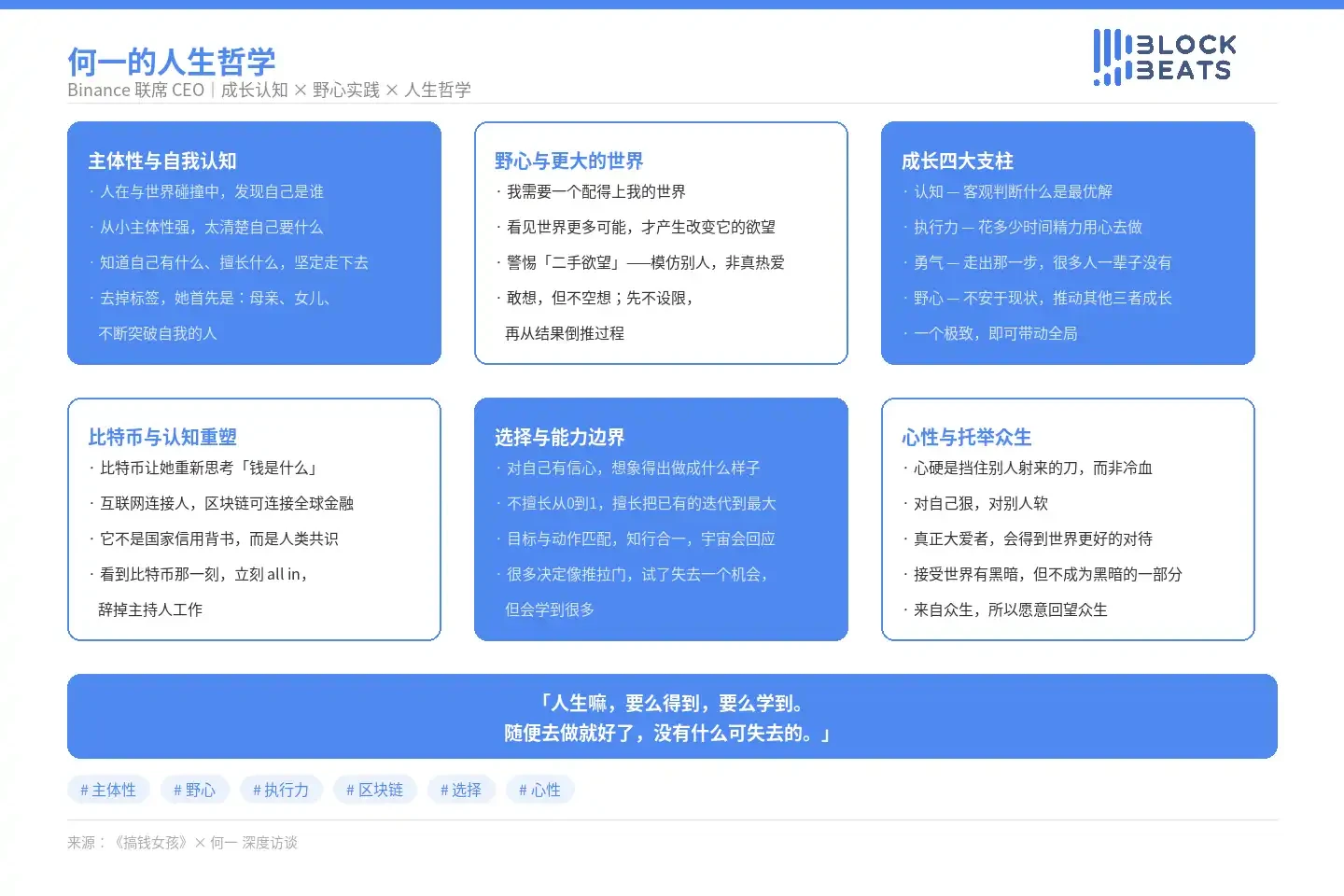
Highlights of Key Insights
On Agency and Self-Cognition
· "A person doesn't exist in isolation. You ultimately discover who you are through every collision with the world. Through every interaction, every engagement, and how you face and handle them, you come to understand yourself better."
· "I think I've had a strong sense of agency since I was a child, to use today's terminology. I've always been very clear about what I want."
· "Why is it that only city kids can like beautiful things, like flowers and plants? Why can't I?"
· "Do you truly know what you have and don't have, what you're good at and not good at? And can you firmly walk that path, enduring even when knives fall from the sky?"
On Ambition and a Bigger World
· "I've probably always been a bit ambitious. I've always felt I need a world that matches me."
· "When you see there are many parts of the world you'd like to try and change, you start to wish for a bigger world to go and try."
· "A lot of the time, our desires are second-hand. We just see others doing something, so we imitate them."
· "You need to dare to imagine, but not just daydream. First, don't set limits, then work backward from the result to the process."
On Cognition, Execution, Courage, and Ambition
· "The so-called four pillars are cognition, execution, courage, and ambition. If one of these four corners is extremely strong, it will drive growth in another. If two grow, they can further push you forward."
· "Knowing yourself means being able to objectively judge whether something is your optimal solution, and whether you truly love it, willing to keep doing it even if it's not profitable."
· "A person's execution isn't just about doing something; it's about how much time and energy you invest. Are you truly committed? Can you endure the long, painful process of self-iteration before success?"
· "Many people think they know a lot and are just unlucky, but they might not even have the courage to take that first step."
· "If you truly love something, pursuing your passion feels effortless."
On Bitcoin and Reshaping Financial Cognition
· "Bitcoin made me rethink what money really is. That's what struck me most."
· "If the internet can connect people all over the world, then perhaps there can also exist a global, trust-based network that connects the world's finances."
· "It's not currency printed by a country or government backed by credit. It's a human consensus."
· "The moment I saw Bitcoin, I felt this was the right direction. I wanted to enter this space and work on this."
On Choices, Mission, and Ability Boundaries
· "I have confidence in myself. If I joined BINANCE, I could envision what I could do. I could turn it into a world-class platform. Reaching its full potential was just a matter of time."
· "I might not be the best at creating something entirely new from 0 to 1, but I am very good at continuously optimizing and scaling an existing thing to its maximum potential."
· "Everyone wants to be a certain person, and go somewhere. In the end, the universe will respond. You just need to align your knowledge with your actions, matching your goals and execution."
· "Many decisions in the world are like sliding doors; you can regret them later. It's okay to try. If you try, you might lose an opportunity, but you will gain a lot of learning."
On Success, Resilience, and Lifting Ordinary People
· "Being tough doesn't mean being cold-hearted. It's about being able to harden up and withstand different opinions and the knives thrown at you."
· "I am quite tough on myself, but soft with others."
· "If there is a truly divine hand in this world, it would be kinder to those who hold great love for the world."
· "The world has black and white, light and darkness. You must accept it as part of the world, but that doesn't mean you choose to become part of the darkness."
· "Life is about either gaining or learning. Just go for it. There's nothing to lose."
Stripped of all social labels, who are you?
Just Xiao Hui: Today, Xiao Hui is in Hong Kong, China, interviewing a truly legendary woman. Born in a rural area of Yibin, Sichuan, she later became an outdoor host for Travel Channel by chance, and then became known as "Customer Service Xiao He" to many users in the blockchain industry. Now, her latest title is Co-CEO of BINANCE, the world's largest blockchain trading platform and ecosystem.
Life can have such an incredible comeback story, so I am very curious about how she grew up. Please welcome He Yi, Co-CEO of BINANCE. Welcome, Sister Yi.
He Yi: Hello everyone, I am He Yi from BINANCE, also your customer service representative, Xiao He.
Just Xiao Hui: Most people imagine a CEO or female president to be very domineering and imposing, but you give off a gentle and approachable vibe. So today, I am also curious to look back and see how "Xiao He" step by step became the person she is today.
There is a popular icebreaker recently: If you remove all your social labels, how would you introduce yourself?
He Yi: I think first and foremost, a mother, a daughter, and someone who constantly breaks through their own limits.
Just Xiao Hui: That's a very grounded expression. As for me, I seem to need a lot of external judgment and dimensions. If I can't define myself, I think about how others would define me. For example, I might have received a lot of feedback saying that Xiao Hui is also an approachable person. Because I do interviews, people say I'm good at making others open up.
But that's also how I am in others' eyes. It seems I need others' confirmation to know who I am.
He Yi: That might mean you're in the process of exploring life. A person doesn't exist in isolation. You ultimately discover who you are through every collision with the world. Through every interaction, every engagement, and how you face and handle them, you come to understand yourself better. It shows you are still young and youthful.
The "Second Child Law" Taught He Yi to Actively Fight for Things from a Young Age
Just Xiao Hui: Before coming here, I did my homework. I found that Sister Yi and I share a very similar trait: you are one of three children, the second child, while I am the third. Psychology has a concept called the "Second Child Law," and it reminded me of my second sister.
My second sister's personality is quite the opposite of yours. She is more domineering, flamboyant, and mischievous, making our parents' heads hurt. I was the well-behaved one, more like the "daughter" role. I wonder, looking back, did being the second child leave a mark on your personality?
He Yi: I think it's quite obvious. I have three kids myself now. Generally, when the first child is born, parents invest a lot of attention, getting nervous over the slightest thing, so the firstborn gets all the love, the most love. By the time the second arrives, people often say, "Raise the first by the book, raise the second casually." Parents worry less. When the child is sick with a fever, they know how to handle it, they are less nervous.
The third child is usually the baby of the family, everyone dotes on them a bit more, they are the apple of everyone's eye. So growing up, parents would definitely say to the elder sister, "Let your little brother have it." Even if you don't compete, they reflexively tell you to give it to the younger one. The firstborn has assured love, the youngest has assured love, but the second child needs to actively fight for it, otherwise, they feel forgotten.
Sometimes, what we call a child's rebelliousness is actually a cry for help. Relatively speaking, they might also become more independent and self-focused.
The Earliest Awakening of Agency: Kicking Up a Fuss to Start Primary School at Age 4, Ultimately Accepted "Beyond the Norm"
Just Xiao Hui: At what moment did you realize, "It seems I have to fight for things myself to get them"?
He Yi: My earliest memory might be from when I was 4, wanting to go to school. My sister is 6 years older than me. When I was 4, she was in primary school. I would think, "Why can my sister go to school, but I can't?" I would make a fuss at home every day, saying, "I want to go to school, I want to go to school," annoying the adults to no end until they finally sent me to school.
My primary school homeroom teacher was a friend of my parents. He asked my parents how old the child was, and they lied, saying 6 years old. Back then, they didn't check ID cards, and we didn't bring the household registration booklet, so they just said, "We'll deal with it later; if her grades are bad, she can repeat a grade later." So I was thrown into school. I never ended up repeating a grade, and my grades were pretty good.
Just Xiao Hui: Because you want to do something yourself, you can do it well. This might be the foundation of your personality: you are very brave in expressing what you want. If the current environment isn't what you desire, you feel you need to find a suitable one.
He Yi: I have another vivid memory from childhood. Because my family lived in the countryside, there were wildflowers and weeds everywhere in rural Sichuan. When I was in primary school, I would pick wildflowers every day, and my mom would laugh at me, saying, "Why is a country kid so into flowers and plants?" To them, wildflowers were common and not worth attention. They felt it might be a privilege of city kids.
But I have a very clear memory from that time: I disagreed with her viewpoint. Why is it that only city kids can like beautiful things, like flowers and plants? Why can't I?
I think this might be a manifestation of my proactive change, or my insistence on self. In today's popular terms, it's having a strong sense of agency, an early awakening of self-awareness. I was probably born with a rebellious streak.
Just Xiao Hui: I have a similar experience. I've been left-handed since childhood, writing with my left hand. When I was little, my parents went through a phase of trying to change me to be right-handed, but luckily my kindergarten teacher was open-minded. She said it was fine, let her be; she writes quite well, no need to force a change. Plus, there's a folk saying that lefties are smarter, so the teacher protected my preference, and my parents accepted it.
But I was also very stubborn in the middle. I wouldn't change, no matter what. They told me to change, and I refused. But they didn't use a harsher approach with me. Were your parents more hands-off, or was there environmental pressure?
He Yi: My mother was very strict. But I think I've had a strong sense of agency since I was a child, too aware of myself.
There's a very outrageous thing from my childhood: I gambled before I was 10 years old. Kids betting small amounts, like one cent, playing with older children. Later, I ended up losing money. I had no allowance, lost 5 yuan, and was severely beaten when my mother found out. Those bamboo sticks from Sichuan are really painful to be hit with. After the beating, she asked me, "Are you going to gamble again?" I said no.
But when I thought about it later, I thought, "No, I still owe people money." A person must have integrity. How could I owe 5 yuan? So I switched to a different group and played again, got caught again, and got beaten again. But by then, I was already in the process of paying off the debt, slowly starting to win back. I continued playing, paid off the debt, and then I never gambled again.
Since before I was 10, I understood gambling: when you lose, you want to win it back; when you win, you want to keep winning. It's endless. So I have absolutely no interest in gambling. I was probably trained out of it before I was 10.
Just Xiao Hui: You were very young, enduring harsh beatings from your strict mother while thinking about how to pay off your debt. How many beatings did you get in total?
He Yi: Not that many. Besides gambling, there was another thing related to reading novels. There was a junk collector in our village who had many books at home. I would go there to get books to read, and later I started renting novels. I was barely in my teens when I was in middle school, and my mom found out again.
Just Xiao Hui: What were you reading? Stuff like Qiong Yao novels?
He Yi: I actually didn't read much Qiong Yao. I read a lot of wuxia novels, and also some semi-classical Chinese stuff like "Strange Tales from a Chinese Studio." There wasn't much choice then; I read whatever the junk yard received. Later, I rented novels. I read a lot of Li Bihua and also a lot of Yi Shu. These two Hong Kong writers influenced me a lot.
Li Bihua is a rather eerie, quirky genius. I still remember a quote of hers: "A 16-character mantra for walking the world: murder pays with life, debts must be repaid, you bet you lose, take responsibility for your own profits and losses." I used it as my QQ status for a while.
Yi Shu's novels can be a bit melodramatic, as they are young adult novels, but ultimately, they have a very important theme: buying your own flowers. They all feature strong female protagonists. That's how works from the 70s and 80s were. So I feel that the independence and agency of Hong Kong women existed very early on. It all seems to have become part of my character's foundation.
Just Xiao Hui: Let's go back to your career experiences after growing up. As I saw it, your life seems to defy convention. It's like whenever an opportunity came along, you wanted to do it and just went for it, without much planning. The first point I'm curious about is that before you became a host, your childhood dream was to be a model. I remember you mentioned in the media that before you were 16, you wanted to be a model.
He Yi: Yes. I was in a normal school then, because my parents were teachers and thought it was a good choice. After graduating from normal school, the path was to become a teacher. Back in school, a teacher once said to me, "It would be a shame if you didn't become a teacher.” Right in front of the whole class, I said to the teacher, "I think it would be a shame if I became a teacher."
Ambition Awakened During Normal School: "I think it would be a shame if I became a teacher"
Just Xiao Hui: You are truly born with a rebellious streak. But because your grades were good, the teachers probably didn't mind too much. Why were you so sure back then that you weren't suited to be a teacher?
He Yi: It wasn't that I felt I wasn't suited to be a teacher; it's more that I was unwilling to be just a teacher.
Just Xiao Hui: Why? For that era, it was a good job