From SpaceX to OpenAI, Is Bitget's Pre-IPO Move True Innovation or Fake Demand?


- Core Thesis: Bitget has launched the IPO Prime platform, offering compliant tokenized Pre-IPO products (preSPAX, preOPAI) that provide ordinary users with pre-listing investment opportunities in top-tier unicorns like SpaceX and OpenAI at a low entry barrier (starting from $100), aiming to break the high-net-worth threshold traditionally associated with Pre-IPO investments.
- Key Elements:
- Bitget IPO Prime's first offering, preSPAX (linked to SpaceX), had an issue price of $650, reached a peak price of $811.22 (up 24.8%), saw 2.9x oversubscription, and attracted 14,435 participants with a total subscription volume of $177 million.
- preSPAX is a debt instrument (Mirror Note) issued by the compliant platform Republic, 1:1 pegged to the economic benefits of SpaceX equity, regulated by the CIMA, and does not confer equity or voting rights.
- The second offering, preOPAI (linked to OpenAI), opened for subscription on April 21st, with an implied valuation of $898.2 billion and an issue price of $725, with a minimum investment of $100. The rules introduce a lock-up mechanism to encourage long-term holding.
- The traditional Pre-IPO investment threshold is approximately RMB 3 million. The total valuation of the world's top 100 unicorns is $2.94 trillion, making participation nearly impossible for ordinary investors. Bitget is the first major CEX to enter this market.
- SpaceX is expected to go public in June 2026 with a target market cap of $1.75 trillion; OpenAI plans an IPO in 2027 with a target valuation of $1.5 trillion, providing potential upside for preSPAX and preOPAI.
In December 2025, SpaceX completed an internal share sale.
Valued at $800 billion, the highest in SpaceX's history. But the shares had already been fully allocated among internal employees and institutions. Ordinary people could see the news but couldn't get a ticket.
Four months later, Bitget cracked the door open.
On April 21, the first phase of IPO Prime, preSPAX, began spot trading. For the first time in a centralized exchange, a platform used stablecoins to allow ordinary users to participate in pre-IPO investments in top-tier unicorns like SpaceX.
Over the following three weeks, the market's feedback was more direct than expected: preSPAX surged from an issuance price of $650 to a high of $811.22, a maximum gain of 24.8%.
At 4 PM today, the second crack opened – Bitget IPO Prime Phase 2, preOPAI, began subscriptions, with the underlying asset linked to OpenAI.
Both phases are issued by Republic, a regulated compliant institution.
01 How Thick is This Wall?
In the crypto industry over the past two years, making money hasn't been easy.
It’s not a price issue – BTC hit new highs, and ETH is still alive. The problem is the old asset narratives are exhausted: People buying BTC are no longer betting on changing the world; they are more often allocating to an "inflation-hedging asset."
Many have turned their attention to companies that haven't gone public yet. But there is a wall there.
PwC's "Global Top 100 Unicorns 2025" data: The total valuation of the world's top 100 unicorns is approximately $2.94 trillion, having multiplied several times or even dozens of times in recent years – yet ordinary investors have almost no chance to share in it.
Traditional Pre-IPO investment thresholds often start at 3 million RMB, a "closed game" accessible only to top VCs and ultra-high-net-worth individuals.
SpaceX is the most extreme case of this.
Founded by Musk in 2002; Falcon 9 has launched over 600 times, accounting for ~90% of global orbital mass in recent years; Starlink has over 10 million subscribers in more than 150 countries, with revenue of approximately $11.4-11.8 billion in 2025.
A company that turned rocket launches into an assembly line process, yet never goes public. The internal share sale in December 2025 saw its valuation break $800 billion for the first time – but participants were almost entirely insiders.
This is the problem Bitget IPO Prime aims to solve.
02 How Bitget Made This Happen
Top exchanges like Binance and Coinbase have not yet ventured into the Pre-IPO market. Bitget is the first.
Why SpaceX First?
Earlier this year, Musk announced SpaceX's acquisition of xAI, upgrading SpaceX's narrative from an aerospace company to the vehicle for "putting AI and computing power into orbit."
Bitget's strategic direction is the Universal Exchange, aiming to integrate crypto assets, tokenized stocks, commodities, and forex into a single platform – Pre-IPO was the final missing piece in this landscape.
Finding Republic: Two Years of Connection, Over Half a Year of Negotiation
The Pre-IPO market is chaotic, with many platforms having unclear underlying assets.
Bitget CEO Gracy Chen met Republic Co-CEO Andrew Durgee two years ago. However, in-depth company-level research only began in September 2025, with formal collaboration initiated early this year.
Republic is one of the few fully licensed platforms with compliance qualifications in the US, Europe, and Asia. Its shareholders include Valor Equity Partners (an early investor in Tesla and SpaceX).
The cooperation model was set rigorously: Must genuinely hold corresponding Pre-IPO equity, held through an independent SPV. Republic then tokenizes the SPV's interests. The tokens represent genuinely purchased equity stakes, not contracts or on-chain exposure.
The Final Sprint
SpaceX's acquisition of xAI briefly disrupted the rhythm, causing market pricing to become chaotic instantly. The team needed to re-verify assets, coordinate with equity sellers, and convince Republic's compliance officers in a very short time.
Ultimately, Bitget secured a total subscription pool of approximately $60 million, with the subscription threshold lowered to $100.
Gracy Chen stated: "We want Web3 users to also be able to share in Musk's 'stars and seas,' just like top-tier venture capitalists."
03 Phase 1 preSPAX: Where is it Now?
Let's be clear: preSPAX is not real SpaceX stock. It is a debt instrument issued to holders reflecting SpaceX's performance, granting no equity, voting rights, or dividend rights.
Key Parameters: Implied valuation of $1.5 trillion, total subscription of 94,000 units at $650/unit, totaling approximately $61.1 million. Minimum investment starting from $100, with a max of $300,000 for VIP 7.
Subscription Side: $177 million poured in over three days
The subscription window lasted three days. Within 4 hours of opening, investments exceeded $77 million. By the next day, it surpassed $100 million. Upon closure, a cumulative total of $177 million from 14,435 participants had been raised – oversubscribed by nearly 2.9 times.
Secondary Market Side: Up 24.8% Since Listing
preSPAX opened at 8 PM on April 21, reaching a high of 662 USDT (+1.85%), stabilizing around 653.4 USDT (+0.52%).
Over the following three weeks, market sentiment was much clearer than on opening day. preSPAX/USDT hit a peak of $811.22 since its listing, a maximum increase of 24.8% from the $650 issuance price. Its implied valuation was pushed from $1.54 trillion to approximately $1.92 trillion at one point.
Looking across the entire market for SpaceX exposure (preSPAX uses its all-time high since listing; other channels are referenced as of April 21):
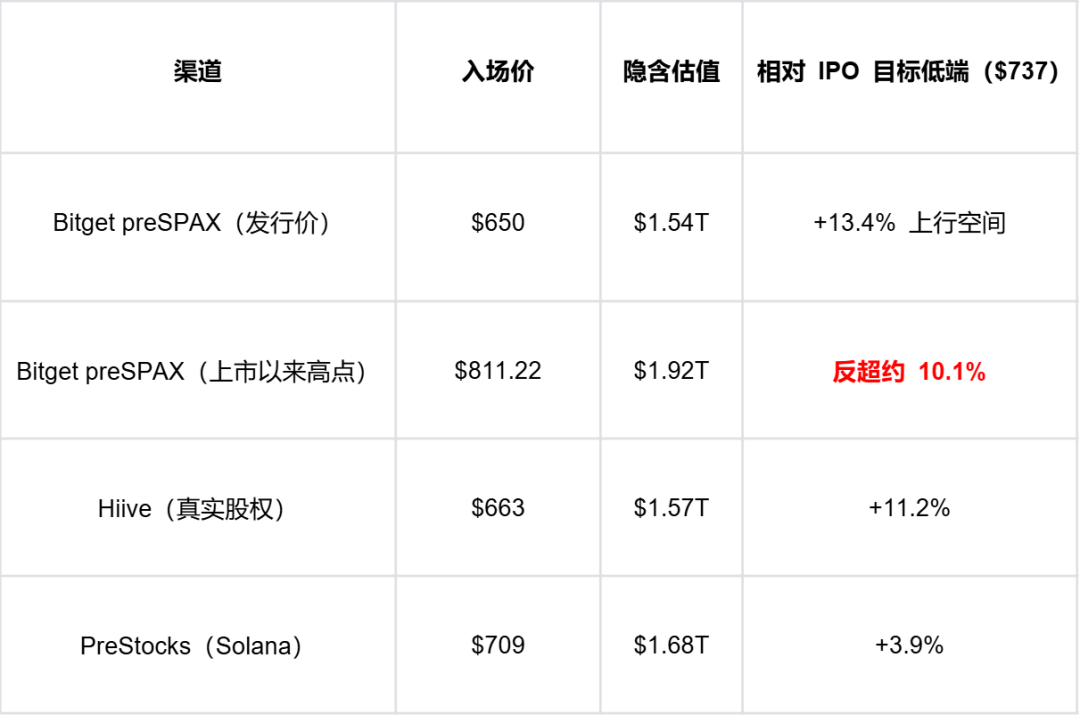
Based on the issuance price, preSPAX has the lowest entry price among all tradeable SpaceX exposures and does not require accredited investor status.
This also explains why more than half of the subscribers didn't immediately sell after the listing – they weren't betting on a few percentage points of opening premium, but on the entire trajectory of SpaceX's primary market valuation converging towards its IPO pricing.
SpaceX is expected to list on Nasdaq in June 2026, with a target price of $737/share ($1.75 trillion market cap) and a retail allocation of 30% – an unusually high proportion for large US IPOs.
Based on mainstream broker base-case scenarios, starting from the preSPAX issuance price of $650, the 6-month upside potential is approximately 13% to 20%, and under optimistic scenarios, 30% to 46%.
04 The Second Crack Opens on OpenAI
IPO Prime is not Bitget's first step in the direction of tokenized assets.
Previously, Bitget had already delved into tokenized stocks for some time. Data from Lookonchain shows that shortly after launch, the cumulative trading volume of Bitget's stock tokens reached $1 billion. In December 2025, its monthly trading volume accounted for 89.1% of Ondo's global market share.
IPO Prime extends this further: moving from tokenized stocks in the secondary market to Pre-IPO shares in the primary market. The success of Phase 1, preSPAX, directly led to Phase 2.
preOPAI Key Parameters
Compliance framework is consistent with Phase 1: Republic's Cayman exempted entity issues a Mirror Note under Regulation S of the US Securities Act of 1933, 1:1 pegged to the economic benefits of OpenAI's IPO. Regulated by CIMA, with annual audits.
OpenAI's implied valuation is $898.2 billion. 1 preOPAI = $725. Total subscription of 29,082 units, totaling approximately $21.08 million. Commitment pool limit of $300 million. Minimum investment starting from $100. VIP individual investment limits range from $10,000 (VIP 0) to $600,000 (VIP 7), supporting USDT and USDGO.
Xie Jiayin, Head of Bitget's Chinese Market, characterized this phase as: "preOPAI is the only token on the entire internet backed by real equity."
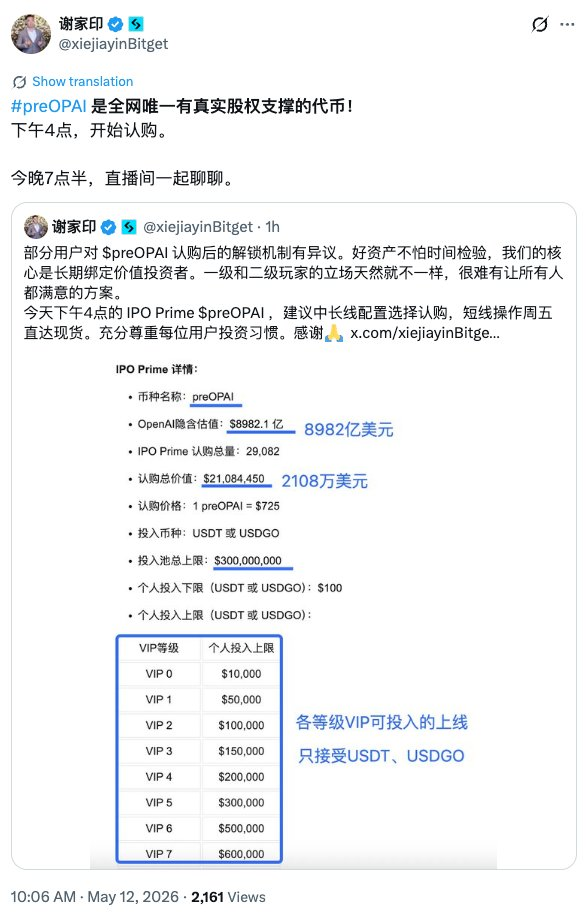
This points directly to the previously mentioned Republic + SPV + Mirror Note structure – the economic benefits behind the token are 1:1 linked to OpenAI's primary equity. It's not an IDO, not a contract token with no backing, and not a bare on-chain exposure.
Why OpenAI?
Valuation multiplied 28x in three years: From a $30 billion private placement round in April 2023 (Thrive Capital + Microsoft) to an $852 billion super funding round in March 2026 (SoftBank, a16z, Microsoft, Nvidia, Amazon).
ARR surpassed $20 billion by the end of 2025, a 10x increase in 3 years – the fastest company in SaaS history to reach $20 billion in ARR.
CFO Sarah Friar publicly stated that the S-1 is planned to be filed before the end of 2026, with an IPO targeted for 2027 at a valuation of $1.5 trillion.
Between the $852 billion valuation and the target $1.5 trillion, the entry price of $898.2 billion via preOPAI is the key to this window.
Rule Adjustments
Phase 2 introduces a partial lock-up mechanism and includes special rewards like financial management bonuses for users, designed to encourage long-term holding.
In other words, Bitget is actively filtering users for IPO Prime, retaining those who recognize the logic of "mid-to-long-term scarce asset allocation". This aims to turn it into a reusable asset gateway, rather than a one-off short-term hype.
05 Summary
Competition among exchanges in 2026 is no longer about "who lists more coins," but about "who can offer a wider variety of asset classes."
Bitget, with Phase 1 connecting to SpaceX (valued at $800 billion) and Phase 2 connecting to OpenAI (valued at trillions), has used blockchain to break down the capital game dictated by Reg D ("net worth of $1 million / annual income of $200,000") – which excluded 99% of participants – into units purchasable for $100 each.
SpaceX challenges the boundaries of the aerospace industry, OpenAI challenges the boundaries of intelligence itself, and Bitget challenges the boundaries of traditional finance.
preSPAX has already provided its answer with a peak gain of 24.8%. The subscription window for preOPAI opened at 4 PM today.
The same ticket, extending from Musk's 'stars and seas' to Altman's intelligent future.
```