






L1 Breaks the Ice First: SUI Up 24% in a Week, TON Doubles in Three Days – Is a Small Altseason on the Horizon?


- Core Thesis: Over the past two weeks, the crypto market has shown signs of recovery. Within the L1 sector, TON and SUI have staged independent rallies driven by their unique fundamental catalysts. This could signal the beginning of an altcoin rotation, but a full-scale rotation still awaits confirmation from macroeconomic conditions.
- Key Factors:
- Macro Background: Bitcoin dominance has risen to 60.3%, hitting a new yearly high, while the Altcoin Season Index stands at around 35. The market remains in "Bitcoin Season," but L1s have already made the first move.
- TON Catalyst: Telegram founder Durov announced that Telegram has become the largest validator on TON. Combined with the Catchain 2.0 upgrade (reducing block time to 400 milliseconds) and a 6x reduction in transaction fees, the token's price surged from $1.35 to $2.89 in just three days.
- SUI Catalyst: Within a month, SUI secured a "trifecta" of institutional catalysts: a spot ETF filing, the launch of CME futures, and a major staking commitment by a publicly listed company (SUI Group Holdings staking 108.7 million SUI). It also partnered with Nigeria's Paga for payments.
- Historical Precedent: The combination of high Bitcoin dominance and a low Altcoin Season Index was observed 2 to 6 months before the start of massive altcoin rallies in 2016-2017 and 2020-2021.
- Conditions for Rotation: A broad altseason would typically require Bitcoin dominance to break below 54% and the Altcoin Season Index to surpass 75. Current indicators are far from these thresholds, so a comprehensive rotation is yet to be confirmed.
Original Author: Curry, TechFlow from Shenchao
Will you return to crypto for a living?
The crypto market has seen a recovery in the past two weeks. Beyond the localized on-chain narrative of the Uniswap Hook V4, a group of "old guard" tokens have experienced a resurgence.
Among them, the L1 sector has shown solid performance, with ZEC, TON, and SUI standing out with impressive gains. We covered ZEC last week, while SUI and TON charted independent paths against a backdrop of a sideways market: TON surged from $1.35 to $2.89 in three days, and SUI broke through $1.24, gaining over 24% in a single week.
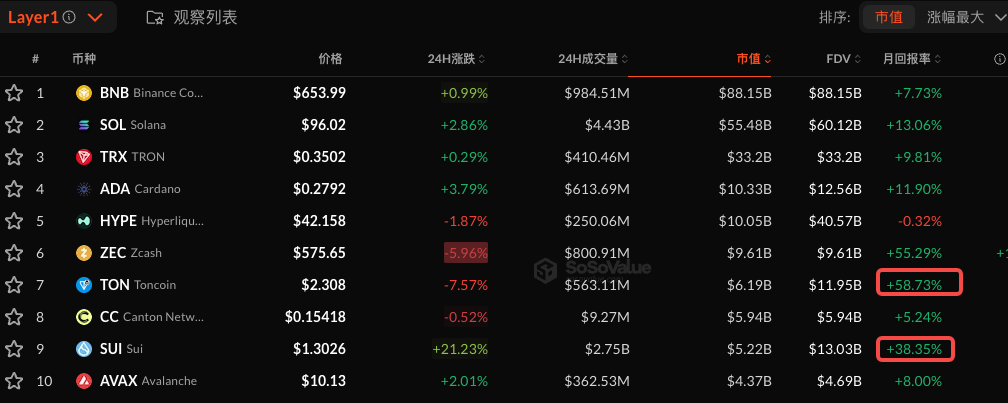
Each chain has its own verifiable catalysts on the news and fundamental front. At the same time, does the L1 sector's early movement signal a broader altcoin rotation is about to begin?
BTC Dominance Hits a New Yearly High, But L1 Sector Moves First
Let's look at the macro backdrop first.
According to Bitget data, as of May 9, BTC dominance rose to 60.3%, the highest level for 2026. The Blockchaincenter Altcoin Season Index reads around 35, far below the 75 threshold needed to confirm an altcoin season, indicating the market is still in a "Bitcoin season."
However, structural signals are emerging. BTC dominance has been consolidating in the 58%-60% range for nearly eight months (August 2025 to April 2026), with the RSI showing signs of stagnation.
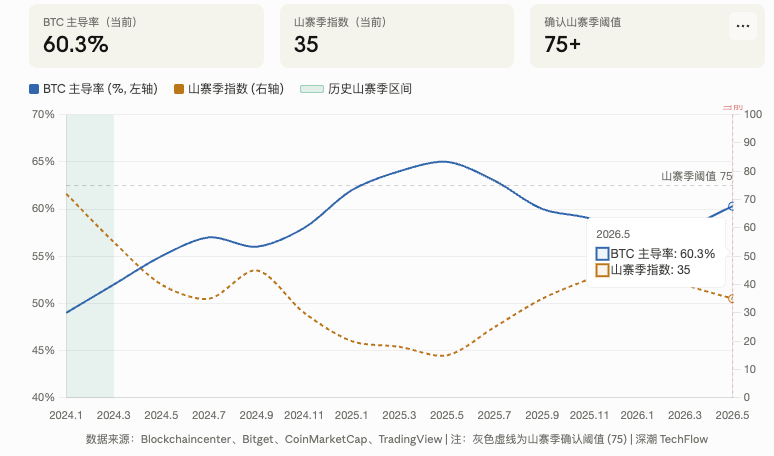
Analyst el_crypto_prof on X noted that the weekly structure of the total altcoin market cap (excluding BTC) bears a strong resemblance to the patterns seen just before the start of the 2016-2017 and 2020-2021 altcoin seasons. In both historical instances, the combination of high dominance and a low Altcoin Season Index ultimately appeared 2 to 6 months before the most profitable altcoin rallies.
It is precisely within this window—where the macro picture remains unconfirmed but individual projects are already moving—that SUI and TON have charted their independent courses.
TON: Telegram Transforms from "Partner" to "De Facto Controller"
TON's rally has a precise trigger: On May 4, Telegram founder Pavel Durov announced on X that Telegram would replace the TON Foundation, becoming the largest validator and primary driving force of the TON network.
The significance of this needs historical context.
In 2020, Telegram was forced to exit the TON project due to an SEC enforcement action, returning $1.22 billion to investors and paying an $18.5 million fine. Durov announced the project's termination in a blog post. Subsequently, the TON Foundation operated as an independent community for five years.
Six years later, Durov himself returned, staking approximately 2.2 million TON, and the ton.org domain switched to an "MTONGA" (Make TON Great Again) themed page.
According to The Defiant, TON surged 33% that day, hitting an intraday high of $1.90. By May 7, the price had rocketed from $1.35 at the start of the month to near $2.89, a roughly 114% gain in three days, with a 24-hour trading volume of $3.31 billion, the highest in TON's history. CoinGlass data shows futures open interest concurrently rose to $628 million, a three-year record.
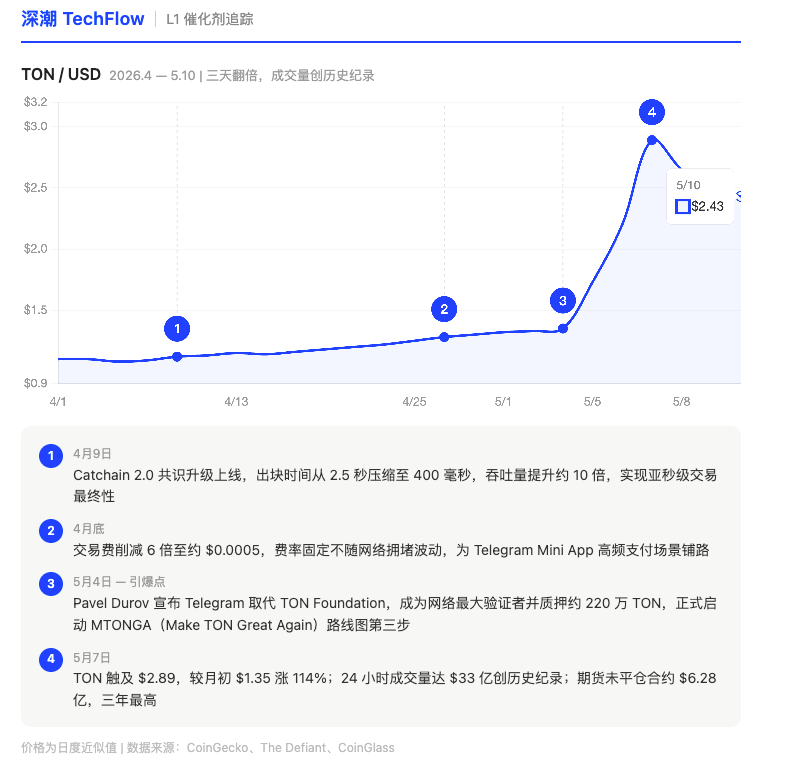
Before Telegram's takeover, Durov spent a month executing a series of intense technical upgrades:
- April 9: The Catchain 2.0 consensus upgrade went live, reducing block time from 2.5 seconds to 400 milliseconds and improving throughput by approximately 10x. In Durov's own words on X, TON is now "the fastest chain with the lowest finality among all major L1s."
- Late April: Transaction fees were slashed from roughly $0.0023 to about $0.0005, a 6x reduction. Fees are now fixed and don't fluctuate with congestion. Durov stated that "most transactions will be completely free" going forward.
Institutional adoption followed suit. Japan's Rakuten Wallet listed TON spot trading in mid-April, and CoinShares launched a TON staking ETP on the Swiss SIX Exchange. Reports indicate that USDT supply on the TON network has surpassed $500 million, and the monthly trading volume of perpetual contracts on Telegram's built-in wallet exceeded $1 billion.
TON's technical upgrades continue. Durov's goal is to transform Telegram into a super-app gateway integrating payments, DeFi, AI agents, and private communication, with TON serving as the underlying financial layer.
However, in the author's opinion, Telegram becoming the largest validator inherently increases the network's dependence on a single entity. If Telegram faces regulatory scrutiny again (the lingering shadow of the SEC case) or its validator node experiences issues, the impact on the network and token price could be far more severe than under a more decentralized structure.
SUI: A Month of Institutional "Triple Whammy"
SUI's catalysts come from a different direction: a dense cluster of institutional infrastructure milestones within a month.
Previously, only BTC and ETH could boast having simultaneously a US spot ETF, CME futures contracts, and significant staking by a publicly listed company. Starting in May, SUI joined this club:
- Spot ETF Cluster (Late February): 21Shares TSUI (Nasdaq, 0.30% fee), Canary Stake SUI ETF, and Grayscale SUI Staking ETF were listed within a week. Bitwise, Franklin Templeton, and VanEck also have related positions.
- CME Futures Launch (May 4): Standard contract (50,000 SUI) and micro contract (5,000 SUI), cash-settled. FalconX and G-20 Group executed the first block trade on May 6. Starting May 29, all CME crypto derivatives will transition to 24/7 trading.
- Listed Company Large-Scale Staking (May 9): Nasdaq-listed SUI Group Holdings staked its entire holding of 108.7 million SUI (2.7% of circulating supply) natively, causing the price to jump 13% on the day.
- Emerging Market Payments Go Live (May 9): At Sui Live Miami, Nigerian fintech company Paga announced deep integration with Sui, planning to use the native stablecoin USDsui to offer users USD accounts and tokenized bonds. Paga processed $11 billion in transactions in 2025.
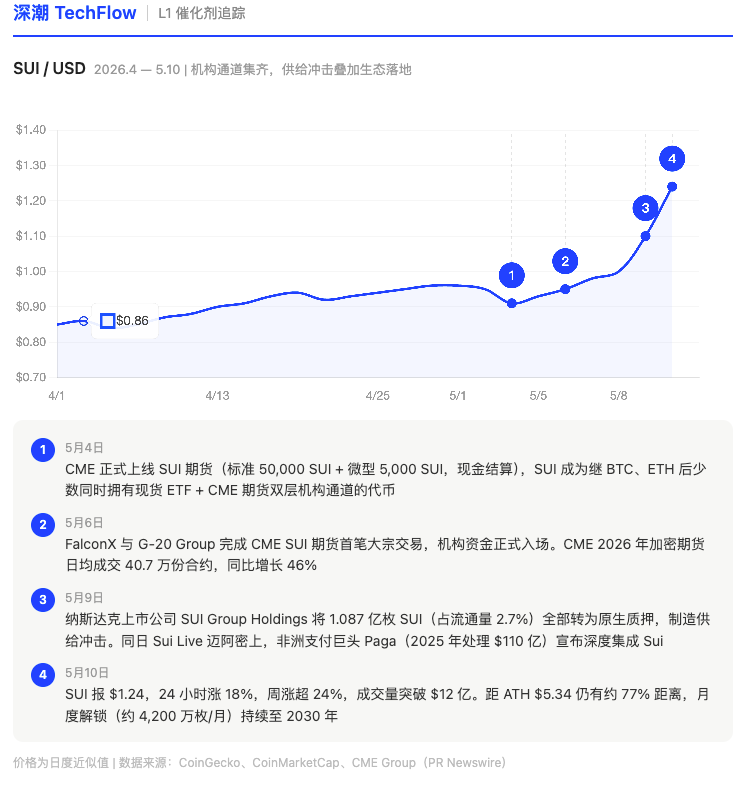
According to CryptoNews analysis, SUI now has a complete "three-tier institutional access structure": spot ETFs for passive allocation, CME futures for active hedging, and staking products for yield generation. Only BTC and ETH had this structure 18 months ago.
As of May 10, SUI was trading at $1.24, up over 24% for the week, with trading volume exceeding $1.2 billion. Interestingly, on the day CME futures launched, SUI actually dipped slightly to $0.91. The real rally occurred five days later, coinciding with the staking lock-up and the Paga partnership announcement. Simultaneously, tokens within the Sui ecosystem also experienced a positive spillover effect, showing decent gains.
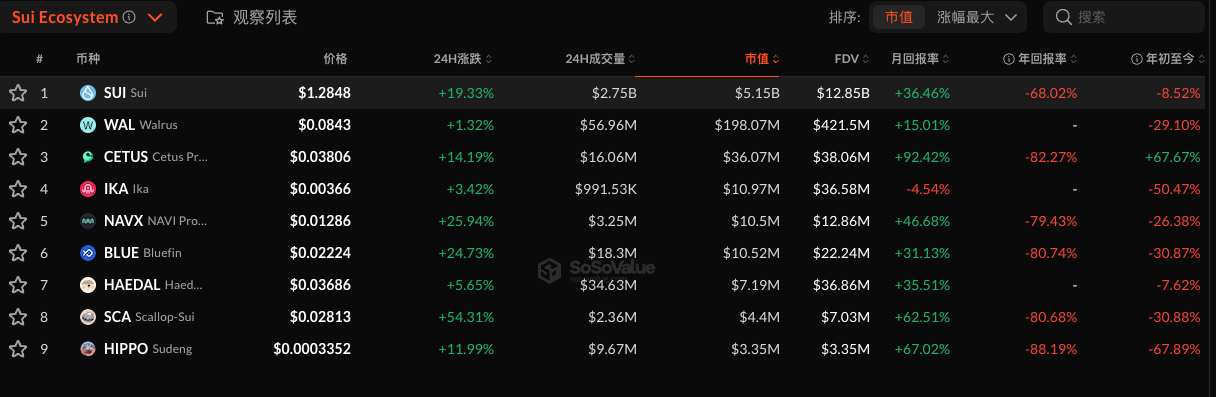
L1 Recovery: Can It Spread to Altcoins?
Examining SUI and TON together, their catalyst structures are completely different. However, the commonality is that project-specific, verifiable fundamental events are driving the price action, not macro liquidity or emotional beta.
Returning to the macro level, the conditions for confirming a broad altcoin season are currently not met. According to historical patterns compiled by Phemex, BTC dominance needs to break below 54% and stay there for over two weeks, and the Altcoin Season Index needs to break above 75 to constitute a reliable rotation signal. The current readings of 60% dominance and an index of 35 remain clearly distant from these thresholds.
Historical data provides a reference:
In late 2019 and late 2020, the combination of high BTC dominance and a low Altcoin Season Index ultimately preceded a large-scale altcoin rally by 2 to 6 months.
During those times, it was also the leading projects with independent catalysts that moved first, before capital gradually spread to small and mid-cap tokens. The unusual price action in SUI and TON may represent this early phase of "individual projects leading, overall rotation awaiting confirmation."
The water warms in spring, and the ducks have already stirred. But the ice on the river hasn't completely melted yet.





