MSTR Earnings Review: "Safety Valve" Added to the Self-Reinforcing Flywheel, Arbitrage Space Opens


Core Trading Summary (TL;DR)
MicroStrategy's (MSTR) latest earnings report has fundamentally changed its playbook: it's no longer a case of "blindly printing shares to buy Bitcoin." Instead, the company has now provided a clear, stated metric — the 1.22x mNAV (net asset value premium). This number will determine whether MSTR buys or sells coins going forward.
● For MSTR:
○ Premium > 1.22x: Continue the old routine: issue overpriced shares, use the proceeds to buy BTC.
○ Premium < 1.22x (Key Reversal): Issuing more shares becomes uneconomical. Management has explicitly stated that if the premium falls below this level, they will sell BTC to raise cash for debt repayment or share buybacks.
● How to Arbitrage: If MSTR's premium drops below 1.22x, it triggers a conditional arbitrage opportunity to "go long MSTR, short BTC." This is because the company itself will step in to "sell Bitcoin and buy its own stock," with its selling action narrowing the spread. This management statement is the core confidence behind this arbitrage trade.
● For STRC (Preferred Stock): Previously, there were fears that a MicroStrategy liquidation would render this 11.5% dividend preferred stock worthless. Now, with the official statement that they will "sell Bitcoin to repay debt if necessary," STRC has a tangible safety net, no longer just a Ponzi gamble.
● For the BTC Market Overall: The myth of "MicroStrategy holds forever and never sells" is shattered, creating short-term bearish sentiment. However, the upside is that the company actively selling coins to deleverage completely eliminates the risk of a forced cascade liquidation in a deep bear market.
Diamond Hands No More: The 1.22x mNAV is the Lifeline and the Dividing Line for Bitcoin Bulls and Bears
Over the past two years, there has been much FUD surrounding MSTR, particularly regarding how it controls its leverage and interest expenses. As Bitcoin generates no cash flow, how can MSTR finance the interest payments on its debt? In this Q1 earnings call, management stated clearly: if the mNAV falls below 1.22x, they will sell Bitcoin.
This effectively reveals the company's "hand" and "automatic execution program":
● Above the Waterline (Expansion/Absorption Phase): The company is a BTC bull. As long as retail investors are willing to pay a premium above 1.22x, MicroStrategy can achieve "risk-free balance sheet expansion." The positive flywheel of issuing shares -> buying BTC -> increasing book value -> boosting the stock price will keep turning.
● Below the Waterline (Defensive/Contraction Phase): The flywheel screeches to a halt. If MSTR's valuation falls too far below the value of its Bitcoin holdings, continuing to issue shares would be selling off company assets at a discount. Rationally, management states that under such conditions, selling BTC for cash to pay dividends, manage debt, or repurchase MSTR common stock at depressed prices provides the greatest value enhancement for existing shareholders.
This means MSTR now has a hard "value floor." It is no longer a runaway train without brakes.
Arbitrage Opportunity: Long MSTR / Short BTC When mNAV Drops Below 1.22x
What does an arbitrageur fear most? Identifying a fantastic spread, only for the market to remain persistently irrational (e.g., MSTR staying at a discount), eventually draining capital through funding rates or interest costs.
However, the 1.22x threshold provided by MSTR offers a high-conviction arbitrage opportunity.
In-Depth Practical Logic:
● Strict Trigger Condition: Only when MSTR's mNAV decisively breaks below the 1.22x level.
● Positioning Action: At this point, MSTR's price is "excessively undervalued" relative to its underlying BTC assets. A trader would go long MSTR while simultaneously shorting an equivalent market value of BTC.
● The Unbeatable Core Logic: Even if market participants don't close the spread, MicroStrategy's management will force it to. Once the threshold is breached, management, aiming to maximize "BTC per share," will initiate their promised self-rescue operation — "selling BTC to buy back undervalued MSTR stock." Do you see it? The direction of your long/short position will be perfectly aligned with the direction of MicroStrategy's hundreds of billions of dollars in official market support. You don't need to predict whether BTC will go up or down tomorrow; you simply collect the risk-free profit from the "spread convergence."
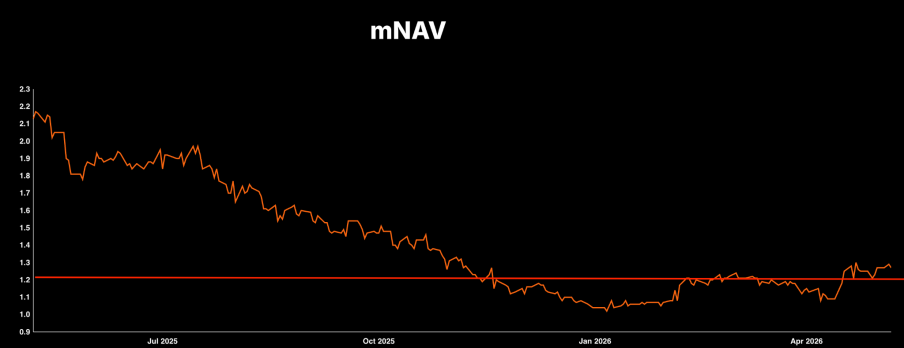
Trading Tip: Currently, MSTR's premium is oscillating around 1.28x, not yet triggering the arbitrage condition. Opening a position now would be getting ahead of yourself. However, it has entered an excellent sniper radar zone. Set price alerts and wait for the break below before acting.
3. STRC (Preferred Stock) Safety Net Significantly Enhanced
STRC offers a juicy 11.5% dividend yield. In the old bearish narrative, MicroStrategy was seen as an over-leveraged gambler. If Bitcoin suffered a black swan event (e.g., a >50% crash), a cash crunch could render STRC preferred stock worthless instantly.
But the Q1 earnings report thoroughly revealed the company's true financial health, not only disproving the bears but also giving fixed-income investors a dose of reassurance:
● Staggering Asset Depth: The company has $13.5 billion in preferred stock and $8.2 billion in convertible bonds on the liability side, offset by a massive $64 billion BTC reserve on the asset side. The net leverage ratio is a mere 9%, an extremely conservative balance sheet by traditional finance standards.
● Extreme Stress Test: Even if the crypto market repeats a major crash, with BTC falling 90% from current levels (to $7,300), selling the holdings would still be sufficient to repay all net debt.
● Cash Moat: In the worst-case scenario, if Bitcoin liquidity dries up temporarily, the company holds $2.25 billion in pure cash. Even earning a paltry interest rate on this cash, it would be enough to comfortably cover debt interest and preferred dividends for the next 1.5 years (annual cost of $1.5 billion). All things considered, as long as BTC grows by a modest 2.3% annually, STRC's interest payments are perfectly covered.
The core expectation reversal lies in: management broke the dogma of "never sell coins." This means that before an extreme crisis hits, they will proactively and gradually sell Bitcoin to protect the company's credit rating and ability to service debt. STRC has completely shed its "crypto Ponzi high-yield debt" label. Its risk pricing logic is now aligning with traditional high-quality corporate bonds, making it highly likely to attract allocation buying from traditional institutional capital.
4. Impact on the BTC Market: Losing the "Die-Hard Buyer," Dismantling the "Cascading Liquidation Bomb"
The emotional impact of this call on the BTC spot market is dual-sided and requires traders to consider different timeframes:
● Short-Term Pain (Sentimentally Bearish): Retail investors previously viewed MicroStrategy as a mythical "only-buys, never-sells, always-provides-support" entity. Management's admission that they would sell if valuations are off directly shatters this bullish totem, delivering a significant blow to market sentiment and speculative hype in the near term.
● Long-Term Bullish (Structural Upgrade): Experienced traders know why the last bear market (2022) was so brutal. Behemoths like LUNA, Three Arrows Capital, and Celsius all chose to "hold until the end," leading to forced liquidations when liquidity dried up completely, triggering a cascading sell-off. MicroStrategy is no longer a blind "believer" but a calculating "Wall Street veteran." It has established clear sell warning lines and knows how to reduce leverage proactively during early stages of a crisis. This effectively removes the single biggest "systemic liquidation nuclear bomb" hanging over the crypto market.
Summary: MicroStrategy remains the largest "BTC bull commander" in the entire US stock market. However, it has evolved from a reckless charger into a calculating actuary, capable of advancing and retreating strategically, even reversing market sentiment for its own gain.