






The Next Generation of Crypto Security Is Built Around Isolation, Not Devices


- 核心观点:下一代加密资产安全正从依赖硬件钱包等单一设备,转向基于系统隔离、架构设计和后量子密码学的“无硬件安全模型”,以应对复杂攻击和未来风险。
- 关键要素:
- 硬件钱包的安全建立在信任设备制造商、固件及供应链的基础上,这与加密行业去信任化的理念存在固有矛盾。
- 硬件钱包在交易签名时需与联网设备交互,攻击者可利用恶意合约、假网站等手段篡改交易信息,这是其关键现实局限。
- 隔离加密钱包通过分离私钥管理、交易签名和网络广播环境,使攻击者即使入侵联网部分也无法直接获取私钥,实现了“架构即安全”。
- NIST于2024年发布首批后量子密码标准,提示量子计算对现有加密算法的破解风险已进入现实讨论阶段,需提前防范“现在收集,未来解密”。
- Lock.com等项目探索的无硬件安全模型,致力于通过开源、可审计的系统设计减少对单一物理设备或厂商的依赖,作为下一代安全基础设施的早期方向。

Over the past decade, hardware wallets have been a key pillar of security in the crypto space. However, as on-chain transactions become more frequent and attack vectors more sophisticated, the limitations of this approach are becoming apparent. Security concerns are no longer just about whether private keys are stored offline; they now encompass transaction signing, online interactions, supply chain trust, and the long-term risks posed by future quantum computing. The next generation of crypto security is shifting from "relying on a single, more secure device" to "relying on a more robust system architecture."
1. Hardware Wallets: The Once Most Trusted Security Solution
In the realm of crypto self-custody, hardware wallets have long been considered the gold standard for security. The cold storage philosophy championed by brands like Ledger and Trezor has become a consensus for many crypto users: Private keys are stored on an offline device, transactions require physical confirmation via the device, making it difficult for hackers to directly access user assets over the network.
For a long time, this logic held true. An offline device could indeed thwart most remote attacks. For early crypto users, hardware wallets offered a simple, clear, and tangible sense of security.
But as the scale of crypto assets has grown, on-chain transactions have become more frequent, and attack methods more complex. A crucial question has emerged: Are hardware wallets still secure enough? Are they merely the current mainstream solution, rather than the ultimate form of crypto security?
Against this backdrop, more security researchers are turning their attention to a new approach: isolated crypto wallets, which protect private keys and transaction signing through clearer system-level isolation.
2. Rethinking Hardware Wallets: Security Still Carries a Trust Cost
Hardware wallets appear very secure, but their security is built upon many underlying assumptions.
First, users must trust the device manufacturer. For instance, is the device firmware secure enough? Has the supply chain been tampered with? Has the secure chip undergone reliable audits? These are questions that are nearly impossible for the average user to verify independently.
Second, firmware updates can also introduce risks. Hardware wallets require regular updates to patch vulnerabilities and support new features, but users often struggle to determine if an update is fully trustworthy. In many cases, they must simply trust the vendor.
Additionally, the physical device itself carries risks. It can be lost, stolen, seized, or even subjected to targeted physical attacks. Even if the device itself isn't compromised, the seed phrase used for wallet recovery can become a new point of vulnerability.
Therefore, the issue with hardware wallets isn't that they are "insecure," but that their security still relies on specific devices, manufacturers, and supply chains. For an industry that emphasizes decentralization and trust minimization, this dependency is increasingly being re-evaluated.
3. The Practical Challenge of Hardware Wallets: They Must Interact with Connected Devices
The core security promise of a hardware wallet is that the private key never leaves the device. However, in real-world use, the transaction still needs to be broadcast to the blockchain network.
This means that when signing a transaction, the hardware wallet typically needs to interact with a phone, computer, or other internet-connected device. Whether via USB, Bluetooth, or QR code, this interaction creates a potential point of vulnerability.
Many attacks don't require directly stealing the private key. Attackers might alter transaction details, tricking users into signing what they believe is a normal transaction while actually authorizing a malicious operation. Or they might use malicious contracts, fake websites, clipboard hijacking, or other methods to trick users into performing dangerous actions unknowingly.
This highlights a practical limitation of hardware wallets: The device itself can be offline, but the user's transaction process can rarely be fully offline.
For users seeking higher security, stricter air-gapped devices exist (never connecting to a network and transmitting data only through methods like QR codes). However, these are more complex to operate and difficult for the average user to maintain over the long term. Ultimately, most users end up making a trade-off between security and convenience.
Consequently, the industry is exploring another possibility: instead of relying on users to always operate the device correctly, why not design the system to clearly separate private keys, signing, and network connectivity?
4. Isolated Crypto Wallets: Building Risk Isolation into System Design
The core idea behind an isolated crypto wallet is straightforward: separate private key management, transaction signing, and network broadcasting into distinct environments.
Simply put, the private key and signing environment remain as offline as possible, without direct internet access. The connected part is solely responsible for sending the already-signed transaction to the blockchain and cannot access the private key.
The advantage of this design is that even if the connected part is compromised, attackers can only access the signed transaction data and cannot directly obtain the private key. For users, this is akin to storing their most important asset key in a more enclosed, less accessible environment.
The key difference from traditional hardware wallets is that hardware wallets rely more on a specific physical device to achieve isolation, whereas isolated crypto wallets emphasize the structural design of the entire system. Security depends not entirely on a specific hardware device but on whether the key, signing, and network components are truly separated.
This embodies the principle of "architecture as security": security isn't just about buying a secure device; it's about proactively separating dangerous pathways from the outset.
5. Post-Quantum Security: Future Risks Are Entering Practical Discussions Today
Beyond current attack risks, another issue gaining traction in the industry is quantum computing.
Many cryptographic algorithms underpinning today's crypto systems, such as elliptic curve cryptography and RSA, are considered secure in the context of classical computers. However, if a sufficiently powerful quantum computer were to be developed in the future, these algorithms could be at risk of being broken.
While this may sound like a distant future problem, the global cryptographic community has already begun preparing. The US National Institute of Standards and Technology (NIST) released its first set of post-quantum cryptography standards in 2024, indicating that post-quantum security has moved from theoretical discussion to practical implementation preparation.
This issue is particularly critical for crypto assets. Because once blockchain assets are exposed to a risk, the impact can be long-term. Notably, there's an attack strategy known as "harvest now, decrypt later." Attackers can collect encrypted data today and attempt to decrypt it once quantum computing matures in the future.
Therefore, post-quantum security isn't a concern to address only after quantum computers become truly viable. For users and projects holding assets for the long term, proactive planning is itself an integral part of a security strategy.
6. The Hardware-Free Security Model: Reducing Dependence on Single Devices
Behind the concept of isolated architecture lies a new security paradigm.
The traditional hardware wallet approach reduces risk through a physical device. It places the private key inside the device, making it harder for attackers to reach via the network. This method is effective and has been validated by the market.
However, the hardware-free security model attempts to further reduce reliance on specific devices. It asks a key question: Can we design systems in a way that makes certain attack paths inherently unviable?
This approach leads to several changes.
First, users no longer need to place complete trust in a single hardware vendor. Second, security is no longer entirely tied to a specific chip or device. Third, if the system itself is open-source and subject to community audits, security assessments can become more transparent.
This is not to say hardware wallets have no value. A physical device could still be an important tool within a security system. However, in the next generation of crypto security infrastructure, it may no longer be the sole core component, but rather one part of a larger security architecture.
7. Lock.com: An Early Explorer in This Direction
In this field, Lock.com is one of the earlier projects to clearly explore isolated signing architecture and post-quantum security.
Lock.com is still in an early access phase and has not been fully publicly released. It aims to integrate private key management, offline signing, and post-quantum cryptographic concepts into a single hardware-free architecture, hoping to reduce the traditional hardware wallet's reliance on physical devices and manufacturer trust.
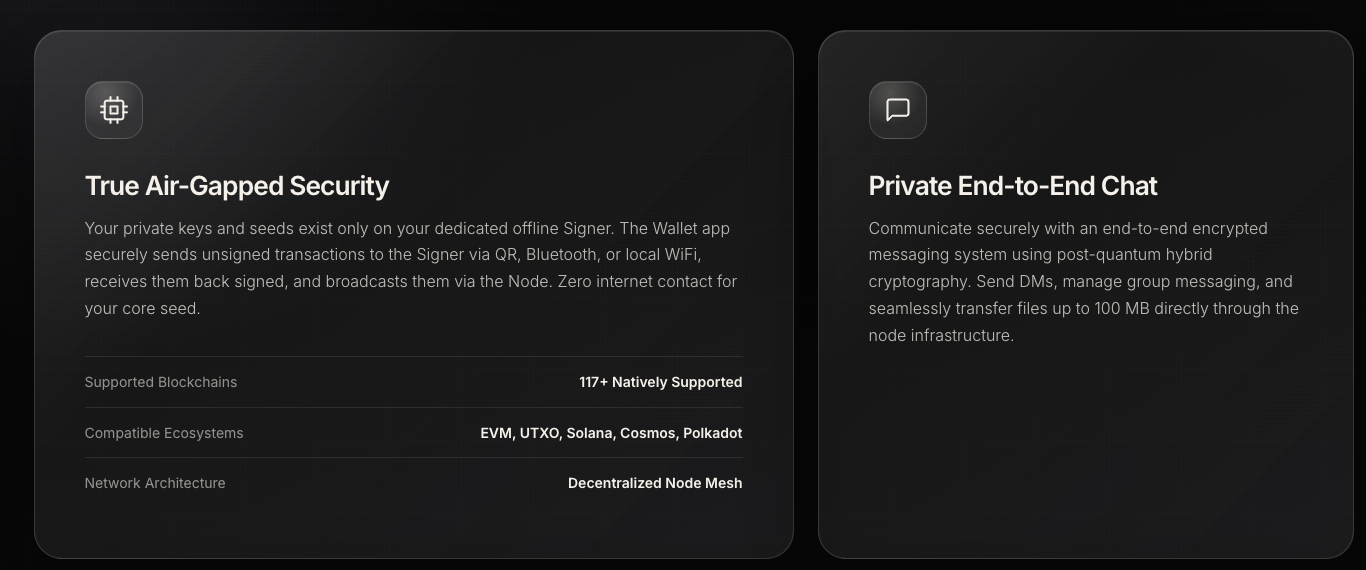
As the project is still in its early stages, many technical details and product features require further refinement. However, from a directional standpoint, it represents a new way of thinking emerging in the industry: the future of wallet security may depend not only on whether the device is secure enough but also on whether the system architecture is clear enough and the isolation is thorough enough.
8. Crypto Infrastructure is Evolving from Point Tools to Complete Systems
The emergence of hardware-free wallets is not an isolated phenomenon. It reflects a broader trend of upgrade within crypto infrastructure.
In the past, wallets, communication, storage, and transaction execution were often handled by disparate products. Users had to combine various tools themselves and bear many operational risks. In the future, these functions may be integrated into more comprehensive infrastructure.
Simultaneously, how users judge security is changing. Previously, many relied on brand reputation and device reviews. Now, an increasing number of users and developers are focusing on whether the code is open-source, the system is auditable, and the architecture is transparent.
In other words, the feeling of security is shifting from "I trust this brand" to "I can understand and verify this system."
Within this trend, the direction represented by Lock.com is a vision for next-generation security infrastructure: where security is not tied to a single device or vendor but is embedded within the system architecture itself.
9. The Industry is Asking a Different Question
A significant change is underway in the field of crypto security.
In the past, the most common question from users was: Which hardware wallet should I buy?
Now, more people are starting to ask: Which security architecture should I trust?
This shift in questioning indicates that the industry's understanding of security is deepening. Hardware wallets have undeniably protected a vast amount of user assets over the past decade, and their historical value should not be dismissed. However, with the evolution of attack methods, the emergence of quantum computing risks into the discussion, and the development of new isolated architectures, it is no longer certain whether hardware devices are the ultimate answer.
The next generation of crypto security infrastructure will likely reduce its dependence on single physical devices, relying more on system design, key isolation, and forward-looking cryptographic solutions.
This transformation has already begun.





