






Top Polymarket Traders Made Millions: What Strategies Do They Use?


- Core Insight: There is no single profitable strategy in the Polymarket prediction market. The success patterns of top wallets fall into at least three distinct and largely uncorrelated categories; position count and per-trade profit are two independent variables that define the fundamental differences among traders.
- Key Elements:
- Political markets far outweigh other categories in scale: The top 10 political wallets generated a total profit of $94 million, dwarfing sports ($60 million) and crypto ($25 million). The top political earner made $22 million, while the sports category champion only reached $11.3 million.
- High-conviction heavy positions vs. high-frequency trading: Political whale "Theo4" earned $22 million with just 18 positions, averaging over $1 million profit per position. In contrast, sports trader "swisstony" accumulated $7.8 million through over 150,000 positions, averaging just $45 per trade.
- Three distinct strategies: First, political experts (e.g., Theo4) rely on a few high-conviction heavy bets; second, systematic sports traders (e.g., swisstony) use automated models for thin-margin, high-frequency profits; third, cross-category generalists (e.g., MonsieurDimanche) diversify profits across 9 different markets.
- Specialization and diversification coexist: Theo4 derives 100% of his profits from political markets, while MonsieurDimanche's earnings are spread across multiple categories with no single category exceeding 31%. Both models can lead to the top.
- The "middle ground" is penalized: Successful traders on the leaderboard all go deep into a single niche; traders stuck in the middle in terms of breadth and volume struggle to replicate their success.
Original Title: The Best Traders on Polymarket
Original Author: Kiyotaka
Original Translation: SpecialistXBT, BlockBeats
Editor’s Note: In the crypto market, profit is the report card. Starting from the on-chain data of top Polymarket wallets, this article explores whether the biggest winners in the prediction market rely on information asymmetry, models, conviction, or sheer trading discipline. The conclusion is that there is no universal strategy for consistently making big profits; the top three profitable well-known accounts employ three almost completely different methods of making money.
After researching the wallets that have made millions of dollars on the world's largest prediction market, it's clear that there isn't a unified approach. Instead, there are at least three, and they have almost nothing in common.
If you frequently browse the prediction market circle on Twitter, you'll quickly see the same set of anonymous IDs appearing in various "biggest winners" list posts. Theo4 made a fortune in the 2024 election market. swisstony quietly and consistently profits from NBA betting markets. MonsieurDimanche seems to appear in the comment sections of almost every market. After a while, you start to wonder: Are these people the same type? Do they do the same things? Is there some identifiable archetype for someone who is "good at Polymarket"?
Your intuition says: Yes. Just like you'd think there's a common archetype for someone "good at poker": patience, mathematical ability...
But after examining the on-chain data of all Top 20 wallets on the platform, the real answer is: No, there is no such unified archetype. There are at least three types, and possibly more. Apart from all appearing on the leaderboard, they have almost nothing in common. This answer is more interesting than expected, so it's worth breaking down exactly what the data tells us.
The data below is from Polymarket, current as of May 5th. The top 10 wallets in political markets alone contributed $94 million in profit; the top 10 in sports contributed another $60 million; and the third largest category, Crypto, contributed $25 million. This figure is even less than the total profit of the top three political wallets.
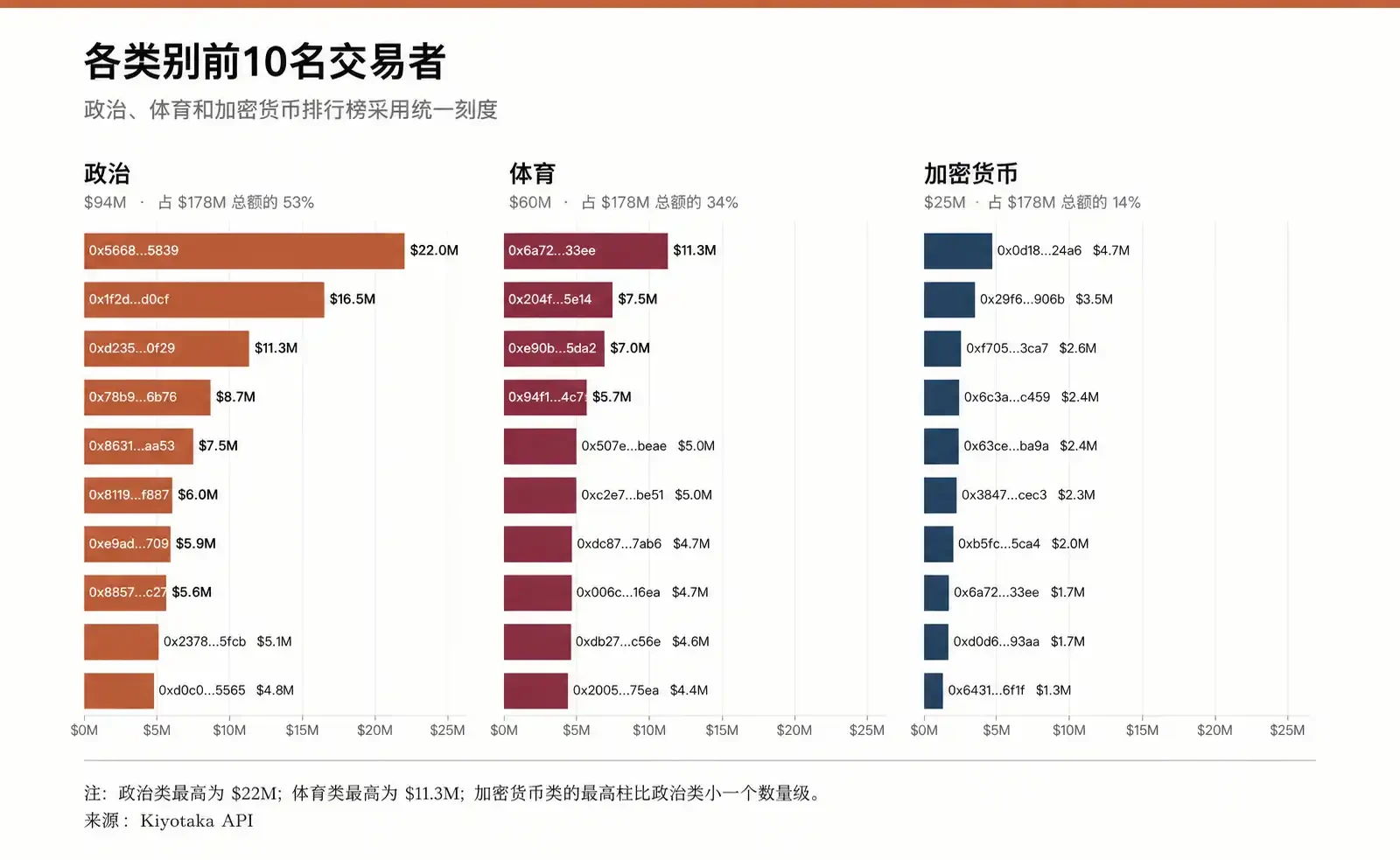
Political Markets Are on Another Level
Comparing the top wallets of each category on the same dollar scale. Political markets clearly lead, both in peak profit for a single wallet and in the total profit of the Top 10 wallets.
The top wallet in the political category has already earned $22 million. The top sports wallet earned $11.3 million. The top Crypto wallet earned $4.7 million. Unfortunately, this amount wouldn't even get it into the top 10 of the political category.
This disparity is not an illusion created by the power-law distribution. The 10th place wallet in politics has about $5 million in profit, surpassing the top wallet in every other category except sports. Political markets are not "the same distribution, just steeper"; they operate on a completely different tier.
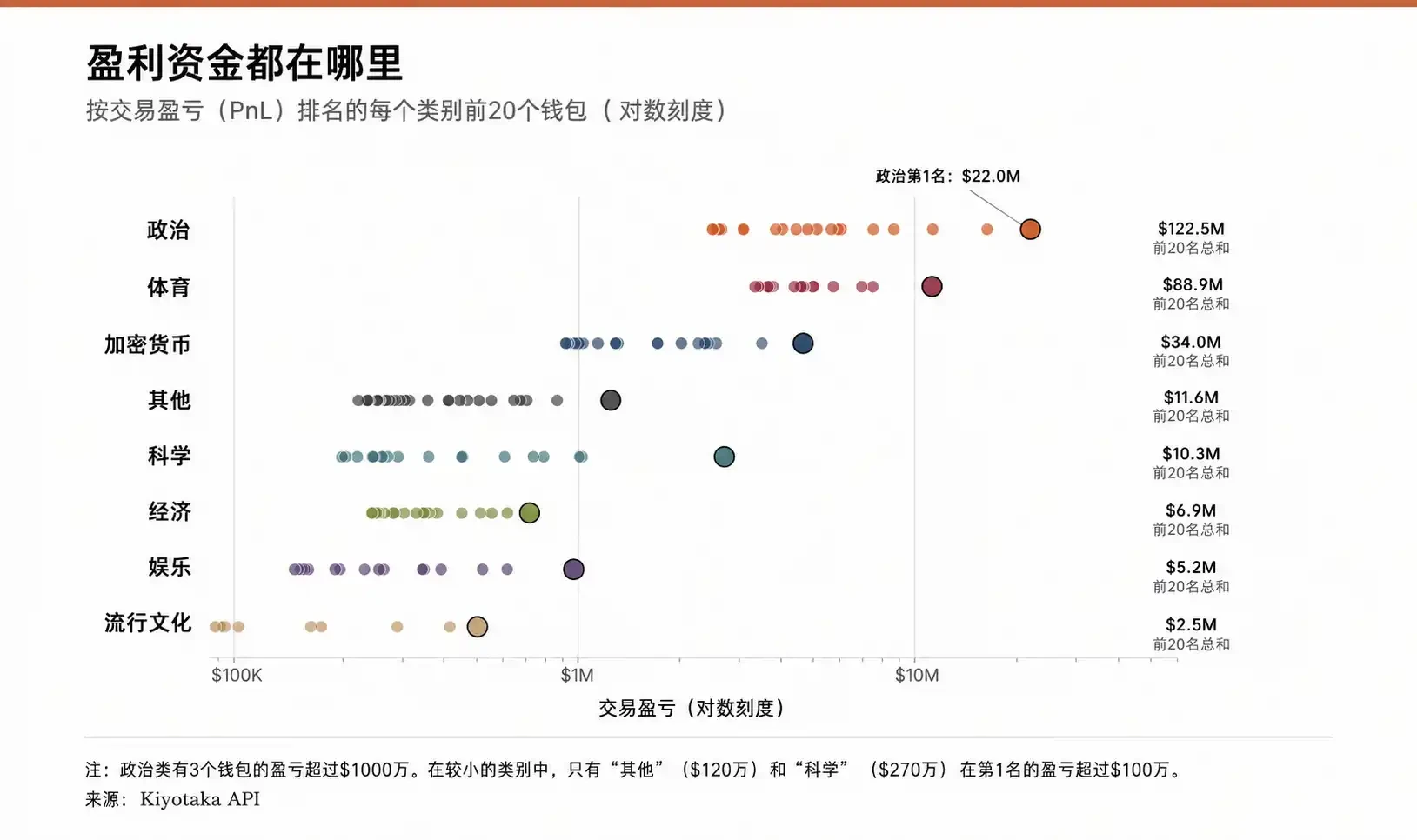
Plotting the total profits of the Top 20 wallets in each category on a logarithmic scale, only the top wallets in Science and "Other" manage to exceed $1 million, besides the three main categories of Politics, Sports, and Crypto.
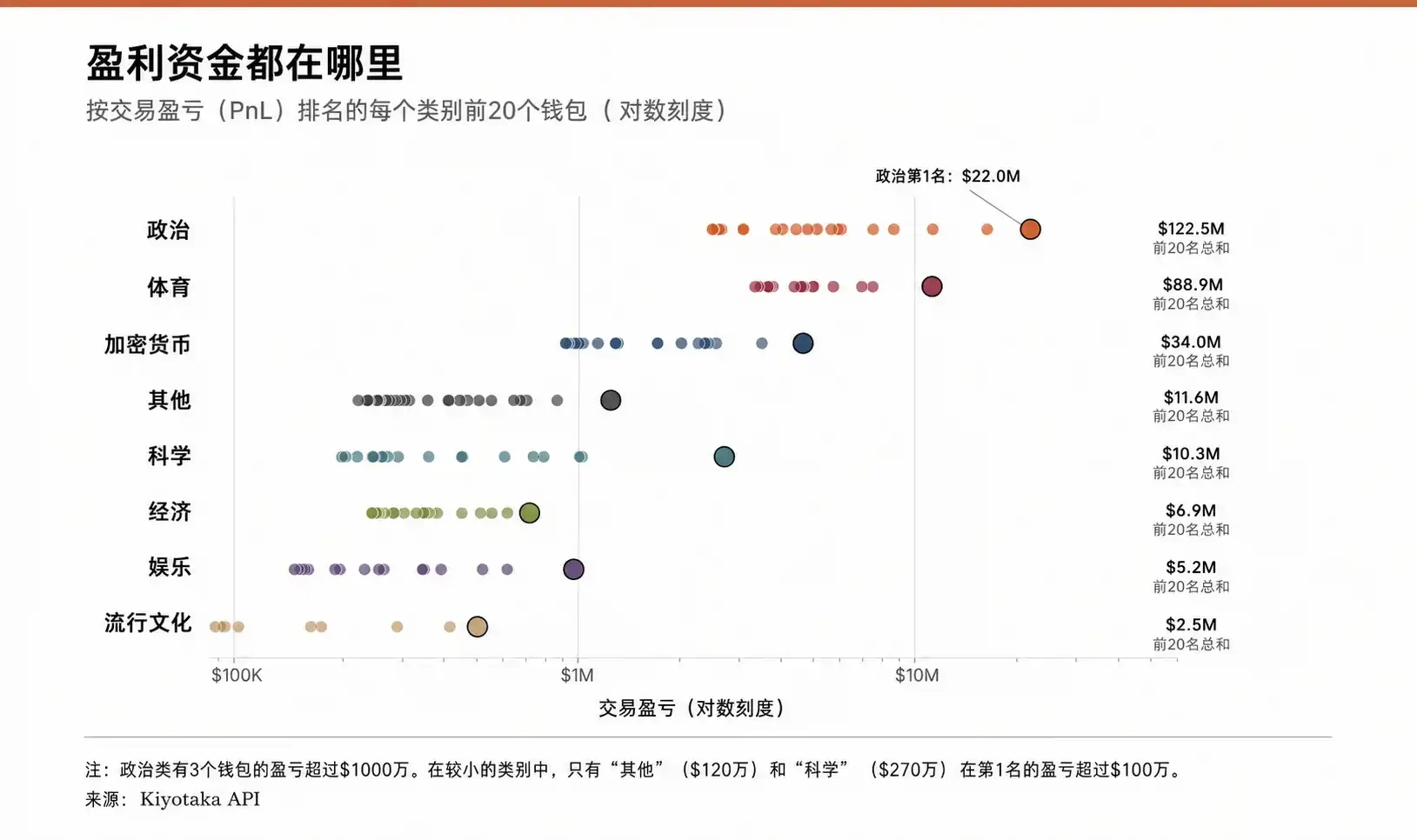
The most straightforward explanation is that political markets are fewer in number, allow for larger individual bets, and have longer settlement cycles. A correct prediction on a presidential election or a controversial policy outcome can be amplified into seven or eight-figure returns. Sports markets typically settle within hours, have thinner spreads, and yield smaller individual profits. Market structure dictates which strategies can prevail.
High-Conviction Heavy Betting vs. High-Frequency Multi-Market Trading
When you plot position count against realized profit, the leaderboard clearly splits into two groups. They share a single vertical axis but have little else in common.
A comparison of position count and trading profit/loss for the Top 10 wallets in Politics, Sports, and Crypto shows: Political whales cluster at the low end of position counts; Sports whales dominate the high-frequency trading end.
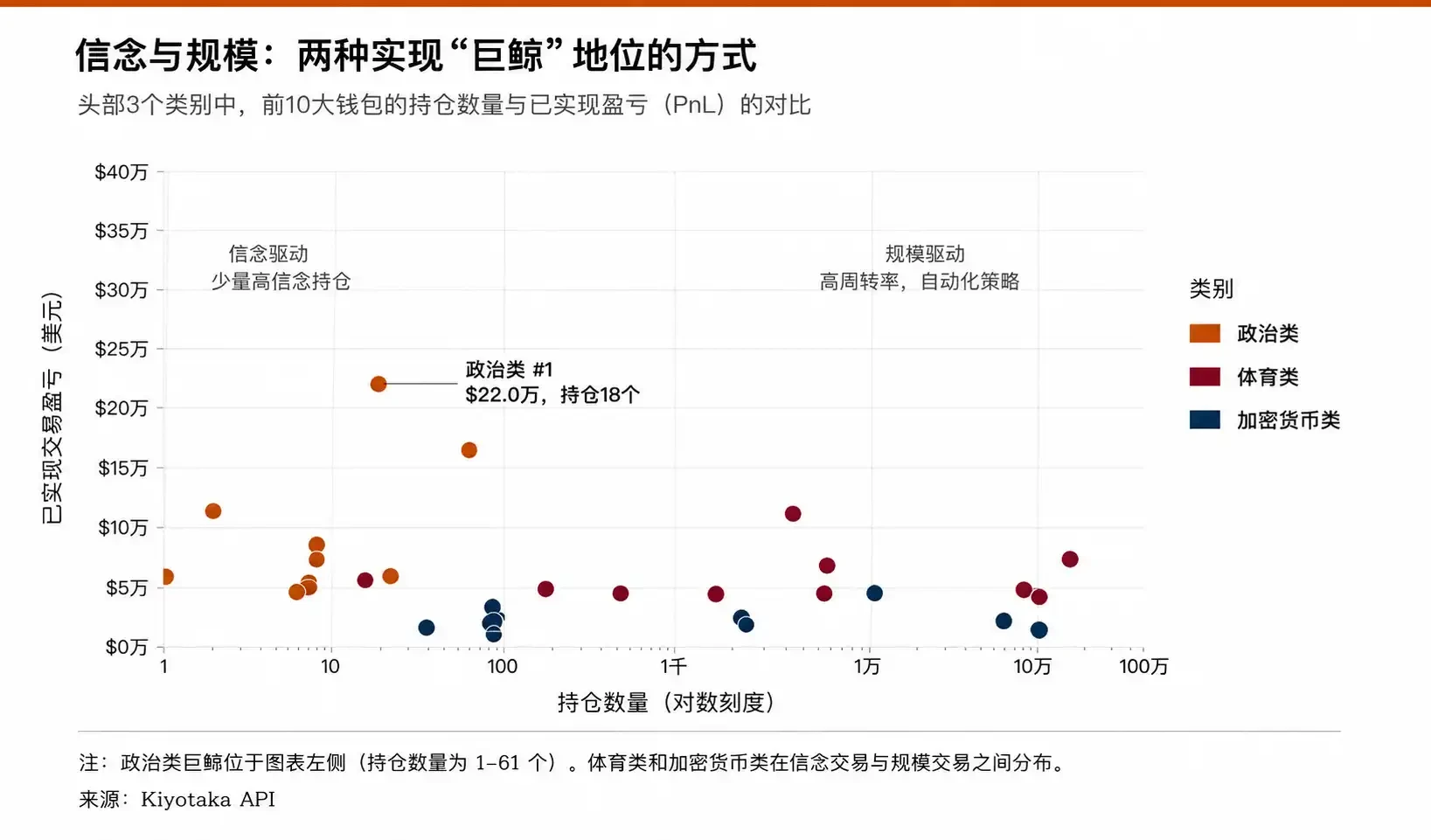
On the left side of the chart, between roughly 1 and 100 positions, it's almost entirely occupied by political whales. The top wallet, 0x5668…5839, earned $22 million with just 18 positions. Another wallet, 0xd235…0f29, earned $11.3 million with only 2 positions.
On the right side of the chart, between 1,000 and 150,000 positions, is the domain of sports traders. The second-ranked sports wallet, 0x204f…5e14, earned $7.5 million across 151,888 positions. This looks more like the footprint of an automated system than an "investor with a strong opinion."
One wallet makes $22 million with 18 positions. Another makes $7.5 million with 151,888 positions. They are on the same leaderboard, but they are not in the same business.
These are two completely different jobs. The first requires extremely strong judgmental conviction and the willingness to place large bets on rare, high-stakes events. The second requires engineering discipline: a model with a thin per-trade profit margin, deployed across enough markets for the law of large numbers to take effect. Crypto falls somewhere in between, with both styles present but on a smaller absolute scale.
Market Selection: Concentration and Diversification Coexist
By introducing 8 named wallets—accounts that can be identified by name from Polymarket's public information—we can see the distribution of strategies more intuitively.
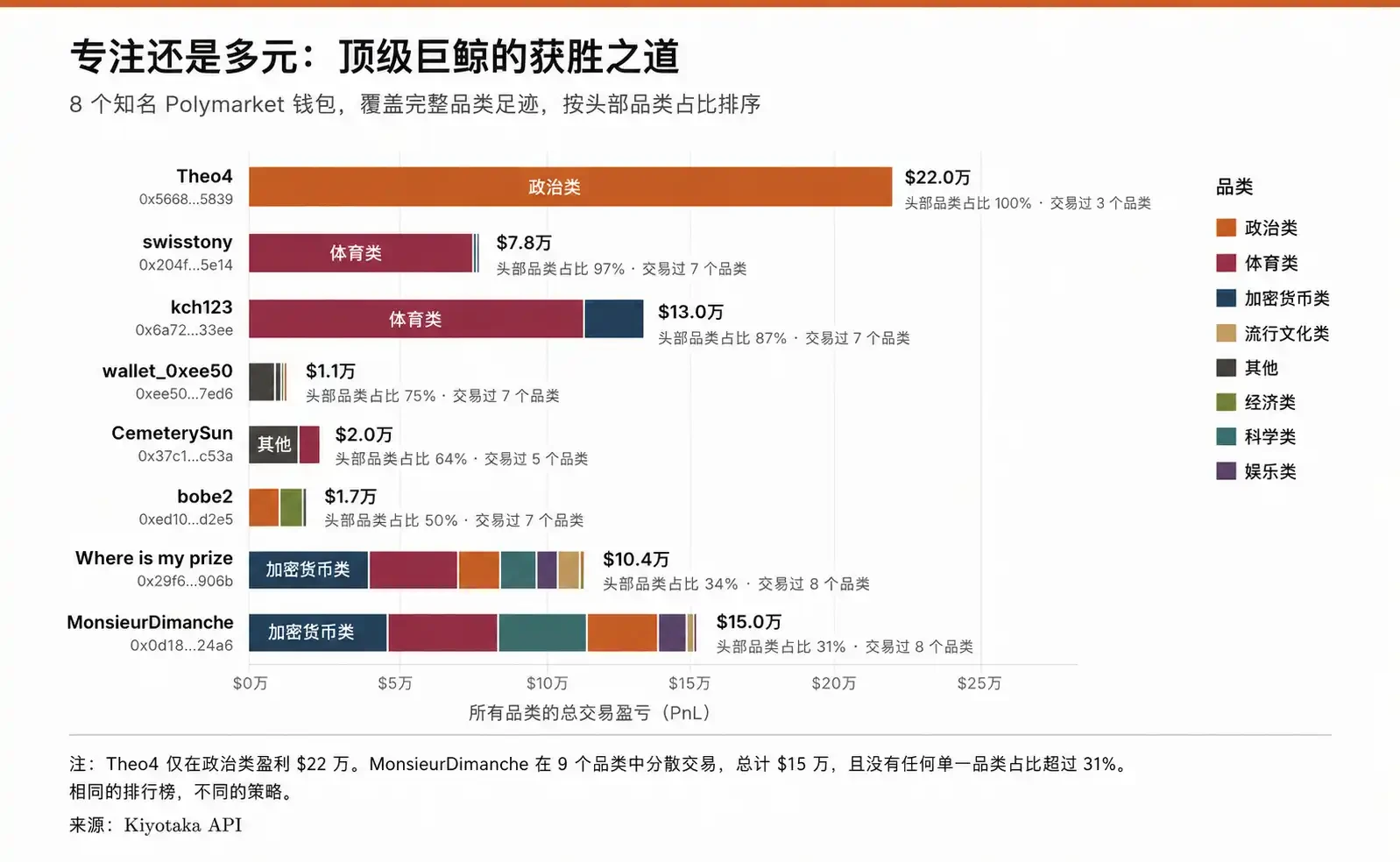
Sorting these 8 wallets by "largest category profit as a percentage of total profit," Theo4 is 100% concentrated in Politics; MonsieurDimanche spans 9 categories.
Theo4's $22 million profit comes 100% from Politics. 97% of swisstony's $7.8 million profit comes from Sports. 87% of the profits for the top sports wallet, kch123, also come from Sports. These are expert traders who don't easily cross boundaries.
On the other end, MonsieurDimanche spreads his $15 million profit across 9 categories, with no single category contributing more than 31%. He doesn't specialize in any one category, yet still stands at the top of the leaderboard.
Conventional wisdom suggests specialization leads to deeper advantages and therefore higher returns. This judgment holds true at the top, but only barely. Theo4, the most concentrated among named wallets, is also number one in total profit. MonsieurDimanche, the most diversified, ranks second.
Position Count vs. Per-Trade Profit
The most useful chart in the entire dataset divides each wallet's profit by its number of positions, measuring the average dollar earned per bet.
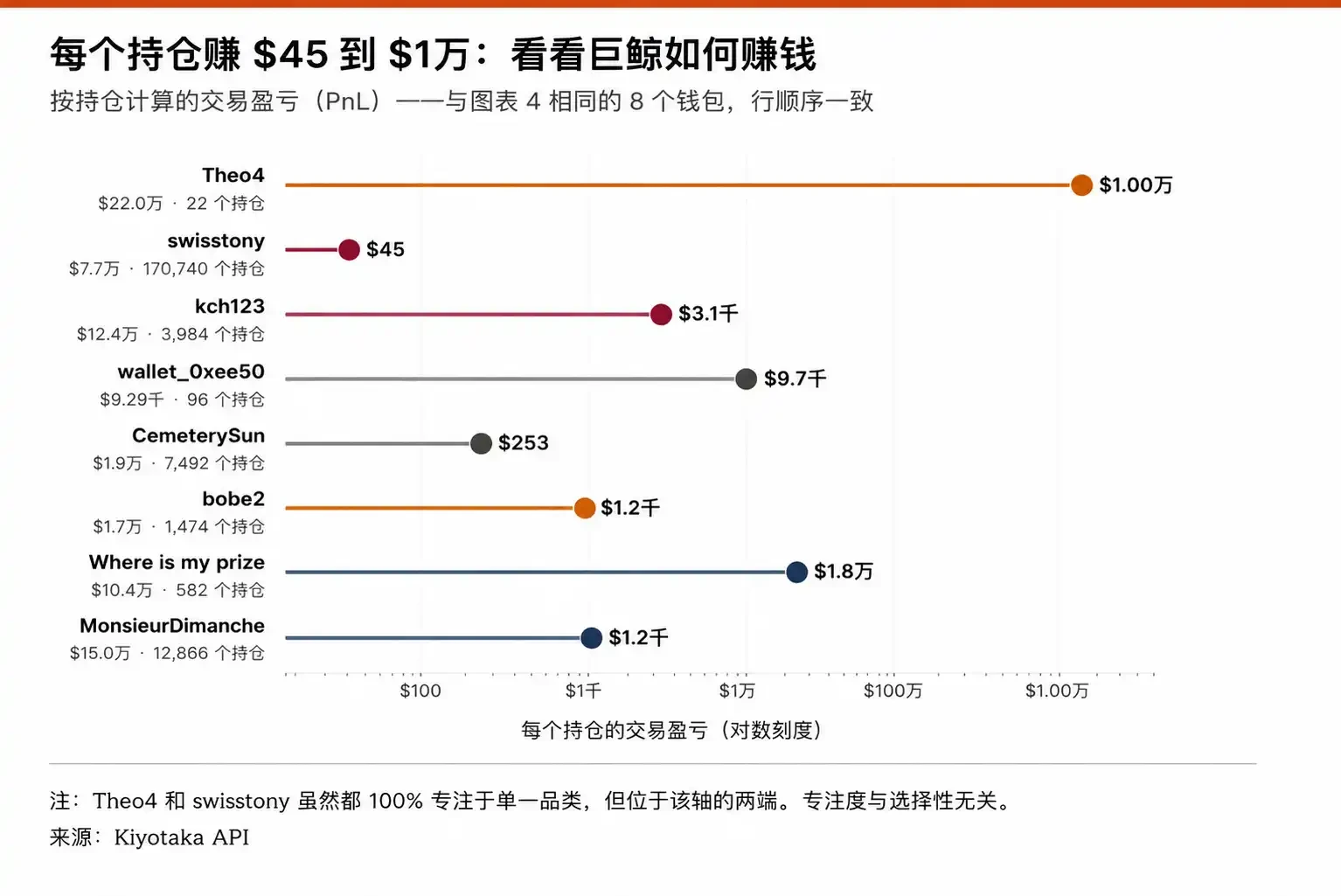
On the log chart of Trade Profit / Position Count, both Theo4 and swisstony are almost 100% concentrated in a single category, yet they differ in selectivity by a factor of about 22,000 times.
Theo4 averages $1 million earned per position. swisstony averages $45 earned per position. Both are essentially single-category traders, nearly indistinguishable on the "concentration" axis. But on the "selectivity" axis, they differ by roughly 22,000 times.
This is the most important analytical finding: Position count and per-trade profit are two independent variables. Conflating them obscures what the leaderboard truly reveals. Which market categories a wallet covers tells you *where* the trader is betting; how many positions correspond to each unit of profit tells you *how* the trader makes money. The two are uncorrelated.
Three Strategies Behind Eight-Figure Returns
The data doesn't reveal one strategy, but three.
The first is the Political Expert. In slow-settling political markets with large odds spaces and high stakes, they use a few high-conviction, high-amount positions to reap enormous gains. Few trades, large positions, deep research. Theo4 is the prime example. The barrier to this approach is primarily psychological: most traders can't scale their positions to a size that makes the strategy truly pay off. It's also not a conventionally scalable path.
The second is the Systematic Sports Trader. They use automated models to price sports markets. Even if their model is only slightly better than the consensus price, they can accumulate profits across thousands or even hundreds of thousands of contracts. Per-trade profit is thin, but the overall system is sustainable. swisstony is the prime example. The barrier here is engineering capability and operational discipline, not just market insight.
The third is the Cross-Category Generalist. They can form well-calibrated judgments on many topics and extract profits from markets that expert traders overlook. MonsieurDimanche is the prime example. The barrier to this approach is breadth of knowledge, which is arguably harder to acquire than building a single-category model.
These skills are not interchangeable. A political expert won't become a systematic sports trader just by trading more frequently, because their advantage doesn't lie there. A systematic sports trader won't become a political expert just by increasing their position size, because their per-trade margin is too thin to withstand highly concentrated holdings. Prediction markets reward three distinct capabilities. Being good at one reveals almost nothing about being good at another.
In a sense, this is reassuring. There is no single answer to "How do you make money on Polymarket?" There are at least three. For any given individual, which one is hardest depends on their personality, engineering skills, and just how many high-quality opinions they can form on how many subjects. And these differences are not flattened by the leaderboard.
What the leaderboard truly seems to punish is the middle ground: traders who have enough breadth to dilute their specialization, and enough trading volume to dilute their conviction. In other words, where most people probably operate. The wallets at the top have all chosen a track and committed to it with enough discipline to stay on it.


