






Contract Audit Passed, Thermometer Not: Polymarket's "Physical Vulnerability" Moment


- Core Viewpoint: Polymarket's prediction market, due to its reliance on physical sensors as data sources, suffered from extremely low-cost manipulation in its Paris temperature market, exposing the vulnerability of oracles at the data input layer—blockchain cannot guarantee the authenticity of off-chain data.
- Key Elements:
- The attacker artificially created a brief high-temperature peak by heating an unprotected weather sensor at Charles de Gaulle Airport with a hairdryer, thereby accurately betting on the abnormal temperature range on Polymarket and profiting approximately $34,000 across two instances.
- Polymarket's response was merely to switch the data source to another, similarly unprotected airport sensor, without recovering profits or strengthening physical security, indicating insufficient defense against similar attacks.
- This incident differs from previous manipulation cases requiring substantial capital, as the cost was extremely low, highlighting that when physical sensors become financial settlement endpoints, their security assumptions are fundamentally altered.
- The French meteorological agency has filed a criminal complaint for "interfering with an automated data processing system," with suspects potentially facing up to 7 years in prison and a €300,000 fine.
- The event reveals the fundamental challenge of oracles: smart contracts can guarantee flawless on-chain execution but cannot verify the authenticity and reliability of the original off-chain data.
Original author: Sanqing, Foresight News
According to a report by French media Le Monde, on April 6th and 15th, the meteorological sensors at Paris Charles de Gaulle Airport experienced two anomalies. The temperature spiked by over 3°C within minutes before quickly returning to normal, as if nothing had happened. Each time, someone had placed a bet on the corresponding low-probability temperature range on Polymarket in advance. From a principal of just tens of dollars, they collectively walked away with approximately $34,000 from these two incidents. The account that placed the first bet was created just two days before the anomaly occurred.
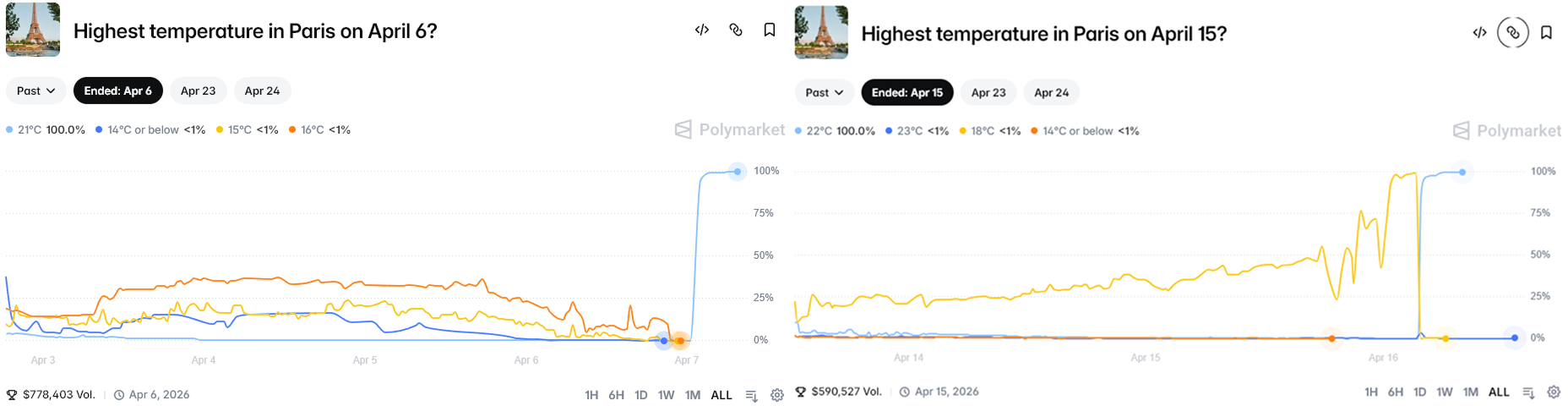
Météo-France subsequently conducted a physical inspection of the sensor, found signs of human tampering, and filed a criminal complaint with the Charles de Gaulle Airport Gendarmerie. The charge is "interference with an automated data processing system." According to an analysis in an AR15 forum post, based on Article 323-2 of the French Penal Code and because Météo-France is a public institution, the maximum penalty for the related charges could be 7 years imprisonment and a fine of 300,000 euros.
The Technical Sophistication of This Scam is Approximately Zero
The settlement chain for Polymarket's Paris temperature market is as follows: Physical sensor → Météo-France → Weather Underground → Polymarket contract.
On this chain, the smart contract part is audited, data transmission is automated, and Weather Underground's data scraping is real-time. The only weak point is at the very beginning: a thermometer standing by the airport roadside, without a fence, without surveillance cameras, accessible to anyone.
All the tools the attacker needed were a battery-powered hairdryer.
Polymarket settles based on the day's highest temperature. This means that creating one brief temperature spike is enough to rewrite the official record for that day.
Acting in the evening or at night is even more ideal, as the daytime high has usually already passed, making subsequent readings more likely to become the new record. Therefore, the suspect chose 7 PM on April 6th and 9:30 PM on April 15th.
The operational process was roughly: buy the low-probability option in advance, walk to the sensor at night, turn on the hairdryer, wait for the reading to cross the target temperature, stop and leave, wait for on-chain settlement.
The entire operation had zero technical sophistication, requiring only a bit of understanding of the settlement mechanism and a pair of legs willing to walk to the airport's edge.
Polymarket's Response: Quietly Swapped the Thermometer
Polymarket has not issued any official statement on this matter. The only thing it did was change the settlement data source for the Paris temperature market from Charles de Gaulle Airport (LFPG) to Le Bourget Airport (LFPB).

The profits from the two accounts were not revoked; the market settled normally according to the on-chain records.
The sensor at Le Bourget Airport is also placed outdoors, similarly without physical protection. They changed the address, but the problem remains exactly the same.
This is not the first controversy for Polymarket. In October 2024, a French trader was accused of manipulating Trump election odds using 4 linked accounts, reportedly profiting $85 million; in March 2025, a whale used 5 million tokens to forcibly push through a UMA governance vote, causing a controversial market to settle as "Yes," involving $7 million; in January and March 2026, anomalous bets appeared in markets related to Venezuela and Iran respectively, with the latter already drawing attention from the US Congress...
Previous incidents at least required millions of dollars in capital or governance tokens. This time, the cost was just a hairdryer.
The Contract Was Audited, the Thermometer Was Not
This story has a sense of absurd humor. A prediction market running on the blockchain, touting decentralization and immutability, was taken for a ride twice by a battery-powered hairdryer. Cryptography was of no help in this matter because it never verifies whether the input data is real.
Polymarket currently has 173 active weather markets. The settlement basis for most of these markets is a single physical sensor at a specific location.
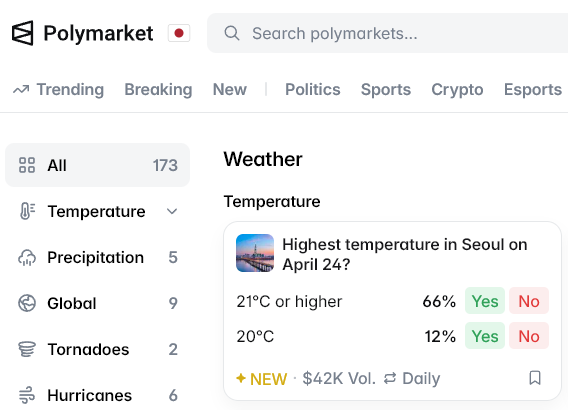
When a sensor is used as a meteorological tool, its credibility stems from the fact that no one has a motive to tamper with it. Polymarket gave it a new incentive structure but provided it with no new physical protection.
Météo-France's thermometer dutifully recorded the temperature it sensed. It just didn't know it had become a financial settlement terminal.


