The Second Half of Macro Star Fu Peng


- Core Viewpoint: Fu Peng, former Chief Economist of Northeast Securities, joining Hong Kong-licensed digital asset management firm New Huo Group, marks a significant crossover of a veteran traditional finance professional into the crypto industry. His core mission is to integrate digital assets into the global macro asset allocation framework, aiming to attract traditional institutions and high-net-worth clients seeking professional narratives to New Huo.
- Key Elements:
- With nearly 20 years of experience in global macro and FICC (Fixed Income, Currencies, Commodities), Fu Peng's joining aims to combine cryptocurrencies (C) with traditional macro research to build an "FICC+C" asset allocation framework.
- Fu Peng is renowned in traditional finance circles for his independent views and strong ability to popularize complex topics, boasting millions of followers on social media. His public influence is a key asset valued by New Huo Group.
- New Huo Group already holds several key financial licenses in Hong Kong and has strategically pivoted to focus on serving institutional clients like family offices and listed companies. It urgently needs to build professional trust to attract traditional capital.
- The backdrop of this collaboration is Fu Peng's social media accounts being suspended following a controversial speech at the end of 2024, and his departure from Northeast Securities in 2025. His comeback choice of the crypto track over traditional securities firms is highly symbolic.
- Although New Huo Group's revenue saw significant growth in FY2025, it remained in an overall loss position. It has designated 2026 as the year for a profitability turnaround. Bringing in Fu Peng is a key move to enhance the professionalism of its institutional services and brand credibility.
Original Author: Bibi News
On the morning of April 20, 2026, the stock price of New Huo Group (01611.HK) suddenly surged, rising over 11% intraday.
The trigger for this market movement was a piece of news that simultaneously ignited both the financial and crypto circles: Fu Peng, former Chief Economist of Northeast Securities, has officially joined New Huo Group as its Chief Economist.
The news was first disclosed by Tencent News' "First Line," and New Huo Group subsequently confirmed it. Fu Peng himself also stated to the media: "It's mainly about combining FICC and C businesses."
Here, FICC refers to Fixed Income, Foreign Exchange, and Commodities, while C refers to Cryptocurrency. His primary role in this new position is to integrate digital assets into the global asset allocation framework, providing macro research and asset allocation support for New Huo's institutional clients.
This marks his first official reappearance in the public eye with a formal position after nearly a year away from Northeast Securities. For him, this is not just a change of employer; it's more like a new beginning for his professional narrative.
The first half of his career reached its peak within the traditional financial system, only to be forcibly interrupted by controversy and illness. The second half is chosen in Hong Kong, in the crypto track, at an intersection where traditional finance and digital assets are slowly converging.
The Path of an Atypical Chief
In 2004, Fu Peng joined Lehman Brothers. He later served as the Head of Global Macro Hedge Strategy Design at Solomon International Investment Group, responsible for the linkage analysis of currencies, commodities, and major asset classes for nearly four years.
He returned to China at the end of 2008, working at various institutions including Shandong High-tech Investment, Zhongzhongqi, Galaxy Futures, Galaxy Securities, and Essence Securities.
In February 2020, he joined Northeast Securities as Chief Economist. His approach in this role differed from most of his peers: he treated self-media as his main battleground.
He is accustomed to using analogies and metaphors to explain economic logic, with a style that is quite performative. His Weibo account, "Fu Peng's Financial World," has amassed over 4 million followers, and his Douyin (TikTok) followers have reached 1.485 million. On Xiaohongshu (Little Red Book) and Bilibili, he has also accumulated 355,000 and 773,000 followers, respectively.

In 2024, he published the book "Witnessing the Countercurrent," using a three-layer framework of "Politics/Distribution—Macro—Assets" to explain the changes in global asset logic after 2016.
This approach has given him considerable recognition within the financial circle, establishing him as an analyst capable of presenting complex macro logic in an accessible way to ordinary investors.
The Consequences of a Speech
In late November 2024, Fu Peng was invited to give a year-end speech at an internal HSBC Private Wealth Planning event in Shanghai. The content touched on China's declining effective demand, shrinking middle-class income, intensifying consumption divergence, and his judgment that current stimulus policies would find it difficult to replicate the effects of 2008.
Recordings and transcripts subsequently spread widely online, were taken down from multiple platforms, and his WeChat and short video accounts were banned for nearly half a year.
A rumor emerged that he had been summoned by regulators, leading to the cancellation of his activities. Fu Peng publicly responded, directly criticizing HSBC and posting chat records, stating, "A lawyer's letter is already on the way, waiting for your apology."
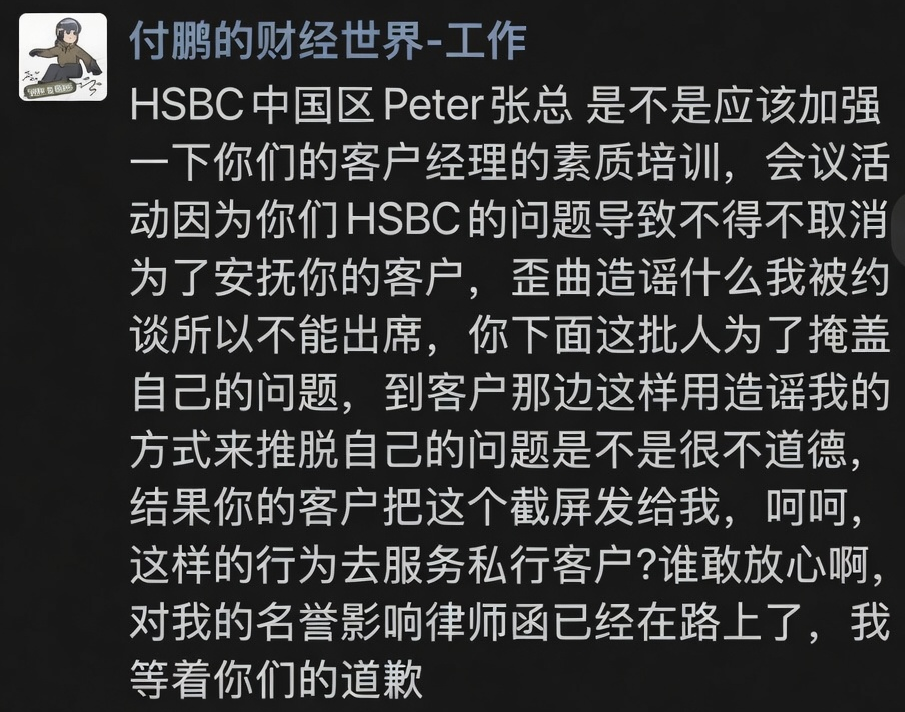
Northeast Securities also stated that there had been no recent regulatory summons. HSBC responded that it was "looking into the relevant situation." After that, the matter quietly faded from public discussion without any follow-up, ultimately ending inconclusively.
During the account ban, Fu Peng's channels for public expression were significantly narrowed.
On April 30, 2025, he officially resigned from Northeast Securities, citing the need for more than six months of rest after undergoing two major surgeries.
Predictive Ability and Its Limits
Among Fu Peng's fan base, there are many stories about his accurate predictions, covering the 2008 financial crisis, the recovery of the Japanese stock market, and turning points in China's real estate cycle. Since 2016, he has consistently emphasized deglobalization and changes in the interest rate anchor, with parts of his framework subsequently receiving some validation.
However, his prediction record is not uniform. There have been clear deviations in areas like short-term exchange rates and specific policy windows. Some of his judgments have been criticized as overly pessimistic or have shown significant inaccuracies due to policy interventions.
He himself acknowledges that macro research focuses on structural variables, not next quarter's data. This is both a methodological self-explanation and a preventive explanation for short-term inaccuracies.
What he provides is a framework for interpreting the world, not a consistently reproducible prediction tool. Describing him as a prophet who gets everything right is a misreading.
One of his major strengths lies in his ability to express complex macro logic in an accessible way while maintaining relatively independent judgment. This allows his influence to reach a broader audience, and this characteristic is precisely what New Huo Group needs most.
Why Choose New Huo
Theoretically, Fu Peng had more than one option for his comeback. Traditional securities firms would welcome him back; the position of Chief Economist is familiar to him. Yet, he chose New Huo.
The space within traditional finance is narrowing. For someone who spoke so bluntly in the HSBC speech, he likely understands better than anyone what returning to the system would mean.
His skill set was never confined to traditional assets; FICC has always been his area of expertise. As crypto assets become more institutionalized, their connection to macro logic becomes increasingly evident. Variables like interest rate cycles, US dollar liquidity, and geopolitical risk premiums act on both traditional and digital assets.
There's also a more pragmatic factor: a comeback needs a suitable stage.
New Huo Group operates under a license in Hong Kong, is listed on the Hong Kong stock exchange, and operates within a compliance framework. At the same time, its size and stage of development provide enough flexibility to allow a strong-minded individual to build a new research system. This is a completely different situation from playing a fixed role within a mature, large institution.
Why New Huo Needs Him
New Huo Group currently positions itself as a digital asset management institution serving high-net-worth clients. It holds Hong Kong Securities and Futures Commission (SFC) Type 1, 4, and 9 licenses as well as a TCSP (Trust or Company Service Provider) license, making it one of the earlier institutions in Hong Kong to achieve full-license virtual asset management.
In 2025, Weng Xiaoqi took over as CEO, launched the Bitfire Premium service, acquired a majority stake in the licensed Japanese exchange BitTrade, exited the retail market, and focused on family offices, listed companies, and institutional clients. At the end of March 2026, the company was renamed New Huo Group Holdings Limited, with the English name Bitfire Group.
Financially, for the 2025 fiscal year, total revenue was HK$8.661 billion, a year-on-year increase of over 450%. However, this growth was primarily driven by high-volume, low-margin crypto OTC trading, and the company as a whole remained in the red. Management has designated 2026 as the year to turn profitable, which is no small pressure.
The compliance framework is in place, and the growth numbers are impressive, but what New Huo truly lacks at this stage is not traffic, but trust.
The clients it serves—partners at family offices, financial heads of listed companies, private investors who have already accumulated substantial wealth—they don't lack information or data. What they lack is a narrative framework that allows them to feel confident about digital assets, and a professional image from the traditional financial world.
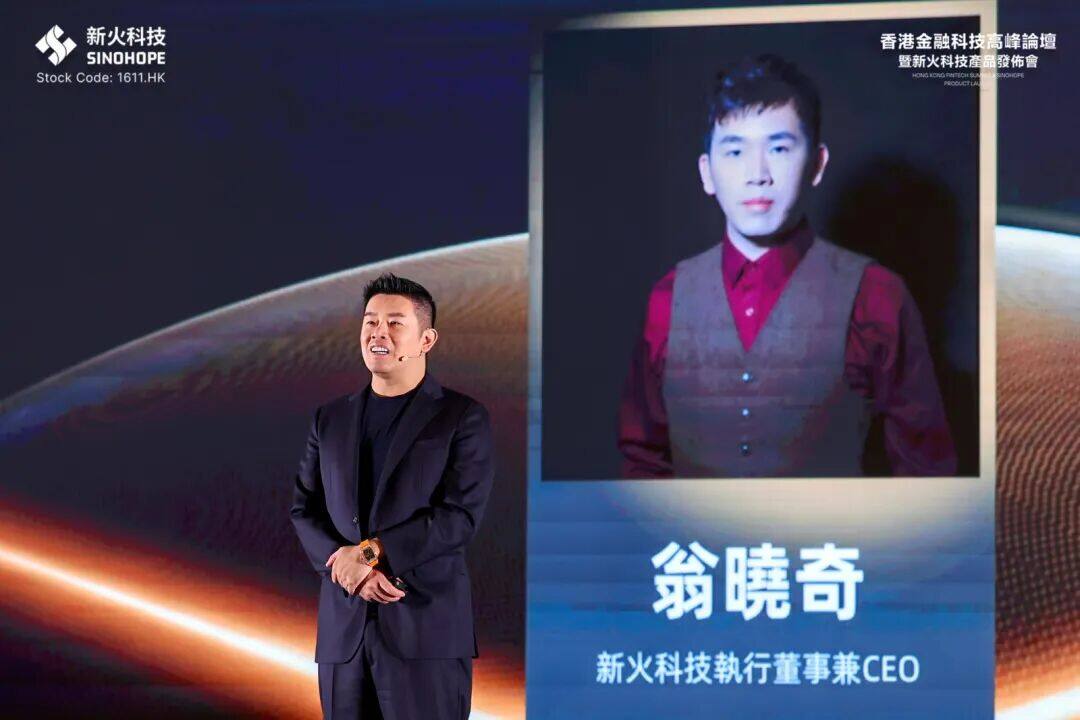
Weng Xiaoqi articulated this logic quite bluntly: "Fu Peng's profound global macro research capabilities and precise market liquidity insights will become the top strategic brain for the company's business... helping clients accurately grasp certainty in the era of 'FICC+C'."
Fu Peng's background in international investment banking and hedge funds, his independent public persona, and his influence reaching millions constitute a recognizable signal of professionalism for the traditional wealthy who are evaluating whether to allocate more funds to digital assets.
This is a transaction where both sides get what they need.
A Beginning Without a Conclusion
On one side is a person who emerged from the traditional financial system, having experienced highs, controversy, and a forced interruption, now seeking a space where he can continue to express himself and contribute.
On the other side is a company striving to transition from a trading platform to an institutional service provider, attempting to establish a language more easily understood by traditional capital.
Can the appeal of macro narratives translate into real institutional capital inflows? How long can Fu Peng's independent style be maintained within the institutional framework of a listed company?
Will the trust of traditional wealthy clients in digital assets ultimately be built on framework recognition, or will it still require further regulatory clarity?
All of these questions will require time to answer.