






In-Depth Analysis of the Fed's Major "Balance Sheet Reduction" Paper: How Much to Reduce, How to Do It, and What Are the Implications?


- Core View: The Federal Reserve published a working paper that systematically argues that by adjusting regulatory and operational frameworks, the size of the balance sheet can be significantly reduced while maintaining "ample reserves." This provides a theoretical path and a menu of options for potential future balance sheet reduction policies.
- Key Elements:
- The paper's core breakthrough is identifying that the bottleneck for balance sheet reduction is "demand" rather than "supply." Specifically, the high demand for reserves in the banking system is largely artificially inflated by regulatory rules (e.g., LCR) and operational frameworks (e.g., the stigma associated with the discount window).
- The paper provides a quantitative estimate, suggesting that through a series of reforms, the Fed's balance sheet could be reduced by $1.2 trillion to $2.1 trillion. This would lower its share of GDP from the current 21% to levels closer to those in 2012 or 2019 (around 18%).
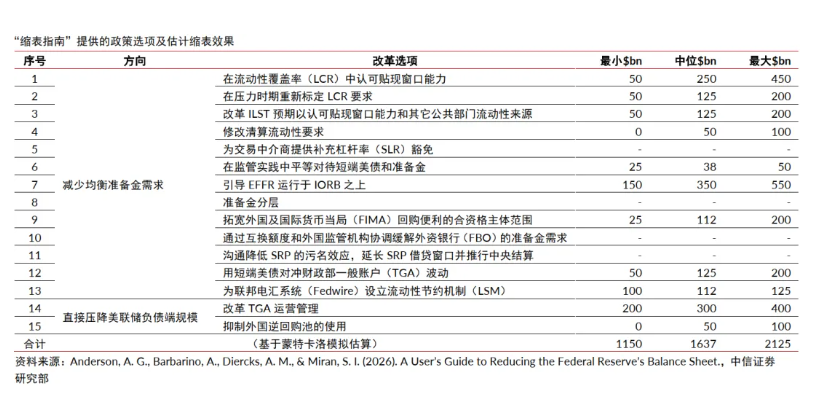
- The paper proposes 15 specific policy options, categorized into two main groups: reducing reserve demand and shrinking non-reserve liabilities. Examples include reforming the LCR standard, destigmatizing the discount window, and adjusting the Treasury General Account (TGA) cash buffer.
- Analysis suggests that technical options like relaxing LCR requirements and reforming the Standing Repo Facility (SRP) have higher practical feasibility. In contrast, options such as tiered interest on reserves and TGA reform require more external coordination or face complex implications.
- This paper is seen as a forward-looking signal of the policy orientation of Kevin Warsh, a potential nominee for Fed Chair. However, actual implementation of reforms will be a gradual process taking several years and will not immediately restart balance sheet reduction.
- Regarding market impact, balance sheet reduction could increase volatility in the U.S. Treasury market. However, its monetary contraction effects could be offset by interest rate cuts. The analysis maintains the judgment that the Fed will cut rates by 25 basis points in the second half of the year.
Original Author: Zhao Ying
Original Source: Wall Street News
At 10 PM Beijing time on Tuesday, the U.S. Senate Banking Committee will hold a hearing on Kevin Warsh's nomination for Federal Reserve Chair. This marks Warsh's first formal appearance on Capitol Hill to systematically articulate his views on monetary policy. Notably, Warsh has long been critical of the Fed's massive balance sheet, and this hearing may serve as a crucial platform for him to express these views.
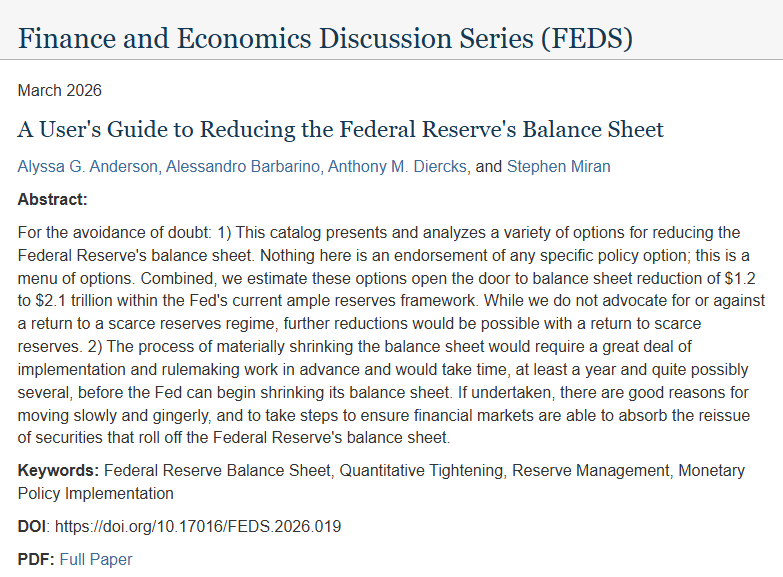
In fact, since late 2025, the direction of the Federal Reserve's balance sheet has been a central topic of intense focus in global financial markets. Against this backdrop, Federal Reserve Governor Stephen Milan, along with three Fed economists, recently co-published a working paper titled "A User's Guide to Reducing the Federal Reserve's Balance Sheet." On March 26, 2026, during a keynote speech at the Miami Economic Club, he systematically explained the Fed's strategic logic and potential pathways for balance sheet reduction.
The core value of this paper lies in challenging conventional market wisdom. In the past, the market widely believed that "the ceiling for Fed balance sheet reduction is the depletion of reserves." However, the paper argues that the demand for reserves itself can be shaped by policy—through adjustments to a series of regulatory and operational frameworks, the Fed could potentially achieve significant balance sheet shrinkage while maintaining an "ample reserves" framework.
Subsequently, CITIC Securities' research team provided an in-depth analysis. Their assessment is that technical options such as relaxing LCR standards, reforming the SRF, and upgrading Fedwire possess a certain degree of practical feasibility. However, schemes like reserve tiering, reforming the TGA, and reducing the foreign reverse repo pool are relatively idealistic. Overall, the balance sheet reduction process is unlikely to alter the fundamental logic behind global central banks' gold purchases. CITIC Securities maintains its forecast of a 25 basis point Fed rate cut in the second half of this year.
Why Reduce the Balance Sheet: Milan's List of Reasons
In his Miami speech, Milan straightforwardly presented multiple reasons for reducing the Fed's balance sheet.
First, to reduce market distortions. An excessively large Fed balance sheet creates unnecessary intervention in funding markets, exacerbating the disintermediation of financial intermediaries. Minimizing the Fed's "footprint" in the market is a fundamental requirement for preserving market price discovery.
Second, to control financial risks. Holding large-scale assets implies greater exposure to mark-to-market losses and increases the volatility of remittances to the Treasury. In recent years, the Fed has faced pressure from unrealized losses due to holding substantial long-duration securities, an issue that can no longer be ignored.
Third, to safeguard the monetary-fiscal boundary. A massive balance sheet objectively involves the Fed in credit resource allocation, blurring the line between monetary and fiscal policy. Furthermore, paying large-scale interest on reserves has been viewed by some members of Congress as an implicit subsidy to financial institutions.
Fourth, to preserve policy ammunition. If another zero lower bound crisis arrives, the Fed will need to expand its balance sheet to provide easing space. Reducing the balance sheet to a reasonable size now is to preserve necessary room for future policy maneuvering.
Milan acknowledged that the prevailing external view is that significant balance sheet reduction is "simply impossible." However, his judgment is starkly different: "Balance sheet reduction is a solvable challenge; those who dismiss it outright simply lack imagination."
Key Diagnosis: What Constrains Reduction is "Demand," Not "Supply"
To understand this discussion, one must first clarify a long-misinterpreted logical structure.
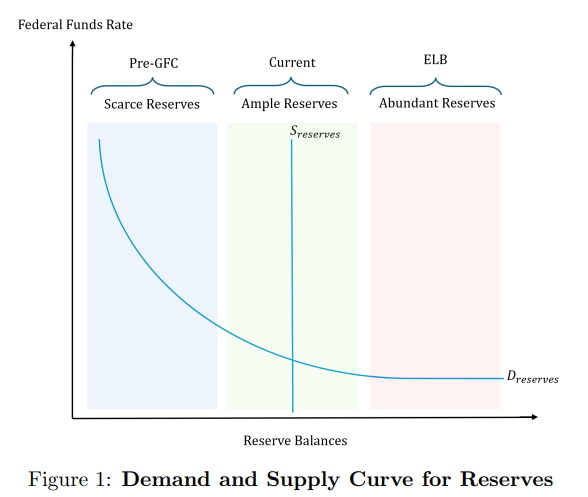
The traditional framework holds that the constraint on Fed balance sheet reduction comes from "reserve supply hitting the steep part of the demand curve"—once supply tightens to a critical point, overnight rates become uncontrollable. Therefore, the Fed can only passively halt reduction once reserves fall to a "scarce" state. The "repo market earthquake" of September 2019 was a real-world manifestation of this logic.
The paper's breakthrough lies in shifting the perspective from the "supply side" to the "demand side." It argues that reserve demand is not an exogenous constraint "naturally determined" by payment and settlement activities. Instead, it is artificially elevated by a combination of regulatory rules, supervisory enforcement approaches, and the Fed's own operational framework—a phenomenon Milan terms "regulatory dominance" over the Fed's balance sheet.
Specifically, the following three mechanisms collectively push up the baseline demand for reserves:
1. Interest rate spreads turn reserves into "easy money assets." After the Fed began paying interest on reserves in 2008, reserves transformed from a pure settlement necessity into an asset competing with Treasury bills. Historically, there have been periods where the interest on reserve balances (IORB) exceeded the yield on 1-month/3-month Treasuries, making banks more willing to hoard reserves from a risk-return perspective.
2. Multiple liquidity regulations create a "ratchet effect." Rules like the LCR (Liquidity Coverage Ratio), ILST (Internal Liquidity Stress Testing), RLEN (Resolution Liquidity Execution Need), NSFR (Net Stable Funding Ratio), and SLR (Supplementary Leverage Ratio) intertwine, creating a dilemma of "robbing Peter to pay Paul"—if one rule is modified, another immediately becomes the new binding constraint.
3. Long-term "stigmatization" of the discount window. The relatively high discount window rate, its historical association with "troubled banks," and the risks of disclosure and supervisory scrutiny associated with its use have led banks to prefer hoarding large amounts of reserves rather than utilizing this policy tool during liquidity stress periods. The same stigma logic has also spread to the Standing Repo Facility (SRF).
This diagnosis implies a fundamental policy path: there is no need to wait for reserves to return to a scarce state. Instead, by lowering the "scarce-ample" demarcation line, the ample reserves framework can continue to function normally with a smaller balance sheet.
How Much Can Be Reduced: Quantitative Estimates of $1.2 Trillion to $2.1 Trillion
The paper uses the Fed's H.4.1 statement data from March 11, 2026, as a baseline. At that time, total Fed assets were approximately $6.646 trillion. The liability-side structure breaks down as follows: reserves about $3.073 trillion, currency in circulation $2.390 trillion, Treasury General Account (TGA) about $806 billion, and the foreign reverse repo pool about $325 billion.
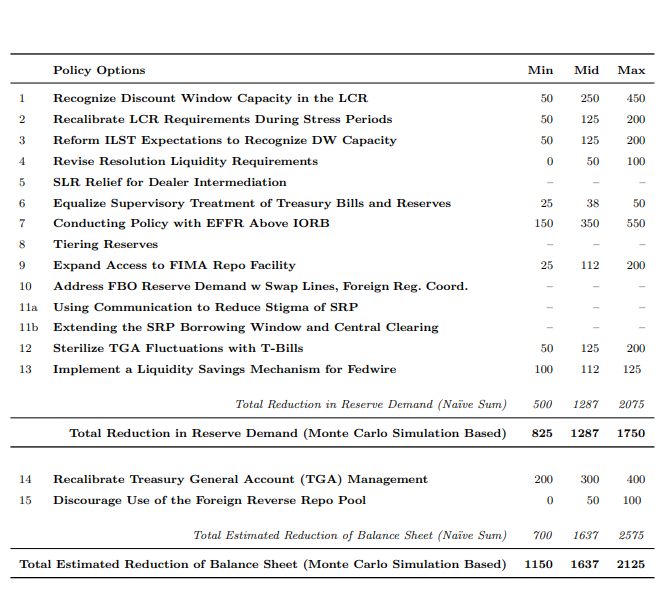
The paper provides quantitative estimates for 15 policy options across two broad directions. However, the most crucial aspect is its refusal to simply sum them up. Due to correlations and substitutability among different policies, the paper employs a Monte Carlo aggregation method under the OMB A-4 framework, arriving at the following confidence intervals:

In his speech, Milan compared the above intervals with historical benchmarks:
- 15% of GDP: The balance sheet level after the end of the first round of QE in 2009, when the banking system could still function normally.
- 18% of GDP (2012 or 2019 levels): Reflects the real liquidity needs of the banking system after the Basel reforms and Dodd-Frank Act requirements became clearer.
The current Fed balance sheet is about 21% of GDP. Based on the median estimate in the paper, if reforms proceed smoothly, the balance sheet could potentially fall back to levels close to those of 2012 or 2019. As for returning to the pre-crisis level of below 10% of GDP, Milan explicitly stated: "Unrealistic, and unnecessary."
How to Reduce: A "Menu-Style" Analysis of the 15 Options
The paper divides the 15 policy tools into two major categories, providing effect range estimates and implementation prerequisites for each.
Category One: Lowering Equilibrium Reserve Demand
(I) Regulatory Reform Level
LCR Reform (Liquidity Coverage Ratio): The core measure is to allow banks to count the financing capacity corresponding to non-HQLA loans pre-pledged at the discount window towards HQLA, with a cap. The paper estimates the impact on reserve demand to be in the range of $50 billion to $450 billion. It also cautions that if only the LCR is reformed, the NSFR might immediately become the new binding constraint, requiring holistic consideration.
ILST and RLEN (Resolution Liquidity Execution Need): If supervisors recognize discount window capacity and short-term liquidity sources, ILST reform could lead to a $50 billion to $200 billion decrease in reserve demand. If RLEN extends the assumed availability window for the discount window, the estimated range is $0 to $100 billion.
(II) Supervisory Approach Level
If banks hold excess reserves to cater to examiner preferences (i.e., T-bills and reserves are not treated as "equivalent" in supervision), adjusting this approach is estimated to have a magnitude of $25 billion to $50 billion. This is a reform that doesn't require changing regulations, relying solely on a shift in supervisory culture, but its difficulty should not be underestimated.
(III) Reducing the Return on Holding Reserves
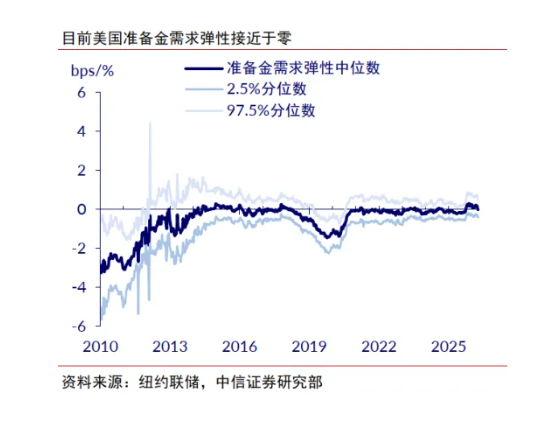
Allowing the Effective Federal Funds Rate (EFFR) to exceed the IORB, breaking the current state where EFFR is consistently below IORB. Citing the Lopez-Salido and Vissing-Jorgensen (2025) framework, the paper estimates that if "EFFR - IORB = +2 bps" is taken as a reference (close to the stress level of September 2019), the corresponding decrease in reserve demand would be $150 billion to $550 billion.
However, this path has clear costs: the volatility of overnight and repo rates would increase significantly. Furthermore, if the market responds by increasing precautionary hoarding, the demand reduction effect could be partially offset. Pursuing this path must be accompanied by support mechanisms like the SRF and Temporary Open Market Operations (TOMO).
(IV) Enhancing the Attractiveness of Alternative Assets
Includes upgrading the Fedwire system, improving Treasury market liquidity, and promoting central clearing. The goal is to make alternative assets like Treasuries more comparable to reserves in attractiveness for banks. These measures also help enhance the private sector's capacity to absorb securities released during Fed balance sheet reduction.
(V) Destigmatizing Fed Liquidity Tools
By eliminating usage concerns associated with the discount window, Standing Repo Facility, daylight overdrafts, etc., banks' precautionary reserve demand can be reduced. This requires systematic coordination from the Fed in terms of transparency, pricing mechanisms, and supervisory communication.
Category Two: Directly Reducing Non-Reserve Liabilities
(I) Recalibrating TGA Management
Reducing the Treasury's cash buffer in its Fed account from "approximately 5 days of operating funds" to "approximately 2 days," with the excess transferred back to the commercial banking system (similar to the historical TT&L arrangement). The estimated reduction for the Fed's balance sheet is $200 billion to $400 billion. The paper also acknowledges that since deposits returning to banks would correspondingly increase banks' demand for reserves, the net effect is not one-to-one.
(II) Reducing the Attractiveness of the Foreign Reverse Repo Pool
Guiding foreign central banks, sovereign funds, and other institutions to shift funds from the Fed's reverse repo pool to the U.S. Treasury market by lowering interest paid or setting size caps. The estimated range is $0 to $100 billion, with relatively limited effect and dependent on the willingness of external institutions to cooperate.
Warsh's Signal: From Technical Paper to Policy Expectations
Understanding this paper cannot be separated from the Fed's personnel context. The market widely expects Warsh to become the next Fed Chair. Warsh has long been critical of the Fed's balance sheet expansion policies since QE and has repeatedly expressed a policy preference for balance sheet reduction.
This working paper led by Milan is seen by outsiders as a forward-looking signal of the Fed's policy orientation in the potential "Warsh era." CITIC Securities' research team points out that given Warsh's stance and the potential space revealed by this paper, the Fed in the "Warsh era" does indeed have the possibility of gradually exploring a restart of balance sheet reduction.
However, both the paper and the speech repeatedly emphasize that speed and pace are the most important constraints at the implementation level. Milan clearly stated in his speech: "Once preparatory work for reforms begins, following the typical pace of government passage under the Administrative Procedure Act (APA), it could easily take over a year, or even several years." He cited SLR reform as a reference—it took nearly six years from temporary relaxation to formal rule finalization.
This means the Fed will not immediately restart balance sheet reduction in the short term because of this paper's release. A more likely path is to begin research on less controversial, technically feasible options while providing the market with forward guidance on how new mechanisms would operate.
CITIC's Interpretation: What's Feasible, What's Idealistic
CITIC Securities' research team systematically assessed the 15 policy options from a practical feasibility perspective, arriving at the following core judgments:
Options with practical feasibility:
- Relaxing LCR standards: A technical regulatory reform with relatively controllable variables; the Fed has greater initiative in reform.
- Reforming the Standing Repo Facility (SRF): Destigmatization work is relatively straightforward and does not involve external legislation.
- Upgrading payment systems like Fedwire: Long-term improvements at the infrastructure level with a clear direction.
- Adjusting ILST supervisory approaches: Some reforms can be advanced through shifts in supervisory culture without changing laws.
More radical or externally dependent options:
- Tiered interest on reserves: Could trigger nonlinear reactions in the banking system and is operationally complex.
- TGA management reform: Involves coordination mechanisms between the Treasury and the Fed, requiring political consensus.
- Reducing the foreign reverse repo pool: Highly dependent on the willingness of external institutions to cooperate, with effects difficult to guarantee.
Overall, CITIC Securities views this as "a reference-worthy, relatively pragmatic reform menu." However, the actual implementation progress will be far slower than the potential upper limits depicted in the paper. It should be seen as directional guidance rather than a near-term policy commitment.
Market Impact: Increased Volatility, But No Change to Rate Cut Logic
Regarding the impact on the bond market, the essence of Fed balance sheet reduction is a decrease in base money supply, inevitably increasing the volume of Treasuries the private sector needs to absorb. CITIC Securities believes this will amplify market volatility and increase tail risks—although some deregulatory measures (like SLR relaxation) could help expand dealer absorption capacity.
In terms of pacing, the paper explicitly opposes accelerating reduction through direct security sales. A more feasible approach is to let securities roll off the balance sheet naturally upon maturity while providing dealers and the repo market with higher absorption capacity reserves. This objectively limits the short-term intensity of the reduction's impact.
CITIC Securities judges that U.S. Treasuries are currently more suitable for trading opportunities, with short-term bonds potentially outperforming long-term bonds.
Regarding the impact on the stock market, balance sheet reduction exerts a contractionary effect on the real economy through two channels: money supply and portfolio balance effects. However, this can be offset by lowering the federal funds rate. CITIC Securities believes that if reduction reforms proceed, the necessity for corresponding adjustments to the interest rate path increases, but this has limited direct connection to the current monetary policy pace. U.S. stocks might wait for pullback windows to find thicker safety margins.
Regarding the impact on the gold market, balance sheet reduction reforms are unlikely to substantially change the strategic logic behind global central banks' gold accumulation. The latter is driven more by geopolitical realignment and the trend towards dollar reserve diversification. Gold still possesses medium-to-long-term allocation value.
Milan clearly stated in his speech that the contractionary effects of balance sheet reduction can be offset by rate cuts, and "balance sheet reduction could lead to a relatively larger decline in the federal funds rate compared to the baseline scenario." CITIC Securities expects U.S. CPI year-on-year to fluctuate within the 3.0% to 3.5% range this year and maintains its forecast of a 25 bps Fed rate cut in the second half of the year. Balance sheet reduction reforms and rate cut decisions are not directly linked.


