






Arthur Hayes: Nearly Zero Trading in Q1, AI Unemployment Wave and Iran War Keep Me on the Sidelines


- Core View: BitMEX founder Arthur Hayes believes the current market is in an "untradable zone," primarily driven by two major risks: AI-induced unemployment of knowledge workers could trigger a deflationary financial collapse, and the Iran war could reshape the global monetary system; Bitcoin may face short-term pressure but will ultimately outperform mainstream assets.
- Key Elements:
- AI Deflation Risk: AI agents will massively replace American knowledge workers, leading to a surge in consumer credit defaults, potentially triggering a financial collapse comparable to 2008, forcing central banks to print money to bail out the markets.
- Geopolitical Shock: The Iran war could block the Strait of Hormuz, forcing countries to sell dollar assets and buy gold and Renminbi to pay "toll fees," thereby shaking the dominance of the US dollar.
- Market Signals: Decreased foreign holdings of US Treasuries, a sharp increase in US gold exports, and rising transaction volume in China's CIPS system all point to a trend of capital flowing from dollar assets to gold and the Renminbi.
- Policy Dilemma: War drives up energy prices, potentially trapping central banks in a contradictory position where they need to raise interest rates to curb inflation while also printing money to subsidize key commodities and fund defense spending.
- Bitcoin Trend: Short-term market volatility and deleveraging may cause a decline, but ultimately, the massive money printing by central banks will form the core long-term driver for its rise.
- Current Strategy: Hayes' managed fund had light trading activity in Q1, mainly slowly accumulating long positions on Hyperliquid and focusing on gold and the $HYPE token.
Original Author: Arthur Hayes
Original Compilation: Shenchao TechFlow
Introduction: BitMEX founder Hayes rarely admits that he made almost no trades in Q1. He believes the market is standing on the edge of two cliffs: AI will destroy white-collar jobs in the US, triggering a deflationary crash, and the Iran war could completely rewrite the dollar's hegemony. Bitcoin may fall first, but will ultimately outperform all mainstream assets.

(This article represents only the author's personal views and should not be used as a basis for investment decisions or considered as investment trading advice.)
Want to learn more? Follow the author on Instagram, LinkedIn, and X
Because trading at the Maelstrom fund was very light in Q1, many brokers occasionally contacted me to ask about my views on the market and what they could do for us. My answer was: "This is an untradeable zone." Apart from slowly increasing our long positions on Hyperliquid, we did almost no trading in Q1. Two factors combined to create a trading dead zone, at least for our long-only portfolio.
The proliferation of AI agents will destroy the career prospects of ordinary knowledge workers in Western developed economies (primarily the US) with flexible labor markets, triggering a deflationary financial collapse. I wrote about this topic in "This Is Fine." Since that article was published, to turn Iran into the latest dumping ground, US President Trump, with the support of Israeli Prime Minister Netanyahu, launched a selective war against Iran. The war has been going on for nearly seven weeks, and the only important question is how the flow of commodities and goods through the Strait of Hormuz will be arranged.
I always preface my war or geopolitical opinions by stating that I am just a simple ski enthusiast, a house music-loving crypto player. I have no inside information on what wars or global leaders will do. But I can read mainstream propaganda narratives and use AI agents to perform simple calculations with publicly available information. I try to cut through the noise and focus on what matters to my portfolio. Fortunately, I don't live in the Levant or the Middle East, so my life and freedom are not at risk.
In my simplified worldview, there are three scenarios to consider; actually four, but the fourth, nuclear war, is uninvestable and therefore not worth writing about. I will present each one and then delve into how they might affect the Bitcoin price. I don't know the probability of each scenario. But what I want to figure out is whether there exists a portfolio allocation that, in the best case, outperforms the price of hydrocarbons and their derivatives like food and fuel, and in the worst case, underperforms hydrocarbon prices but outperforms all major asset classes.
Scenario 1: Return to Normal
In this scenario, the war ends immediately, and the pre-war status quo is restored. However, the long-term trend of replacing expensive digital symbol-manipulating knowledge workers with cheaper, more efficient AI agents continues. The US economy is the most vulnerable, as about 70% of its GDP is driven by consumer spending. Consumers finance materialistic consumption with bank credit, and these loans become assets on bank balance sheets. If the debt-servicing capacity of ordinary knowledge workers disappears, these banks will become effectively insolvent, requiring central banks to print money heavily.
Scenario 2: Tehran Toll Booth
In this scenario, the US military is unwilling or unable to stop Iran from restricting ship passage through the Strait of Hormuz. Iran makes good on its promise, allowing "friendly" vessels to pass through the strait by paying $2 million in RMB, cryptocurrency, sanctioned dollars, or through other diplomatic arrangements. The worst-case scenario for US financial hegemony is that countries now have to figure out how to obtain RMB. Given that most countries have a trade deficit with China, the only way to raise RMB on a large scale is to sell dollar assets (like US Treasuries or US tech stocks), buy physical gold, and then sell the gold for RMB through the Shanghai or Hong Kong gold markets. Among the top ten economies by GDP, only Brazil and Russia have a trade surplus with China; they are the ninth and tenth largest economies. In contrast, the US has the largest trade deficit of all economies, financed by an equally large capital account surplus. However, when countries dump dollar assets to raise RMB or cover commodity shortages at exorbitant prices in the spot market, the empire's capital surplus mathematically must decline. The financialized US economy needs foreign capital to finance government spending; without it, the numbers don't add up. Ultimately, falling bond prices or rising yields and falling stock prices will require money printing to finance the government.
Scenario 2.5: Stars and Stripes Blockade
Interestingly, after US and Iranian negotiators failed to reach a permanent ceasefire agreement, on Sunday, April 12th, Trump announced that the US Navy would blockade all ships entering and exiting the strait. Perhaps this blockade will evolve into robber baron tolls, where ships must pay double passage fees to both Iran and the US, two rogue states, and then shout Allahu Akbar and Hallelujah. Or perhaps there will be too many exemptions issued afterward for this or that country, and the blockade will just be a moldy Swiss cheese. The above viewpoint still holds: if holding dollars doesn't guarantee that pirates won't sink your ship, why hold dollars at all?
Scenario 3: Empire Strikes Back
In this scenario, the US Air Force and Navy do what they are supposed to do, destroying the Islamic Revolutionary Guard Corps' (IRGC) ability to interfere with shipping in the Strait of Hormuz through punitive long-range bombing. The strait reopens, and any ship can pass safely without additional fees. The restoration of a powerful imperial hegemony eliminates the need for countries to use any currency other than the dollar, nor do they need to bid for expensive commodities in the spot market, at least for a few days. The problem is that ending Iran's control over the strait likely means the complete destruction of the country. Or, as Trump said, "send them back to the Stone Age." Many Americans, indoctrinated since birth that Iran is the most evil country on Earth, cheer for this tough stance against the arch-enemy. However, destroying Iran in this way means that with its last breath, Iran will make good on its promise to take the rest of the Gulf's commodity and energy production with it to the grave. Spices will definitely not flow, and global central banks will have no choice but to print money to save the global financial system as commodities soar across the board.
If you live in certain shithole countries, the local currency will hyperinflate against the dollar or ruble. The US and Russia will be the only large swing producers left to fill the gap left by the scorched earth in the Middle East. There will be famine and widespread social unrest. So, while your Bitcoin might be worth an infinite number of units of some worthless fiat paper, your well-being will be at serious risk if you can't escape in time.
Before I continue discussing Bitcoin's performance in each scenario, let's take a quick look at some chart porn to provide visual evidence for my words.
Return to Normal
Given that I wrote in detail about this scenario in "This Is Fine," let me repost some charts and tables provided in that article:
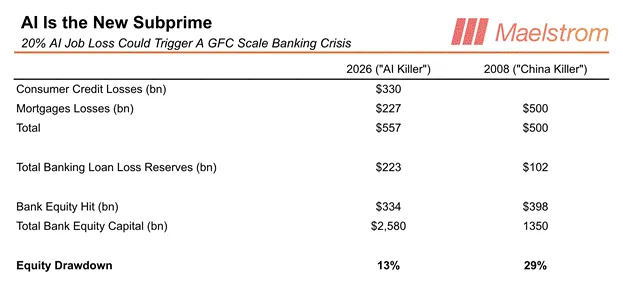
In summary, the severity of the AI agent deflationary crash is comparable to the 2008 US subprime mortgage crisis.
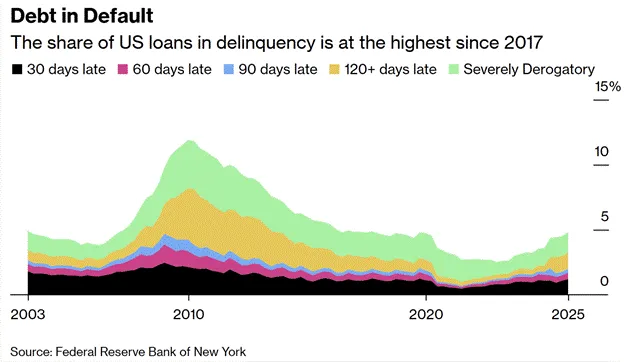
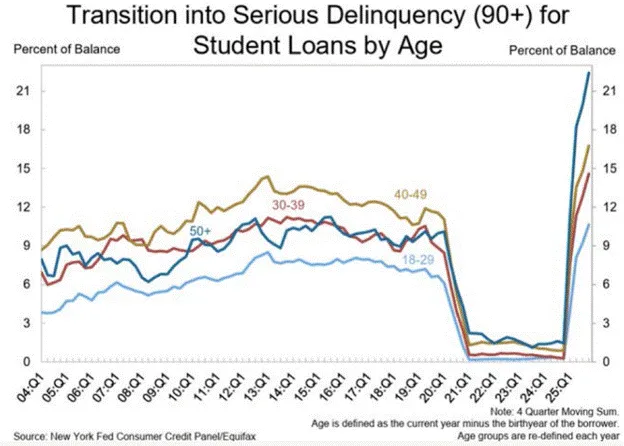
Consumer credit delinquency rates are already rising, and the layoff party hasn't even really started yet.
Tehran Toll Booth
Essentially, if this scenario occurs, it's the end of the petrodollar and the rise of a new global reserve currency or basket of currencies. Currently, the IRGC is very flexible on payment terms. But if they consolidate power over the strait, why continue accepting dollar payments when the US is doing everything to limit their ability to use dollars? Ultimately, I believe they will not allow payments in dollars. RMB and gold are likely to become the two main currencies for sovereign trade.
If you can't ship goods without paying in RMB, why save in dollars? Given that most major economies have a trade deficit with China, the only way to raise RMB is to sell dollars, buy gold, and then buy RMB. From now on, countries must save trade surpluses as gold, not US Treasuries or stocks.
To highlight the growth in the use of RMB in trade, I want to focus on a few charts released by Luke Gromen, which show a quasi-RMB-gold standard quietly emerging.
Step 1: Sell Dollar Assets (Treasuries) and Buy Gold
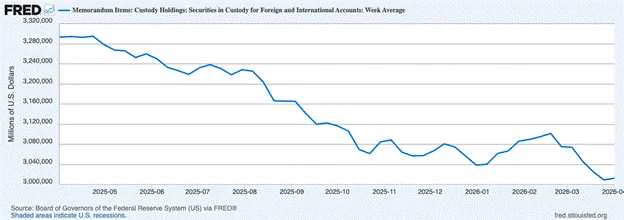
Since the war began, foreign holdings of securities at the Fed have decreased by a net $63 billion. I use this as a directional proxy for foreign holdings of Treasuries and other dollar securities like stocks.
What did the sellers do with these dollars?
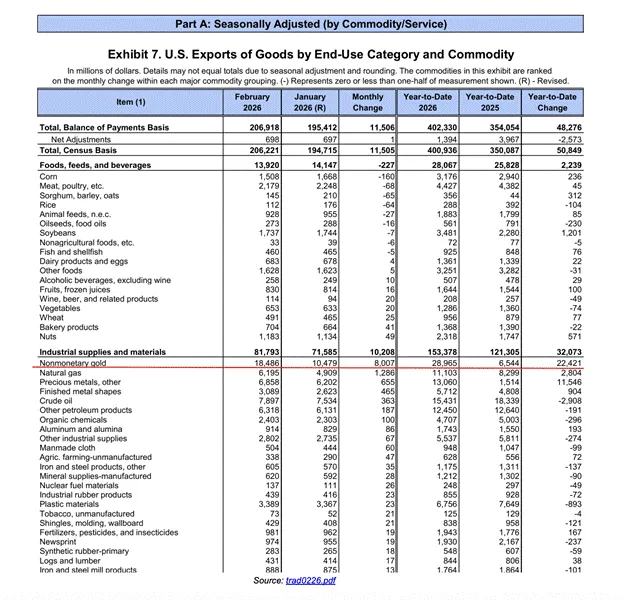
Non-monetary gold has been the largest US export for 4 out of the past 5 months, up 342% year-over-year.
They used these dollars to buy gold and ship it out of the US. So much for the US manufacturing renaissance; the only thing leaving the US is the barbarous relic. Sorry to all the Trump supporters who thought they'd get high-paying factory jobs back. Another US presidential term leading to blue-collar workers getting fucked without lube.
Step 2: Sell Gold for RMB
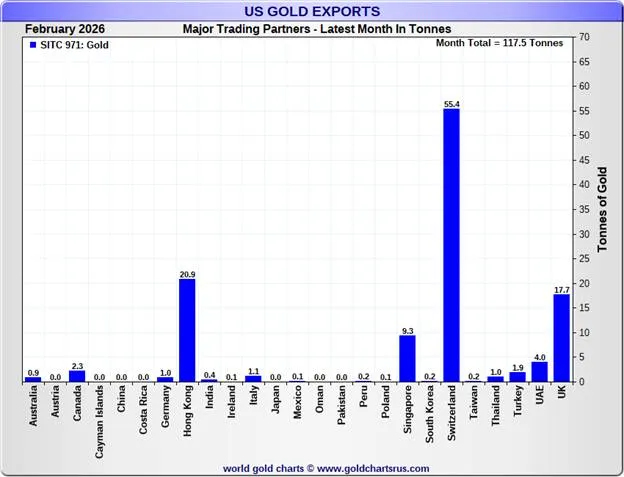
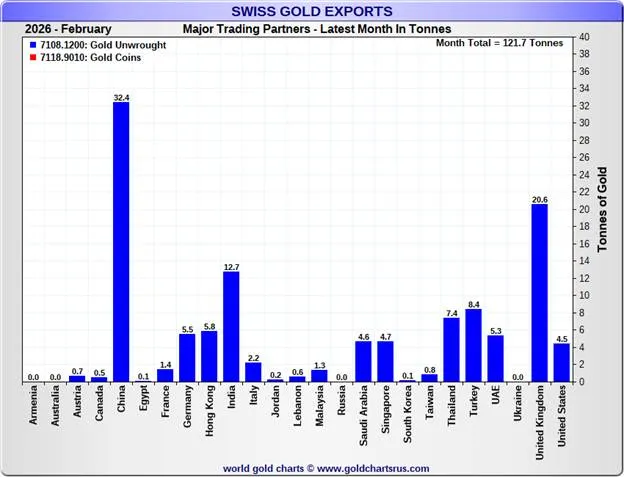
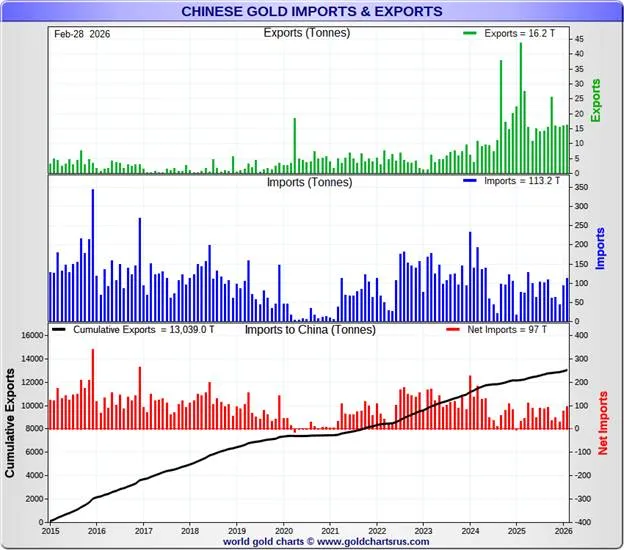
Swiss refineries receive US gold and recast it into bars suitable for delivery to China.
Step 3: Pay the Tehran Toll
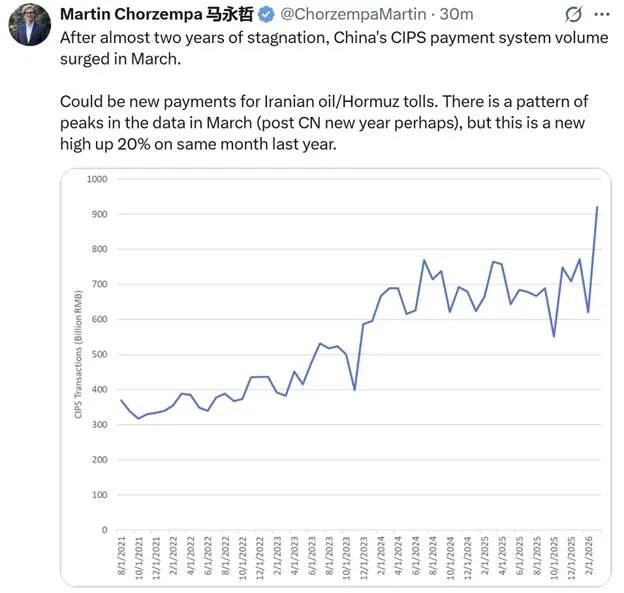
Treasury Secretary Besant was serious when he said "use dollars or get sanctioned again." Due to sanctions imposed by the US about fifteen years ago, Iran cannot use the SWIFT payment network. Transferring RMB into the IRGC's dirty hands requires using China's fiat CIPS messaging system. As you can see, transaction volume increased significantly after the war started.
This series of charts shows the flow from dollar asset selling to gold buying, ultimately funding RMB payments to Tehran or other suppliers. It doesn't matter that the dollar is still the dominant currency used in trade. Markets are forward-looking, so the acceleration in the use of RMB in global trade is more important than its low absolute usage relative to the dollar. By ditching dollar assets before the consensus accepts the existence of a new monetary system, investors can protect their portfolios. The pound sterling was technically the global reserve currency until the 1944 Bretton Woods Agreement, but the dollar effectively replaced it as the global reserve currency in the early 20th century because the US economy became the world's most productive. In 2026, the US has a trade deficit with the most productive economies: China, Japan, South Korea, Germany, Taiwan, etc. Most countries have a trade deficit with China. Let me say it even more emphatically: if you have to pay those Stone Age towelheads in RMB to receive goods, what the fuck is the point of holding dollars?
Stars and Stripes Blockade & Empire Strikes Back
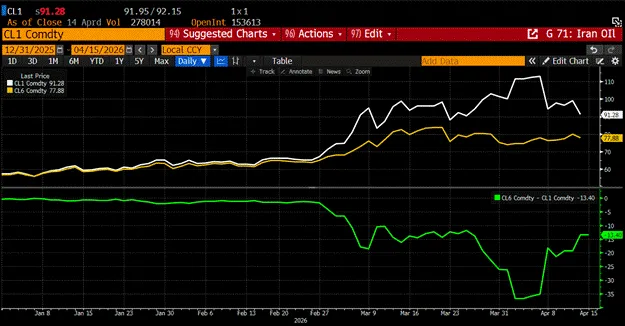
To judge whether the strait is open or closed, look at the chart above, or generate a similar version with your favorite charting tool. The top panel shows the WTI futures price for May 2026 (CL1, white line) vs. October 2026 (CL6, gold line). I use WTI because this benchmark price is most relevant to US gasoline consumers. Only if gasoline prices remain persistently high before the November midterm elections will Trump truly de-escalate the situation. The bottom panel is the spread between the two contracts (back month minus front month); the curve is in backwardation. Since the back-month oil price hasn't risen as much as the front-month, the market believes oil flow through the strait will increase significantly. If that happens, the spread will widen as the front-month price plummets. But if the spread narrows due to the back-month price rising, the global economy will be in chaos. Ignore the war of words between Trump and the IRGC and focus on this chart.
Quantity vs. Price of Money
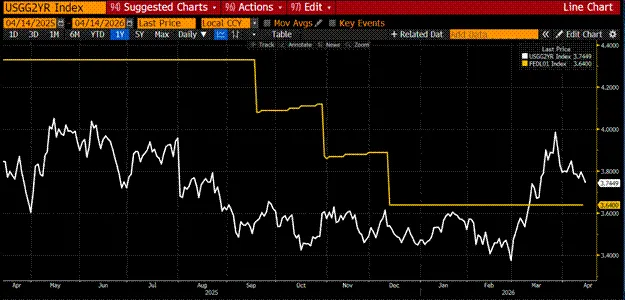
After the war started, the two-year Treasury yield (white line) spiked much higher than the effective federal funds rate (gold line). This indicates the market believes the Fed will raise rates to combat rising energy inflation.
It's important to form a judgment on this because I think we might enter a situation where major central banks, including the Fed, could be raising rates while printing money, whether directly or through the commercial banking system. As war causes food and energy prices to soar, competent politicians will subsidize the main input costs of the economy. Not doing so could trigger social unrest or famine. But to prevent inflation from spreading to all goods and services, central banks must destroy demand by raising rates, suppressing activity in the credit-sensitive parts of the economy. Any entity borrowing to buy goods and services will spend less if the cost of credit rises.
If central banks stop there, my prediction for Bitcoin would be straightforward. In an environment where people cut spending on everything except food and energy, the Bitcoin price would fall. But every country, whether ally or adversary of the Pax Americana order, must increase defense spending and hoard critical commodities. Do you want your country to be like Australia, which is almost 100% dependent on imports from China for refined hydrocarbons? When the war started, China stopped all exports, and Australia's reserves lasted less than a month. They had to turn to Singapore, and I believe paid sky-high prices for jet fuel; otherwise, all those Aussie bogans would have to stay home indefinitely! I know some of you would cheer for that outcome, especially Japanese skiers.
Making bombs, especially nukes, to protect yourself from being turned into a trash can country by skinny tie prophets, and hoarding commodities, require governments to borrow significantly more. If domestic private investors cannot or will not buy this garbage government debt, central banks and/or the commercial banking system will print money to buy these bonds, thereby increasing the fiat money supply.
Keep this dynamic in mind when reading my predictions for Bitcoin's movement in various scenarios. You


